
In recent years, as urbanization has accelerated globally, high-rise buildings have proliferated, presenting unprecedented challenges in fire rescue operations. Traditional methods often fall short due to height limitations, complex environments, and risks to human life. From my perspective as a researcher in fire safety technology, the integration of unmanned aerial vehicles, specifically fire drones, offers a transformative solution. This article delves into the characteristics, practical necessities, functionalities, and recommendations for deploying fire drones in high-rise fire rescue, emphasizing their potential to revolutionize emergency response. I will use tables and formulas to summarize key points, ensuring a comprehensive analysis that highlights the critical role of fire drones.
The term “fire drone” refers to an unmanned aircraft system tailored for firefighting and rescue missions. These fire drones are typically composed of six main components: the airframe, flight control and navigation system, power system, data link system, ground control station, and mission payload such as gimbals and sensors. Key technologies involved include structural design, advanced materials like carbon fiber, flight control algorithms, wireless communication, and real-time image transmission. The fire drone’s ability to operate in hazardous environments without endangering human lives makes it an invaluable asset. For instance, fire drones can hover at altitudes exceeding hundreds of meters, providing aerial surveillance that is impossible for ground teams. Below is a table summarizing the core components of a typical fire drone:
| Component | Description | Function in Fire Rescue |
|---|---|---|
| Airframe | Made of lightweight materials like carbon fiber | Provides structural integrity and durability in high-temperature environments |
| Flight Control System | Includes GPS, inertial sensors, and autopilot software | Ensures stable flight, precise navigation, and autonomous operation |
| Power System | Electric motors or hybrid engines with fire-resistant design | Delivers thrust for lift and maneuverability, with safety features for fire zones |
| Data Link System | Wireless communication modules (e.g., 5G, Wi-Fi) | Enables real-time data transmission between the fire drone and ground control |
| Ground Control Station | Portable hardware with software interface | Allows operators to pilot the fire drone and monitor feeds remotely |
| Mission Payload | High-definition cameras, thermal imagers, speakers, extinguisher systems | Facilitates reconnaissance, communication, and fire suppression tasks |
The adoption of fire drones is driven by several pressing realities. High-rise building fires are notoriously difficult to combat due to their vertical spread and limited access. Current aerial ladder trucks, for example, can only reach heights of 60-80 meters, which is inadequate for skyscrapers exceeding 100 meters. Moreover, firefighter casualties remain a significant concern; statistics show that dozens of rescuers perish annually in fire-related incidents globally. From my analysis, human limitations—such as fatigue, exposure to toxins, and physical constraints—underscore the need for robotic alternatives. Fire drones can mitigate these risks by performing tasks that are too dangerous for humans. The following formula illustrates the advantage of fire drones in terms of operational efficiency, where the rescue effectiveness $E$ can be enhanced by reducing human risk $R_h$ and increasing drone capability $C_d$:
$$ E = \frac{C_d}{R_h} $$
Here, $C_d$ represents the composite capability of the fire drone, including its speed, payload capacity, and sensor accuracy, while $R_h$ denotes the risk factor for human responders, which decreases as fire drones take on more roles. As $C_d$ increases through technological advancements, $E$ grows exponentially, highlighting the value of fire drones.
In terms of functionality, fire drones excel in multiple aspects of high-rise fire rescue. First, they serve as advanced reconnaissance tools. Equipped with high-resolution cameras and thermal imaging, a fire drone can quickly survey a burning building, identifying hotspots, structural weaknesses, and trapped individuals. This real-time data is transmitted to command centers, enabling informed decision-making. For example, the coverage area $A$ that a fire drone can scan during a mission depends on its flight speed $v$, mission time $t$, and sensor field-of-view width $w$, expressed as:
$$ A = v \times t \times w $$
Assuming a fire drone flies at $v = 10 \, \text{m/s}$ for $t = 600 \, \text{s}$ (10 minutes) with $w = 50 \, \text{m}$, the coverage area $A$ would be $300,000 \, \text{m}^2$, far surpassing ground-based observation. Second, fire drones facilitate monitoring and command. By providing aerial footage, they help coordinators track fire dynamics and allocate resources efficiently. Third, fire drones assist in direct rescue operations. They can deliver supplies like ropes, first-aid kits, or even fire extinguishers to stranded victims. Some advanced fire drones are capable of deploying water or foam through integrated systems, targeting specific windows or floors. The water discharge rate $Q$ from a fire drone’s extinguisher can be modeled using fluid dynamics, where $Q$ is proportional to the nozzle pressure $P$ and cross-sectional area $A_n$:
$$ Q = k \cdot P \cdot A_n $$
Here, $k$ is a constant dependent on the fluid properties. This allows fire drones to apply灭火剂 precisely, minimizing water waste. Fourth, fire drones can act as automated巡查 platforms, integrating with 5G networks for seamless data同步. Fifth, they enable air quality monitoring by carrying sensors to detect toxic gases or temperature gradients, enhancing situational awareness. The table below summarizes these functionalities with examples:
| Function | Description | Example Use-Case |
|---|---|---|
| Reconnaissance | Aerial surveillance using cameras and thermal imagers | Identifying fire origin on the 50th floor of a skyscraper |
| Monitoring & Command | Real-time video feed to指挥 centers | Guiding firefighter teams via live aerial views |
| Assisted Rescue | Delivery of tools, communication devices, or extinguishers | Dropping a life-line to trapped occupants on a rooftop |
| Automated Patrol | Scheduled flights for preventive inspection | Regular scans of building exteriors for fire hazards |
| Air Monitoring | Detection of gases, temperature, and风速 | Measuring CO levels near a fire zone to assess toxicity |
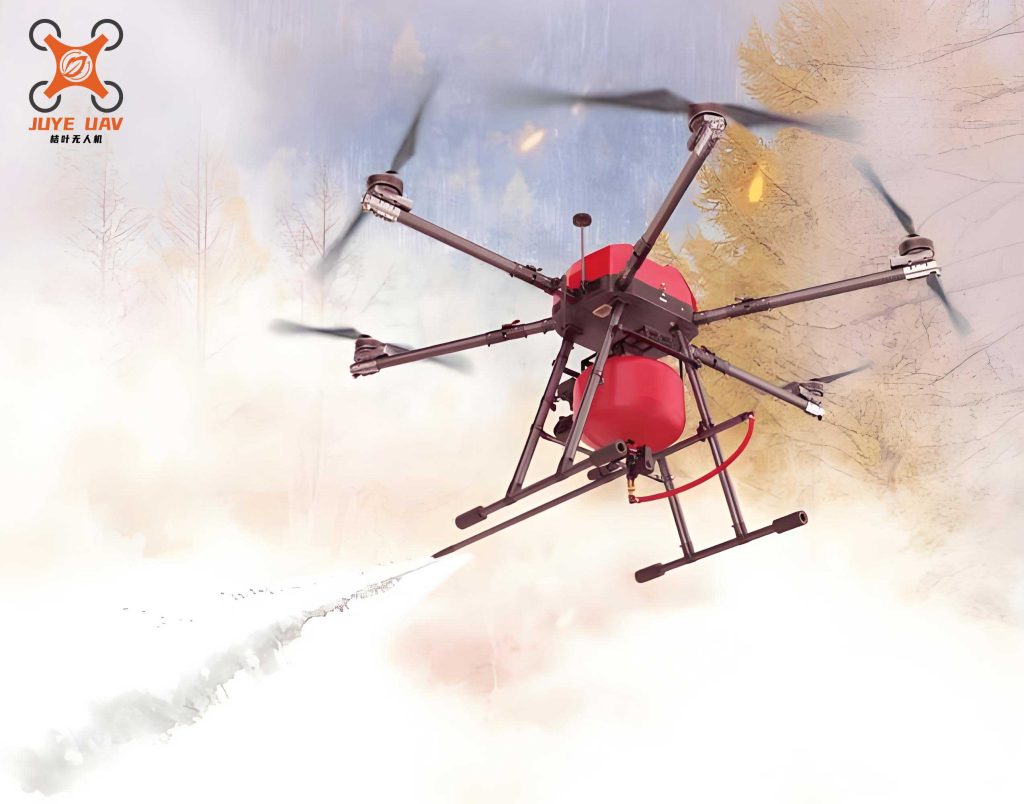
The image above depicts a fire drone in action, showcasing its compact design and versatility in fire rescue scenarios. From my experience, such visual aids underscore the practicality of fire drones, but their efficacy hinges on proper deployment. To promote the widespread use of fire drones in high-rise消防, I recommend several strategies. First, research and development must focus on实战-oriented designs, improving autonomy and reliability. This includes enhancing battery life, which can be approximated by the formula for flight duration $T$: $$ T = \frac{E_b}{P_d} $$ where $E_b$ is the battery energy capacity and $P_d$ is the power demand of the fire drone. By increasing $E_b$ through better energy storage, $T$ can be extended, allowing longer missions. Second, fire departments should accelerate procurement and training programs, ensuring that personnel are proficient in operating fire drones. Third, regular drills and simulations should integrate fire drones to refine tactics. For instance, the灭火 efficiency $\eta$ of a fire drone team can be evaluated as: $$ \eta = \frac{V_{extinguished}}{V_{total}} \times 100\% $$ where $V_{extinguished}$ is the volume of fire suppressed and $V_{total}$ is the total fire volume. Through iterative practice, $\eta$ can be optimized. Fourth, collaboration with aviation authorities is essential to establish safe flight protocols, avoiding airspace conflicts. The table below outlines these recommendations:
| Recommendation | Action Plan | Expected Outcome |
|---|---|---|
| R&D Enhancement | Invest in AI-driven flight controls and robust materials | More adaptive and durable fire drones for extreme conditions |
| Increased Deployment | Budget allocation for fleet acquisition and maintenance | Higher availability of fire drones across消防 units |
| Training & Drills | Conduct simulated high-rise fire scenarios with fire drones | Improved operator skills and战术 coordination |
| Regulatory Compliance | Liaise with air traffic control for flight permissions | Safe and legal operations, minimizing disruptions |
In conclusion, fire drones represent a paradigm shift in high-rise building fire rescue. Their ability to perform reconnaissance, command support, direct救援, and environmental monitoring addresses critical gaps in traditional methods. From my perspective, the integration of fire drones not only boosts efficiency but also safeguards human lives, aligning with modern消防 trends toward automation and smart technology. As innovations in 5G, artificial intelligence, and materials science progress, fire drones will become even more integral, potentially solving the “world-class challenge” of high-rise fires. I urge stakeholders to embrace this technology, fostering a future where fire drones are standard装备 in every消防 department. Through continued analysis and application, we can harness the full potential of fire drones to create safer urban environments.