
From my perspective as a professional engaged in modern firefighting strategy, the integration of Unmanned Aerial Vehicles (UAVs), specifically fire drone systems, represents a paradigm shift in our operational capabilities. The traditional challenges of reconnaissance in opaque, toxic, and structurally unstable environments are being overcome by the deployment of these aerial platforms. A fire drone is not merely a remote-controlled camera; it is a sophisticated mobile sensor and actuator node that extends our situational awareness and intervention reach into zones deemed too hazardous for initial human entry. The core value proposition lies in its ability to maximize operational efficiency while acting as a powerful force multiplier, effectively serving as an indispensable assistant in complex fire and rescue scenarios. This analysis will delve into the systemic functions, technical characteristics, and applied integration of fire drone technology, employing engineering models and comparative frameworks to elucidate its transformative impact.
System Architecture and Core Functional Modules of a Fire Drone
The efficacy of a fire drone in fire suppression and rescue stems from its integrated system architecture. This architecture can be decomposed into distinct functional modules, each contributing to the overall mission objective. The primary functions extend beyond simple video capture to form a cohesive data acquisition, processing, and action loop.
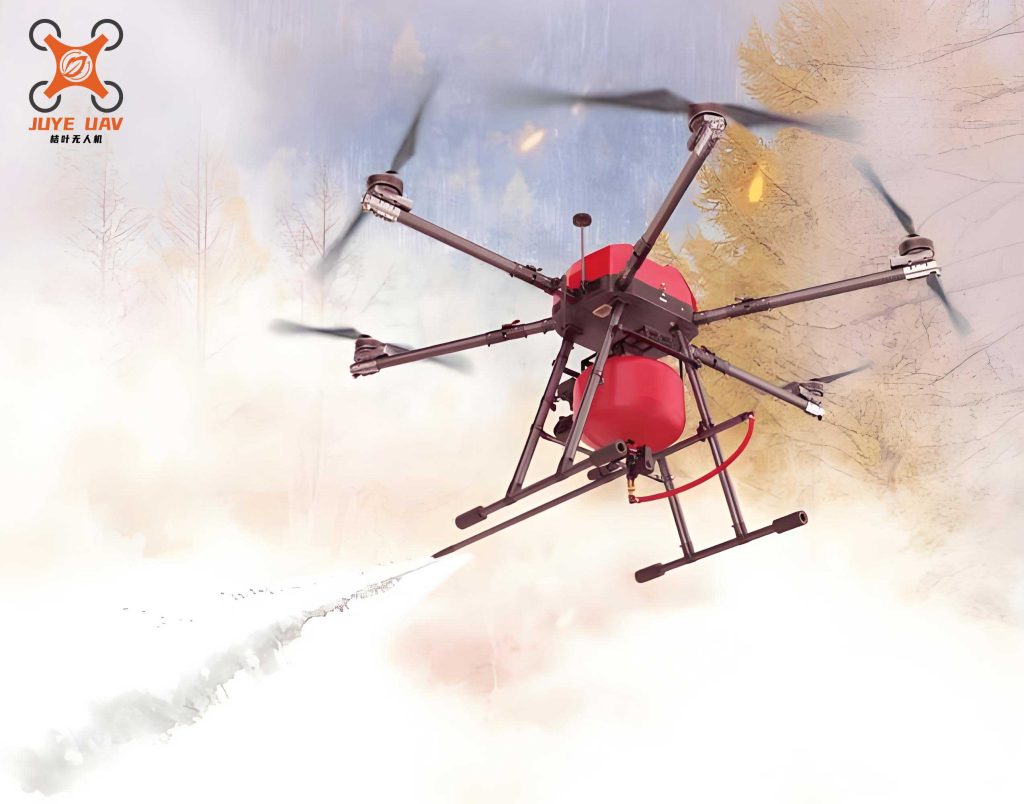
The sensory suite is the fire drone‘s primary interface with the incident environment. It typically includes:
- Visible Spectrum Cameras: Provide high-resolution real-time video for general assessment, structural analysis, and search patterns.
- Thermal Imaging Cameras (Infrared): Critical for seeing through smoke, identifying thermal hotspots ($T_{hotspot}$), locating victims via body heat signatures, and detecting latent fire spread within building cavities. The radiated power $P$ detected by the sensor can be modeled by the Stefan-Boltzmann law for a gray body: $$P = \epsilon \sigma A T^4$$ where $\epsilon$ is emissivity, $\sigma$ is the Stefan-Boltzmann constant, $A$ is the area, and $T$ is absolute temperature.
- Multi-gas Sensors: Detect and quantify hazardous atmospheric compounds (e.g., $CH_4$, $CO$, $H_2S$), providing critical data for risk assessment.
- Light Detection and Ranging (LiDAR): Creates detailed 3D point-cloud maps of the environment, useful for structural integrity assessment and navigation in GPS-denied areas.
The data from these sensors is fused and transmitted via a secure, high-bandwidth communication link (often leveraging 4G/5G or dedicated radio frequencies) to the Ground Control Station (GCS). The navigation and positioning module, relying on GNSS (like GPS or BeiDou) and aided by inertial measurement units (IMUs) and the aforementioned sensors for obstacle avoidance, ensures precise geo-referencing of all collected data. This allows for the creation of a Common Operational Picture (COP). Finally, the payload delivery module can range from simple speaker/life-pod droppers for rescue to integrated liquid or dry-agent discharge systems for direct fire attack. The functional matrix of a typical advanced fire drone system is summarized below:
| Functional Module | Key Components | Primary Output/Function | Technical Metric Examples |
|---|---|---|---|
| Sensory & Data Acquisition | HD/Zoom Camera, Thermal Imager, Multi-gas Sensor, LiDAR | Real-time video, thermal maps, gas concentrations, 3D models | Resolution (e.g., 640×512 IR), Sensitivity (ppm), Point Density (pts/m²) |
| Data Link & Communication | Digital Data Radio, 4G/5G Module, Encryption Unit | Low-latency, secure transmission of sensor data and telemetry | Range (km), Latency (ms), Bandwidth (Mbps) |
| Navigation & Positioning | GNSS Receiver, IMU, Ultrasonic/Visual Sensors | Autonomous flight, waypoint navigation, obstacle avoidance, precise geo-tagging | Positional Accuracy (m), Obstacle Detection Range (m) |
| Payload & Actuation | Liquid Discharge System, Payload Release Mechanism, Loudspeaker, Spotlight | Targeted suppression, delivery of emergency supplies, communication, illumination | Payload Capacity (kg/L), Flow Rate (L/min), Effective Throw Range (m) |
| Command & Control (C2) | Ground Control Station Software, Data Fusion Algorithms | Mission planning, real-time control, data visualization, AI-based analysis | Number of Simultaneous UAVs Controlled, AI Inference Speed (FPS) |
Quantitative Analysis of Fire Drone Performance Characteristics
The operational superiority of a fire drone can be distilled into quantifiable technical characteristics. Let’s model some of these key performance parameters.
1. Area Coverage Efficiency for Reconnaissance:
The time $T_{cover}$ required for a fire drone to visually scan a given area $A_{zone}$ depends on its sensor field of view (FOV) and flight pattern. For a nadir-pointing camera with a rectangular footprint, the area covered per unit time during a systematic search pattern is:
$$A_{rate} = v \cdot w_{eff}$$
where $v$ is the drone’s ground speed and $w_{eff}$ is the effective swath width of the sensor on the ground. For a camera with an angular FOV $\theta$ flying at altitude $h$, $w_{eff} \approx 2h \cdot \tan(\theta/2)$. Therefore, the approximate scan time is:
$$T_{cover} \approx \frac{A_{zone}}{v \cdot w_{eff}}$$
This model clearly shows that a fire drone operating at a safe altitude can cover a large industrial complex or forest edge orders of magnitude faster than ground teams.
2. Thermal Detection and Localization:
A primary task is identifying the coordinates of a thermal anomaly. Using a gimbaled thermal sensor on a fire drone, the location of a hotspot $(X_h, Y_h, Z_h)$ can be determined by fusing the drone’s own GNSS/IMU-derived position $(X_d, Y_d, Z_d)$ and attitude (roll $\phi$, pitch $\theta$, yaw $\psi$) with the sensor’s pan-tilt angles $(\alpha, \beta)$ and measured slant range $r$ (if available from laser rangefinder or derived from image scaling).
$$
\begin{bmatrix} X_h \\ Y_h \\ Z_h \end{bmatrix} = \begin{bmatrix} X_d \\ Y_d \\ Z_d \end{bmatrix} + \mathbf{R}_{body}^{world} \cdot \mathbf{R}_{sensor}^{body} \cdot \begin{bmatrix} 0 \\ 0 \\ r \end{bmatrix}
$$
Where $\mathbf{R}$ are rotation matrices. This geolocation accuracy is vital for directing ground crews or other fire drone assets for targeted suppression.
3. Payload Delivery and Suppression Modeling:
For a fire drone equipped with a liquid agent system, the effective suppression volume $V_{sup}$ delivered on a target is a function of flow rate $Q$, discharge time $t_{dis}$, wind drift $d_{wind}$, and evaporation loss factor $f_{evap}$.
$$V_{sup} = Q \cdot t_{dis} \cdot (1 – f_{evap}) \cdot \eta_{aim}$$
Here, $\eta_{aim}$ is an aiming efficiency factor ($0 < \eta_{aim} \leq 1$) representing the accuracy of the delivery system, which is enhanced by the stable hovering and targeting capabilities of the fire drone.
The following table contrasts the core technical characteristics that define modern fire drone systems against traditional methods.
| Characteristic | Fire Drone Implementation | Traditional Method (Human-Centric) | Operational Impact |
|---|---|---|---|
| Intelligence & Autonomy | High. Uses AI for obstacle avoidance, target tracking, and automated flight paths. Operates via predefined logic and real-time sensor fusion. | Low. Relies entirely on human judgment and manual control in the moment, susceptible to cognitive overload and error. | Enables safe, consistent, and repeatable operations in chaotic environments, acting as a reliable automated scout. |
| System Reliability | Deterministic. Performance is bounded by engineering specifications (MTBF). Unaffected by toxic gases, extreme heat (within limits), or psychological stress. | Probabilistic. Subject to human physical and mental fatigue, sensory limitations (smoke blindness), and direct physical danger. | Provides a persistent, risk-tolerant asset for initial assessment and continuous monitoring where human entry is prohibitive. |
| Deployment Flexibility & Agility | Extreme. Vertical Take-Off and Landing (VTOL), access to confined spaces, rapid redeployment, modular payload swaps for different missions. | Constrained. Limited by terrain, building access points, ladder reach, and the time required for team mobilization and setup. | Offers rapid, multi-perspective situational awareness and the ability to intervene in otherwise inaccessible areas (e.g., high-rise facades, chemical tank tops). |
| Situational Awareness Fidelity | Multi-spectral, Data-Rich. Provides fused thermal, visual, gas, and spatial data, creating a layered digital twin of the incident. | Primarily Visual/Tactile. Limited to line-of-sight and physical touch, often obscured by smoke and confined to ground-level perspectives. | Empowers command with comprehensive, objective data for strategic decision-making, revealing hidden fire spread and victim locations. |
Applied Integration in High-Risk Scenarios: A Systems Engineering View
The theoretical capabilities of a fire drone are actualized in specific high-consequence environments. The application dictates the required sensor mix, payload, and operational protocols.
Energy and Petrochemical Facility Incidents
In these complex, high-hazard sites, the fire drone serves as the primary remote sensor. The mission profile involves:
1. Rapid Assessment: Deploying an intrinsically safe or explosion-proof rated fire drone to conduct an initial overflight, identifying the epicenter, involved units, and potential for BLEVE or domino effects.
2. Continuous Monitoring: Using thermal imaging to monitor tank farm temperatures, employing the formula $P \propto T^4$ to estimate radiant heat flux and predict failure points. Gas sensors map explosive or toxic gas plumes, defining hot zones and safe approach paths for crews.
3. Targeted Intervention: Large-capacity fire drone platforms with extended flow nozzles can apply foam or dry agent directly to seal leaks or cool specific vessels from a safe stand-off distance, a task often impossible for ground monitors due to equipment positioning and radiation heat. The effective cooling power $H_{cool}$ can be related to the water flow rate and temperature difference: $$H_{cool} = \dot{m} \cdot c_p \cdot (T_{surface} – T_{water})$$ where $\dot{m}$ is the mass flow rate from the fire drone, and $c_p$ is the specific heat capacity of water.
Wildland and Forest Fire Management
Here, the fire drone operates as a wide-area surveillance and intelligence node. Key functions include:
– Early Detection: Automated patrols using AI-powered thermal imaging to identify nascent fires when $T_{hotspot}$ is just slightly above ambient, minimizing the Time-to-Detect ($T_d$), a critical factor in fire growth modeling where fireline intensity $I$ often follows a relationship like $I \propto e^{k \cdot t}$.
– Perimeter Mapping and Spread Prediction: LiDAR and thermal data create real-time fire perimeter maps. By analyzing rate of spread (ROS) vectors and integrating them with GIS data on fuel type and topography in predictive models like Rothermel’s surface fire spread model, the fire drone feeds data for simulations: $$ROS = \frac{I_R \cdot \xi \cdot (1+\phi_w)}{\rho_b \cdot \epsilon \cdot Q_{ig}}$$ where parameters like reaction intensity $I_R$, wind factor $\phi_w$, and fuel properties are informed by fire drone observations.
– Operational Support: Illuminating fire lines at night, monitoring spot fires, and assessing the effectiveness of retardant drops.
Urban Search and Rescue (USAR) & High-Rise Firefighting
In dense urban and high-rise environments, the fire drone‘s agility is paramount. Applications are multifaceted:
1. Exterior Reconnaissance: A fire drone quickly ascends to scan the building envelope, identifying external fire spread, compromised windows, and potential victims signaling from balconies. It measures the height $H_{floor}$ of visible phenomena.
2. Interior Mapping (Post-Blast/Collapse): Small, agile fire drone units can enter structurally unsound buildings. Using SLAM (Simultaneous Localization and Mapping) algorithms, they generate 3D maps, identifying void spaces where survivors may be trapped. The SLAM process involves solving for the drone’s trajectory $x_{1:t}$ and map $m$ given observations $z_{1:t}$ and controls $u_{1:t}$: $$P(x_{1:t}, m | z_{1:t}, u_{1:t})$$
3. Communication Relay and Payload Delivery: Acting as a temporary communications node to penetrate radio-dead zones within structures. It can deliver compact survival supplies (two-way radios, medicines, breathing masks) to trapped individuals on specific floors, with delivery accuracy defined by $\eta_{aim}$ from our earlier model.
System Integration Challenges and Future Trajectory
The full potential of the fire drone ecosystem is realized not through standalone units, but through networked integration. The future lies in the “5G+/IoT+fire drone” paradigm, creating a smart firefighting mesh. In this model, fire drone assets are continuously connected, sharing data in real-time with command vehicles, firefighter wearables, and building IoT sensors (e.g., smoke detectors, smart sprinkler heads). This enables predictive analytics and automated response workflows. For instance, a building alarm triggers an automated pre-programmed fire drone launch from a nearby station. The fire drone conducts an initial external and accessible internal scan, streaming data back. An AI engine analyzes thermal and visual feeds to confirm the fire, locates it on a Building Information Model (BIM), and recommends an optimal response tactic to the incident commander before the first engine arrives.
However, challenges remain for full integration. These include standardizing data protocols, ensuring cybersecurity of the C2 links, managing urban airspace with other drones, developing robust autonomous decision-making logic for complex environments, and creating seamless human-swarm interaction interfaces where a single operator can manage a fleet of heterogeneous fire drone units. The trajectory is clear: the fire drone will evolve from a tactical tool to a central node in a cognitive, data-driven firefighting system, fundamentally enhancing our ability to protect lives, property, and the environment with unprecedented speed, precision, and safety.