
In recent years, the rapid advancement of drone technology has revolutionized both military and civilian sectors, offering benefits such as low cost, high flexibility, and strong隐蔽性. However, this proliferation also introduces significant security risks, including privacy侵犯, public safety threats, and challenges to national defense. As a researcher in this field, I believe that constructing a robust anti-drone warfare technology system and developing effective strategies are critical to safeguarding national security and social stability. This article explores the importance of such systems, delves into the integration of detection and打击 technologies, outlines operational processes, and adapts to complex scenarios, all aimed at enhancing anti-drone capabilities.
The importance of an anti-drone warfare technology system cannot be overstated. First, it is essential for defending national security sovereignty and巩固国防战略根基. Drones can be exploited by adversaries to bypass traditional air defense systems, conducting reconnaissance, strikes, and intelligence gathering. An effective anti-drone system integrates multiple detection technologies, such as radar, electro-optical, and acoustic sensors, to provide comprehensive, real-time monitoring. This enables early detection and rapid countermeasures, such as jamming or interception, thereby mitigating threats and protecting territorial integrity. For instance, the detection probability in an anti-drone system can be modeled using a formula that accounts for signal-to-noise ratio and environmental factors: $$P_d = 1 – e^{-\frac{SNR \cdot A}{\lambda^2 \cdot d^2}}$$ where \(P_d\) is the detection probability, \(SNR\) is the signal-to-noise ratio, \(A\) is the sensor area, \(\lambda\) is the wavelength, and \(d\) is the distance to the drone. This highlights how technological integration improves detection rates in anti-drone operations.
Second, an anti-drone system维护社会稳定安宁 and保障民众安全权益. In sensitive areas like military bases or public events, drones pose risks of espionage, interference, or accidental harm. By deploying anti-drone technologies, we can monitor and neutralize unauthorized drones, ensuring mission success and reducing safety hazards. For example, in urban environments, the use of distributed acoustic sensors and AI-driven analysis can quickly identify drone threats, allowing for timely responses. The economic impact of anti-drone measures can be summarized in Table 1, which compares the costs and benefits of different approaches in various scenarios.
| Scenario | Detection Technology | Countermeasure | Cost (USD) | Effectiveness (%) |
|---|---|---|---|---|
| Military Base | Radar + Electro-optical | Laser Interception | 500,000 | 95 |
| Urban Public Event | Acoustic Sensors + AI | RF Jamming | 100,000 | 85 |
| Critical Infrastructure | Multi-layered Network | Drone Swarm Defense | 1,000,000 | 90 |
Third, developing anti-drone systems drives前沿技术创新 and enhances national科技竞争力. This field involves cutting-edge technologies in sensing, data processing, and通信控制. Innovations like high-performance radar for low-altitude detection or AI algorithms for predicting drone intentions not only boost anti-drone capabilities but also spur industry growth. The relationship between technology investment and anti-drone effectiveness can be expressed as: $$E = \alpha \cdot \ln(I) + \beta$$ where \(E\) is the effectiveness score, \(I\) is the investment in R&D, and \(\alpha\) and \(\beta\) are constants derived from empirical data. This underscores how sustained innovation in anti-drone technologies contributes to broader technological advancement.
Moving to the construction of the anti-drone warfare technology system, we must整合探测打击技术链路 to build an efficient framework. This involves creating a multi-layered detection network that combines radar, electro-optical, and acoustic systems. Radar provides long-range, high-precision detection, while electro-optical devices offer detailed visual识别 in complex environments. Acoustic sensors complement these by capturing unique sound signatures of drones, especially for low-speed targets. The integration of these technologies reduces盲区 and increases the probability of detection. Additionally, an intelligent information processing platform运用大数据和人工智能技术 to analyze multi-source data in real-time, identifying drone types, trajectories, and intentions. This platform forms the core of the anti-drone system, enabling data fusion and决策支持. A mathematical representation of data fusion efficiency is: $$F = \frac{\sum_{i=1}^{n} w_i \cdot D_i}{\sqrt{\sum_{i=1}^{n} w_i^2}}$$ where \(F\) is the fusion score, \(D_i\) is the data input from sensor \(i\), and \(w_i\) is the weight assigned based on sensor reliability. This formula helps optimize the anti-drone detection network.
协同作战机制 is another critical aspect. Anti-drone operations require close coordination among探测系统,指挥控制系统, and打击系统, as well as collaboration with civilian entities like local police and drone manufacturers. Establishing information-sharing protocols and joint response plans enhances overall efficiency. For example, in a coordinated anti-drone exercise, the response time can be minimized through integrated command structures. Table 2 outlines the roles and responsibilities in a typical anti-drone协同作战 scenario.
| Entity | Primary Role | Key Tasks | Communication Protocol |
|---|---|---|---|
| Military Detection Unit | Initial Target Acquisition | Deploy radar and sensors, transmit data to command | Encrypted RF links |
| Command Center | Decision Making | Analyze data, assess threat level, issue orders | Secure network with AI辅助 |
| Countermeasure Unit | Interception and Neutralization | Execute jamming or physical strikes based on commands | Real-time video and control feeds |
| Civilian Partners | Support and Intelligence | Provide drone registries, assist in legal追责 | Standardized data exchange formats |
Following the detection and coordination framework, we must遵循预警响应处置流程 to conduct精准反无人机作战行动. This process starts with an intelligent预警网络 that integrates multi-source感知技术. Traditional radar is combined with毫米波雷达 and相控阵雷达 for wide-area搜索, while声学传感器 and光电摄像机 are deployed in低空 regions to capture细节. AI algorithms analyze this data against a drone特征数据库, enabling proactive threat assessment. The预警 accuracy can be modeled as: $$A_w = \frac{TP}{TP + FP + FN}$$ where \(A_w\) is the预警 accuracy, \(TP\) is true positives, \(FP\) is false positives, and \(FN\) is false negatives. This metric is crucial for refining anti-drone systems.
Based on the预警 output, a分级响应机制 is activated. For low-risk drones,非杀伤性手段 like广播警告 or电子干扰 are used to驱离 them. For medium-risk threats,便携式防空武器 or激光武器 are employed for精确打击. The effectiveness of laser武器 in anti-drone scenarios can be expressed as: $$E_l = \frac{P_{laser} \cdot t_{exp}}{d^2 \cdot \sigma}$$ where \(E_l\) is the laser effectiveness, \(P_{laser}\) is the laser power, \(t_{exp}\) is the exposure time, \(d\) is the distance, and \(\sigma\) is the drone’s cross-sectional area. For high-risk drones,三级响应 involves防空导弹 or无人机蜂群拦截. The success rate of drone蜂群拦截 can be estimated using: $$P_s = 1 – \prod_{i=1}^{n} (1 – p_i)$$ where \(P_s\) is the overall success probability, and \(p_i\) is the success probability of individual interceptor drones. This hierarchical approach ensures tailored responses in anti-drone operations.
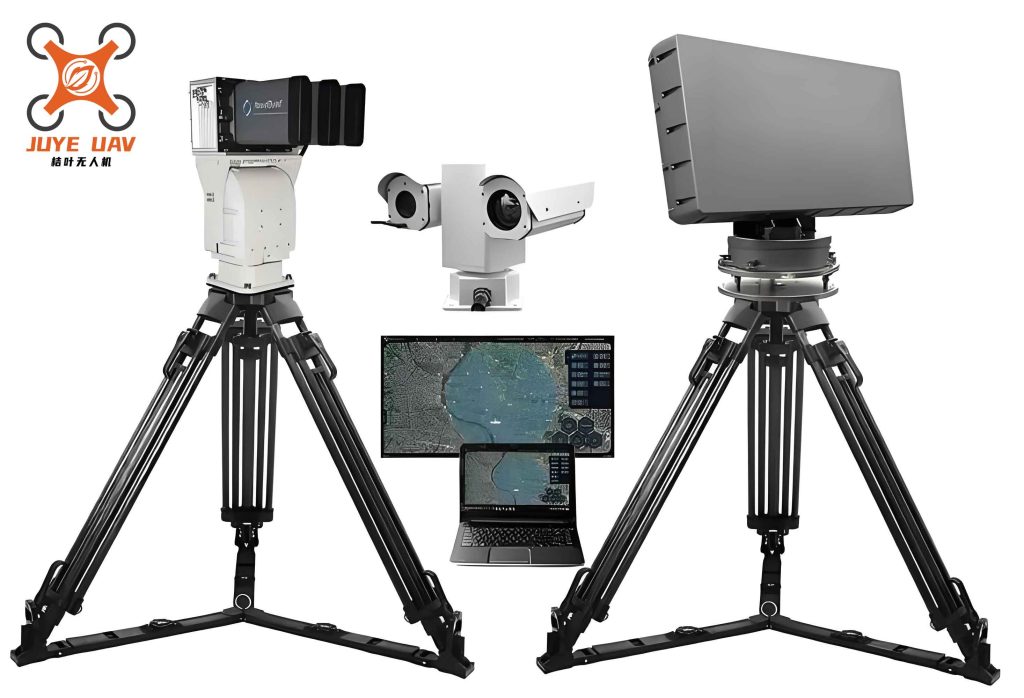
Adapting to复杂多样场景, particularly urban environments, requires灵活反无人机作战策略. Cities present challenges like高楼林立 and人员密集区域, which can hinder traditional anti-drone methods. To address this, we构建立体感知网络 by leveraging existing infrastructure.低空补盲雷达 are installed on rooftops to cover盲区, while分布式声学传感器 and光电摄像机 are placed in streets and squares. 5G networks facilitate real-time data transmission, and AI algorithms perform融合分析 to determine drone intent. The network coverage efficiency in urban anti-drone部署 can be calculated as: $$C = \frac{\sum_{j=1}^{m} A_j \cdot \rho_j}{A_{total}}$$ where \(C\) is the coverage ratio, \(A_j\) is the area covered by sensor \(j\), \(\rho_j\) is its reliability, and \(A_{total}\) is the total urban area of interest. This ensures comprehensive monitoring in anti-drone efforts.
In terms of tactics, diverse approaches are employed based on the urban landscape. In commercial areas with narrow spaces,无人机“猎手”战术 involves deploying autonomous interceptor drones that track and disable target drones using干扰设备 or物理攻击装置. The kinematic equation for such interceptor drones can be described as: $$\vec{v}_i(t) = \vec{v}_0 + \int_0^t \vec{a}(\tau) d\tau$$ where \(\vec{v}_i(t)\) is the interceptor velocity vector, \(\vec{v}_0\) is the initial velocity, and \(\vec{a}(\tau)\) is the acceleration vector controlled by AI. In crowded public spaces,“电磁陷阱”战术 uses定向电磁干扰 to disrupt communication and导航系统, forcing drones to land safely. The interference power required for effective anti-drone jamming is given by: $$P_j = \frac{P_t \cdot G_t \cdot G_r \cdot \lambda^2}{(4\pi d)^2 \cdot L}$$ where \(P_j\) is the jamming power, \(P_t\) is the transmitter power, \(G_t\) and \(G_r\) are antenna gains, \(\lambda\) is the wavelength, \(d\) is the distance, and \(L\) is the loss factor. For distant high-threat drones,防空导弹系统 deployed on city outskirts provide a final layer of defense. Table 3 summarizes the战术 approaches for different urban scenarios in anti-drone operations.
| Urban Scenario | Primary Challenge | Recommended Tactics | Key Technologies | Expected Success Rate (%) |
|---|---|---|---|---|
| High-rise Commercial Zone | Limited line-of-sight, signal multipath | Drone “Hunter” Swarms | Autonomous navigation, collision avoidance | 88 |
| Crowded Public Square | Risk of collateral damage | Electromagnetic Traps | Directional RF jammers, GPS spoofing | 92 |
| City Periphery | Long-range incursions | Integrated Air Defense Missiles | Radar-guided interceptors, network-centric control | 96 |
| Mixed Residential Area | Noise interference, privacy concerns | Stealth Monitoring and Soft Kill | Low-probability-of-intercept sensors, cyber takeovers | 85 |
Furthermore, the integration of advanced technologies like artificial intelligence and machine learning enhances the adaptability of anti-drone systems. AI can predict drone flight paths based on historical data, improving interception accuracy. A predictive model for drone trajectory in anti-drone contexts can be expressed as: $$\hat{y}(t+1) = f(\mathbf{X}(t), \mathbf{W}) + \epsilon$$ where \(\hat{y}(t+1)\) is the predicted position at time \(t+1\), \(\mathbf{X}(t)\) is the feature vector of past positions and environmental factors, \(\mathbf{W}\) is the weight matrix learned from training data, and \(\epsilon\) is the error term. This allows for proactive anti-drone measures, reducing response times.
The development of anti-drone systems also involves addressing ethical and legal considerations. As drones become more autonomous, issues like accountability and proportionality in countermeasures arise. We must ensure that anti-drone technologies comply with international laws and norms, minimizing unintended harm. For instance, the use of kinetic strikes should be guided by rules of engagement that weigh the threat level against potential collateral damage. This aligns with the broader goal of maintaining public trust in anti-drone initiatives.
In conclusion, the evolving landscape of drone technology necessitates a comprehensive and dynamic approach to anti-drone warfare. By构建反无人机作战技术体系 that integrates detection, coordination, and response, and by制定科学合理的作战策略 tailored to diverse scenarios, we can significantly enhance our ability to counter drone threats. This not only捍卫国家安全主权 and维护社会稳定安宁 but also drives technological innovation, positioning nations at the forefront of global security advancements. The continuous refinement of anti-drone systems, supported by interdisciplinary research and international cooperation, will be crucial in addressing future challenges. As we advance, the focus should remain on developing scalable, cost-effective, and ethical anti-drone solutions that protect both military and civilian interests.
To summarize key metrics, the overall effectiveness of an anti-drone system can be quantified using a composite index: $$I_{ad} = \omega_1 \cdot P_d + \omega_2 \cdot P_s + \omega_3 \cdot C – \omega_4 \cdot Cost$$ where \(I_{ad}\) is the anti-drone effectiveness index, \(P_d\) is the detection probability, \(P_s\) is the interception success rate, \(C\) is the coverage ratio, \(Cost\) is the normalized system cost, and \(\omega_i\) are weights reflecting operational priorities. This index helps in evaluating and optimizing anti-drone deployments across different contexts.
Ultimately, the fight against unauthorized drones is a multifaceted endeavor that requires sustained investment in research, development, and collaboration. By embracing innovative technologies and adaptive strategies, we can build resilient anti-drone capabilities that safeguard our skies and ensure a secure future. The journey towards mastering anti-drone warfare is ongoing, and through collective effort, we can turn challenges into opportunities for growth and protection.