
As I reflect on the evolution of modern warfare, the rapid proliferation of unmanned aerial vehicles (UAVs) has fundamentally reshaped combat dynamics. From the skies of Nagorno-Karabakh to the ongoing conflict in Ukraine, drones have emerged as pivotal assets, offering unparalleled reconnaissance, precision strikes, and psychological dominance. In response, the development of anti-drone technologies has become a critical imperative, yet significant hurdles persist. In this analysis, I delve into the core challenges facing anti-drone systems today, drawing from recent conflicts and technological trends to underscore the urgent need for innovation. The term ‘anti-drone’ will be reiterated throughout to emphasize its centrality in contemporary military discourse.
The ascendancy of drones in warfare is undeniable. These devices, often low-cost and highly adaptable, have democratized aerial surveillance and attack capabilities, enabling even non-state actors to contest airspace. However, this very accessibility complicates anti-drone efforts, as traditional defense systems struggle to counter swarms of small, agile targets. As I explore the intricacies of anti-drone warfare, I will employ tables and mathematical models to crystallize key concepts, ensuring a comprehensive understanding of the obstacles at hand.
One of the foremost challenges in anti-drone operations is the inherent stealth of UAVs. Modern drones, especially commercial variants, are designed to be quiet and compact, making detection by human senses or conventional radar exceedingly difficult. For instance, acoustic signatures often fall below 60 decibels at short ranges, and visual identification becomes impractical beyond 100 meters. This stealth is compounded by advancements in coatings and materials that reduce radar cross-sections. In contrast, drones equipped with high-resolution cameras, thermal imaging, and GPS can surveil areas up to 5 kilometers away, creating an asymmetric information gap. To quantify this, consider the probability of detection \(P_d\) for a drone as a function of range \(r\) and sensor capability \(S\):
$$ P_d(r, S) = 1 – e^{-\alpha S / r^2} $$
where \(\alpha\) is a constant related to environmental factors. As \(r\) increases, \(P_d\) diminishes rapidly, highlighting the difficulty in early warning. The table below summarizes common detection methods and their limitations in anti-drone contexts:
| Detection System | Typical Range | Limitations in Anti-Drone Scenarios |
|---|---|---|
| Radar | 1-10 km | Poor performance against low-RCS drones; clutter interference |
| Radio Frequency (RF) Sensors | 2-5 km | Requires drone transmission; jamming may obscure signals |
| Electro-Optical/Infrared (EO/IR) | 1-3 km | Weather-dependent; high false-alarm rates |
| Acoustic Sensors | 0.5-1 km | Background noise degradation; limited range |
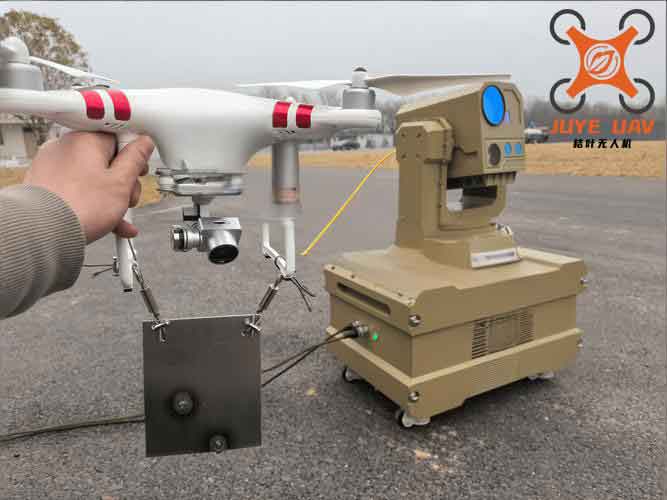
Another critical issue is the limitation of current anti-drone hardware. Systems like electronic jammers, laser weapons, and high-power microwaves often demand substantial power supplies and are bulky, restricting deployment in mobile or rugged environments. For example, directed-energy weapons require stable electricity, which is scarce in野战 conditions. Moreover, their effectiveness decays with distance, as described by the inverse-square law for energy dissipation:
$$ I(r) = \frac{P_0}{4\pi r^2} $$
where \(I(r)\) is the intensity at range \(r\), and \(P_0\) is the initial power. This means that to neutralize a drone at double the distance, four times the power is needed, posing logistical challenges. The table below compares various anti-drone interception systems:
| Interception System | Approximate Cost per Engagement | Success Rate (%) | Mobility |
|---|---|---|---|
| Surface-to-Air Missiles | $100,000 – $1,000,000 | High (>90) | Low |
| Electronic Jammers | $10,000 – $50,000 | Variable (60-80) | Medium |
| Laser Weapons | $5,000 – $20,000 | Moderate (70-85) | Low to Medium |
| Kinetic Nets/Drone Catchers | $1,000 – $10,000 | Low to Moderate (50-70) | High |
The concept of battlefield transparency further complicates anti-drone efforts. Drones enable real-time, grid-like surveillance, rendering large emplacements like jamming vehicles vulnerable to detection and subsequent strikes. This has driven a shift toward decentralized, small-unit tactics, but it also means that anti-drone systems themselves become priority targets. The effectiveness of an anti-drone network can be modeled using network theory, where nodes represent detection or interception assets, and edges denote communication links. The robustness \(R\) of such a network against targeted attacks is given by:
$$ R = 1 – \frac{N_f}{N_t} $$
where \(N_f\) is the number of failed nodes after an attack, and \(N_t\) is the total nodes. As drones proliferate, \(N_f\) increases rapidly due to pinpoint strikes, undermining \(R\).
Cost-effectiveness, or the lack thereof, is a pivotal concern in anti-drone warfare. The disparity between expensive interceptors and cheap drones creates unsustainable economic dynamics. For instance, using a missile costing hundreds of thousands of dollars to down a drone worth a few thousand is inherently inefficient. This can be expressed through a cost-benefit ratio \(CBR\):
$$ CBR = \frac{C_i}{C_d \cdot P_k} $$
where \(C_i\) is the cost of interception, \(C_d\) is the drone cost, and \(P_k\) is the kill probability. For viable anti-drone solutions, \(CBR\) should approach or fall below 1, but current systems often exhibit values far exceeding this threshold. The table below illustrates this imbalance using data inspired by recent conflicts:
| Anti-Drone Asset | Average Cost per Use | Typical Drone Cost | CBR (Estimated) |
|---|---|---|---|
| High-End Interceptor Missile | $500,000 | $2,000 | 250 |
| Mobile Jamming System | $30,000 | $1,500 | 20 |
| Portable Drone Gun | $10,000 | $1,000 | 10 |
| Bullet-Based Air Defense | $1,000 | $800 | 1.25 |
Psychological warfare adds another layer of complexity to anti-drone operations. The constant presence of enemy drones can induce stress and erode morale among troops, reducing combat effectiveness. This psychological impact \( \Psi \) can be approximated as a function of exposure time \(t\) and perceived threat level \(T\):
$$ \Psi(t, T) = \beta \cdot \ln(1 + t) \cdot T $$
where \(\beta\) is a constant based on unit training and resilience. As \(t\) increases, \(\Psi\) grows logarithmically, potentially leading to decision fatigue and operational paralysis. Anti-drone crews, in particular, face immense pressure, which may degrade their performance over time.
Looking ahead, the future of anti-drone technology hinges on innovation in artificial intelligence, quantum sensing, and directed energy. AI-driven systems can enhance tracking and prediction, as seen in emerging platforms that use machine learning to analyze drone behavior patterns. Quantum sensors promise improved detection sensitivity, potentially overcoming stealth limitations. Moreover, advances in compact laser and microwave systems could yield more portable and efficient anti-drone tools. The integration of these technologies into layered defense networks will be crucial for achieving a balanced cost-benefit outcome.
In conclusion, the challenges in anti-drone warfare are multifaceted, spanning technical, economic, and psychological domains. As drones continue to evolve, so too must our approaches to countering them. By leveraging mathematical models and systemic analyses, we can identify gaps and prioritize developments in anti-drone capabilities. The path forward requires a concerted effort to enhance detection, reduce costs, and mitigate human factors, ensuring that anti-drone strategies remain robust in the face of an increasingly crowded and contested airspace. The repeated emphasis on ‘anti-drone’ throughout this discussion underscores its critical role in shaping the future of military engagements.