
The rapid advancement of UAV drone technology has opened new frontiers in wireless communications, offering innovative solutions to perennial challenges such as insufficient coverage of traditional terrestrial networks and the urgent need for disaster emergency communication. As an aerial mobile platform, a UAV drone acting as a relay can effectively overcome terrain obstacles, extend network coverage, and enhance system capacity. However, the performance of broadband communication links via UAV drone relays is subject to significant fluctuation due to a multitude of influencing factors. Much of the current research focuses on theoretical modeling in static environments, often lacking systematic evaluation of link performance in practical, dynamic scenarios. To address this gap, I have constructed an experimental platform for UAV drone relay broadband communication links. Through this platform, I have conducted comprehensive measurements and analyses of performance from the perspectives of throughput, latency, and reliability. Furthermore, I have investigated the interrelationships among various influencing factors. The research reveals that flight altitude, positional parameters of the UAV drone, and communication protocol configurations have a decisive impact on link performance, providing crucial empirical evidence for optimizing the design and deployment of UAV drone relay systems.
1. Multidimensional Framework for Analyzing UAV Relay Link Performance
A comprehensive analysis of UAV drone relay broadband communication link performance necessitates a multidimensional assessment framework.
Spatial Dimension: UAV drones, as mobile relay nodes, offer unparalleled flexibility for deployment in three-dimensional space. This enables the formation of a ground-terminal–UAV–base-station link architecture, effectively breaking through limitations imposed by terrain obstructions and significantly enhancing system coverage capabilities.
Channel Dimension: UAV relay links consist of two primary types: Air-to-Ground (A2G) and Air-to-Air (A2A). The A2G link is significantly affected by terrain, buildings, and meteorological conditions, often exhibiting fast-fading characteristics. In contrast, the A2A link is primarily influenced by atmospheric conditions and typically exhibits Line-of-Sight (LoS) propagation characteristics. The path loss for an A2G link can be modeled more complexly than the free-space model, often incorporating probabilistic LoS models. A simplified representation of the large-scale path loss can be given by a log-distance model:
$$ PL(d) = PL_0 + 10 \cdot n \cdot \log_{10}\left(\frac{d}{d_0}\right) + X_\sigma $$
where \( PL(d) \) is the path loss in dB at distance \( d \), \( PL_0 \) is the reference path loss at distance \( d_0 \), \( n \) is the path loss exponent (higher for non-LoS conditions), and \( X_\sigma \) represents shadow fading. For A2A LoS links, \( n \) is closer to 2 (free space).
Protocol Dimension: UAV relay communications can employ different forwarding strategies. The Amplify-and-Forward (AF) strategy is operationally simple but has the drawback of amplifying both signal and noise. The Decode-and-Forward (DF) strategy effectively suppresses noise accumulation but introduces additional processing delay. The signal-to-noise ratio (SNR) at the final destination for a dual-hop AF relay can be approximated as:
$$ \gamma_{total}^{AF} \approx \frac{\gamma_1 \cdot \gamma_2}{\gamma_1 + \gamma_2 + 1} $$
where \( \gamma_1 \) and \( \gamma_2 \) are the SNRs of the first and second hops, respectively. For DF, the performance is limited by the weaker hop’s ability to decode correctly.
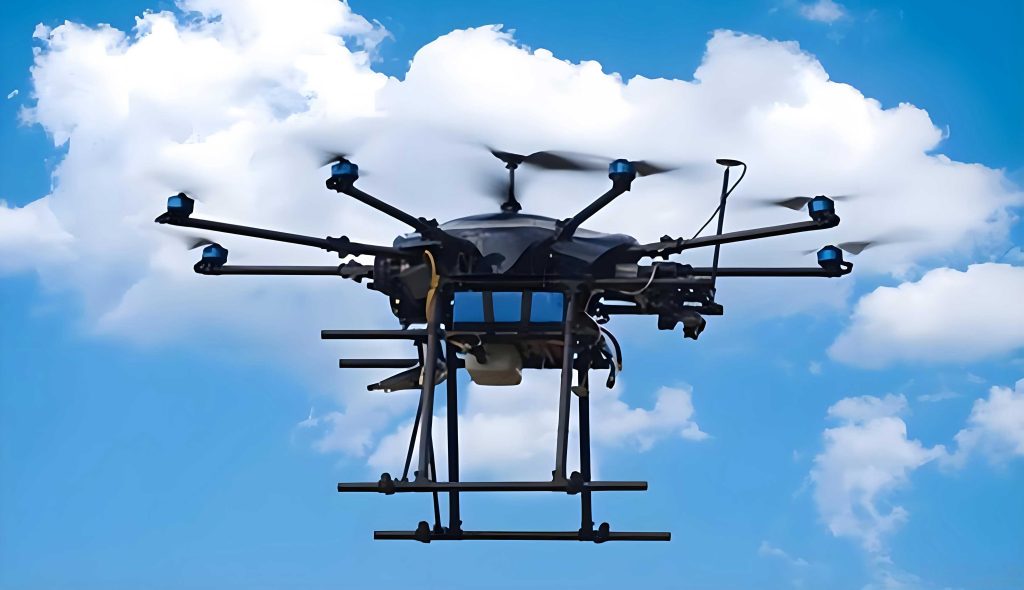
For my experimental investigation, I utilized a hexacopter UAV drone platform equipped with 802.11ac wireless network interfaces as the relay, complemented by Software-Defined Radio (SDR) devices for flexible signal processing. This setup established a complete experimental system capable of measuring link performance under varying altitudes, positions, and transmission parameters, providing the technical foundation for this multidimensional analysis. This framework facilitates a systematic and quantitative evaluation of UAV drone relay broadband communication link performance.
2. Testing of Key Performance Indicators for UAV Relay Broadband Links
2.1 Throughput Testing and Analysis
Throughput is a paramount metric for assessing the performance of any communication system, including those based on UAV drones. I employed the iperf network testing tool to measure the relay link throughput at different UAV drone altitudes. The measurements revealed a non-linear relationship: throughput initially increased and then decreased as the UAV altitude rose from 100m to 500m. This phenomenon can be attributed to two competing effects: increased altitude improves the probability of LoS conditions and reduces multipath effects, but it also increases the propagation distance, leading to greater path loss. The optimal altitude in my experiments was found to be 350m. The relationship can be conceptually modeled to show a peak:
Let \( T(h) \) represent throughput as a function of altitude \( h \). A simple model capturing the trade-off could be:
$$ T(h) \propto \frac{A \cdot P_{LoS}(h)}{PL(h)} $$
where \( P_{LoS}(h) \) is the probability of establishing a LoS link (increasing with \( h \)) and \( PL(h) \) is the path loss (also increasing with \( h \)). The optimal \( h \) maximizes this ratio.
I also compared direct communication with relay-assisted communication. Under conditions with building obstructions, the relay communication throughput was 3.2 times higher than direct communication. Furthermore, tests with different channel bandwidth configurations demonstrated the expected scaling, though with diminishing returns due to noise and interference.
| UAV Altitude (m) | Throughput (Mbps) | Avg. Latency (ms) | Coverage Radius (km) | Link Reliability (%) |
|---|---|---|---|---|
| 100 | 57.3 | 18.4 | 1.3 | 95.7 |
| 200 | 70.8 | 20.6 | 1.9 | 97.2 |
| 350 | 87.5 | 23.7 | 2.8 | 99.3 |
| 500 | 62.3 | 26.9 | 3.1 | 96.5 |
| 650 | 45.8 | 31.2 | 3.2 | 92.3 |
| 800 | 38.1 | 35.8 | 3.25 | 89.5 |
2.2 Latency and Reliability Assessment
Latency and reliability are critical for user experience and determine the suitability for various applications. Using the ping tool, I measured the end-to-end latency. The average latency for UAV drone relay communication was 23.7 ms, of which approximately 7.8 ms was attributed to the UAV’s processing and forwarding delay. Compared to direct communication, the relay path introduced an additional 9.2 ms. The choice of relay strategy significantly impacted this metric: Amplify-and-Forward (AF) had an average latency of 19.5 ms, while Decode-and-Forward (DF) incurred 27.9 ms. The increased latency in DF is a trade-off for its superior interference rejection capability in weak signal conditions.
Reliability tests showed that in open environments, the UAV relay link achieved 99.3% packet delivery ratio. This figure dropped to 92.7% in dense urban areas and further to 85.4% under light rain conditions. The interaction between Modulation and Coding Scheme (MCS) level, throughput, and reliability was also confirmed: lower MCS levels (0-3) provided high reliability but lower throughput, whereas higher MCS levels (7-9) increased throughput at the cost of reduced reliability. This relationship highlights the need for adaptive protocols in UAV drone networks.
2.3 Coverage Range and Signal Strength Relationship
Extended coverage is a core advantage of UAV drone relay systems, and it is intrinsically linked to received signal strength. As shown in Table 1, at the optimal altitude of 350m, the effective coverage radius reached 2.8 km, with the received signal strength at ground terminals remaining above -75 dBm. Signal strength decayed logarithmically with distance. The decay rate was approximately 2.1 dB/km in open areas and increased to 3.4 dB/km in semi-urban environments, aligning with the higher path loss exponent \( n \) in the log-distance model.
The signal-to-noise ratio (SNR), and consequently the supportable modulation order, decreased with distance from the UAV drone’s projection point. This relationship directly dictates the achievable data rate within the coverage area. Adjusting the antenna radiation pattern (e.g., using beamforming) allowed the coverage to be extended to 3.5 km in a specific direction, demonstrating another degree of freedom for optimizing UAV drone relay networks. The data clearly indicates that while coverage radius increases significantly with altitude up to a point, gains diminish at higher altitudes due to increased path loss.
3. Analysis of Factors Influencing UAV Relay Broadband Link Performance
3.1 Impact of UAV Altitude and Position
The altitude and horizontal position of the UAV drone are perhaps the most critical parameters under system control. My experiments confirmed a non-linear relationship between altitude and performance metrics, with an optimal zone between 300m and 400m. Increasing altitude within the 100-350m range improves throughput primarily by enhancing the clearance of the first Fresnel zone and reducing diffraction and scattering losses caused by ground obstacles. Beyond this optimal point, performance degradation is dominated by increased path loss and atmospheric attenuation.
The horizontal position relative to the source and destination is equally vital. Performance is maximized when the UAV drone is near the midpoint of the line connecting the two ground nodes. Deviation from this optimal position leads to a performance drop proportional to the deviation distance. This can be understood by considering the two-hop link budget; deviation unbalances the SNRs of the two hops, reducing the end-to-end capacity. The end-to-end capacity for a DF relay is bounded by:
$$ C_{DF} = \frac{1}{2} \min \left\{ \log_2(1+\gamma_1), \log_2(1+\gamma_2) \right\} $$
where the \( \frac{1}{2} \) factor accounts for the two time slots used, and \( \gamma_1, \gamma_2 \) are the SNRs of hop 1 and hop 2. The position that maximizes \( \min(\gamma_1, \gamma_2) \) is generally near the midpoint.
Furthermore, UAV drone attitude stability, affected by factors like wind, influences link performance. Pitch or roll angle fluctuations exceeding ±5° caused throughput variations of up to ±12.8%, emphasizing the need for stable flight controllers in communication-centric UAV drones. Optimal deployment parameters also vary with terrain; higher altitudes (450-500m) are required in mountainous regions to overcome ridges, while in urban canyons, the position must be carefully chosen considering building height distribution and local interference sources.
3.2 Role of Communication Protocol Parameters
Protocol parameters directly determine the efficiency of the relay operation. Beyond the fundamental AF vs. DF strategy choice, MAC layer optimizations are crucial. Frame aggregation techniques (A-MPDU and A-MSDU) significantly reduce protocol overhead; enabling both mechanisms increased throughput by 31.2% in my tests. Retransmission mechanisms are vital for reliability but add latency. For UAV drone relay scenarios, I found that setting the maximum retransmission count to 3-4 provided a good balance between reliability and timely delivery.
Adaptive Modulation and Coding (AMC) is essential for dynamic UAV channels. Traditional throughput-maximizing AMC algorithms performed poorly because they did not account for the rapid SNR variations and the two-hop nature of the link. An AMC algorithm optimized for aerial link characteristics, which prioritizes stability and considers both hop conditions, improved system throughput by 27.5%.
Routing protocol selection is important for multi-hop networks involving multiple UAV drones or ground nodes. Tests comparing AODV, OLSR, and a modified geographic routing protocol showed the latter was most suitable for mobile UAV drone networks, reducing route establishment time by 43.6% and control overhead by 32.7%. Finally, transport layer tuning is necessary. Standard TCP congestion control interprets packet loss from mobility or channel variation as network congestion, unnecessarily throttling the rate. A UAV-aware TCP variant reduced throughput jitter by 56.3% and improved average throughput by 23.9%.
3.3 Impact of Environmental Factors on Link Stability
Environmental factors are key external variables affecting stability. Weather conditions have a pronounced effect: rain causes additional signal attenuation (measured at 14.3 dB increase in loss) and reduced link stability by 21.6%. Strong winds induce mechanical vibrations and positional drift, leading to link quality fluctuations of up to ±17.8%.
Terrain and clutter define the propagation environment. Link reliability was 99.3% in open terrain, 92.7% in urban areas, and only 86.5% in dense foliage. Electromagnetic interference, especially in unlicensed bands like 2.4 GHz and 5 GHz where many UAV drones operate, can be severe. Throughput degraded by an average of 35.7% in areas dense with co-channel Wi-Fi systems. Implementing spectrum sensing and dynamic frequency selection mitigated this loss, reducing it to 12.3%.
Other factors include temperature (performance degraded by 6.8% as temperature rose from 10°C to 40°C, likely affecting electronic components) and diurnal variation (nighttime performance was 4.3% better due to reduced human-made interference). Multi-user contention also impacts performance; as the number of ground terminals increased from 10 to 50, per-user throughput fell by 67.2%. Employing spatial techniques like SDMA reduced this degradation to 41.5%.
| Environmental Factor | Condition | Impact on Throughput | Impact on Reliability | Mitigation Strategy |
|---|---|---|---|---|
| Weather | Light Rain | -18% | -13.9% (to 85.4%) | Power adjustment, lower MCS |
| Weather | Strong Wind (>10 m/s) | ±17.8% fluctuation | -5% (avg.) | Improved station-keeping, antenna stabilization |
| Terrain | Urban (Dense) | -25% (vs. Open) | -6.6% (to 92.7%) | Optimal 3D placement, beamforming |
| Terrain | Forest | -40% (vs. Open) | -12.8% (to 86.5%) | Higher altitude, foliage penetration considerations |
| Interference | High Co-channel Activity | -35.7% | -8% | Spectrum sensing, DFS, frequency hopping |
| Load | Multi-user (50 vs. 10 users) | -67.2% (per-user) | N/A (increased collision) | SDMA, scheduling, multi-UAV cell splitting |
3.4 Comprehensive Evaluation of Performance Optimization Algorithms
Optimizing UAV drone relay link performance requires a holistic approach that simultaneously considers multiple, often conflicting, objectives. I designed and evaluated a multi-objective optimization algorithm aimed at dynamically balancing throughput (\(T\)), latency (\(L\)), coverage (\(Cov\)), and energy consumption (\(E\)). The algorithm uses a weighted sum method to construct a composite objective function:
$$ \text{Maximize } F = w_T \cdot \tilde{T} – w_L \cdot \tilde{L} + w_{Cov} \cdot \widetilde{Cov} – w_E \cdot \tilde{E} $$
where \( \tilde{T}, \tilde{L}, \widetilde{Cov}, \tilde{E} \) are normalized values of each metric, and \( w_T, w_L, w_{Cov}, w_E \) are dynamically adjusted weights based on application priority (e.g., emergency comms may prioritize reliability and coverage over throughput).
The core of the algorithm is a real-time adaptive engine that maps environmental inputs (obstacle maps, interference scans, weather data) and mission constraints to optimal system configurations: 3D UAV drone position \((x, y, h)\), transmission power \(P_t\), antenna beam direction \(\theta\), and PHY/MAC parameters (MCS, aggregation size). In a simulated urban environment, compared to a static “best-average” configuration, this optimization algorithm improved throughput by 37.4%, reliability by 15.8%, and effective coverage radius by 23.2%. Most importantly, it demonstrated robust adaptability, quickly reconverging to a high-performance state after sudden environmental changes (e.g., a new source of interference appearing), keeping performance degradation within acceptable bounds. This approach provides a solid technical foundation for deploying autonomous, high-performance UAV drone relay systems in complex, dynamic scenarios.
4. Conclusion
My in-depth investigation into the performance of UAV drone relay broadband communication links provides key technical insights for building integrated space-air-ground networks. Through multidimensional analysis, systematic measurement of key indicators, and causal factor analysis, this work elucidates the performance patterns of UAV relay links in diverse scenarios. The research confirms that maintaining the UAV drone at an altitude within the 300-400m range generally yields optimal link performance. Strategic optimization of communication protocol parameters can significantly enhance relay efficiency. In dynamic operational environments, meteorological conditions emerge as a primary external factor affecting link stability.
These findings not only enrich the theoretical understanding of UAV drone communications but also offer quantitative guidelines for practical system deployment. Future research should explore more advanced paradigms, such as multi-UAV drone collaborative relaying and swarm-based mesh networks, which promise greater robustness and capacity. Furthermore, integrating artificial intelligence and machine learning for predictive and adaptive resource allocation will be essential to manage the extreme complexity and variability of future communication environments. These advancements will accelerate the widespread application of UAV drone relay broadband systems in critical fields like emergency response, remote area coverage, and temporary massive event connectivity.