
In recent years, amid intensifying competitive landscapes, strategic initiatives such as the third “Offset Strategy” have emerged, advocating for novel technologies and operational concepts to alter the rules of engagement and future battlefields. Among these, UAV swarm warfare stands out as a core tactic, representing a significant innovation. A UAV swarm refers to a group of small unmanned aerial vehicles that operate under human supervision or command, autonomously networking to execute unified missions. These swarms can consist of identical or diverse UAVs, organized in master-slave or decentralized architectures. According to the “2016-2036 Small Unmanned Aircraft Systems Flight Plan,” UAV swarms can conduct intelligence, surveillance, and reconnaissance in low-threat environments, collaborate with other UAVs for kinetic strikes, provide target designation for aerial platforms, and in high-threat scenarios, perform electronic attacks and suppress enemy air defenses. Numerous UAV swarm projects have been launched, including micro-UAV swarm initiatives, low-cost swarm programs, and projects like “Gremlins,” each designed with distinct purposes and characteristics to meet diverse operational needs and integrate with manned/unmanned platforms. In this article, we delve into UAV swarm research, analyze the traits of low, slow, and small (LSS) UAVs and swarms, examine the market scale and applications, categorize key anti-UAV technologies, and propose strategies for countering UAV swarms. We assess various anti-UAV engagement methods, highlight their features, and contemplate future directions for anti-UAV swarm technology development, offering insights for advancing related fields.
The proliferation of UAV swarms poses a multifaceted challenge, demanding robust anti-UAV solutions. As we explore this domain, it becomes evident that anti-UAV systems must evolve to address the unique threats posed by swarms. This analysis aims to provide a comprehensive overview, leveraging technical evaluations to inform anti-UAV strategies.
| Category | Name | Weight (kg) | Altitude (km) | Speed (km/h) | Remarks |
|---|---|---|---|---|---|
| 1 | Micro UAV System | < 9 | 0.4 | < 185 | Capable of carrying small payloads |
| 2 | Small Tactical UAV System | 10-25 | 1 | < 463 | Compact airframe, low radar cross-section, medium endurance |
| 3 | Tactical UAV System | 25-599 | < 3 | < 463 | Higher logistical demands |
| 4 | Endurance UAV System | > 599 | < 6 | – | Extended range and endurance, requires runways |
| 5 | Penetrating UAV System | > 599 | > 6 | – | Similar logistics to manned aircraft |
UAV swarms, particularly those composed of LSS UAVs (Categories 1-3), revolutionize warfare through “swarming” tactics—overwhelming defenses with coordinated, distributed attacks. This approach embodies distributed and mosaic warfare concepts across time, space, and spectrum domains, disrupting traditional kill chains and achieving nonlinear escalation in combat effectiveness. Key characteristics include quantity superiority, cost-effectiveness, aggregated效能, and system-level operations. The collective intelligence of swarms enables emergent behaviors, allowing them to accomplish complex missions beyond the capability of single platforms. The efficacy of a swarm can be modeled using formulas that account for synergistic effects. For instance, the overall effectiveness \( E_{\text{swarm}} \) might be expressed as:
$$ E_{\text{swarm}} = N \cdot \alpha \cdot \beta \cdot \gamma $$
where \( N \) is the number of UAVs, \( \alpha \) represents individual capability, \( \beta \) denotes coordination efficiency, and \( \gamma \) accounts for environmental factors. This highlights how anti-UAV measures must counteract not just individual units but the swarm’s collective power.
Anti-UAV technologies against LSS UAVs and swarms are broadly classified into four categories, each offering distinct mechanisms for neutralization. These anti-UAV approaches form the backbone of modern counter-swarm strategies.
| Category | Description | Primary Mechanism | Suitability for Swarms |
|---|---|---|---|
| 1. Jamming and Disruption | Emits directional high-power RF interference to disrupt C2 links, GSM, or GPS/PNT signals, forcing UAVs to land or return. | Signal denial | Effective against loosely coordinated swarms |
| 2. Direct Destruction | Utilizes kinetic or energy weapons to physically damage or destroy UAVs via projectiles, lasers, or microwaves. | Physical/electronic kill | Suitable for dense swarms; scalable with area effects |
| 3. Monitoring and Control | Hacks into UAV communication codes to seize control, enabling guided landing or capture without destruction. | Cyberspace intrusion | Challenging for swarms but theoretically feasible |
| 4. Proximity Inspection and Capture | Deploys interceptor UAVs to approach, inspect, capture, or collide with target UAVs for neutralization. | Close engagement | Effective against slow, low-maneuverability swarms |
Each anti-UAV category has its merits and limitations. For instance, jamming is a non-kinetic anti-UAV method that avoids collateral damage but may be mitigated by autonomous swarm behaviors. Direct destruction offers assured kills but can be costly against large swarms. We must consider these trade-offs when designing integrated anti-UAV systems.
The global UAV market underscores the urgency of advancing anti-UAV capabilities. Military UAVs constitute approximately 65% of the market, with projections indicating robust growth. Based on industry data, we can model the market scale using formulas. Let \( M_t \) represent the military UAV market size in year \( t \), and \( G \) be the annual growth rate. Then:
$$ M_t = M_0 \cdot (1 + G)^{t} $$
where \( M_0 \) is the base year size. For example, if \( M_0 = 141 \) billion USD in 2018 and \( G = 0.12 \), by 2025, \( M_{2025} = 141 \cdot (1.12)^{7} \approx 268 \) billion USD. The number of UAVs, \( N_{\text{UAV}} \), can be estimated from market values and average costs. Assuming an average cost per military UAV of \( C \), we have:
$$ N_{\text{UAV}} = \frac{M_t}{C} $$
If \( C \) ranges from 0.1 to 0.5 million USD, \( N_{\text{UAV}} \) in 2025 could be between 191,000 and 956,000 units. Given that LSS UAVs may comprise around 75.5% of these, the military LSS UAV count \( N_{\text{LSS}} \) is:
$$ N_{\text{LSS}} = 0.755 \cdot N_{\text{UAV}} $$
yielding 144,000 to 722,000 units. The Asia-Pacific region might account for 37.8% of this, indicating 54,000 to 273,000 LSS UAVs. These figures highlight the scale of the threat, necessitating scalable anti-UAV solutions. The proliferation among non-state actors further amplifies risks, driving an arms race in anti-UAV technologies.
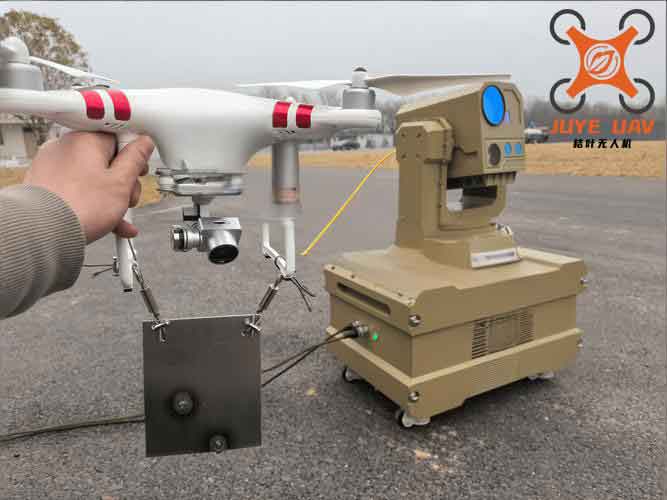
Engagement means against LSS UAV swarms encompass diverse anti-UAV systems, each with unique characteristics. We analyze them below, incorporating formulas to quantify their performance.
1. Air Defense Missiles: These offer long range, high maneuverability, and high kill probability but face cost and saturation challenges against swarms. The kill probability \( P_k \) for a missile against a UAV can be modeled as:
$$ P_k = 1 – e^{-\lambda \cdot A} $$
where \( \lambda \) is a lethality coefficient and \( A \) is the engagement area. For swarm interception, cost-effectiveness is critical. Dedicated low-cost missiles, like the “Vampire” system, are being developed for anti-UAV roles, with unit cost \( C_m \) and swarm capacity \( S_m \). The cost per kill \( C_{pk} \) against a swarm of size \( N_s \) is:
$$ C_{pk} = \frac{C_m \cdot n_m}{N_s \cdot P_k} $$
where \( n_m \) is the number of missiles fired. This drives innovation in affordable, swarm-optimized anti-UAV missiles.
2. Counter-UAV Drones: Employing “drone vs. drone” tactics, these systems engage at close range. They can be suicidal,撞击, or non-suicidal with payloads. The effectiveness of a counter-drone \( E_{cd} \) depends on its speed \( v \), agility \( \omega \), and payload \( p \). For撞击式 types, the kinetic energy \( KE \) upon impact is:
$$ KE = \frac{1}{2} m v^2 $$
where \( m \) is the mass. This energy must exceed the target’s durability \( D \) for kill: \( KE > D \). Non-suicidal types, equipped with jammers or directed energy, offer reusable anti-UAV platforms, enhancing sustainability against swarms.
3. High-Energy Laser Weapons: These provide low cost-per-shot and continuous engagement capabilities, ideal for swarms. The laser damage mechanism involves beam power \( P \), exposure time \( t \), and target material properties. The critical power density \( I_{\text{crit}} \) for damaging a UAV is:
$$ I_{\text{crit}} = \frac{P}{A_{\text{spot}}} $$
where \( A_{\text{spot}} \) is the beam spot area. The time to disable a target \( t_d \) can be approximated as:
$$ t_d = \frac{E_{\text{req}}}{\eta \cdot P} $$
with \( E_{\text{req}} \) as the required energy and \( \eta \) an efficiency factor. Lasers enable multi-target engagement through rapid slewing, making them potent anti-UAV tools. Their effectiveness scales with power and cooling, allowing sustained anti-swarm fire.
4. High-Power Microwave Weapons: Emitting broad-area electromagnetic pulses, HPMs disrupt electronics across multiple UAVs simultaneously. The field strength \( E \) at distance \( r \) from the source is:
$$ E = \frac{k \cdot P_{\text{trans}}}{r^2} $$
where \( k \) is a constant and \( P_{\text{trans}} \) is transmitted power. To fry electronics, \( E \) must exceed a threshold \( E_{\text{th}} \). The affected area \( A_{\text{HPM}} \) for a swarm is:
$$ A_{\text{HPM}} = \pi r^2_{\text{max}} $$
where \( r_{\text{max}} \) is the maximum effective radius. This area effect makes HPMs highly suitable for anti-UAV swarm defense, though they may cause collateral damage.
5. Anti-Aircraft Artillery and Specialty Ammunition: Guns offer high rate-of-fire, all-weather performance, and cost advantages. The probability of hit \( P_h \) for a shell can be expressed as:
$$ P_h = \frac{A_{\text{target}}}{A_{\text{dispersion}}} $$
where \( A_{\text{target}} \) is the UAV’s cross-section and \( A_{\text{dispersion}} \) is the shell dispersion area. With smart munitions, such as proximity-fused or guided rounds, \( P_h \) increases significantly. The total kills \( K \) by a gun system against a swarm is:
$$ K = ROF \cdot t_{\text{eng}} \cdot P_h \cdot P_k $$
with \( ROF \) as rate of fire and \( t_{\text{eng}} \) engagement time. Modern guns are being adapted with advanced弹药 for anti-UAV roles, providing a layered defense.
6. Electronic Detection and Jamming: This soft-kill approach targets navigation and communication links. The jamming effectiveness \( J_{\text{eff}} \) depends on the jamming-to-signal ratio \( J/S \):
$$ J/S = \frac{P_j \cdot G_j \cdot \lambda^2}{(4\pi r)^2 \cdot P_s \cdot G_s} $$
where \( P_j \) and \( G_j \) are jammer power and gain, \( P_s \) and \( G_s \) are signal power and gain, \( \lambda \) is wavelength, and \( r \) is range. Successful jamming requires \( J/S > \text{threshold} \). While non-destructive, it complements hard-kill anti-UAV methods, especially in dense swarm scenarios.
In conclusion, as UAV swarm threats escalate, anti-UAV and anti-swarm operations are becoming a critical warfare and security paradigm. Drawing from global anti-UAV experiences, we must develop comprehensive anti-UAV equipment systems, enhance existing platforms’ counter-swarm capabilities, and emphasize multi-asset coordination and multi-mechanism interception. A layered, multi-effect defense is essential to address current and future challenges. We should explore technological and tactical innovations, fostering anti-UAV solutions that are adaptive, scalable, and cost-effective. The future of anti-UAV swarm technology lies in integration, autonomy, and resilience, ensuring dominance in the evolving battlespace.