
The development of agricultural mechanization is entering a new era characterized by the continuous emergence of intelligent and automated equipment. Among these, the agricultural UAV, specifically the plant protection unmanned aerial vehicle equipped with a pesticide spraying system, represents a significant technological leap. By the end of 2019, over 300 such units had been deployed, primarily electric multi-rotor models, extensively applied for aerial plant protection operations in crops like rice and citrus orchards. This analysis delves into the spraying efficacy, core technologies, and operational considerations of these systems.
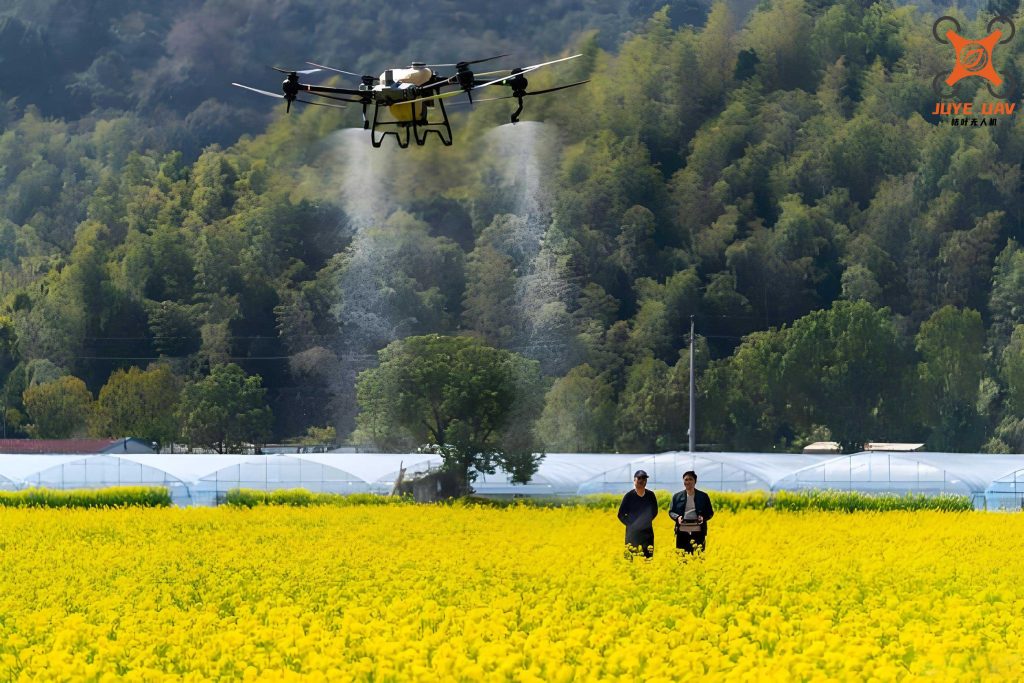
The fundamental structure of a typical multi-rotor agricultural UAV consists of three main subsystems: the airframe (flight vehicle), the ground control station, and the spraying system. The airframe integrates the flight control system, motors, electronic speed controllers (ESCs), propellers, a battery, and a payload comprising the liquid tank and spray nozzles. Operation is achieved through radio remote control or pre-programmed navigation. The pilot’s commands from the remote controller are transmitted as radio waves (typically in the shortwave or ultra-shortwave bands) to the UAV’s receiver. The flight controller processes these signals and directs the ESCs to adjust motor RPM. This change in rotor speed alters lift, thereby controlling the UAV’s attitude and position with precision. The spraying system is activated and modulated based on flight speed and predefined application rates.
The advantages of using an agricultural UAV over traditional ground-based sprayers are substantial and multifaceted, leading to superior application efficacy.
1. Superior Applicability: Their compact size and ability to hover allow operation in diverse and challenging terrains—hilly landscapes, deep muddy paddies, and plots without dedicated landing areas. They are effective on both tall and short crops, from orchards to rice fields.
2. High Operational Efficiency: They dramatically reduce labor intensity. Field data indicates an agricultural UAV can cover 200-300 acres per day, compared to only 6-8 acres per day for manual spraying. This represents a 5-15 fold increase over ground machinery and a 20-30 fold increase over manual labor. This efficiency can be quantified by the simple ratio:
$$ \text{Efficiency Ratio} = \frac{\text{Area Covered by UAV per Day}}{\text{Area Covered by Manual per Day}} \approx 30 $$
3. Enhanced Spray Efficacy and Resource Savings: The high-speed rotation of the propellers generates a strong downwash airflow. This airflow improves droplet atomization, enhances canopy penetration, and increases the deposition of pesticide on the target foliage, reducing drift and runoff. Consequently, significant savings in water and chemical usage are achieved, often reported around 40% less chemical and 90% less water compared to conventional methods. More importantly, the biological efficacy of the application is significantly improved, as evidenced by field trials against common pests. The following table consolidates data on control efficacy against Rice Leaf Roller (*Cnaphalocrocis medinalis*) and Brown Planthopper (*Nilaparvata lugens*):
| Target Pest | Days After Application | Control Efficacy (%) – UAV | Control Efficacy (%) – Traditional | Efficacy Advantage |
|---|---|---|---|---|
| Rice Leaf Roller | 3 | 86 | 59 | +27 |
| 5 | 88 | 52.9 | +35.1 | |
| 10 | 80 | 30 | +50 | |
| Brown Planthopper | 3 | 97.4 | 82.6 | +14.8 |
| 5 | 92.8 | 67.8 | +25 | |
| 10 | 90.02 | 28.2 | +61.82 |
The data clearly shows not only a higher initial kill rate but, crucially, a much more sustained residual effect from the agricultural UAV application, which is vital for integrated pest management.
4. Improved Operator Safety: The system enables separation of the operator from both the vehicle and the chemicals. Remote operation eliminates direct exposure to pesticides, drastically reducing the risk of poisoning—a critical concern during hot summer application periods when traditional spraying poses severe health hazards.
Despite these advantages, certain limitations of the current agricultural UAV technology must be acknowledged:
1. High Initial and Operational Cost: The upfront investment is significant, with prices ranging from tens to hundreds of thousands. Additionally, the recurring cost of battery depletion and replacement adds to the operational expense.
2. Potential for Crop Damage: The intense downwash airflow, while beneficial for deposition, can cause mechanical damage (whipping or lodging) to delicate plant tissues, especially in seedling stages.
3. Technical Skill Requirements: Operating an agricultural UAV is not trivial. Pilots require certification and must possess the knowledge to adjust flight parameters (altitude, speed) and pesticide mixing ratios according to field conditions, crop stage, and pest pressure.
The proliferation of hardware does not guarantee successful or profitable operation. Mastery of aerial application technology is paramount. Key aspects include flight operations, chemical application science, and troubleshooting.
Flight Operational Requirements: A primary and costly risk is “crashing.” A single crash can lead to expensive repairs and major workflow disruption. Mandatory pre-flight checks (propellers, frame integrity, battery status) are essential. In hilly terrain, establishing an observation post and flying from lower to higher elevation is advisable. Operations near obstacles like power lines, poles, or trees should be avoided or conducted with the flight path parallel to the obstacles. Certified pilots must internalize operational protocols, such as checking battery voltage under load before takeoff.
Chemical Application Science: The effectiveness of the treatment is highly dependent on correct chemical use. Under-dosing fails to achieve control, while over-dosing causes phytotoxicity. Application must be scientifically calibrated based on pesticide type, formulation, recommended dosage, and the growth stage of the crop. Droplet size (Volume Median Diameter – VMD) should be adjusted for different chemicals and canopy densities. The use of anti-drift nozzles is recommended to minimize off-target movement. The deposition efficiency can be modeled considering downwash velocity ($v_d$), droplet size ($D_v$), and release height ($h$):
$$ \text{Deposition Efficiency} \propto \frac{v_d \cdot \sqrt{D_v}}{h} $$
This highlights why lower flight heights and appropriate downwash are critical for an agricultural UAV.
Common Field Troubleshooting: A competent pilot must handle basic field issues:
1. GPS Signal Loss: Check for signal blockage (buildings, mountains) or electromagnetic interference (power lines). Relocate to an open area. If the GPS hasn’t been used for a long time, a cold start may take minutes.
2. Severe Deviation from Planned Route: Check aircraft trim (ensure level flight in manual mode), avoid strong wind conditions, and verify the attitude sensor calibration.
3. Ground Station Data Link Failure: Verify all physical connections, ensure the correct communication port and baud rate are set, confirm the data link channels match between the aircraft and ground station, and check if the aircraft’s GPS is providing valid data to the flight controller. A system restart (ground station software and aircraft power) often resolves communication glitches.
Considering the vast scale of arable land, the potential market for agricultural UAV services is enormous. To foster healthy development, several policy and infrastructural supports are suggested.
Optimizing Support Policies: Financial subsidy schemes should be refined to reflect the technological and cost diversity among different agricultural UAV models, moving beyond a simple fixed-amount subsidy for broad categories. Furthermore, promoting government-procured unified pest control services conducted by professional agricultural UAV fleets can demonstrate effectiveness, build farmer trust, and accelerate market adoption.
Building a Robust Support Ecosystem: A widespread and reliable after-sales service network is currently underdeveloped. Manufacturers should be encouraged to establish or authorize local service centers for prompt maintenance and repair. Concurrently, there is a pressing need for a skilled workforce. Operating a successful agricultural UAV service requires a blend of skills in aeronautics, electronics, agronomy, and chemistry. Supporting agricultural vocational institutions in developing specialized training programs for agricultural UAV operation and technology is crucial for sustaining industry growth. The total cost of operation (TCO) can be a deciding factor, which can be approximated as:
$$ \text{TCO} = C_{\text{capital}} + N_{\text{batt}} \cdot C_{\text{batt}} + C_{\text{chem}} + C_{\text{labour}} + C_{\text{maint}} $$
where reducing $C_{\text{batt}}$ (battery cost) and $C_{\text{maint}}$ (maintenance) through better technology and service networks is key to profitability.
In conclusion, the agricultural UAV is a transformative tool in modern precision agriculture. Its demonstrated advantages in efficacy, efficiency, and safety are compelling. However, realizing its full potential depends on continuous technological refinement, the development of skilled human resources, and the implementation of supportive policies that address cost barriers and build a sustainable service infrastructure. The future of crop protection is increasingly airborne, and mastering the associated technology is the pathway to harnessing its benefits.