
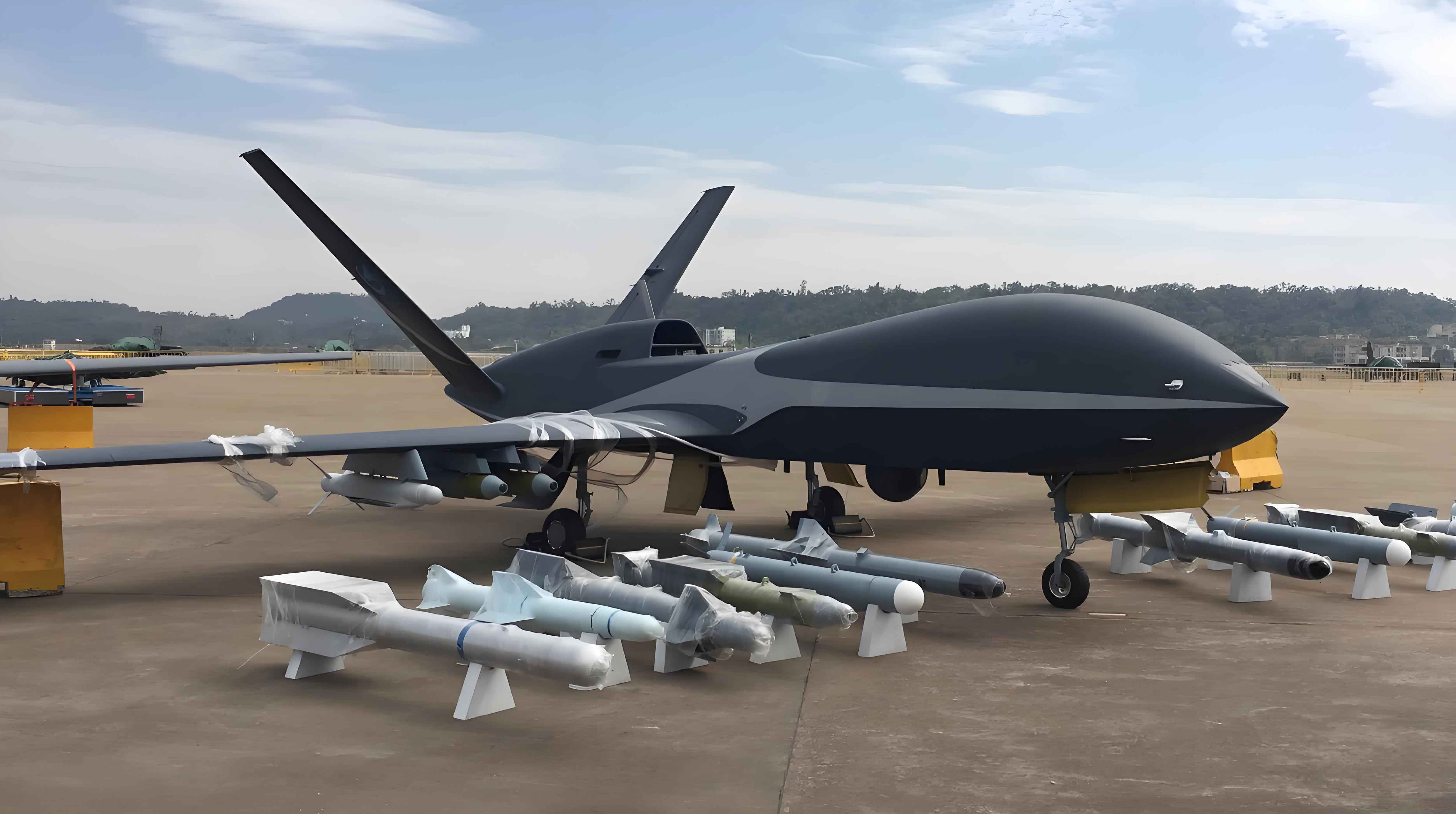
The evolution of modern warfare is increasingly defined by the pervasive presence and critical role of Unmanned Aerial Vehicles (UAVs). As a cornerstone of contemporary and future combat systems, the performance, endurance, and mission capability of a military drone are fundamentally determined by the effectiveness of its propulsion system. Unlike their manned counterparts, the design of unmanned systems is liberated from many constraints imposed by human physiological limits and safety requirements, allowing for a more mission-centric approach. This shift unlocks potential for unprecedented performance in speed, altitude, range, and maneuverability. Consequently, understanding the distinctive characteristics and key demands placed on military drone engines is paramount for advancing aerial combat capabilities. This analysis focuses on turbofan engines, the dominant propulsion choice for advanced medium-to-high performance UAVs, systematically examining their key requirements, the relationship between these requirements and engine design parameters, and the selection criteria tailored to different mission profiles.
1. Characteristics of Turbofan Engines for Military Drones
1.1 Features of Typical Military Drone Engines
Military drones are categorized based on their primary function, with major types including Unmanned Combat Aerial Vehicles (UCAVs), reconnaissance UAVs, and unmanned tankers. Each class imposes unique demands on its powerplant. A review of prominent international UAV programs reveals distinct trends, particularly in the critical area of stealth, which is a paramount concern for survivability.
UCAVs, designed for strike, air dominance, and suppression missions, universally emphasize low observability. Their engines incorporate several specialized design adaptations:
- Air Intake Design: Dorsal-mounted, S-shaped serpentine inlets are prevalent (e.g., X-45A, X-47B, “Okhotnik,” “Grom”) to shield the compressor face from radar waves and reduce radar cross-section (RCS).
- Exhaust System: Specially treated exhaust nozzles, including S-shaped ducts and flattened “beavertail” designs (e.g., X-45C, X-47B, “Grom”), are used to manage infrared (IR) signature and RCS.
- IR Signature Control: A common modification from baseline fighter engines is the removal of the afterburner (e.g., X-45A, X-47B, “Okhotnik”), drastically reducing the high-temperature plume, a primary source of IR emission.
- Material Application: Advanced radar-absorbent materials (RAM) and IR-suppressant coatings are integral to designs like “Neuron” and “Taranis.”
For reconnaissance drones like the RQ-170, RQ-180, and MQ-20, stealth requirements have also become increasingly critical. Their propulsion systems employ similar stealth adaptations, including dorsal intakes and S-ducts. Beyond stealth, these platforms place a premium on fuel efficiency for long endurance, lightweight construction, and low noise signatures.
1.2 Key Parameters and Development Strategies
The propulsion systems for current operational and demonstrator military drone platforms are predominantly derived from mature, existing engines. This strategy leverages proven reliability, reduces development cost and risk, and significantly shortens the integration timeline. Table 1 summarizes key parameters of engines used in notable UAVs.
| Drone Type | UAV Platform | Engine | Thrust (kN) | Bypass Ratio | Engine Origin | Development Path |
|---|---|---|---|---|---|---|
| UCAV | X-45A | F124-GA-100 | 28.0 | ~0.47 | Light Fighter | Adaptation |
| X-45C | F404-GE-102 | 78.7 | ~0.34 | Trainer/Fighter | Adaptation | |
| “Neuron” | Adour Mk 951 | 40.0 | ~0.75 | Trainer | Adaptation | |
| X-47B | F100-PW-220U | 74.0 | ~0.60 | Fighter | Major Adaptation | |
| “Okhotnik” | AL-31F derivative | ~123.0 | ~0.57 | Fighter | Adaptation | |
| “Grom” | AI-222-25 | 24.5 | ~1.18 | Light Fighter/Trainer | Adaptation | |
| Reconnaissance | RQ-4 Global Hawk | AE 3007H | 42.0 | ~4.9 | Regional Jet | Adaptation |
| RQ-170 Sentinel | TF34 | 40.3 | ~6.2 | Attack Aircraft | Adaptation | |
| MQ-20 Avenger | PW545B | 20.0 | ~4.1 | Business Jet | Adaptation | |
| Tanker | MQ-25 Stingray | AE 3007N | 40.0 | ~5.0 | Regional Jet | Adaptation |
Analysis of the data reveals clear patterns in engine selection. UCAVs, with their emphasis on high-specific-thrust for potential supersonic dash and compact installation for low observability, consistently utilize adapted military low-bypass turbofans (e.g., F404, F100, AL-31). The adaptation for the X-47B’s F100-PW-220U is illustrative: the afterburner was removed and replaced with a compact, wraparound S-shaped nozzle; higher-strength bearings were incorporated for carrier landing loads; and turbine cooling was optimized to increase dry thrust.
In contrast, reconnaissance and tanker drones, where long endurance and fuel efficiency are paramount, overwhelmingly employ adapted high-bypass ratio civil engines (e.g., AE 3007, CF34, PW545). Their design prioritizes low Specific Fuel Consumption (SFC), which is fundamentally linked to high propulsive efficiency achieved through high bypass ratios. The fundamental relationship for ideal thrust $F$ and SFC highlights this trade-off:
$$F = \dot{m} \cdot (V_j – V_0)$$
$$SFC \propto \frac{1}{\eta_{th} \cdot \eta_{prop}}$$
where $\dot{m}$ is total mass flow, $V_j$ is jet velocity, $V_0$ is flight velocity, $\eta_{th}$ is thermal efficiency, and $\eta_{prop}$ is propulsive efficiency. A high-bypass ratio increases $\dot{m}$ while lowering average $V_j$, improving $\eta_{prop}$ and reducing SFC for subsonic flight, albeit at the cost of a larger engine diameter and frontal area.
2. Key Requirements for Military Drone Propulsion
2.1 System-Level Requirements from the Airframe
The demands placed on a military drone engine vary significantly with its intended mission role. These requirements can be categorized into five primary areas: Performance, Stealth, Reliability & Maintainability, Cost, and Environment. Table 2 assesses the relative importance (High-H, Medium-M, Low-L) of these requirements for the three primary classes of military drones.
| Key Requirement | Importance by Drone Type | ||
|---|---|---|---|
| UCAV | Reconnaissance | Tanker | |
| Performance | |||
| Low SFC (Subsonic) | M | H | H |
| High Thrust-to-Weight Ratio | H | L | L |
| High Inlet Temperature ($T_1$) Capability* | H | L | M |
| High Power Off-take | M | H | M |
| High-Altitude Operation | M | H | M |
| High Maneuver Tolerance | M | L | L |
| Stealth | |||
| Low Radar Cross-Section (RCS) | H | M | L |
| Low Infrared (IR) Signature | H | M | M |
| Reliability & Maintainability | |||
| Long Life | L | H | M |
| High Cycle Usage Tolerance | M | L | M |
| High Maintainability | M | H | H |
| Cost | |||
| Low Acquisition Cost | M | M | M |
| Low Development Cost | H | H | H |
| Low Maintenance Cost | L | M | M |
| Environment | |||
| Low Noise | L | L | L |
| Low Emissions (e.g., NOx) | L | M | L |
* For supersonic dash or high-subsonic flight at low altitude.
The table highlights distinct priority profiles. The military drone designed for combat (UCAV) places the highest emphasis on stealth and high-temperature performance. The reconnaissance platform prioritizes endurance (low SFC, high altitude), mission systems (high power off-take), and reliability (long life, high maintainability). The tanker shares the reconnaissance platform’s focus on fuel efficiency and maintainability. Notably, all types rate low development cost and high maintainability as highly important, reflecting the cost-conscious and support-efficient nature of unmanned systems. Environmental factors like noise and emissions are generally lower priority for military applications.
2.2 Mapping Requirements to Engine Design Parameters
The airframe’s key requirements must be translated into specific engine design features and thermodynamic cycle choices. This mapping involves complex, and often competing, relationships. For instance, a low specific thrust (high bypass ratio) is excellent for subsonic SFC but detrimental to achieving a high thrust-to-weight ratio or a small frontal area for low RCS. Table 3 outlines these relationships between top-level requirements and detailed engine characteristics.
| Engine Characteristic | Correlation with Key Requirement (Legend Below) | ||||||||||||||
|---|---|---|---|---|---|---|---|---|---|---|---|---|---|---|---|
| Low SFC | High T/W | High $T_1$ | High P-off | High Alt | High Man. | Low Noise | Low RCS | Low IR | Long Life | Hi-Cycle | Maint. | Low $Cost_{Acq}$ | Low $Cost_{Dev}$ | Low $Cost_{Mnt}$ | |
| Thermodynamic Cycle | |||||||||||||||
| Low Specific Thrust / Low FPR | ++ | — | o | o | o | ** | o | – | * | o | o | * | o | * | * |
| High Overall Pressure Ratio (OPR) | * | – | – | o | – | o | o | – | o | o | o | o | – | – | – |
| High Turbine Entry Temp. (SOT) | * | ** | o | o | o | o | o | – | o | o | – | – | – | o | – |
| High Component Efficiency ($\eta_c$, $\eta_t$) | ** | o | o | o | * | o | o | * | o | o | – | o | – | – | – |
| Mixed Exhaust Flow | * | o | o | o | o | o | * | o | * | ** | o | o | o | o | o |
| Engine Design | |||||||||||||||
| Large Compressor Stall Margin | – | o | o | * | * | * | o | o | * | o | * | o | o | – | – |
| Stringent Tip Clearance Control | ** | – | o | o | * | – | o | o | o | o | – | – | – | – | – |
| High Turbine $N^2A$** | o | * | o | o | o | o | o | o | o | o | – | – | – | o | o |
| Modular/Unitized Construction | o | – | o | o | o | o | o | o | o | o | o | ** | – | * | ** |
| Systems & Installation | |||||||||||||||
| Full-Authority Digital Control (FADEC) | * | o | o | * | * | * | o | * | o | o | * | * | * | o | – |
| Engine Health Monitoring (EHM) | * | – | o | o | o | * | o | * | o | * | * | * | * | – | ** |
| Cooled/Low-Observable Nozzle | — | – | o | o | o | o | o | o | ** | ** | – | – | – | – | – |
| Radar/IR Signature Materials | o | – | o | o | o | o | o | ** | * | – | – | – | – | – | – |
Legend: ++/** = Critical; * = Important; o = Minor/Negligible; – = Undesirable; — = Opposite is Critical.
** $N^2A$ (Turbine rotational speed squared x Annulus area) relates to blade stress.
The interactions can be classified into three types. First, some characteristics have negligible impact on certain requirements (e.g., modular construction has little effect on SFC). Second, some involve complex trade-offs. For example, a high SOT (Turbine Entry Temperature) allows for a smaller, lighter core, potentially reducing cost, but may require expensive materials and cooling, increasing cost. The net effect on acquisition cost is non-linear and design-dependent. The benefit in thrust-to-weight ratio, however, is direct and can be expressed conceptually as an improvement in specific power:
$$\text{Specific Power} \propto \eta_{th} \cdot \text{SOT} \cdot \left(1 – OPR^{-\frac{\gamma-1}{\gamma}} \right)$$
Third, compensation effects exist: if one parameter adversely affects a requirement, another can be optimized to compensate. For instance, if tip shrouds are omitted for cost, reducing stage loading can partly recover efficiency losses.
3. Selection and Optimization of Characteristic Parameters
The design of a propulsion system for a military drone is a multi-disciplinary optimization problem, balancing a vast array of interconnected parameters against mission-defined priorities. Not all design parameters are equally critical for every application. While technologies like FADEC and EHM are now essential for all advanced UAVs, features like cooled nozzles and signature materials are specific to stealth-focused military applications. The prioritization of key characteristic parameters varies decisively with the drone’s mission, as summarized in Table 4.
| Engine Characteristic | Priority & Selection Tendency | ||
|---|---|---|---|
| UCAV | Reconnaissance | Tanker | |
| Thermodynamic Cycle | |||
| Low Specific Thrust / High BPR | – (Undesirable) | ++ (Critical) | + (Important) |
| High OPR | – | + | – |
| High SOT | + | – | – |
| Mixed Exhaust Flow | ** (Critical) | o (Minor) | + |
| Engine Design | |||
| Modular/Unitized Construction | + | ** | ** |
| Systems & Installation | |||
| FADEC | + | ** | ** |
| Engine Health Monitoring (EHM) | + | ** | ** |
| Cooled/Low-Observable Nozzle | ** | o | — (Opposite Critical) |
| Radar/IR Signature Materials | ** | o | – |
The critical differentiators are clear. For the military drone engaged in combat, the propulsion system’s most critical features are those enabling survivability: mixed exhaust flow, cooled/low-observable nozzles, and radar/IR signature materials. These directly address the high-priority requirements for low RCS and IR signature. The mixed exhaust helps lower the average jet temperature, reducing IR signature, while the specialized nozzle and materials manage both IR and radar returns.
For the long-endurance reconnaissance military drone, the paramount characteristics are low specific thrust (high BPR), modular construction, FADEC, and EHM. The high BPR is the primary enabler for low SFC. Modularity, FADEC, and EHM are the triad that ensures high reliability, rapid maintenance, and predictable servicing—key for platforms requiring high availability and long mission cycles.
The unmanned tanker’s priorities align closely with the reconnaissance drone in terms of supportability (modularity, FADEC, EHM) and efficiency (moderate-to-high BPR). It explicitly does not require the stealth features of a UCAV (hence “–” for cooled nozzle), favoring instead simpler, more efficient exhaust systems.
4. Concluding Remarks
The propulsion system is the pivotal element defining the operational envelope and effectiveness of a military drone. This analysis underscores that there is no universal engine solution; the optimal design is intrinsically tied to the vehicle’s mission profile. UCAVs demand a focus on high-specific-thrust cycles adapted for ultra-low observability. Reconnaissance and tanker drones necessitate high-bypass cycles optimized for endurance and supportability. The prevailing and prudent strategy of adapting mature engines significantly de-risks development and accelerates fielding. Future advancements in adaptive cycles, more electric architectures, and integrated vehicle/propulsion control will further enhance the capability and flexibility of these unmanned systems, solidifying their role as central assets in the future battlespace. The continuous analysis and matching of key requirements to detailed engine characteristics, as outlined here, provide the essential framework for the successful design and selection of next-generation military drone propulsion systems.