
In recent years, quadcopters have gained significant attention due to their simple structure, ease of control, low cost, and capabilities such as hovering and vertical take-off and landing. These unmanned aerial vehicles (UAVs) are increasingly deployed in civilian and military applications, including urban logistics, forest fire monitoring, emergency disaster response, environmental surveillance, power line inspection, and agricultural plant protection. As the complexity of tasks expands, quadcopters will inevitably face diverse and challenging flight environments, particularly complex atmospheric disturbances like wind. Quadcopters are inherently multi-variable, underactuated, and strongly coupled nonlinear systems. Their lightweight design, small size, and low flight speed make them highly sensitive to external environmental disturbances. Therefore, analyzing the impact of complex wind fields on the motion characteristics of quadcopters is crucial for enhancing their performance and reliability.
Traditional studies often focus on ideal conditions or simplified wind models, but real-world scenarios involve a combination of wind shear, discrete gusts, and turbulence. This paper aims to address this gap by developing a comprehensive model that integrates these wind components and incorporates blade flapping effects and aerodynamic drag. We establish a dynamic model based on Newtonian mechanics and use numerical simulations to evaluate the quadcopter’s behavior during point hovering and trajectory tracking. Our findings highlight the necessity of considering these factors in high-precision control system design for quadcopters operating in complex environments.
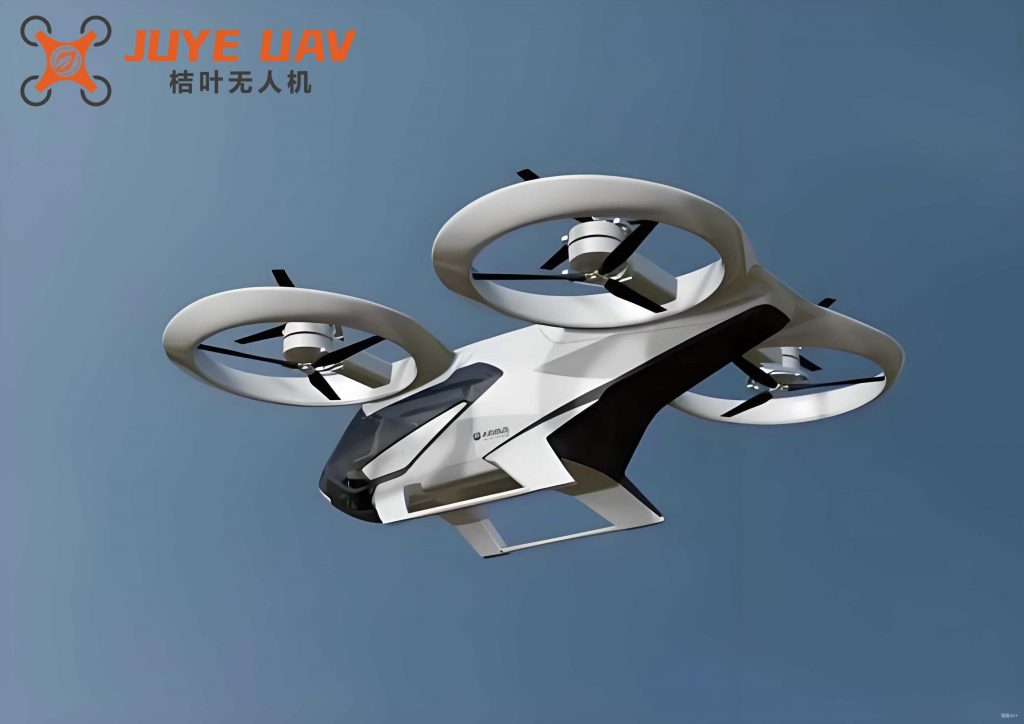
To model the complex wind field, we combine wind shear, discrete gusts, and Dryden turbulence. Wind shear is represented using a logarithmic model that varies with height, capturing the low-frequency characteristics of wind changes near the ground. The wind shear velocity \( V_{wq} \) is given by:
$$ V_{wq} = V’_{wq} \frac{\ln(h / Z_0)}{\ln(h’ / Z_0)} $$
where \( h \) is the flight height, \( h’ \) is a reference height (typically 6.096 m), \( V’_{wq} \) is the wind speed at \( h’ \), and \( Z_0 \) is the surface roughness (0.046 m for take-off and landing, and 0.61 m for other phases). Discrete gusts are modeled using a half-wavelength (1-cosine) function to simulate sudden wind changes:
$$ V_{wt} = \begin{cases}
0 & x < 0 \\
\frac{V_{wtm}}{2} \left(1 – \cos\left(\frac{\pi x}{d_m}\right)\right) & 0 \leq x \leq d_m \\
V_{wtm} & x > d_m
\end{cases} $$
Here, \( V_{wtm} \) is the peak gust velocity, \( d_m \) is the gust scale, and \( x \) is the distance from the gust center. By assuming the quadcopter moves at a constant velocity \( V_0 \), we transform this spatial domain model into the time domain using \( x = V_0 t \) and \( d_m = V_0 t_m \), where \( t_m \) is the time to reach the peak gust. For turbulence, we employ the Dryden model, which uses shaping filters to generate colored noise from white noise, representing high-frequency random wind components. The transfer functions for the turbulence velocities in three axes are:
$$ G_x(s) = \frac{K_x}{T_x s + 1}, \quad K_x = \sigma_x \sqrt{\frac{L_x}{\pi V}}, \quad T_x = \frac{L_x}{V} $$
$$ G_y(s) = \frac{K_y}{T_y s + 1}, \quad K_y = \sigma_y \sqrt{\frac{L_y}{\pi V}}, \quad T_y = \frac{2L_y}{3V} $$
$$ G_z(s) = \frac{K_z}{T_z s + 1}, \quad K_z = \sigma_z \sqrt{\frac{L_z}{\pi V}}, \quad T_z = \frac{2L_z}{3V} $$
where \( \sigma_x, \sigma_y, \sigma_z \) are turbulence intensities, \( L_x, L_y, L_z \) are turbulence scales, and \( V \) is the quadcopter’s velocity. The total wind disturbance \( V_w \) is the sum of these components:
$$ V_w = V_{wq} + V_{wt} + V_{wd} $$
The airspeed \( V_k \) of the quadcopter relative to the air is then \( V_k = V_e – V_w \), where \( V_e \) is the ground speed. This airspeed affects blade flapping and aerodynamic drag, which are critical for accurate motion characterization.
Blade flapping occurs due to the flexibility of propeller materials, leading to bending and oscillations that alter the thrust direction. This effect induces additional forces and moments on the quadcopter. The induced drag forces from blade flapping in the body frame are modeled as:
$$ F_{hxb} = -k V_{kxb}, \quad F_{hyb} = -k V_{kyb} $$
where \( k \) is the drag coefficient due to blade flapping, and \( V_{kxb}, V_{kyb} \) are the airspeed components in the body frame. The corresponding moments are:
$$ M_{hxb} = l F_{hyb}, \quad M_{hyb} = -l F_{hxb} $$
with \( l \) being the distance from the propeller rotation center to the quadcopter’s center of mass along the \( Z_b \)-axis. Aerodynamic drag forces and moments are calculated based on airspeed and are given by:
$$ F_{we} = -\frac{1}{2} \rho \begin{bmatrix} V_{kxe}^2 c_x S_x \text{sgn}(V_{kxe}) \\ V_{kye}^2 c_y S_y \text{sgn}(V_{kye}) \\ V_{kze}^2 c_z S_z \text{sgn}(V_{kze}) \end{bmatrix}, \quad M_{wb} = \frac{1}{2} \rho \begin{bmatrix} V_{kxe}^2 c_x d S_x \\ V_{kye}^2 c_y d S_y \\ V_{kze}^2 c_z d S_z \end{bmatrix} $$
where \( \rho \) is air density, \( c_x, c_y, c_z \) are drag coefficients, \( S_x, S_y, S_z \) are characteristic areas, and \( d \) is the arm length of the quadcopter.
The dynamic model of the quadcopter is derived using Newton-Euler equations. We define two coordinate systems: the body frame \( O_b X_b Y_b Z_b \) and the earth frame \( O_e X_e Y_e Z_e \). The rotation matrix from the earth frame to the body frame is:
$$ R_b^e = \begin{bmatrix}
\cos\vartheta \cos\psi & \cos\vartheta \sin\psi & -\sin\vartheta \\
\sin\vartheta \cos\psi \sin\gamma – \sin\psi \cos\gamma & \sin\vartheta \sin\psi \sin\gamma + \cos\psi \cos\gamma & \cos\vartheta \sin\gamma \\
\sin\vartheta \cos\psi \cos\gamma + \sin\psi \sin\gamma & \sin\vartheta \sin\psi \cos\gamma – \cos\psi \sin\gamma & \cos\vartheta \cos\gamma
\end{bmatrix} $$
where \( \vartheta \) is pitch, \( \psi \) is yaw, and \( \gamma \) is roll. The translational dynamics in the earth frame are:
$$ m \frac{dV_e}{dt} = F_{Te} + G + F_{he} + F_{we} $$
Here, \( m \) is mass, \( F_{Te} = R_e^b \sum_{i=1}^4 F_{Ti} \) is the total thrust from rotors (with \( F_{Ti} = [0, 0, -c_T \omega_i^2]^T \), where \( c_T \) is thrust coefficient and \( \omega_i \) is rotor speed), \( G = [0, 0, mg]^T \) is gravity, \( F_{he} = R_e^b F_{hb} \) is the blade flapping force, and \( F_{we} \) is aerodynamic drag. The rotational dynamics are:
$$ \begin{bmatrix} \dot{p} \\ \dot{q} \\ \dot{r} \end{bmatrix} = \begin{bmatrix}
\frac{U_2 + \frac{1}{2} \rho V_{kxe}^2 c_x d S_x – k l V_{kyb} – (J_z – J_y) q r}{J_x} \\
\frac{U_3 + \frac{1}{2} \rho V_{kye}^2 c_y d S_y + k l V_{kxb} – (J_x – J_z) p r}{J_y} \\
\frac{U_4 + \frac{1}{2} \rho V_{kze}^2 c_z d S_z – (J_y – J_x) p q}{J_z}
\end{bmatrix} $$
where \( p, q, r \) are angular rates, \( J_x, J_y, J_z \) are moments of inertia, and \( U_2, U_3, U_4 \) are control moments from rotor torques. The full dynamic model incorporates these equations to simulate quadcopter motion under complex wind conditions.
For simulation, we use parameters typical of a standard quadcopter, as shown in Table 1. The control system employs a cascade PID structure, with proportional control for position and attitude loops, and PID control for velocity and angular rate loops. Controller parameters are listed in Table 2.
| Parameter | Value | Parameter | Value |
|---|---|---|---|
| Mass \( m \) (kg) | 1.45 | Blade flapping coefficient \( k \) (N/(m/s)) | 0.1 |
| Arm length \( d \) (m) | 0.225 | Thrust coefficient \( c_T \) (N/(rad/s)^2) | 8.517e-6 |
| Moment of inertia \( J_x, J_y \) (kg·m²) | 0.041 | Torque coefficient \( c_Q \) (N/(rad/s)^2) | 2.026e-7 |
| Moment of inertia \( J_z \) (kg·m²) | 0.043 | Drag coefficients \( c_x, c_y, c_z \) | 0.23 |
| Air density \( \rho \) (kg/m³) | 1.29 | Characteristic areas \( S_x, S_y \) (m²) | 0.045 |
| Propeller distance \( l \) (m) | 0.065 | Characteristic area \( S_z \) (m²) | 0.18 |
| Control Loop | P Gain | Control Loop | P, I, D Gains |
|---|---|---|---|
| Pitch angle | 5 | Pitch rate | 1, 3, 0.06 |
| Roll angle | 5 | Roll rate | 1, 3, 0.06 |
| Yaw angle | 2 | Yaw rate | 10, 8, 0.2 |
| X position | 1 | X velocity | 12, 7, 2 |
| Y position | 1 | Y velocity | 12, 7, 2 |
| Z position | 1 | Z velocity | 100, 10, 0.1 |
We conducted numerical simulations for two scenarios: point hovering and trajectory tracking. In point hovering, the quadcopter aims to maintain a fixed position at 5 m height, with wind disturbances introduced after 10 s. The wind parameters include a reference wind shear speed of 5 m/s at 6.096 m, a discrete gust peak of 5 m/s reaching maximum in 3 s, and Dryden turbulence. We analyze three cases: only blade flapping, only aerodynamic drag, and both combined. The results show that wind shear and gusts cause low-frequency deviations, leading to constant pitch and roll angles, while turbulence adds high-frequency jitter. For instance, with both effects, position standard deviations reach up to 0.0241 m in X, 0.0508 m in Y, and 0.0011 m in Z, and attitude angles exhibit significant oscillations (e.g., pitch standard deviation of 0.4842°).
In trajectory tracking, the quadcopter follows a sinusoidal path: \( [X_{ec}, Y_{ec}, Z_{ec}] = [\sin(0.2094t), \sin(0.2094t), 5 + \sin(0.2094t)] \), with zero yaw command. Wind disturbances cause similar effects as in hovering, but with additional dynamic errors due to the changing commands. The position and attitude errors include both sinusoidal components from the trajectory and jitter from turbulence. This highlights the challenge of maintaining precision in complex wind environments for a quadcopter.
The simulations demonstrate that blade flapping and aerodynamic drag have comparable impacts on quadcopter motion. Wind shear and discrete gusts introduce low-frequency disturbances, resulting in steady-state offsets in attitude, while turbulence causes high-frequency vibrations. When all wind components are combined, the quadcopter experiences larger deviations and increased jitter, emphasizing the need for comprehensive modeling. For high-precision control systems, it is essential to account for wind shear, gusts, turbulence, blade flapping, and drag simultaneously. This approach ensures better performance and stability for quadcopters in real-world applications.
In conclusion, our analysis reveals that complex wind fields significantly affect the motion characteristics of quadcopters. By integrating detailed models of wind disturbances, blade flapping, and aerodynamic forces, we can better understand and mitigate these effects. Future work should focus on advanced control strategies, such as disturbance estimation and compensation, to enhance quadcopter resilience in diverse environments. This research provides practical insights for engineering robust quadcopter systems capable of operating reliably under challenging conditions.