
The evolution of modern warfare is increasingly defined by the proliferation of intelligent unmanned systems. As artificial intelligence converges with aerial combat theory, a profound revolution in weaponry is underway. Unmanned Aerial Vehicles (UAVs), integrated with advanced algorithms, demonstrate superior capabilities in comprehending the battlefield, planning routes, and executing tactical decisions. They have moved beyond traditional roles in reconnaissance and surveillance to become pivotal assets in precision strikes against land and maritime targets. Conflicts from Nagorno-Karabakh to Ukraine have starkly illustrated the transformative impact of UAVs and drone swarms, capable of overwhelming sophisticated air defenses and striking high-value assets with asymmetric efficiency. Consequently, the development of robust, multi-layered countermeasures, collectively termed anti-UAV systems, has emerged as a critical imperative for modern militaries. This analysis explores the operational applications of UAVs, examines the complete kill-chain of anti-UAV warfare, and details the key technological pillars—detection, deception, soft-kill, and hard-kill—that constitute an integrated defensive architecture.
Operational Applications of Modern UAVs and Swarms
Contemporary UAV systems are no longer single-role platforms but form the core of networked, intelligent clusters capable of executing complex, multi-domain missions. Their value stems from attributes like low cost, high scalability, significant autonomy, and formidable survivability.
| Mission Type | Core Capabilities | Operational Impact |
|---|---|---|
| Intelligence, Surveillance & Reconnaissance (ISR) & Communications Relay | Equipped with EO/IR sensors, SAR radar, and data links; long endurance. | Provides persistent, real-time situational awareness over vast maritime and land areas; fills coverage gaps between satellites and manned aircraft; acts as an aerial communication node to extend network range and resilience. |
| Strike and Assault | Armed with missiles, guided bombs, or loitering munitions; capable of swarm coordination. | Enables distributed, saturation attacks that saturate and defeat point-defense systems; can be integrated into kill-webs with manned platforms for coordinated strikes; offers a low-risk option for attacking heavily defended targets. |
| Electronic Warfare (EW) & Deception | Carries jamming payloads, signature decoys, or network infiltration tools. | Simulates attack profiles to trigger and expose enemy air defenses; conducts localized jamming against communications, navigation, or radar signals; disrupts command and control (C2) coherence within enemy formations. |
The mathematical formulation for a simple swarm task allocation, a cornerstone of their effectiveness, can be modeled as an optimization problem. Let a swarm of N UAVs be tasked with engaging M targets. Each UAV i has a capability vector C_i, and each target j has a requirement vector R_j and a value V_j. The objective is to find an assignment matrix X (where x_{ij} = 1 if UAV i is assigned to target j) that maximizes total effectiveness:
$$
\text{Maximize: } Z = \sum_{j=1}^{M} V_j \cdot f\left(\sum_{i=1}^{N} x_{ij} \cdot \text{Synergy}(\mathbf{C_i}, \mathbf{R_j})\right)
$$
$$
\text{Subject to: } \sum_{j=1}^{M} x_{ij} \leq 1 \quad \forall i, \quad \text{and} \quad \sum_{i=1}^{N} x_{ij} \geq \text{MinUAVs}(j) \quad \forall j
$$
Here, the function \(f(\cdot)\) represents the synergistic effect of combined UAV capabilities on a target, and \(\text{MinUAVs}(j)\) is the minimum number of UAVs required to engage target j effectively. Solving such problems dynamically is key to swarm efficacy.
The Integrated Anti-UAV Kill Chain: A Phased Approach
Effective anti-UAV defense requires a systematic approach that engages the threat throughout its operational timeline. A phased strategy, aligned with the UAV’s mission profile, is essential for a layered defense.
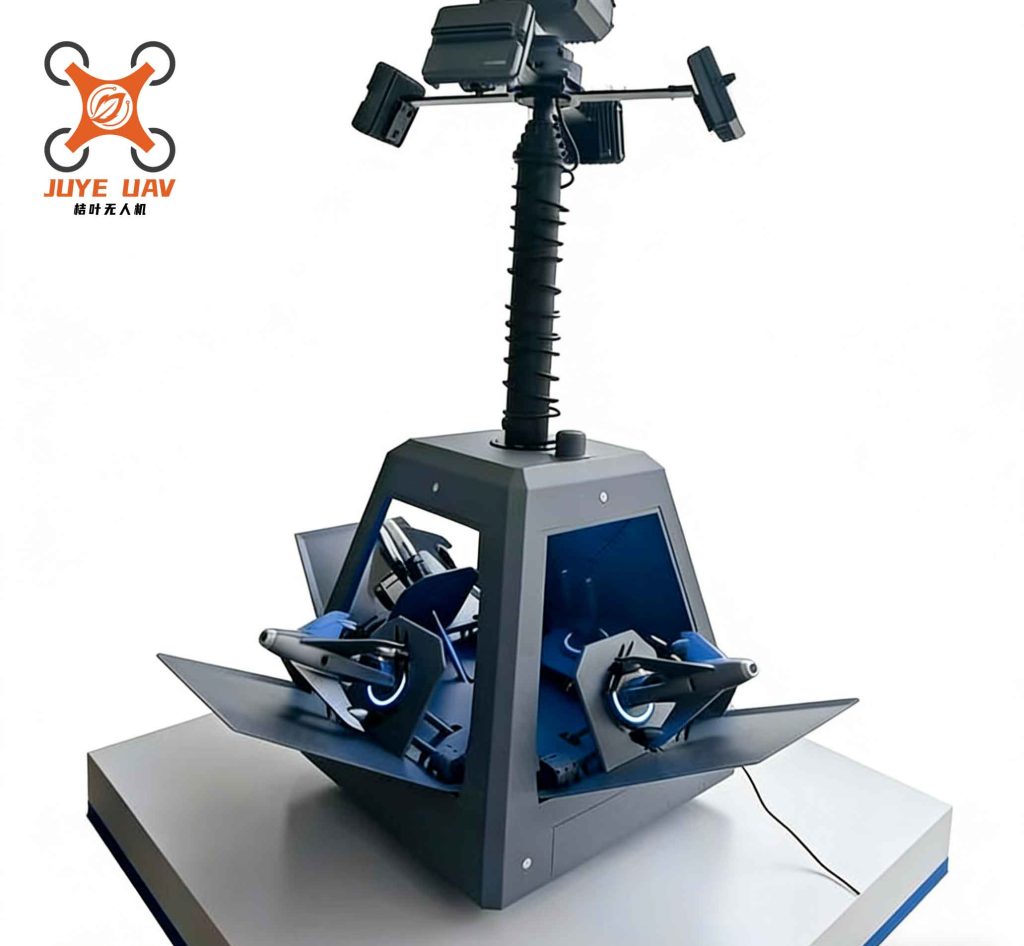
The overarching framework for anti-UAV warfare can be visualized as a continuous cycle of detection, decision, and engagement, incorporating all kinetic and non-kinetic effects. This holistic view is critical for coordinating the phased tactics described below.
| Engagement Phase | UAV Mission Stage | Primary Anti-UAV Objectives | Key Technologies / Methods |
|---|---|---|---|
| 1. Long-Range Detection & Early Warning | Launch, Cruise, Loitering | Early detection, classification, tracking, and intent identification of UAVs/swarms. | Radar (AESA, MIMO), RF Signal Intelligence (SIGINT), Electro-Optical/Infrared (EO/IR), Acoustic sensors, Satellite surveillance. |
| 2. Mid-Range Disruption & Control Denial | Approach, Pre-Attack Positioning | Disrupt C2 links, corrupt navigation, deceive sensors, and ideally seize control. | Radio Frequency (RF) Jamming, GPS/GNSS Spoofing & Jamming, Cyber Takeover, Deceptive EW. |
| 3. Short-Range Hard-Kill & Point Defense | Final Attack Run, Weapon Release | Physically destroy or incapacitate the UAV before it can inflict damage. | High-Energy Lasers (HEL), High-Power Microwave (HPM) systems, Kinetic Interceptors (missiles, guns), Net/Capture systems. |
| 4. Terminal Point & Area Protection | Terminal Engagement | Protect the specific high-value asset (HVA) through active and passive measures. | Active Protection Systems (APS), Smokescreens, Hardening, Camouflage, Decoys, Electronic Countermeasures (ECM). |
Pillar I: Detection and Tracking for Anti-UAV Operations
The foundation of any anti-UAV system is reliable detection. The “low, slow, and small” (LSS) signature of many UAVs presents a significant challenge, necessitating a fusion of heterogeneous sensors.
| Sensor Modality | Principle of Operation | Advantages | Limitations / Challenges |
|---|---|---|---|
| Radar (AESA/MIMO) | Emits RF waves and analyzes reflections. Advanced arrays can form multiple, agile beams. | Long range, all-weather, precise tracking, velocity data. Modern radars can detect small RCS targets. | Clutter interference (especially for low-flying drones), susceptibility to stealth materials, difficulty in classification. |
| RF Spectrum Sensing (SIGINT) | Passively listens for communication and telemetry signals between UAV and ground control station (GCS). | Passive (covert), long detection range, can identify specific drone models via RF fingerprinting, good for early warning. | Ineffective against pre-programmed/autonomous drones; requires database of signal signatures; crowded spectrum. |
| Electro-Optical / Infrared (EO/IR) | Uses cameras (visible light and thermal) to detect visual contrast or heat signatures. | Provides high-resolution imagery for positive identification (PID); passive; excellent for tracking. | Range limited by weather (fog, rain), line-of-sight required; thermal cameras can be fooled by ambient heat. |
| Acoustic Sensing | Uses microphone arrays to detect and localize the distinct acoustic signature of UAV propellers/engines. | Passive, effective in urban/complex terrain, low cost, can work in visual obscurants. | Very short range, highly degraded by background noise, limited bearing accuracy. |
Sensor fusion is paramount. The detection probability \(P_D\) of a fused system using n independent sensors can be modeled as:
$$
P_{D_{\text{fused}}} = 1 – \prod_{k=1}^{n} (1 – P_{D_k})
$$
where \(P_{D_k}\) is the detection probability of the k-th sensor. For example, if a radar has \(P_{D_1} = 0.7\) and an EO system has \(P_{D_2} = 0.6\) against the same target, the fused system has \(P_{D_{\text{fused}}} = 1 – (0.3 \times 0.4) = 0.88\). This mathematically demonstrates the robustness gained from a multi-layered anti-UAV sensor grid.
Pillar II: Deception and Soft-Kill Anti-UAV Techniques
Once detected, the goal is to neutralize the UAV’s mission without necessarily destroying it physically. These “soft-kill” methods target the information systems the UAV relies on.
1. Navigation Spoofing and Jamming: Global Navigation Satellite System (GNSS) signals like GPS are vulnerable. Spoofing involves broadcasting counterfeit GNSS signals that are stronger than the authentic ones, tricking the UAV’s receiver. A simplified model for required spoofing power \(P_{spoof}\) is:
$$
P_{spoof} \geq P_{legit} \cdot \text{SNR}_{margin} \cdot L_{path}
$$
where \(P_{legit}\) is the legitimate signal power at the target, \(\text{SNR}_{margin}\) is the desired signal-to-noise ratio advantage (e.g., 3 dB), and \(L_{path}\) is the path loss. Jamming simply overwhelms the receiver with noise.
2. Communication Link Jamming and Hijacking: This targets the C2 datalink, typically in the 2.4 GHz, 5.8 GHz, or specific military bands. Barrage jamming blocks the frequency, while more sophisticated protocols can inject forged commands. The jamming-to-signal ratio (J/S) required is a key metric:
$$
\frac{J}{S} = \frac{P_j G_j L_j R_t^2}{P_t G_t L_t R_j^2}
$$
Here, \(P\) is power, \(G\) is antenna gain, \(L\) is loss, \(R\) is range, and subscripts \(j\) and \(t\) denote jammer and transmitter (GCS) respectively. Achieving a sufficient J/S ratio is fundamental to effective RF-based anti-UAV disruption.
3. Cyber Takeover: This involves exploiting software vulnerabilities in the UAV’s firmware or communication protocol to infiltrate its system and either take control or install malware.
| Soft-Kill Technique | Mechanism | Intended Effect | Counter-Countermeasures |
|---|---|---|---|
| GNSS Spoofing | Transmits counterfeit positioning/timing data. | Diverts UAV to a false location or causes navigation failure. | Cryptographically secured signals (e.g., M-Code), inertial navigation system (INS) integration, GNSS direction-of-arrival checking. |
| GNSS Jamming | Emits high-power noise in GNSS bands. | Denies position/timing data, forcing UAV to rely on less accurate backup systems or abort mission. | Advanced filtering (null-steering antennas), multi-frequency GNSS receivers. |
| C2 Link Jamming | Overwhelms the control frequency with noise. | Forces UAV into a pre-programmed “lost-link” behavior (e.g., return-to-home, hover, land). | Frequency hopping spread spectrum (FHSS), low-probability-of-intercept (LPI) waveforms, directional antennas. |
| Protocol Hijacking | Exploits weak encryption or authentication to inject commands. | Seizes control of the UAV, allowing for capture or redirect. | Strong, certified encryption, multi-factor authentication for critical commands. |
Pillar III: Hard-Kill and Terminal Anti-UAV Defense
When soft-kill measures fail or are inappropriate, physical destruction or capture is required. This is the last line of anti-UAV defense, characterized by high speed and precision.
1. Directed Energy Weapons (DEWs):
- High-Energy Lasers (HEL): Focus coherent light energy on a spot, causing thermal ablation of the airframe or optics. The time-to-effect \(t_{kill}\) for a given laser power \(P_l\), spot size radius \(r\), and target material absorption/threshold can be approximated by an energy balance equation. A critical parameter is the irradiance \(I\) on target:
$$
I = \frac{P_l \cdot \eta_{atm}}{\pi r^2}
$$
where \(\eta_{atm}\) is atmospheric transmission efficiency. A high \(I\) must be maintained on the moving target long enough to deposit the required lethal energy. - High-Power Microwave (HPM): Emits a burst of broad-spectrum RF energy. This couples into the UAV’s electronic circuits, inducing high voltages that cause temporary upset or permanent burnout. HPM is inherently an area weapon effective against swarms.
2. Kinetic Effectors:
- Missiles & Advanced Projectiles: Range from small, agile missiles (e.g., miniature hit-to-kill) to gun systems firing programmable airburst munitions. The probability of kill \(P_{K}\) for a kinetic interceptor often depends on a guidance law’s ability to close the miss distance.
- Net Guns and Capture Drones: Deploy physical nets to entangle and capture the target UAV, useful in permissive environments where collateral damage must be avoided.
| Hard-Kill System | Engagement Range | Key Advantage | Key Limitation | Cost-per-Engagement |
|---|---|---|---|---|
| High-Energy Laser (HEL) | Short to Medium (1-5 km) | Very low cost per shot, speed-of-light engagement, scalable effects. | Line-of-sight required, degraded by weather (fog, rain, dust), high power demand. | Very Low (cost of electricity) |
| High-Power Microwave (HPM) | Short Range (0.5-1 km) | Wide beam, effective against swarms, can engage non-line-of-sight targets. | Short range, potential for fratricide of friendly electronics, large system size. | Low |
| Missile / Interceptor | Medium to Long (2-10+ km) | High single-shot probability of kill (Pk), proven technology, all-weather. | High cost per engagement, limited magazine depth against swarms. | Very High |
| Electronically-Set Artillery | Short to Medium (1-4 km) | High rate of fire, good for area defense, lower cost than missiles. | Lower Pk per round, significant collateral damage risk, ammunition logistics. | Medium |
The selection of hard-kill systems for an anti-UAV architecture is a trade-off analysis, often framed as an optimization to maximize overall defensive effectiveness \(E\) under budget \(B\) and weight/power constraints \(W\):
$$
\text{Maximize } E = \sum_{k} P_{D_k} \cdot P_{Engage_k} \cdot P_{K_k}
$$
$$
\text{Subject to: } \sum_{k} \text{Cost}_k \leq B, \quad \sum_{k} \text{Weight}_k \leq W
$$
where the index \(k\) runs over all detection and engagement systems in the layered defense.
Conclusion: Toward an Integrated Anti-UAV Defense Ecosystem
The future battlefield will be increasingly contested by intelligent, collaborative unmanned systems. No single anti-UAV technology provides a silver bullet. The lesson from recent conflicts and technological analysis is clear: success depends on a system-of-systems approach. A resilient anti-UAV defense must integrate disparate sensors into a common operating picture, leverage AI for rapid threat assessment and weapon pairing, and seamlessly orchestrate a sequence of effects from long-range detection through soft-kill disruption to final hard-kill interception. This requires not only technological advancement in directed energy, advanced radar, and cyber-electronic warfare but also the development of agile command and control (C2) structures and adaptive tactics. As UAV swarms become more autonomous and resilient, anti-UAV strategies must evolve in parallel, focusing on defeating the swarm’s collective intelligence and coordination, not just its individual platforms. The nation that masters this integrated, intelligent anti-UAV warfare paradigm will gain a decisive advantage in the high-stakes domain of modern and future conflict.