
As a researcher deeply involved in the field of precision agriculture, I have witnessed the transformative impact of agricultural UAVs, commonly known as crop protection drones, on modern farming practices. These unmanned aerial vehicles have revolutionized pesticide application, shifting from labor-intensive manual methods to automated, efficient, and safer operations. The adoption of agricultural UAVs aligns with global trends toward agricultural mechanization, intelligence, and sustainability. In this article, I will explore the current landscape, identify key challenges, propose solutions, and envision the future of agricultural UAVs, emphasizing the keyword “agricultural UAV” throughout to highlight its centrality in this discourse.
The traditional methods of pesticide application, such as backpack sprayers or tractor-mounted systems, often involve direct human exposure to chemicals, leading to health risks like poisoning or allergies. Moreover, these methods are prone to inefficiencies like uneven coverage, missed spots, or over-spraying, which can damage crops. In contrast, agricultural UAVs offer a paradigm shift: they enable remote operation, reducing human contact with pesticides; they provide precise, uniform spraying through advanced path planning; and their rotors generate downward airflow that enhances pesticide adhesion to plant surfaces, including leaves and roots. This technological leap not only improves safety but also boosts productivity and environmental stewardship. The integration of autonomous obstacle avoidance and terrain-following capabilities further allows agricultural UAVs to operate in complex terrains with obstacles like trees or power lines, outperforming larger manned aircraft in such scenarios.
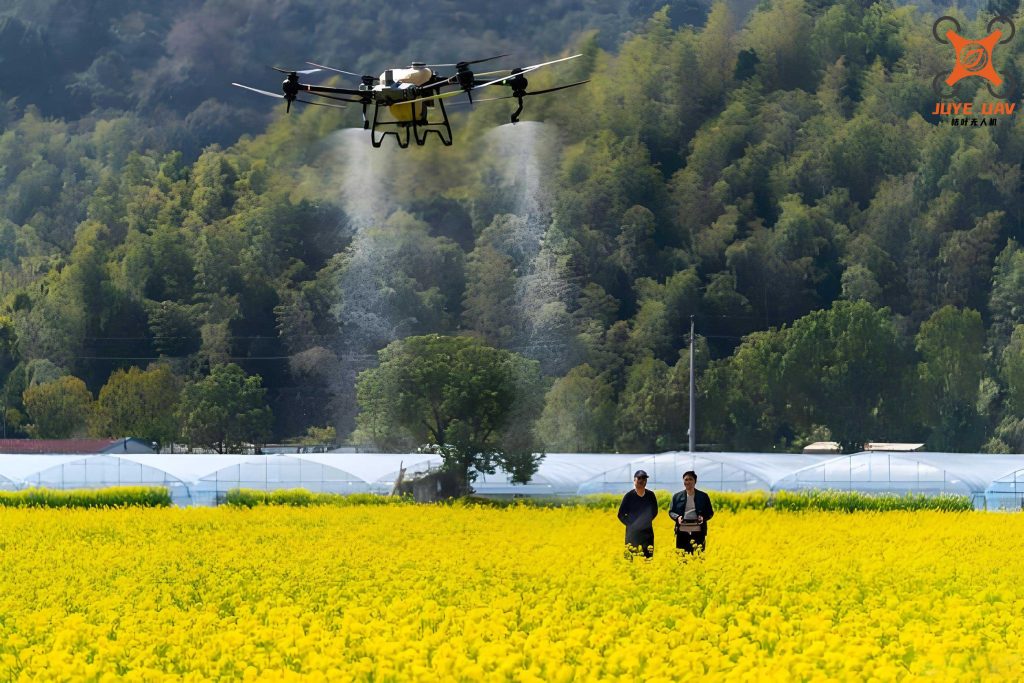
Globally, the development of agricultural UAVs has been uneven, with Japan leading the way since the 1980s. The first agricultural UAV, the R50, was introduced in Japan, and today, the country boasts over 2,700 registered units and more than 14,000 operators, reflecting mature technology and widespread adoption. In North America, particularly the United States, regulatory concerns over pesticide drift and cost-effectiveness have limited the use of agricultural UAVs for spraying, but they are extensively employed for monitoring and data collection—for instance, NASA uses them to survey large coffee plantations. Europe has seen rapid growth, with Germany reporting sales of 400,000 drones in 2017 and projections nearing 1 million by 2020, while Spain explores applications in water resource management. Other regions like Russia, Israel, and South Korea are also actively developing agricultural UAVs. According to the Association for Unmanned Vehicle Systems International (AUVSI), agriculture is poised to dominate drone usage, with an estimated 80% of future applications in this sector.
In China, the journey of agricultural UAVs began later but accelerated rapidly due to policy support and research initiatives. Starting with the “863 Program” in 2008, which focused on low-altitude spraying technology, China has seen a surge in manufacturers, reaching over 300 by 2017. Companies like DJI and XAG have become household names, driving innovation and market penetration. However, compared to global leaders, China’s focus has been more on spraying than on monitoring or mapping, indicating room for growth in diversified applications. The table below summarizes the global development status of agricultural UAVs, highlighting key regions and their primary uses.
| Region/Country | Development Status | Primary Applications | Key Challenges |
|---|---|---|---|
| Japan | Mature, with high adoption rates | Pesticide spraying, precision agriculture | Aging farmer population, regulatory updates |
| United States | Limited for spraying, strong in monitoring | Crop monitoring, data collection | Regulatory restrictions on pesticide drift |
| Europe (e.g., Germany, Spain) | Rapid growth in sales and applications | Spraying, water management, mapping | Integration with EU agricultural policies |
| China | Fast-growing, with many manufacturers | Pesticide spraying, initial forays into monitoring | Lack of standardized regulations, training gaps |
| Other Regions (e.g., Israel, South Korea) | Active development and experimentation | Spraying, monitoring, research | Technological adaptation to local conditions |
Through field investigations and surveys, I have analyzed the application status of agricultural UAVs in various farming communities. For instance, in a regional study, it was observed that while the adoption rate is increasing, with 120 agricultural UAVs purchased in one area alone, only a small fraction of farmers owned them personally. Most relied on shared or rental services, leading to shortages during peak spraying seasons. The concentrated usage periods, such as during spring ploughing, often result in high demand, causing logistical challenges like limited availability and rushed operations. Additionally, complex terrains with obstacles like tree belts or power lines sometimes lead to minor issues such as missed spots or crop damage due to the autonomous path adjustments of agricultural UAVs.
Despite the advantages, several persistent issues hinder the widespread and effective use of agricultural UAVs. Based on my observations and interactions with farmers, I have categorized these problems into technical, operational, and regulatory aspects. Below is a detailed table outlining the key issues, along with their impacts on agricultural practices.
| Category | Specific Issue | Impact on Agriculture | Frequency in Field Use |
|---|---|---|---|
| Technical Issues | Limited payload capacity (e.g., up to 20L) | Reduces efficiency for large farms, requires frequent refills | High |
| Short battery life and fast power consumption | Disrupts continuous operations, increases downtime for charging | Very High | |
| Operational Issues | Inaccurate field mapping and positioning | Causes uneven spraying, missed areas, or over-spraying | Moderate |
| Lack of proper training for operators | Leads to improper use, safety risks, and reduced effectiveness | High | |
| Pesticide drift due to fine droplet size | Pollutes surrounding environment, reduces targeting accuracy | Moderate to High | |
| Regulatory Issues | Absence of standardized national regulations | Creates inconsistency in operations, hinders large-scale adoption | High |
| Maintenance Challenges | Complex repairs and limited service points | Increases downtime, reduces farmer confidence in technology | Moderate |
To elaborate on these issues, the limited payload capacity of agricultural UAVs is a significant bottleneck. For example, a typical agricultural UAV can carry only 20 liters of pesticide, which is insufficient for large-scale farms compared to manned aircraft that can handle hundreds of liters. This necessitates multiple trips, increasing operational time and cost. The battery life problem is equally critical; most agricultural UAVs rely on lithium-ion batteries that provide energy for only about 1 hectare per charge. Farmers often have to carry generators to recharge batteries in the field, which is cumbersome and reduces overall efficiency. Mathematically, the operational time \( T \) of an agricultural UAV can be expressed as:
$$ T = \frac{C \times E}{P} $$
where \( C \) is the battery capacity (in ampere-hours), \( E \) is the energy efficiency (in hectares per kilowatt-hour), and \( P \) is the power consumption rate (in kilowatts). Current batteries yield low \( T \) values, highlighting the need for advancements in energy storage.
Operational issues stem from inadequate training and poor infrastructure. Many operators receive only brief tutorials from salespoints, leading to mishandling such as incorrect pesticide mixing or improper flight path settings. This not only risks crop health but also compromises safety. Moreover, the fine droplets produced by agricultural UAVs, while enhancing coverage, are susceptible to wind drift. The drift distance \( D \) can be modeled using the formula:
$$ D = v \times t \times \sin(\theta) $$
where \( v \) is the wind speed, \( t \) is the droplet settling time, and \( \theta \) is the angle of release. Even light winds can cause significant drift, contaminating non-target areas. Regulatory gaps exacerbate these problems, as the lack of uniform standards for agricultural UAV operations results in varying local rules, confusing farmers and slowing adoption.
Addressing these challenges requires a multifaceted approach involving technology innovation, policy frameworks, and farmer education. As a proponent of sustainable agriculture, I propose the following countermeasures to enhance the effectiveness and adoption of agricultural UAVs.
First, training and support systems must be strengthened. Agricultural UAV manufacturers and distributors should organize regular training sessions during off-peak seasons, covering topics like safe operation, maintenance basics, and optimal spraying techniques. These can be delivered through in-person workshops or digital platforms like online courses and live streams. Additionally, user manuals should be comprehensive and accessible, with clear troubleshooting guides. Establishing more service centers in rural areas will enable quick repairs, minimizing downtime. Farmers should be empowered to perform minor fixes, possibly through remote guidance via IoT-enabled devices.
Second, technological improvements are crucial. Research institutions and companies must focus on enhancing battery technology to extend the flight time of agricultural UAVs. Innovations such as wireless charging stations using magnetic resonator coupling could allow continuous operation without manual battery swaps. The efficiency of wireless power transfer can be described by the equation:
$$ \eta = \frac{P_{\text{received}}}{P_{\text{transmitted}}} = \frac{k^2 Q_1 Q_2}{(1 + k^2 Q_1 Q_2)} $$
where \( \eta \) is the efficiency, \( k \) is the coupling coefficient, and \( Q_1 \) and \( Q_2 \) are the quality factors of the transmitter and receiver coils. Implementing such systems in fields could revolutionize the续航 of agricultural UAVs. Furthermore, pesticide formulations should be optimized—for instance, by pre-mixing adjuvants into pesticides to simplify preparation and reduce human exposure. This aligns with the trend toward “smart chemicals” tailored for agricultural UAV applications.
Third, regulatory bodies need to develop national standards for agricultural UAV operations, including certification for operators, safety protocols, and environmental guidelines. This will ensure consistency and build trust among farmers. Collaboration between governments, industry players, and academia can accelerate this process. The table below summarizes the proposed countermeasures aligned with the identified issues.
| Issue Category | Proposed Countermeasure | Expected Outcome | Implementation Timeline |
|---|---|---|---|
| Technical Issues | Develop high-capacity batteries and wireless charging | Increased operational time, reduced downtime | Medium-term (2-5 years) |
| Operational Issues | Enhance training programs and improve user manuals | Better operator skills, fewer errors | Short-term (1-2 years) |
| Pesticide Drift | Optimize nozzle designs and droplet size control | Reduced environmental contamination | Short-term (1-3 years) |
| Regulatory Issues | Establish national standards and certification systems | Uniform practices, faster adoption | Long-term (3-5 years) |
| Maintenance Challenges | Expand service networks and promote modular designs | Quick repairs, higher farmer satisfaction | Medium-term (2-4 years) |
Looking ahead, the future of agricultural UAVs is promising, driven by advancements in artificial intelligence, IoT, and robotics. In my view, several trends will shape the next generation of agricultural UAVs. First, intelligent recognition systems will enable real-time adaptation during spraying. For example, agricultural UAVs equipped with cameras and sensors can identify crop height, density, and health, automatically adjusting pesticide dosage to avoid over-spraying or under-spraying. This can be modeled using machine learning algorithms where the spray rate \( S \) is a function of crop parameters:
$$ S = f(H, D, H_{\text{index}}) $$
where \( H \) is crop height, \( D \) is density, and \( H_{\text{index}} \) is a health index derived from spectral data. Such precision will conserve resources and improve efficacy.
Second, the integration of IoT will facilitate remote monitoring and control. By setting up base stations in agricultural regions, farmers can operate agricultural UAVs from a distance, collecting field data and executing spraying tasks over wide areas. This will enhance convenience and allow for centralized management of multiple agricultural UAVs. Third, collaborative swarming of agricultural UAVs will become feasible, where fleets work together to cover large fields simultaneously. This approach can increase coverage and ensure thorough spraying, especially on the undersides of leaves. The coordination can be optimized using algorithms for path planning, minimizing overlaps and gaps.
Fourth, cloud-based platforms will emerge to store and share field data. Currently, agricultural UAVs record plot information locally, but cloud integration would enable farmers to access historical data, share insights, and download pre-mapped fields for efficient operations. This will foster a connected ecosystem for precision agriculture. Lastly, cost reduction through subsidies and economies of scale will drive broader adoption. As governments recognize the benefits of agricultural UAVs, incorporating them into subsidy programs will make them more accessible to smallholder farmers, accelerating the transition to smart farming.
In conclusion, agricultural UAVs represent a cornerstone of modern agriculture, offering solutions to longstanding challenges in pesticide application. From my perspective, the journey from novelty to necessity has been rapid, but hurdles remain in terms of technology, operations, and regulation. By addressing these through collaborative efforts—spanning research, policy, and education—we can unlock the full potential of agricultural UAVs. The future will likely see these devices evolving beyond spraying to encompass holistic farm management, including monitoring, mapping, and even planting. As the keyword “agricultural UAV” becomes synonymous with innovation in farming, its continued development will play a pivotal role in achieving global food security and sustainable agricultural practices. The path forward requires persistence and creativity, but the rewards—increased efficiency, reduced environmental impact, and improved farmer livelihoods—are well worth the effort.