
In the context of digital agriculture, I have explored the application of crop spraying drones for weed management in wheat fields, focusing on their performance compared to traditional ground-based equipment. This study was conducted under standardized conditions to minimize environmental variability, emphasizing the role of spraying UAVs in precision farming. The primary objective was to evaluate whether low-volume, high-atomization spraying UAVs could achieve weed control efficacy comparable to conventional sprayers, using a common herbicide dosage. Through rigorous field trials and data analysis, I aimed to provide empirical evidence supporting the integration of crop spraying drones into digital wheat cultivation systems.
The experimental site was characterized by heavy clay soil with uniform fertility, managed digitally to ensure consistent planting and fertilization. Wheat (variety not specified) was sown with a row spacing of 25 cm and a seeding rate of 180 kg/ha, following a phased fertilization strategy: base fertilizer application included diammonium phosphate at 225 kg/ha and urea at 225 kg/ha, with subsequent top-dressings of urea at 150 kg/ha, 225 kg/ha, and 150 kg/ha during tillering, green-up, and flag leaf stages, respectively. Soil parameters, such as pH 7.2, organic matter 2.8%, and nutrient levels, were monitored to maintain homogeneity. This digital management facilitated precise comparisons between the crop spraying drone and a self-propelled boom sprayer, both applying 8% clodinafop-propargyl EW at 1200 mL/ha during the 3–5 leaf stage of hard grass weeds. Meteorological conditions during application included an average temperature of 7.2°C, relative humidity of 77%, and wind speed of 2 m/s, with no rainfall, ensuring optimal operation for both spraying UAV and ground equipment.
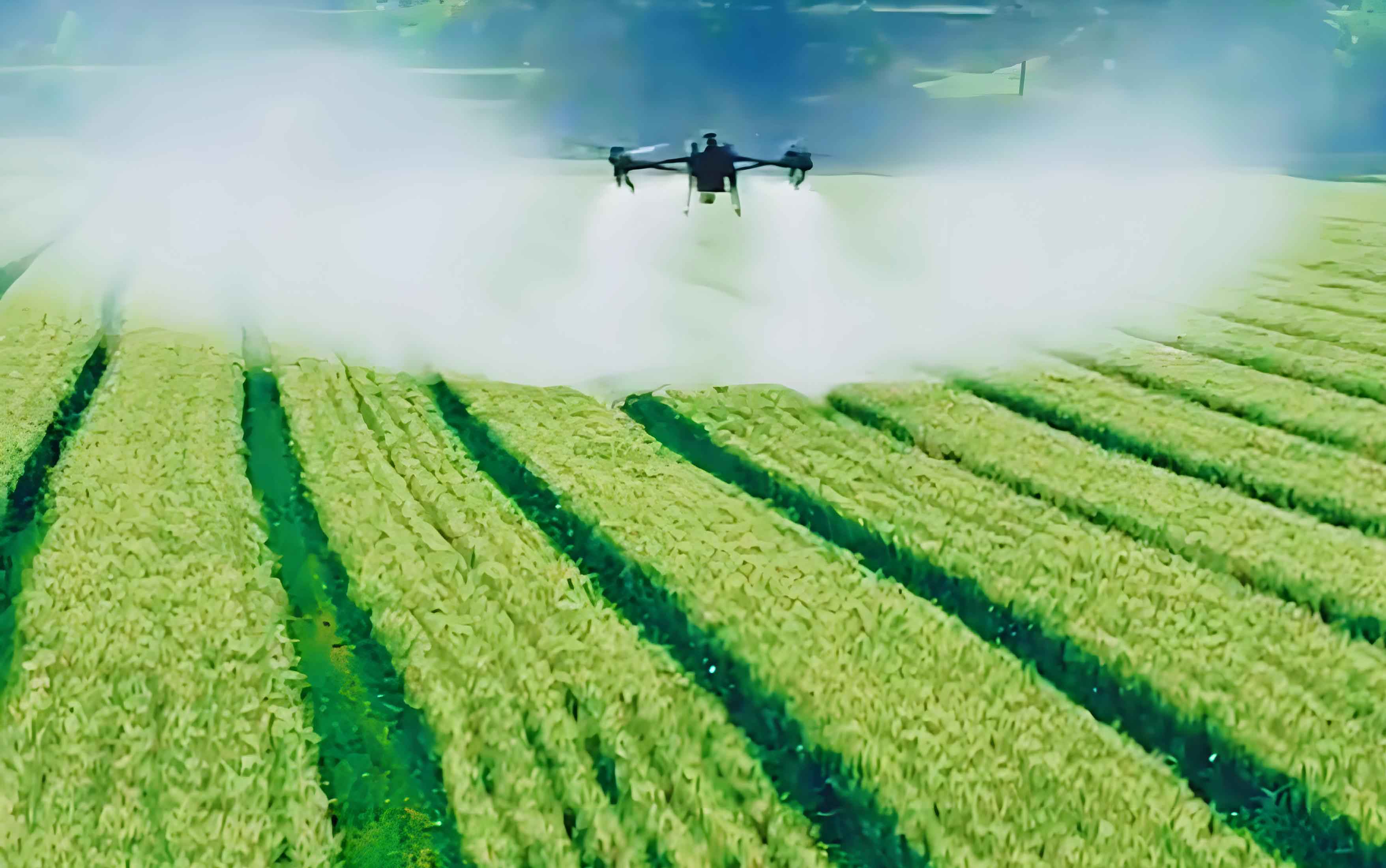
To assess the efficacy of the crop spraying drone, I designed a comparative experiment with three treatments: one using a spraying UAV (model analogous to the Jifei P20), another using a self-propelled boom sprayer (model analogous to the 3WYTZ1000-21), and a清水对照区 with no herbicide application. Each treatment covered an area of 1 ha for the herbicide applications and 667 m² for the control, with fixed survey points to monitor weed populations and crop safety. The spraying UAV operated with a spray width of 3 m, flight height of 2 m, speed of 7 m/s, application volume of 15 L/ha, and droplet size of 110 μm, representing low-volume, high-atomization technology. In contrast, the boom sprayer used a conventional application volume of 450 L/ha, typical of ground-based methods. This setup allowed me to isolate the effects of the application technology while keeping herbicide dosage constant, highlighting the potential of spraying UAVs in digital agriculture.
Data collection involved safety assessments of wheat plants and weed control efficacy measurements. For weed control, I calculated corrected plant control efficacy and fresh weight control efficacy using standardized formulas. The corrected plant control efficacy accounts for natural weed growth in the control area and is given by:
$$ \text{Corrected Plant Control Efficacy (\%)} = \left(1 – \frac{N_t \times N_{c0}}{N_{t0} \times N_c}\right) \times 100 $$
where \(N_t\) is the weed count in the treatment after application, \(N_{t0}\) is the weed count in the treatment before application, \(N_c\) is the weed count in the control after application, and \(N_{c0}\) is the weed count in the control before application. Similarly, the fresh weight control efficacy is computed as:
$$ \text{Fresh Weight Control Efficacy (\%)} = \left(1 – \frac{W_t}{W_c}\right) \times 100 $$
where \(W_t\) is the fresh weight of weeds in the treatment and \(W_c\) is the fresh weight in the control. These formulas ensure accurate evaluation of the spraying UAV’s performance by normalizing for environmental factors. Statistical analysis was performed using Duncan’s multiple range test at significance levels of 0.05 and 0.01, with data processed in Excel and DPS software to confirm the reliability of results, despite the absence of replicates in the experimental design.
The results demonstrated that both the crop spraying drone and the boom sprayer provided effective weed control without causing phytotoxicity to wheat. Observations over 30 days post-application showed no abnormalities in leaf color, tillering, or stem development, indicating the safety of the herbicide at the recommended dose. This aligns with the advantages of spraying UAVs, which can achieve precise droplet deposition even at low volumes, minimizing crop stress. The weed control data, summarized in Table 1, reveal that the corrected plant control efficacy for hard grass exceeded 89% for both equipment types at 30 days, with no significant differences (P > 0.05). Similarly, the fresh weight control efficacy reached over 98%, underscoring the comprehensive suppression of weed growth by the crop spraying drone.
| Spraying Equipment | Pre-application Weed Count | Weed Count at 15 Days | Corrected Plant Control Efficacy (%) | Weed Count at 30 Days | Corrected Plant Control Efficacy (%) | Fresh Weight (g) | Fresh Weight Control Efficacy (%) |
|---|---|---|---|---|---|---|---|
| Crop Spraying Drone | 73.00 | 54.00 | 28.51 aA | 8.00 | 89.96 aA | 1.06 | 98.89 aA |
| Boom Sprayer | 73.33 | 56.00 | 26.20 aA | 7.67 | 90.42 aA | 0.95 | 99.01 aA |
| Control | 76.67 | 79.33 | — | 83.67 | — | 95.50 | — |
Further analysis of the data highlights the temporal dynamics of weed control. At 15 days post-application, the corrected plant control efficacy was lower, around 26–29%, due to the slow translocation of the herbicide in weeds at the 3–5 leaf stage. However, by 30 days, the efficacy improved significantly, as the herbicide inhibited acetyl-CoA carboxylase, disrupting fatty acid synthesis in hard grass. The fresh weight data corroborate this, showing near-complete growth inhibition. This performance of the spraying UAV can be attributed to its high atomization and uniform droplet distribution, which compensates for the lower application volume. In digital agriculture, such precision is crucial for optimizing resource use, and the crop spraying drone exemplifies this by delivering comparable results to traditional methods with reduced inputs.
To generalize the findings, I considered the operational parameters of the spraying UAV and their impact on efficacy. The relationship between droplet size, coverage, and control efficacy can be modeled using a simplified equation for deposition efficiency:
$$ E_d = k \times \frac{V_d \times A}{D} $$
where \(E_d\) is the deposition efficiency, \(V_d\) is the droplet volume, \(A\) is the atomization factor, \(D\) is the drift potential, and \(k\) is a constant specific to the spraying UAV design. For the crop spraying drone in this study, the small droplet size (110 μm) and low flight height enhanced \(E_d\), leading to effective herbicide uptake by weeds. This contrasts with the boom sprayer, where higher water volume might reduce drift but increase runoff. The statistical equivalence in efficacy (P > 0.05) suggests that the spraying UAV’s low-volume approach is viable, supporting its adoption in large-scale wheat production systems.
In discussing the implications, I emphasize that the crop spraying drone not only matches traditional equipment in weed control but also offers additional benefits in digital farming. For instance, the ability to integrate with GPS and data platforms allows for variable-rate applications based on real-time field maps. This aligns with the broader trend of precision agriculture, where spraying UAVs contribute to sustainable practices by minimizing chemical usage and environmental impact. The results from this study indicate that with proper calibration, a spraying UAV can achieve over 98% fresh weight control efficacy, similar to ground-based sprayers, while reducing operational time and labor costs. Future research should explore the synergy between crop spraying drones and other digital tools, such as remote sensing for weed mapping, to further enhance efficacy in diverse agro-ecological conditions.
In conclusion, my analysis confirms that crop spraying drones are effective tools for weed control in wheat fields, performing on par with conventional boom sprayers in terms of safety and efficacy. The use of a spraying UAV in this digital agriculture framework demonstrates its potential for scalable, precision applications, with key advantages in efficiency and resource optimization. As the adoption of spraying UAVs grows, their role in integrated weed management will likely expand, driven by advancements in automation and data analytics. This study provides a foundation for further innovation, underscoring the value of crop spraying drones in modern wheat cultivation systems.