
As an observer and analyst in the field of aviation law and regulation, I have witnessed the rapid proliferation of civilian drones and the subsequent challenges in managing their operations. The introduction of real-name registration systems for civilian drones has become a global trend, aimed at enhancing accountability and safety. However, upon closer examination, I find that the nature of this registration system is ambiguous, its legal status unclear, and its practical implementation fraught with issues. In this article, I will delve into the utility, practice, and legal underpinnings of civilian drone real-name registration, offering insights into its necessity and potential improvements. Throughout, I will emphasize the critical role of civilian drones in modern society and the need for robust regulatory frameworks.
The concept of real-name registration for civilian drones stems from the need to address incidents such as airspace violations, privacy infringements, and safety hazards. Countries like the United States, the European Union, and Japan have adopted variations of this system, typically requiring registration for drones above a certain weight threshold. In my view, this approach seeks to balance innovation with public safety, but it must be theoretically justified and practically effective. I will explore this by analyzing the utility of registration, its real-world applications, and its legal nature, using tables and formulas to summarize key points. For instance, the utility of registration can be modeled as a function of factors like traceability and compliance. Consider the following formula representing the overall safety benefit $B$ from registering civilian drones:
$$ B = \alpha \cdot T + \beta \cdot C – \gamma \cdot C_r $$
where $T$ denotes traceability (ability to identify operators), $C$ represents compliance with regulations, $C_r$ is the cost of registration, and $\alpha, \beta, \gamma$ are weighting coefficients. This highlights how registration aims to maximize $B$ by increasing $T$ and $C$ while minimizing $C_r$.
One of the primary utilities of real-name registration for civilian drones is to determine liability in cases of accidents or infringements. Unlike traditional manned aircraft, which are often operated by organizations, civilian drones are frequently owned by individuals, making it difficult to attribute responsibility. Registration provides a mechanism to link a drone to its owner or operator, thereby facilitating legal recourse. For example, in the event of a collision or privacy breach, authorities can use registration data to identify the responsible party. This is crucial for maintaining public trust and ensuring that victims have a means of redress. Moreover, registration acts as a deterrent, as users are more likely to follow rules when they know they can be held accountable. I believe this aspect is fundamental to the registration system’s rationale, especially as civilian drones become more integrated into daily life.
Another key utility is enhanced regulatory oversight and improved safety. By mandating registration, authorities can monitor the population of civilian drones, track their usage patterns, and implement targeted safety measures. This is particularly important given the diverse applications of civilian drones, from delivery services to aerial photography. Registration data can inform risk assessments and help prioritize enforcement efforts. For instance, if a certain model of civilian drones is frequently involved in incidents, regulators can issue specific guidelines or restrictions. To illustrate this, I have compiled a table comparing the registration requirements for civilian drones in various jurisdictions, emphasizing how different approaches impact safety outcomes.
| Jurisdiction | Registration Threshold | Key Requirements | Safety Impact |
|---|---|---|---|
| United States | ≥250g | Online registration, visible ID number | High traceability, reduced incidents |
| European Union | All drones (with exceptions) | Operator registration, geo-awareness | Improved compliance, airspace safety |
| Japan | All drones for commercial use | Mandatory registration, penalties for non-compliance | Enhanced accountability, terrorism prevention |
| China | ≥250g | Real-name registration, nationality registration | Mixed results due to implementation gaps |
This table shows that while registration thresholds vary, the common goal is to boost safety through better oversight of civilian drones. However, the effectiveness depends on implementation, which leads me to the practical aspects.
In practice, the real-name registration system for civilian drones faces several challenges. Based on my analysis, I have identified three main issues: imperfect procedures, incomplete coverage of registrants, and unclear functional nature. First, the registration process often lacks robust verification mechanisms. For example, in some systems, drone serial numbers are not uniformly formatted, making it difficult to validate entries. This undermines the goal of accurate traceability, as false or duplicate registrations can occur. I estimate that this reduces the utility function $B$ by increasing $C_r$ without corresponding gains in $T$. Second, the scope of registrants is limited. Typically, only owners are required to register, but users—who may be different from owners—are not always included. This creates a gap in accountability, especially when civilian drones are leased or borrowed. Third, the legal nature of registration is ambiguous. It is neither a classic administrative license nor a confirmation of rights, but rather a hybrid form that I term “quasi-administrative registration.” This ambiguity leads to confusion in enforcement and legal disputes, such as in cases of ownership transfer without registration updates.
To elaborate on the practical shortcomings, consider the formula for registration effectiveness $E$:
$$ E = \frac{V \cdot A}{D} $$
where $V$ is verification accuracy, $A$ is the coverage of registrants (including users and dealers), and $D$ is the complexity of procedures. From reports, $V$ is low due to poor serial number validation, $A$ is limited as dealers and users are often excluded, and $D$ is high because of redundant requirements like simultaneous nationality registration. Thus, $E$ remains suboptimal for many civilian drones systems.
The nature of real-name registration for civilian drones warrants deeper analysis. In my view, it is essential to distinguish it from other types of registration, such as nationality registration and rights registration. Nationality registration, mandated by international law, confers a drone with state affiliation and imposes regulatory duties on the flag state. For civilian drones, this is often integrated with real-name registration, but the overlap can be redundant. For instance, in China, both nationality and real-name registration are required for drones over 250g, doubling the bureaucratic burden without clear added value. Rights registration, on the other hand, pertains to property claims, like ownership or mortgages. While valuable for high-value assets, it may be unnecessary for small civilian drones. I argue that real-name registration should be streamlined as a purely administrative tool for oversight, separate from these other functions. This can be expressed through a set relationship: let $R_n$ be nationality registration, $R_r$ be rights registration, and $R_s$ be real-name registration. For civilian drones, the ideal is:
$$ R_s \subset (R_n \cup R_r)^c $$
meaning real-name registration should complement rather than duplicate existing systems.
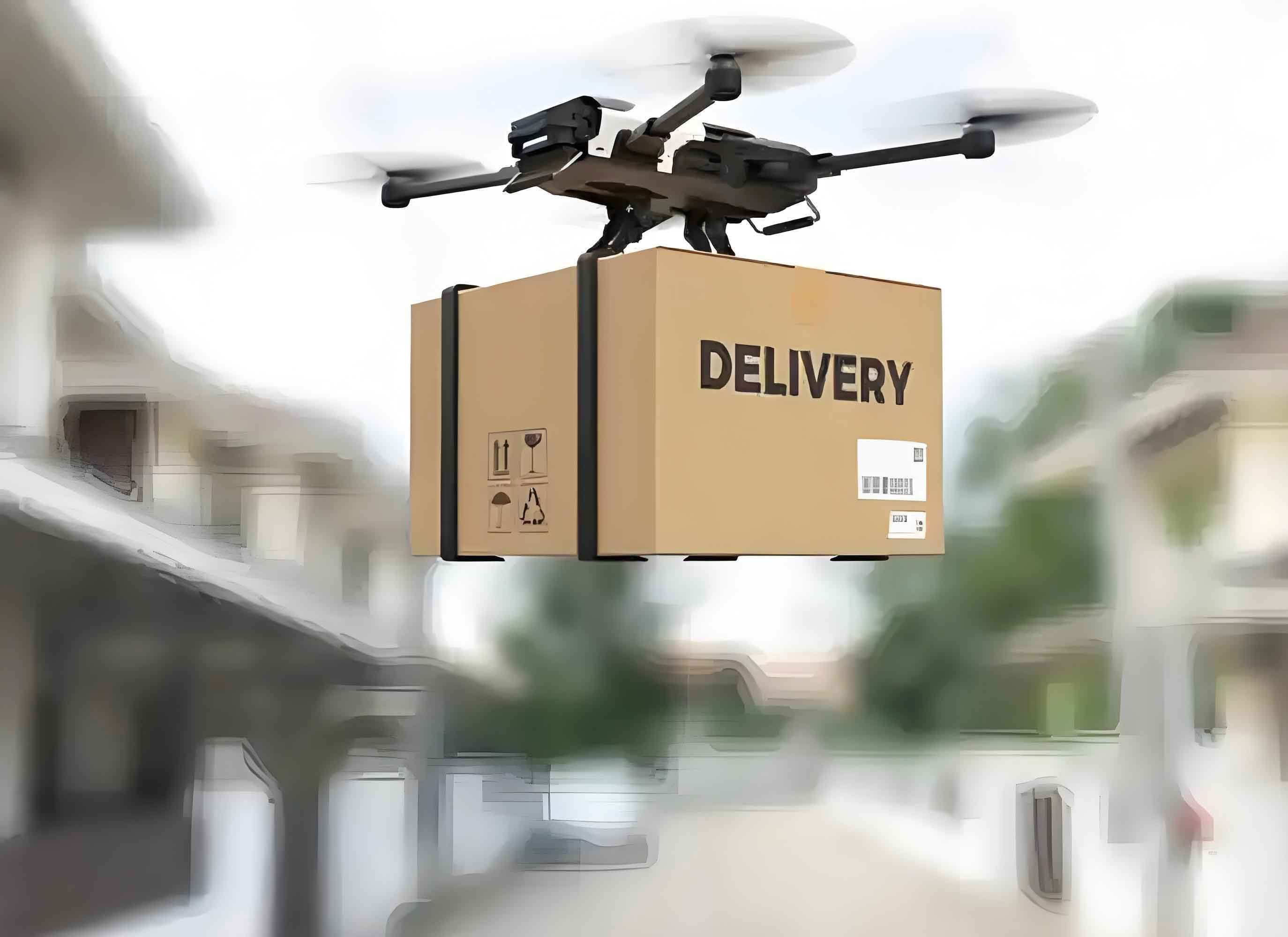
The image above depicts a delivery drone, highlighting one of the many applications of civilian drones that necessitate robust registration. As these drones become more common in logistics, ensuring their traceability through registration is paramount for security and efficiency.
Regarding legal classification, I have evaluated whether real-name registration constitutes an administrative permit or confirmation. Administrative permits typically grant permission for specific activities, while confirmations resolve legal statuses. Real-name registration for civilian drones does neither; it merely records information for future reference. Therefore, I categorize it as a quasi-administrative act focused on information collection and monitoring. This has implications for enforcement: penalties for non-registration are punitive rather than preventative. For example, fines or flight bans may be imposed, but these are reactive measures. To improve this, registration should be integrated with proactive tools like geofencing or remote identification for civilian drones.
Moving to legal pathways for optimization, I propose three main avenues: clarifying the legal nature of registration, refining drone categorization for registration, and expanding the scope of registrants. First, legislation must explicitly define real-name registration as a distinct administrative process aimed at safety management, with clear legal consequences. This would eliminate conflicts with nationality and rights registration, providing a solid foundation for enforcement. Second, drone categories should be aligned with registration requirements. Currently, many systems use weight-based thresholds (e.g., 250g), but this is too simplistic. Instead, I recommend a multi-factor classification based on weight, purpose, and operational risk. For instance, large civilian drones used for cargo transport might require full nationality and rights registration, while small recreational drones only need simplified real-name registration. This can be modeled with a decision matrix:
| Drone Category | Weight Range | Purpose | Registration Type |
|---|---|---|---|
| Micro | <250g | Recreational | None or voluntary |
| Small | 250g-25kg | Commercial/Recreational | Real-name only |
| Large | >25kg | Commercial/Industrial | Real-name + Nationality |
This approach tailors requirements to risk, reducing unnecessary burdens on operators of civilian drones.
Third, the range of registrants should be broadened to include not only owners but also users, dealers, and manufacturers. Dealers, in particular, play a crucial role in the supply chain of civilian drones; by mandating their registration, authorities can ensure that only compliant drones enter the market. This creates a closed-loop system that enhances traceability. In mathematical terms, if $O$ represents owners, $U$ users, $D$ dealers, and $M$ manufacturers, the registration coverage $C$ should be:
$$ C = \sum_{i \in \{O, U, D, M\}} w_i \cdot R_i $$
where $w_i$ are weights reflecting each group’s impact on safety, and $R_i$ is their registration status. Maximizing $C$ would significantly improve the effectiveness of registration for civilian drones.
In conclusion, the real-name registration system for civilian drones is a well-intentioned initiative that addresses genuine concerns about safety and accountability. However, my analysis reveals that its current form suffers from theoretical ambiguities and practical inefficiencies. By clarifying its legal nature, optimizing categorization, and expanding registrant coverage, we can enhance its utility and ensure that civilian drones continue to thrive in a regulated environment. The future of civilian drones depends on smart regulations that balance innovation with public interest, and real-name registration, when properly designed, can be a cornerstone of this framework.
To further illustrate the importance of registration, consider the dynamic interaction between drone density and incident rates. Let $N$ be the number of civilian drones in a region, $I$ the incident rate (e.g., accidents per 1000 flights), and $R$ the registration compliance rate. Empirical data suggests that $I$ decreases as $R$ increases, but this relationship is nonlinear. A potential model is:
$$ I = k \cdot \frac{N}{R^2} $$
where $k$ is a constant. This implies that improving registration compliance for civilian drones can disproportionately reduce incidents, especially as drone populations grow. Such insights underscore the need for continuous refinement of registration systems.
In summary, I have explored the multifaceted aspects of civilian drone real-name registration, from its theoretical underpinnings to practical challenges and legal solutions. By incorporating tables and formulas, I aimed to provide a comprehensive analysis that underscores the critical role of registration in managing civilian drones. As technology evolves, so must our regulatory approaches, always with an eye toward fostering safe and innovative uses of civilian drones.