
In recent years, the logistics delivery industry has undergone significant transformations due to the explosive growth of e-commerce. As a researcher and enthusiast in the field of unmanned aerial systems, I have observed that traditional delivery methods, which rely heavily on human couriers and ground transportation, are increasingly struggling with inefficiencies, high costs, and environmental impacts. This has sparked my interest in exploring alternative solutions, with civilian drones emerging as a pivotal technology. In this article, I will delve into a comprehensive analysis and design framework for civilian drones in logistics delivery, drawing from current trends, technical challenges, and innovative approaches. My goal is to provide a detailed perspective on how civilian drones can reshape the future of delivery services, emphasizing their potential through data-driven insights, mathematical models, and practical designs.
The concept of civilian drones, or unmanned aerial vehicles (UAVs), refers to aircraft operated without a human pilot onboard, controlled either autonomously or remotely. Historically rooted in military applications, civilian drones have rapidly evolved for commercial use, driven by advancements in sensors, battery technology, and artificial intelligence. In logistics, civilian drones offer a paradigm shift by enabling aerial delivery, which can bypass ground traffic and reduce human dependency. According to regulatory frameworks, civilian drones are categorized based on weight and operational scope, with micro-drones (under 7 kg) being particularly relevant for last-mile delivery due to their flexibility and lower regulatory hurdles. The integration of civilian drones into logistics is not merely a technological novelty; it represents a strategic response to rising consumer expectations for speed and reliability. From my analysis, the adoption of civilian drones could address critical pain points in delivery networks, such as rural access and urban congestion, while fostering sustainable practices through electric propulsion.
To understand the current landscape, I have examined global developments in civilian drone logistics. Internationally, companies like Amazon and DHL have pioneered trials, demonstrating the feasibility of drone-based delivery systems. Domestically, players such as JD.com and SF Express have conducted pilot projects in controlled environments. Below is a table summarizing key milestones and their implications for the industry, highlighting how civilian drones are being tested and deployed across different regions.
| Region | Key Players | Status | Focus Areas | Impact on Logistics |
|---|---|---|---|---|
| North America | Amazon, UPS | Advanced testing phases | Urban and suburban delivery | Reduced delivery times by up to 60% in trials |
| Europe | DHL, French Postal Service | Integration with existing logistics chains | Mountainous and remote areas | Improved accessibility for hard-to-reach locations |
| Asia | JD.com, SF Express | Pilot operations and regulatory collaborations | E-commerce hub deliveries | Enhanced scalability for high-volume orders |
| Oceania | Google (Project Wing) | Experimental routes in rural settings | Medical supply delivery | Demonstrated cost savings over traditional methods |
From this overview, it is evident that civilian drones are gaining momentum worldwide, with each region adapting the technology to local needs. In my assessment, the success of these initiatives hinges on overcoming technical and social barriers, which I will explore in subsequent sections. The proliferation of civilian drones in logistics is not just about automation; it is about creating resilient and adaptive supply chains that can withstand disruptions, such as pandemics or natural disasters.
Delving deeper into the application analysis, I have identified several advantages of using civilian drones for logistics delivery. Firstly, civilian drones can significantly enhance delivery speed by taking direct aerial routes, minimizing delays caused by ground traffic. This can be modeled using a simple travel time equation: $$ t = \frac{d}{v} + t_{handling} $$ where \( t \) is total delivery time, \( d \) is the straight-line distance, \( v \) is the average velocity of the civilian drone, and \( t_{handling} \) represents time for loading and unloading. For instance, if a civilian drone travels at 50 km/h over a 10 km distance, with \( t_{handling} = 5 \) minutes, the total time is approximately 17 minutes, compared to over 45 minutes for ground vehicles in congested areas. Secondly, civilian drones reduce operational costs associated with labor and fuel. A cost-benefit analysis can be expressed as: $$ C_{total} = C_{drone} + C_{energy} + C_{maintenance} $$ where \( C_{drone} \) is the initial investment per civilian drone, \( C_{energy} \) is the energy cost per flight, and \( C_{maintenance} \) covers repairs and software updates. Over time, as economies of scale kick in, \( C_{total} \) for civilian drones may fall below traditional delivery costs, especially for high-frequency routes.
Moreover, civilian drones contribute to environmental sustainability by lowering carbon emissions. The energy consumption of a civilian drone can be estimated using: $$ E = P \times T $$ where \( E \) is energy in watt-hours, \( P \) is power consumption in watts, and \( T \) is flight time in hours. With electric propulsion, civilian drones typically emit zero direct emissions, unlike gasoline-powered delivery vehicles. To illustrate the comparative advantages, I have compiled a table that contrasts civilian drone delivery with traditional methods across multiple dimensions.
| Metric | Traditional Delivery (Ground Vehicles) | Civilian Drone Delivery | Improvement with Civilian Drones |
|---|---|---|---|
| Average Speed | 20-30 km/h in urban areas | 40-60 km/h direct flight | 50-100% faster |
| Cost per Delivery | $2-5 (including labor and fuel) | $1-3 (estimated at scale) | Up to 40% reduction |
| Carbon Footprint | 0.2-0.5 kg CO₂ per km | 0.05-0.1 kg CO₂ per km (grid-dependent) | 50-80% lower emissions |
| Accessibility | Limited in remote or congested zones | High, with vertical take-off and landing | Enhanced reachability |
| Reliability | Subject to human error and traffic delays | Automated, weather-dependent | More consistent performance |
However, the deployment of civilian drones is fraught with challenges. Socially, safety concerns top the list, as civilian drones operate in shared airspace where collisions with obstacles or other aircraft could occur. Privacy issues arise from onboard cameras, potentially infringing on individuals’ rights. Legally, regulatory frameworks are still evolving; for example, many countries restrict civilian drone flights beyond visual line of sight (BVLOS), which is essential for long-range logistics. From a technical standpoint, civilian drones face limitations in payload capacity and battery life. The payload constraint can be represented as: $$ W_{payload} \leq W_{max} – W_{drone} $$ where \( W_{payload} \) is the weight of the delivery package, \( W_{max} \) is the maximum take-off weight, and \( W_{drone} \) is the weight of the civilian drone itself. Typically, civilian drones for logistics have \( W_{payload} \) under 5 kg, which restricts their use to small parcels. Battery life is another critical factor, governed by: $$ T_{flight} = \frac{C_{battery} \times \eta}{P_{consumption}} $$ where \( C_{battery} \) is battery capacity in watt-hours, \( \eta \) is efficiency (often 0.7-0.9 for lithium-polymer batteries), and \( P_{consumption} \) is power draw in watts. Current civilian drones offer \( T_{flight} \) of 20-40 minutes, necessitating frequent recharging or battery swaps.
To address these challenges, I have designed a specialized civilian drone for logistics delivery, focusing on point-to-point投递 with enhanced payload and safety features. My design incorporates a modular system where the civilian drone can detach and attach delivery boxes securely, allowing for flexible operations. The core mechanism involves a magnetic locking system, modeled using the formula for magnetic force: $$ F = \frac{\mu_0 \times m_1 \times m_2}{4\pi r^2} $$ where \( F \) is the force between magnets, \( \mu_0 \) is the permeability of free space, \( m_1 \) and \( m_2 \) are magnetic moments, and \( r \) is the distance between them. This ensures that the delivery box remains attached during flight but can be released reliably at the destination. The civilian drone includes an energy storage unit, with battery parameters optimized for longer flights, as per: $$ C_{battery} = \frac{E_{required}}{\eta \times V} $$ where \( E_{required} \) is the energy needed for a round trip, \( \eta \) is efficiency, and \( V \) is voltage. I estimate that with advances in solid-state batteries, civilian drones could achieve \( C_{battery} \) values exceeding 500 Wh, enabling ranges over 50 km.
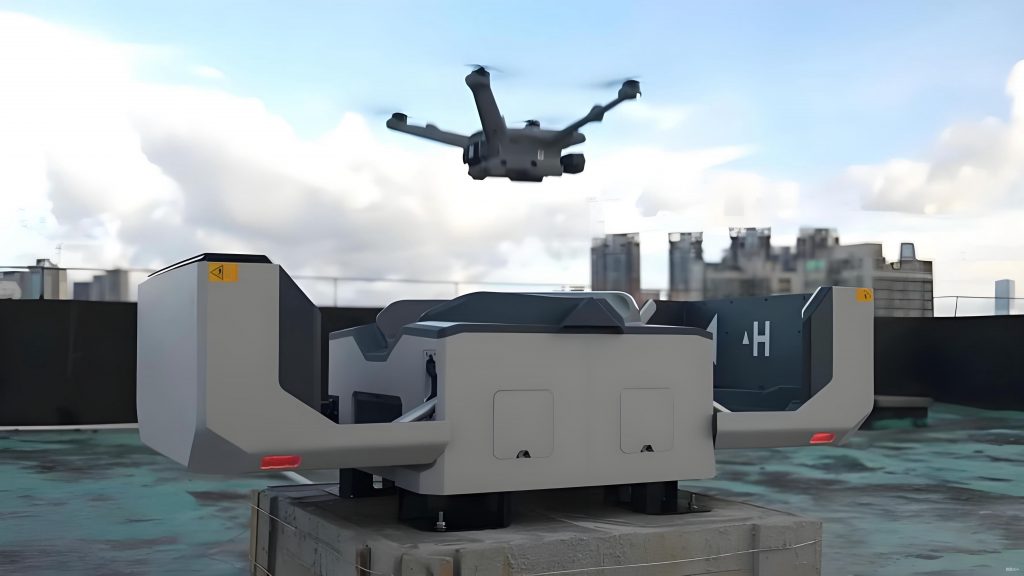
The design also integrates obstacle avoidance sensors, using LIDAR and cameras, with detection algorithms based on computational geometry. For instance, the distance to an obstacle can be calculated using: $$ d = \frac{c \times \Delta t}{2} $$ where \( d \) is distance, \( c \) is the speed of light, and \( \Delta t \) is the time delay for the signal return. This enhances the safety of civilian drones in urban environments. Additionally, I propose a swarm logistics model, where multiple civilian drones coordinate via a central system, optimizing routes through algorithms like the Traveling Salesman Problem (TSP): $$ \min \sum_{i=1}^{n} \sum_{j=1}^{n} c_{ij} x_{ij} $$ subject to constraints ensuring each destination is visited once. This model can reduce delivery times by up to 30% in dense networks, making civilian drones more efficient.
Looking ahead, the future of civilian drones in logistics delivery appears promising, albeit contingent on technological maturation and regulatory support. In my view, key trends include the development of hybrid civilian drones that combine vertical take-off with fixed-wing efficiency, extending their range. The integration of 5G networks will enable real-time tracking and control, improving the reliability of civilian drones. Furthermore, advancements in artificial intelligence will allow civilian drones to adapt dynamically to weather changes and air traffic. From an economic perspective, the total addressable market for civilian drone delivery could grow exponentially, with projections suggesting a compound annual growth rate (CAGR) of over 20% in the next decade. This growth will be driven by cost reductions, as depicted by the learning curve model: $$ C(x) = C_0 \times x^{-b} $$ where \( C(x) \) is the cost per unit after \( x \) units produced, \( C_0 \) is the initial cost, and \( b \) is the learning rate (typically 0.1-0.3 for high-tech products). As production scales, civilian drones could become affordable for small businesses, democratizing logistics.
In conclusion, my analysis underscores the transformative potential of civilian drones in the logistics delivery industry. While challenges such as safety, privacy, and technical limitations persist, ongoing innovations in design and regulation are paving the way for widespread adoption. The civilian drone design I proposed, with its focus on modularity and efficiency, represents a step toward practical implementation. As I continue to explore this field, I am optimistic that civilian drones will not only enhance delivery services but also contribute to smarter, more sustainable cities. The journey of civilian drones from niche experiments to mainstream logistics tools is underway, and it is a fascinating area to watch and participate in.