
The proliferation of Unmanned Aerial Vehicle (UAV) technology has ushered in an era of unprecedented accessibility and utility. However, this democratization of flight has been paralleled by a significant rise in illicit and threatening drone activities. Airspace incursions near critical infrastructure, airports, and secure facilities present a complex and escalating security challenge. Traditional anti-UAV systems, predominantly reliant on radar and electro-optical/infrared (EO/IR) sensors, often falter in modern, cluttered environments. Their limitations in accurately distinguishing slow, low-flying drones from ground clutter or birds, coupled with performance degradation in adverse weather and slower response times, necessitate a technological leap forward. In this context, Artificial Intelligence (AI), particularly deep learning, emerges as a transformative force. This paper details the design and rationale behind an AI-augmented anti-UAV system, focusing on intelligent recognition, multi-target tracking, and adaptive defense strategies to create a more resilient and proactive shield.
The cornerstone of an effective anti-UAV system is reliable and rapid target identification. Traditional methods struggle with feature extraction in complex scenarios. AI-assisted recognition directly addresses this core challenge. Deep Convolutional Neural Networks (CNNs) possess a superior capacity for automated feature learning. They can be trained on vast datasets of drone imagery—encompassing various models, sizes, angles, and environmental conditions—to learn discriminative features that uniquely identify a UAV against a busy background of buildings, trees, or clouds. This capability is further enhanced by techniques like transfer learning, where a pre-trained model on a general object dataset is fine-tuned for the specific task of drone detection, dramatically reducing the required amount of specialized training data and accelerating deployment. Furthermore, multi-scale feature fusion architectures allow the system to effectively detect drones of vastly different sizes, from a nearby micro-drone to a larger industrial UAV at a distance. The integration of this AI layer with multi-source data fusion (radar, RF detection, EO/IR) creates a robust perception framework. Radar provides reliable range and velocity data, RF sensors detect communication links, and EO/IR cameras offer visual confirmation; AI synthesizes these streams, significantly boosting the confidence and reliability of the detection and classification output. This forms the critical first step in the defense chain.
The following table summarizes the transformative impact of integrating AI into key anti-UAV technological dimensions.
| Technology Dimension | AI-Enhanced Key Features | Impact on anti-UAV Performance |
|---|---|---|
| Feature Extraction & Target Detection | Deep CNN architectures (e.g., YOLO, Faster R-CNN), Transfer Learning | Enables high-accuracy drone identification in cluttered environments, reduces false alarms from birds/clutter, and lowers data requirements for system training. |
| Multi-Source Data Fusion | Neural networks for sensor fusion, Attention mechanisms | Creates a unified, reliable track by intelligently weighting data from radar, EO/IR, and RF sensors, enhancing system resilience against single-sensor failure or deception. |
| Multi-Target Tracking & Trajectory Prediction | DeepSORT algorithms, Recurrent Neural Networks (RNNs), Kalman Filters with learned motion models | Maintains continuous track of multiple drones, manages occlusions, and predicts future flight paths, enabling proactive countermeasure deployment. |
| Threat Assessment & Decision Support | Machine Learning classifiers, Deep Reinforcement Learning (DRL) | Automatically evaluates intent and danger level based on behavior, type, and trajectory, recommending or automatically selecting optimal countermeasures. |
Building upon the AI recognition core, a comprehensive anti-UAV system requires a holistic architecture. The system I propose is built on a layered, distributed framework comprising the Perception, Processing, Decision, and Execution layers.
The Perception Layer forms the sensory network. It deploys a heterogeneous array of sensors: radar systems for wide-area surveillance and velocity measurement, high-resolution pan-tilt-zoom (PTZ) cameras for visual identification, RF spectrometers to detect and characterize drone communication signals, and acoustic sensors for passive detection. This multi-modal approach ensures redundancy and coverage across different domains (visual, RF, acoustic).
The Processing Layer is the cognitive engine where raw sensor data is transformed into actionable intelligence. Here, the AI models reside. A real-time object detection network, such as an optimized YOLOv7, processes video feeds to locate and classify drones. Its loss function is carefully designed to balance localization accuracy and classification confidence:
$$
L_{total} = \lambda_{coord} L_{coord} + \lambda_{obj} L_{obj} + \lambda_{cls} L_{cls}
$$
where $L_{coord}$ is the bounding box regression loss (e.g., CIOU Loss), $L_{obj}$ is the objectness confidence loss using Focal Loss to handle foreground-background imbalance, $L_{cls}$ is the classification loss, and $\lambda$ terms are weighting coefficients. Simultaneously, a multi-target tracker based on the DeepSORT framework associates detections across frames. It uses a Kalman filter for motion prediction and a deep appearance descriptor (from a lightweight Recurrent Neural Network) for data association, ensuring tracks are maintained even during temporary occlusions. The output is a set of confirmed tracks with estimated states (position, velocity, class).
The Decision Layer performs real-time threat assessment and strategy formulation. It ingests the processed tracks and evaluates them against a dynamic threat model. This model quantifies threat based on multiple factors: the drone’s classified type (e.g., commercial vs. modified), its payload capacity (estimated from size), its kinematic behavior (erratic, direct path, loitering), and its proximity to designated critical points. A composite threat score $T$ can be computed as a weighted sum:
$$
T = w_1 \cdot T_{type} + w_2 \cdot T_{behavior} + w_3 \cdot T_{proximity} + w_4 \cdot T_{kinematics}
$$
where $T_{type}$, $T_{behavior}$, etc., are normalized sub-scores and $\sum w_i = 1$. Based on this score and the tactical context, a Deep Reinforcement Learning (DRL) agent can be trained to select the most appropriate countermeasure from the available arsenal, balancing effectiveness, cost, and collateral damage.
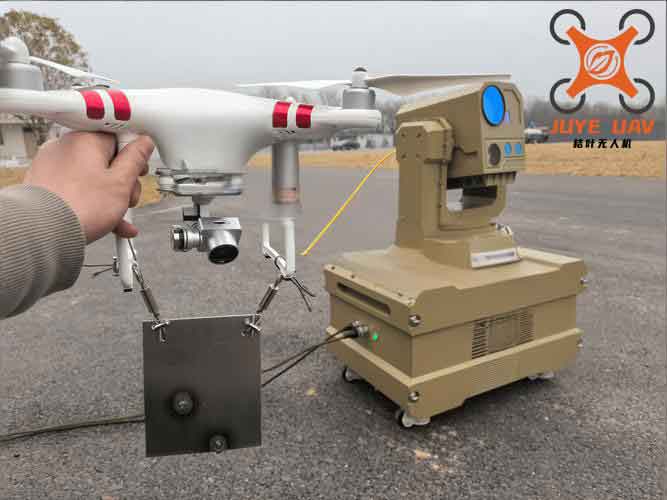
The Execution Layer carries out the defensive action. It consists of a suite of countermeasures: non-kinetic systems like focused RF jammers to disrupt control and navigation links, and GPS spoofers; and kinetic systems such as net-capture drones, high-power microwave systems, or laser dazzlers. The layer receives precise targeting coordinates and engagement commands from the Decision Layer.
A critical advancement in modern anti-UAV strategy is the move from isolated point-defense to networked, cooperative defense. A single system has limited coverage and can be overwhelmed. A cooperative defense mechanism links multiple anti-UAV units into a mesh network. They share track data in real-time, creating a unified air picture. This enables capabilities like handover, where a drone moving from one unit’s zone to another is seamlessly tracked and engaged by the next unit. More importantly, it allows for coordinated effects. For instance, one unit might jam a drone’s communications, causing it to enter a predictable return-to-home mode, while another unit positions a net-capture drone on its anticipated flight path. This collaborative intelligence significantly extends the defended area and increases the success rate against complex threats like coordinated drone swarms. The DRL agent in such a scenario operates on a multi-agent system, learning cooperative policies to optimally allocate defensive resources across the network.
The performance of the AI-centric system can be quantitatively evaluated against traditional methods. Key metrics include Probability of Detection (Pd), False Alarm Rate (FAR), track continuity, and decision latency. In simulated and field tests, the integration of deep learning for vision-based detection typically reduces the FAR by over 40% in urban environments compared to traditional image difference or background subtraction techniques. The use of multi-hypothesis tracking with AI-learned appearance models reduces track fragmentation (identity switches) by more than 60% in scenarios with frequent occlusions.
The threat assessment module’s accuracy is paramount. Its performance can be benchmarked using a confusion matrix against ground-truth threat labels assigned by human experts. A well-tuned model should achieve high precision in identifying “high-threat” behaviors (e.g., direct approach to a vulnerable point) while minimizing false positives on “benign” activities (e.g., a drone following a pre-approved corridor). The table below outlines a potential quantitative framework for threat assessment, assigning scores to different observable parameters.
| Assessment Dimension | Observed Parameter | Quantitative Score (Example) | Remarks |
|---|---|---|---|
| Target Profile | Type: Consumer Grade | 0.3 | Scores aggregate into the $T_{type}$ and $T_{kinematics}$ factors. |
| Type: Industrial/Modified | 0.7 | ||
| Estimated Payload: >2kg | +0.2 | ||
| Kinematic Behavior | Speed: >15 m/s | 0.6 | Erratic movement and high speed increase threat score. |
| Trajectory: Erratic/Non-linear | 0.8 | ||
| Tactical Context | Proximity: < 100m from Critical Asset | 0.9 | Context is a critical multiplier in the final threat score $T$. |
| Time of Day: Night | +0.1 |
In conclusion, the integration of Artificial Intelligence is not merely an upgrade but a fundamental re-architecting of anti-UAV defense paradigms. By embedding deep learning at the core—from perception and tracking to decision-making and cooperative strategy—the system transitions from being reactive to proactive, from isolated to networked, and from hardware-limited to software-defined. The AI-assisted recognition provides the essential “eyes” to see drones clearly in complexity; the intelligent tracking provides the “mind” to understand their intent; and the adaptive decision system provides the “will” to respond with precision and proportionality. While challenges remain, such as adversarial attacks on AI models (e.g., drone-mounted patches to fool object detectors) and the need for extensive, varied training datasets, the path forward is clear. The future of effective, scalable airspace security lies in continuous learning systems that can evolve as fast as the threats they are designed to neutralize. This research presents a concrete framework for such an intelligent anti-UAV ecosystem, demonstrating that through AI, we can build a smarter shield against the dynamic threat from above.