
In the rapidly evolving landscape of military technology, drone systems have become pivotal assets. The effective training of in-service officers responsible for drone operations, however, faces significant challenges due to traditional, standardized pedagogical approaches. Conventional methods often fail to account for the diverse backgrounds, skill levels, and learning paces of officers, leading to suboptimal training outcomes. To address this, we have embarked on a research initiative to explore and implement an AI-driven, adaptive learning framework specifically tailored for drone training. This article details our comprehensive study, from problem analysis and capability requirement definition to the development of a smart training system and empirical evaluation. Our goal is to revolutionize drone training by introducing personalized, efficient, and实战-oriented learning pathways, thereby enhancing the operational readiness and expertise of in-service officers in drone装备保障与运用. The core of our investigation lies in leveraging artificial intelligence to create a dynamic, responsive training ecosystem that continuously adapts to each learner’s needs.
The current state of professional military education, particularly for in-service officers specializing in drone systems, reveals several systemic issues that hinder the development of high-level operational competence. Firstly, the trainee cohort is remarkably heterogeneous. Officers enter training with vastly different foundations in terms of prior knowledge, technical proficiency, operational experience, and even psychological resilience. A one-size-fits-all curriculum inevitably leaves some learners behind while under-challenging others, resulting in普遍的学习动力不足. Secondly, the instructor corps itself often lacks extensive, diverse field experience with the latest drone operational paradigms, creating a gap between theoretical instruction and practical,实战化 demands. Thirdly, the教学内容 remains largely static and uniform, lacking the flexibility to cater to individual cognitive styles and learning objectives. Finally, assessment mechanisms are predominantly summative and unidirectional, failing to provide continuous, diagnostic feedback on a trainee’s evolving knowledge state or to predict their future performance in assigned roles. These shortcomings collectively undermine the efficacy of drone training programs.
A precise understanding of capability requirements is the cornerstone of effective training design. Through extensive fieldwork, surveys, and analysis involving various drone units, we have distilled the essential competencies for in-service drone officers. These requirements extend far beyond mere technical know-how, encompassing a holistic profile necessary for modern,信息化 warfare.
| Capability Category | Detailed Description & Relevance to Drone Training |
|---|---|
| Expert Technical Knowledge | Mastery of complex drone system architectures, including airframe, ground control station, data-link, payload, and integrated support systems. This requires a deep, structured understanding of interdisciplinary engineering principles, which forms the bedrock of all drone training. |
| Superior Psychological Fortitude | Possession of unwavering conviction, resilience under stress, and adaptive mental models. Drone operations, especially in contested environments, demand冷静 decision-making and sustained focus, making psychological conditioning a critical component of advanced drone training. |
| Fundamental Combat Command Aptitude | Ability to plan, coordinate, and execute missions within a joint operational framework. Drone training must therefore integrate elements of tactical thinking, resource management, and multi-asset synchronization to develop this command素养. |
| Tactical Drone Employment Proficiency | Skill in leveraging the unique战技性能 of drone platforms to achieve tactical and strategic objectives. This involves understanding operational concepts, mission planning, threat analysis, and effective integration with manned assets, representing the ultimate goal of applied drone training. |
These capabilities are not isolated; they interact synergistically. For instance, technical knowledge enables tactical employment, while psychological fortitude supports effective command under pressure. Our drone training paradigm must, therefore, address these competencies in an integrated manner.
To meet these multifaceted requirements, we propose a novel培训方法 grounded in AI-powered adaptive learning. Adaptive learning refers to educational systems that dynamically adjust the presentation of learning material, its sequence, and the nature of tasks based on individual learner performance and behavior. The principal challenge is the accurate diagnosis of a learner’s knowledge state and the subsequent精准推荐 of an optimal learning path. AI technologies, particularly machine learning algorithms, provide the necessary tools to overcome this challenge. Our framework for AI-enhanced drone training is a cyclic, data-driven process consisting of five interconnected stages.
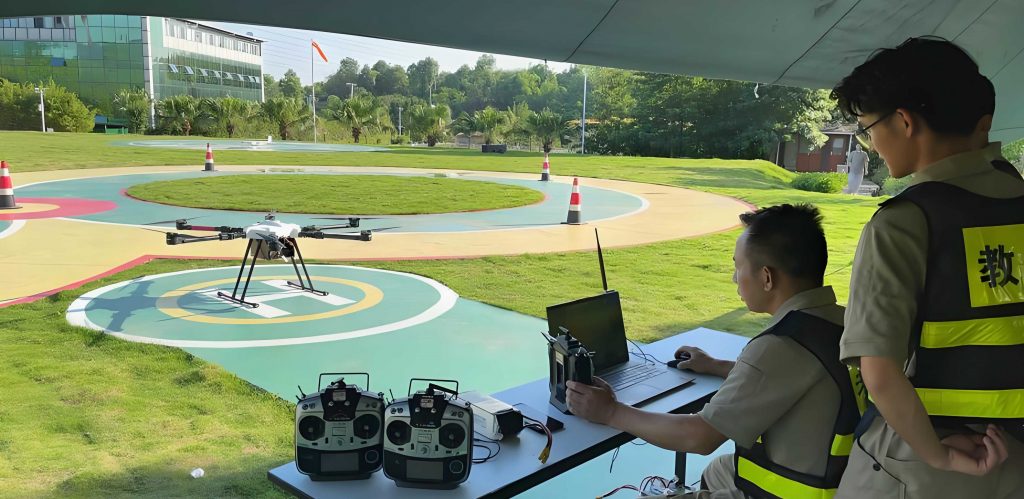
Stage 1: Capability Demand Analysis and Model Construction. This initial phase involves formalizing the capability requirements identified earlier into a structured, computable model. We define a set of knowledge components (KCs) and skills (S) that map onto the required competencies. Let the set of all required knowledge points for comprehensive drone training be denoted as $K = \{k_1, k_2, …, k_n\}$. Each knowledge point $k_i$ has an associated difficulty parameter $\delta_i$ and is linked to specific capabilities from Table 1. The relationships between KCs can be modeled as a prerequisite graph $G = (V, E)$, where vertices $V$ represent KCs and edges $E$ represent prerequisite relationships (e.g., $k_a \rightarrow k_b$ means $k_a$ must be mastered before $k_b$). This graph forms the backbone of our adaptive system’s ontology for drone training.
Stage 2: Learner Profiling and Pre-Training Intelligent Assessment. Upon entry into the drone training program, each officer (learner $L_j$) undergoes a profiling process. We collect static data $D^s_j$: rank, prior assignment, self-reported learning goals, and educational background. Crucially, $L_j$ then completes a pre-training diagnostic test—the “Intelligent Assessment” or智测. This test is designed using Item Response Theory (IRT) to efficiently probe mastery across the KC set $K$. For each test item $i$ targeting KC $k$, the probability of $L_j$ answering correctly is modeled by a three-parameter logistic (3PL) IRT function:
$$P(\theta_j) = c + \frac{1-c}{1+e^{-a(\theta_j – b)}}$$
where:
$\theta_j$ is the latent ability of learner $L_j$,
$a$ is the item discrimination parameter,
$b$ is the item difficulty parameter (aligned with $\delta_k$),
$c$ is the pseudo-guessing parameter.
The system administers a tailored sequence of items using a Computerized Adaptive Testing (CAT) engine, rapidly converging on an estimate of $\theta_j$ for each relevant KC. The output is a personalized knowledge state vector $\vec{KS}_j = [p_{j1}, p_{j2}, …, p_{jn}]$, where $p_{ji} \in [0,1]$ represents the estimated probability that $L_j$ has mastered knowledge point $k_i$. This vector precisely identifies strengths and weaknesses before formal drone training commences.
| Knowledge Point (k_i) | Description (Related to Drone Training) | Trainee A: Mastery Prob. (p_Ai) | Trainee B: Mastery Prob. (p_Bi) |
|---|---|---|---|
| k_1 | Principles of UAV Aerodynamics | 0.92 | 0.45 |
| k_2 | Data-Link Encryption Protocols | 0.30 | 0.88 |
| k_3 | EO/IR Payload Image Interpretation | 0.60 | 0.62 |
| k_4 | Contingency Procedures for Link Loss | 0.25 | 0.70 |
| k_5 | Joint Terminal Attack Controller (JTAC) Coordination Protocols | 0.40 | 0.35 |
Stage 3: Dynamic Content Recommendation and Guided Learning. Based on $\vec{KS}_j$, the AI system curates and pushes a personalized set of learning resources $R_j$ to $L_j$. These resources include theoretical readings, interactive simulations, operational video footage, maintenance case studies, and virtual reality scenarios—all focused on drone training. The recommendation logic uses a utility function that considers both the knowledge gap ($1 – p_{ji}$) and the prerequisite structure $G$. For a resource $r$ that addresses a set of KCs $K_r$, its priority for $L_j$ is calculated as:
$$U(j, r) = \sum_{k_i \in K_r} w_i \cdot (1 – p_{ji}) \cdot I(\text{Prereqs}(k_i) \text{ are satisfied})$$
where $w_i$ is a weight reflecting the importance of $k_i$ in the overall drone training curriculum, and $I()$ is an indicator function ensuring learning follows logical dependencies. As $L_j$ interacts with the resources, their activities (time spent, quiz scores, simulation outcomes) are logged as behavioral data $D^b_j(t)$, which is used to update $\vec{KS}_j$ in real-time via Bayesian knowledge tracing or similar algorithms:
$$P(L_j \text{ knows } k_i | \text{obs}) = \frac{P(\text{obs} | \text{knows}) \cdot P(\text{knows})}{P(\text{obs})}$$
This continuous updating allows the system to refine its understanding of the learner’s state throughout the drone training process.
Stage 4: Difficulty Stratification and Targeted Practice. To scaffold learning effectively, the system organizes knowledge points and associated practice tasks into a difficulty-stratified continuum. It constructs a personalized learning path $PL_j$, which is a sequence of learning units. Each unit focuses on a cluster of related KCs, ordered by increasing difficulty and respecting prerequisites. For each unit, the system generates targeted “靶向练习” – practice problems tailored to $L_j$’s specific misconceptions. The difficulty of these problems is adjusted dynamically using a policy akin to a learning progress-based heuristic. If success rate is high, difficulty increases; if low, the system may reintroduce foundational concepts. This ensures that drone training remains within the optimal zone of proximal development for each officer.
Stage 5: Learning Analytics and Instructor Intervention. The AI system generates detailed learning analytics reports for both the learner and the instructor. These reports visualize progress, identify persistent knowledge gaps, and even suggest learning styles (e.g., visual vs. textual preference inferred from interaction data). Crucially, this stage enables human-in-the-loop guidance. Instructors can review the analytics dashboard to identify trainees who are struggling with specific aspects of drone training, such as战术运用 or system diagnostics, and then provide focused, one-on-one or small-group tutoring. This symbiosis between AI-driven personalization and expert human mentorship is vital for holistic development.
To evaluate the efficacy of our proposed AI-enhanced drone training framework, we conducted a pilot study with a cohort of in-service officers from a 2020 short-term course on drone equipment support and employment. We implemented a prototype智测系统 encompassing the first three stages and gathered feedback through surveys, interviews, and analysis of final examination scores. Evaluation focused on four dimensions: software design, learning content, learning outcomes, and overall system impact.
| Stakeholder Group | Very Satisfied | Moderately Satisfied | Dissatisfied |
|---|---|---|---|
| Drone Trainees (N=45) | 19 | 75 | 6 |
| Instructors (N=12) | 18 | 70 | 12 |
| Subject Matter Experts (N=8) | 20 | 75 | 5 |
Trainees appreciated the intuitive interface and fast loading speeds, which facilitated self-directed drone training. Instructors and experts noted occasional software faults and suggested further optimization for a more user-centric design, emphasizing that the tool should seamlessly integrate into the broader drone training ecosystem without causing technical distractions.
| Stakeholder Group | Very Satisfied | Moderately Satisfied | Dissatisfied |
|---|---|---|---|
| Drone Trainees | 6 | 90 | 4 |
| Instructors | 14 | 81 | 5 |
| Subject Matter Experts | 10 | 77 | 13 |
The content was praised for its comprehensiveness in covering drone training topics. However, experts recommended streamlining the question bank to reduce test duration and increasing the proportion of实战化, scenario-based items, including virtual实操 tasks. This feedback directly informs our next iteration for more efficient and relevant drone training content curation.
| Stakeholder Group | Very Satisfied | Moderately Satisfied | Dissatisfied |
|---|---|---|---|
| Drone Trainees | 9 | 85 | 6 |
| Instructors | 18 | 72 | 10 |
| Subject Matter Experts | 15 | 65 | 20 |
Trainees reported increased learning efficiency and a better understanding of their own proficiency gaps, which are crucial for effective drone training. Instructors found that pre-training diagnostics allowed for more focused classroom teaching. Experts raised a critical point: the system’s current algorithm for inferring learning style and recommending paths might be overly simplistic, potentially pigeonholing learners and stifling the development of versatile problem-solving skills essential for advanced drone operations. They cautioned against over-reliance on algorithmic recommendations in drone training.
A qualitative synthesis of open-ended feedback reveals several key insights regarding the overall impact of AI on drone training. Firstly, the system enables highly efficient human-computer interaction, allowing learners to engage in a “dialogue” with the training platform, leading to optimized resource utilization. The non-linear, adaptive presentation of knowledge helps officers construct a more coherent and interconnected mental model of drone systems, promoting deeper understanding and knowledge transfer—a significant advancement over linear drone training curricula.
Secondly, this approach fundamentally innovates the learning模式 for military officers. It fosters self-regulated learning and enhances analytical and troubleshooting abilities, contributing to both knowledge acquisition and skill development—a dual objective of high-quality drone training. The immediate feedback and detailed learning analytics reports empower trainees to take ownership of their professional development in drone training.
Thirdly, the aggregated data from learner profiles and interaction histories allow for the construction of sophisticated learner models. These models can be used not only for personalization but also for macro-level analysis. Instructors can identify common难点 across a cohort, enabling targeted group interventions. Curriculum designers can evaluate the effectiveness of specific training modules, and institutional leaders can make data-informed decisions about resource allocation and curriculum reform for future drone training programs. The data serves as a valuable asset for continuous improvement of military drone training.
However, a paramount consideration is the balanced integration of AI and human instructors. While AI can alleviate some instructional burdens in drone training, it must not diminish the role of the instructor. The mentorship, moral guidance, nuanced practical insights, and motivational support provided by experienced officers are irreplaceable. Furthermore, an over-dependence on system-suggested paths could potentially weaken an officer’s capacity for autonomous learning, creative thinking, and collaborative problem-solving—attributes vital in the dynamic, unpredictable domain of drone warfare. Therefore, the optimal drone training ecosystem is one of synergy, where AI handles personalization, diagnostics, and resource management, while human experts focus on高级辅导, complex case studies, leadership development, and fostering the warrior ethos.
In conclusion, our research demonstrates the substantial potential of AI-powered adaptive learning systems to transform drone training for in-service officers. By moving from a standardized model to a personalized, data-driven, and dynamic approach, we can address the heterogeneous needs of the trainee population, bridge the gap between theory and practice, and ultimately cultivate a more proficient, adaptable, and mentally resilient drone operator corps. The proposed framework, involving capability modeling, intelligent assessment, adaptive content delivery, and human-AI collaboration, provides a viable roadmap. Future work will focus on refining the underlying algorithms, particularly in the areas of deep knowledge tracing and sophisticated learning path optimization, expanding the library of实战-based training simulations, and conducting longitudinal studies to assess the long-term impact of such AI-enhanced drone training on operational performance in the field. The journey towards truly intelligent and effective drone training is ongoing, and we believe this research represents a significant step forward.