
As a researcher deeply immersed in the field of modern agriculture, I have witnessed firsthand the transformative impact of agricultural UAVs, commonly known as crop protection drones, on farming practices worldwide. In many agricultural nations, including my own context, crop disease and pest control have long been critical yet challenging aspects of production. The advent of agricultural UAVs offers a promising solution, addressing inefficiencies in traditional methods and paving the way for sustainable farming. This article delves into the current application landscape, economic and social benefits, and challenges associated with agricultural UAVs, while proposing future directions. Through detailed analysis, tables, and mathematical formulations, I aim to provide a comprehensive overview of why agricultural UAVs are indispensable for contemporary agriculture.
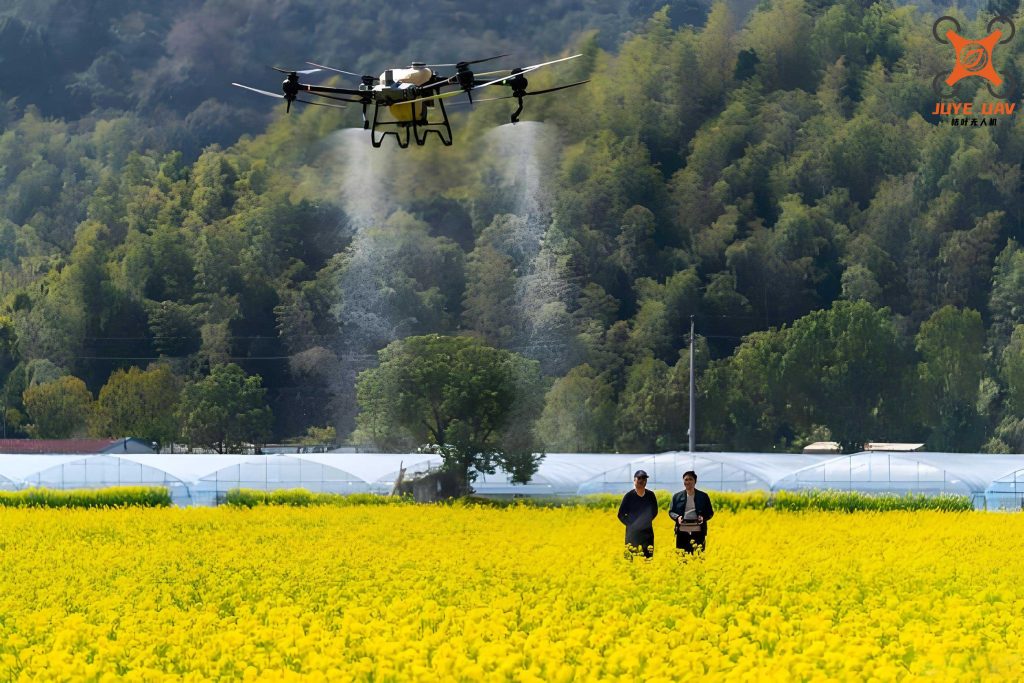
The proliferation of agricultural UAVs in recent years has been nothing short of remarkable. These unmanned aerial vehicles, equipped with advanced spraying systems, have evolved from niche gadgets to essential tools in precision agriculture. From my observations, the adoption rate of agricultural UAVs has skyrocketed, driven by their ability to perform tasks with unprecedented efficiency and accuracy. In this analysis, I will explore how agricultural UAVs are reshaping the economic and social fabric of farming communities, while also acknowledging the hurdles that must be overcome for wider integration.
Economic Benefits of Agricultural UAVs
To quantify the economic advantages of agricultural UAVs, I often refer to comparative studies involving traditional equipment like backpack sprayers and self-propelled spray booms. Consider a scenario where a large-scale rice field, spanning 120 hectares, requires periodic pest control. Based on operational data, I have compiled a table that highlights key metrics for different sprayers over a complete treatment cycle.
| Equipment Type | Daily Operation Area (hm²) | Labor Required (persons) | Daily Labor Cost (USD) | Water Usage per 667 m² (kg) | Total Days per Treatment Cycle | Total Labor Cost per Cycle (USD) | Total Water Usage per Cycle (t) |
|---|---|---|---|---|---|---|---|
| Agricultural UAV | 20 | 2 | 150 | 3 | 6 | 1800 | 5.4 |
| Backpack Sprayer | 10 | 4 | 150 | 60 | 12 | 7200 | 108 |
| Self-propelled Spray Boom | 13.33 | 2 | 150 | 60 | 9 | 2700 | 108 |
From this table, it is evident that agricultural UAVs outperform other methods in multiple dimensions. The efficiency of an agricultural UAV can be expressed mathematically. Let the daily operation area be denoted as \( A \) (in hm²/day), the total treatment area as \( T = 120 \) hm², and the number of days required as \( D \). Then, the efficiency ratio between two equipments can be calculated as:
$$ \text{Efficiency Ratio} = \frac{A_{\text{UAV}}}{A_{\text{other}}} $$
For the backpack sprayer:
$$ \text{Ratio} = \frac{20}{10} = 2 $$
For the self-propelled spray boom:
$$ \text{Ratio} = \frac{20}{13.33} \approx 1.5 $$
This indicates that the agricultural UAV completes tasks twice as fast as the backpack sprayer and 1.5 times faster than the self-propelled spray boom. In terms of cost savings, the total labor cost per cycle for the agricultural UAV is \( C_{\text{UAV}} = 1800 \) USD, while for the backpack sprayer it is \( C_{\text{backpack}} = 7200 \) USD and for the self-propelled spray boom \( C_{\text{boom}} = 2700 \) USD. The savings can be modeled as:
$$ \text{Savings}_{\text{backpack}} = C_{\text{backpack}} – C_{\text{UAV}} = 7200 – 1800 = 5400 \text{ USD} $$
$$ \text{Savings}_{\text{boom}} = C_{\text{boom}} – C_{\text{UAV}} = 2700 – 1800 = 900 \text{ USD} $$
Water conservation is another critical factor. The agricultural UAV uses only 5.4 tons of water per cycle, compared to 108 tons for both traditional methods. The water savings per cycle are:
$$ \text{Water Savings} = 108 – 5.4 = 102.6 \text{ t} $$
This reduction is significant, especially in regions facing water scarcity. Furthermore, the precision of agricultural UAVs often leads to higher crop yields due to better pesticide distribution. The incremental revenue from increased yield can be approximated using a simple formula:
$$ \Delta R = Y_{\text{UAV}} \times P – Y_{\text{traditional}} \times P $$
where \( Y \) denotes yield per hectare and \( P \) is the market price per unit yield. In practice, fields treated with agricultural UAVs have shown yield improvements of 5-10%, amplifying the economic returns.
Beyond direct comparisons, the operational flexibility of agricultural UAVs reduces downtime and allows for timely interventions, which is crucial in pest management. The low water usage also translates to lower costs for water procurement and storage, though in many cases, the water expense is negligible due to minimal volumes. Overall, the economic case for agricultural UAVs is compelling, fostering a cycle of cost reduction and revenue enhancement that benefits farmers and cooperatives alike.
Social Benefits of Agricultural UAVs
The social implications of adopting agricultural UAVs are profound and multifaceted. From my perspective, the integration of these drones into farming systems has catalyzed positive changes across several domains.
Enhancing High-Efficiency Agricultural Machinery
Historically, crop protection has been a weak link in the agricultural chain, often reliant on manual labor or inefficient machinery. The rise of agricultural UAVs has accelerated the phasing out of outdated equipment. In many regions, I have seen how agricultural UAVs are setting new standards for precision and automation. For instance, the deployment of agricultural UAVs has grown exponentially, with millions of hectares treated annually. This surge is supported by policy initiatives, such as subsidies and pilot programs, aimed at standardizing and promoting agricultural UAV technology. The智能化 (intelligent) and专业化 (specialized) capabilities of agricultural UAVs are driving a transition from traditional, labor-intensive methods to modern, data-driven approaches. This shift not only boosts productivity but also elevates the overall technological sophistication of the agricultural sector.
Alleviating Rural Labor Shortages
One of the most pressing issues in contemporary agriculture is the aging workforce and scarcity of labor. Through my engagements with farming communities, I have noted that agricultural UAVs mitigate this challenge by reducing dependency on human labor. The high operational speed of an agricultural UAV means that large areas can be covered quickly, minimizing the need for manual sprayers. This efficiency is quantified by the labor productivity metric:
$$ \text{Labor Productivity} = \frac{\text{Area Covered per Day}}{\text{Number of Laborers}} $$
For the agricultural UAV, this is \( 20 / 2 = 10 \) hm² per person per day, compared to \( 10 / 4 = 2.5 \) hm² per person per day for the backpack sprayer. This fourfold increase demonstrates how agricultural UAVs optimize human resources. Moreover, the allure of operating advanced technology like agricultural UAVs is attracting younger generations back to rural areas, fostering entrepreneurship and employment in飞防 (aerial application) services. This demographic shift helps revitalize rural economies and ensures the sustainability of agricultural practices.
Promoting Green Agricultural Development
Environmental sustainability is a cornerstone of modern agriculture. Agricultural UAVs contribute significantly to this goal by enabling precise chemical application. The reduction in pesticide and water usage aligns with global initiatives, such as the “Zero Growth in Pesticide Use” action plan. The pesticide utilization efficiency can be expressed as:
$$ \text{Pesticide Utilization Efficiency} = \frac{\text{Effective Dose on Target}}{\text{Total Dose Applied}} $$
Agricultural UAVs, with their low-volume spraying systems, achieve higher efficiency rates, often exceeding 90%, compared to 30-40% for conventional methods. This minimizes runoff and environmental contamination, ensuring food safety and quality. Additionally, the decreased chemical load supports biodiversity and soil health. From a broader perspective, the adoption of agricultural UAVs fosters a sustainable agricultural model that balances productivity with ecological stewardship, ultimately enhancing the resilience of farming systems.
Challenges and Recommendations for Agricultural UAVs
Despite the promising trajectory, the rapid expansion of agricultural UAVs has exposed several challenges that require addressed. Based on my analysis, these issues span technical, regulatory, and supply chain domains.
Technical Limitations of Agricultural UAVs
The performance of current agricultural UAVs is constrained by factors like battery life and payload capacity. Typically, an agricultural UAV operates for 15-30 minutes per battery charge, necessitating multiple batteries and frequent recharging during fieldwork. This downtime reduces effective operational hours. The payload is often limited to 10-20 liters, requiring frequent refills. The overall efficiency can be modeled as:
$$ \text{Effective Field Capacity} = \frac{\text{Payload} \times \text{Number of Flights per Hour}}{\text{Area per Flight}} \times \text{Operational Time} $$
Given that battery swaps and refilling interrupt continuous operation, the actual capacity is lower than theoretical values. To overcome this, I recommend that manufacturers collaborate with research institutions to develop next-generation agricultural UAVs with enhanced endurance and load-bearing capabilities. Innovations in hybrid power systems or quick-charging infrastructure could revolutionize the usability of agricultural UAVs.
Inadequate Industry Standards
The regulatory framework for agricultural UAVs is still evolving. While some guidelines exist, comprehensive standards for作业质量 (operation quality), safety, and efficacy are lacking. This gap leads to variability in service outcomes and potential risks. For instance, the absence of uniform protocols for spray drift management can result in off-target chemical deposition. I urge agricultural authorities to establish a robust standards体系 (system) that covers all aspects of agricultural UAV operations. This includes certification procedures for operators, maintenance benchmarks, and environmental compliance metrics. Standardization will not only ensure consistent performance but also build trust among stakeholders, accelerating the adoption of agricultural UAVs.
Scarcity of Specialized Formulations
Agricultural UAVs employ ultra-low volume (ULV) or low-volume spraying techniques, which require adjuvants and formulations tailored for aerial application. However, the market currently offers limited options, forcing practitioners to use conventional pesticides that may not optimize the potential of agricultural UAVs. The effectiveness of a treatment can be described by the dose-response relationship:
$$ E = \frac{E_{\text{max}} \times C^n}{EC_{50}^n + C^n} $$
where \( E \) is the effect, \( C \) is the concentration, \( E_{\text{max}} \) is the maximum efficacy, \( EC_{50} \) is the half-maximal effective concentration, and \( n \) is the Hill coefficient. Specialized ULV formulations can enhance \( E \) at lower \( C \), reducing chemical usage. Therefore, I advocate for stronger partnerships between agricultural UAV companies and agrochemical firms to co-develop高效 (high-efficiency),抗漂移 (anti-drift) formulations. Such innovations will maximize the benefits of agricultural UAVs while supporting global pesticide reduction goals.
Future Outlook and Conclusion
Reflecting on the current state, I am optimistic about the future of agricultural UAVs. These drones have already demonstrated their value in addressing labor shortages, improving resource efficiency, and promoting sustainable practices. As technology advances, I anticipate further integration of artificial intelligence and IoT sensors into agricultural UAVs, enabling real-time monitoring and adaptive spraying. The economic models suggest that with scale, the costs of agricultural UAV operations will decline, making them accessible to smallholder farmers as well.
In conclusion, agricultural UAVs represent a paradigm shift in crop protection. Their economic and social benefits are clear, and while challenges persist, concerted efforts from industry, government, and academia can overcome them. As we move forward, the continued innovation and adoption of agricultural UAVs will be instrumental in achieving food security, environmental sustainability, and rural prosperity. The journey of agricultural UAVs is just beginning, and I am excited to witness their evolving role in shaping the future of agriculture.
Throughout this discussion, I have emphasized the transformative power of agricultural UAVs. By leveraging data-driven insights and technological advancements, these drones are not merely tools but catalysts for a greener, more efficient agricultural era. The repeated mention of agricultural UAVs in this article underscores their centrality to modern farming solutions. As I continue to explore this field, I remain committed to advocating for policies and practices that harness the full potential of agricultural UAVs for the benefit of all.