
As a researcher in modern agricultural technologies, I have observed the growing demand for efficient and safe plant protection methods due to the expanding scale of agricultural production. In this context, agricultural UAVs (unmanned aerial vehicles) have emerged as a transformative tool, particularly suited for large-scale operations and complex terrains. The promotion of agricultural UAVs is pivotal for advancing precision agriculture, and in this article, I will delve into their characteristics, current status, challenges in application, and recommendations for widespread adoption. Throughout, I will emphasize the role of agricultural UAVs in enhancing productivity while addressing environmental and economic concerns.
The core features of agricultural UAVs stem from their integration with advanced technologies such as ultrasonic sensors, radar, and precision spraying systems. These agricultural UAVs overcome limitations of traditional methods—like low efficiency, uneven chemical application, high labor costs, and health risks to workers. For instance, agricultural UAVs can achieve spraying efficiencies up to 60 times higher than manual labor, as demonstrated by models like the Tianying-3. Moreover, agricultural UAVs offer unparalleled adaptability through vertical take-off and landing capabilities, enabling operations in challenging environments such as mountains, wetlands, or densely planted fields. Categorically, agricultural UAVs can be classified by power source (fuel-powered or electric) and structure (fixed-wing, single-rotor, or multi-rotor), each with distinct advantages for specific scenarios. The benefits of agricultural UAVs are especially pronounced in paddy fields, high-stalk crops, and during sudden pest outbreaks, where rapid response is critical.
| Parameter | Traditional Plant Protection | Agricultural UAVs |
|---|---|---|
| Operational Efficiency | Low (e.g., 1-2 hectares per day manually) | High (e.g., 10-20 hectares per hour for a typical agricultural UAV) |
| Labor Requirement | High (multiple workers needed) | Low (single operator per agricultural UAV) |
| Terrain Flexibility | Limited to accessible flat areas | Excellent (can handle slopes, rough terrain) |
| Chemical Exposure Risk | High for operators | Minimal (remote-controlled operation) |
| Precision and Uniformity | Variable, often poor | High (guided by GPS and sensors for even coverage) |
To quantify the efficiency gains, consider the spraying coverage formula for agricultural UAVs: $$ C = \frac{A_{eff}}{A_{total}} \times 100\% $$ where \( C \) is the coverage percentage, \( A_{eff} \) is the effectively sprayed area, and \( A_{total} \) is the total target area. Agricultural UAVs often achieve \( C > 90\% \) due to optimized flight paths, whereas traditional methods may fall below 70%. Additionally, the application rate \( R \) (in liters per hectare) can be precisely controlled: $$ R = \frac{V_{spray}}{A_{covered}} $$ where \( V_{spray} \) is the spray volume and \( A_{covered} \) is the area covered per flight. This precision reduces chemical waste and environmental impact, a key advantage of agricultural UAVs.
In China, the adoption of agricultural UAVs has accelerated over the past decade, driven by policy initiatives and technological advancements. However, the industry remains fragmented, with varying product standards and quality levels. Many enterprises focus on assembly rather than independent R&D, leading to high costs that deter smallholder farmers. The conservative mindset of farmers and diverse crop structures across regions further complicate scaling. Despite this, efforts like the “China Agricultural Aviation Industry Innovation Alliance,” established in 2013, have fostered collaboration among 33 institutions to promote innovation and policy advocacy. The 2014 Central No. 1 Document’s emphasis on agricultural aviation provided a significant boost, aligning agricultural UAVs with national goals for green and precision agriculture.
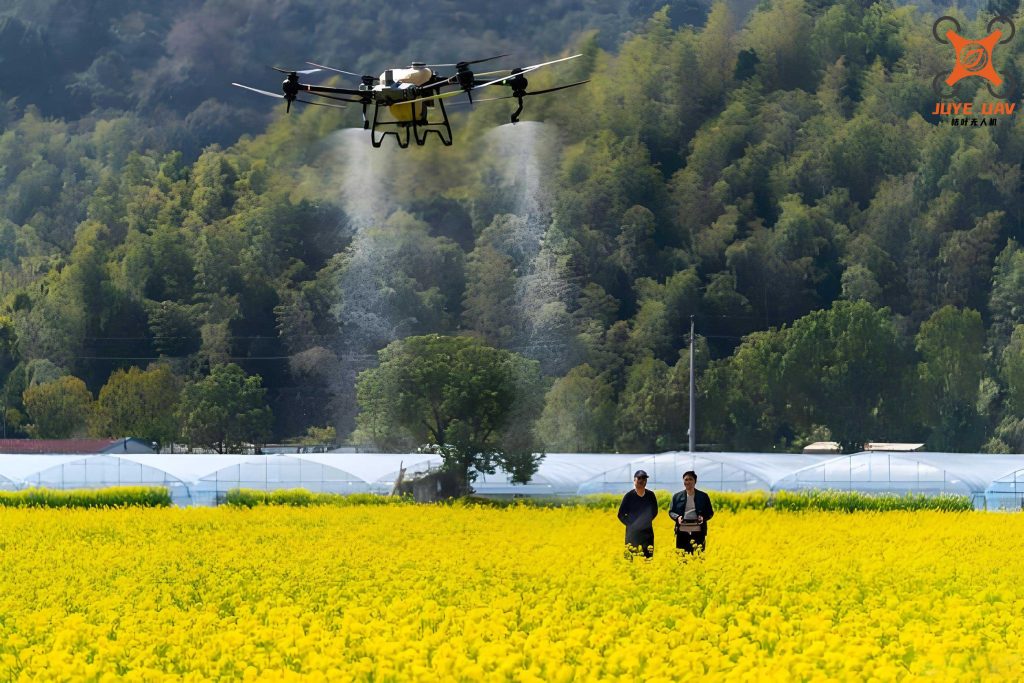
The visual above illustrates an agricultural UAV in action, showcasing its ability to cover vast crop fields efficiently. This image underscores the practical implementation of agricultural UAVs, which is becoming increasingly common in regions like Asia and North America. As adoption grows, the market for agricultural UAVs is projected to expand globally, with compound annual growth rates exceeding 20% in recent years.
| Region | 2015 (Units) | 2020 (Units) | 2025 (Projected, Units) | Primary Crop Applications |
|---|---|---|---|---|
| China | ~5,000 | ~50,000 | ~200,000 | Rice, wheat, corn |
| United States | ~2,000 | ~15,000 | ~60,000 | Corn, soybeans, cotton |
| European Union | ~1,000 | ~10,000 | ~40,000 | Vineyards, cereals |
| South America | ~500 | ~8,000 | ~30,000 | Soybeans, sugarcane |
The growth can be modeled using an exponential function: $$ N(t) = N_0 e^{rt} $$ where \( N(t) \) is the number of agricultural UAVs at time \( t \), \( N_0 \) is the initial count, and \( r \) is the growth rate. For China, \( r \approx 0.4 \) per year from 2015 to 2020, indicating rapid expansion. This trend reflects the increasing recognition of agricultural UAVs as vital tools for sustainable farming.
However, the promotion of agricultural UAVs faces several hurdles. First, cost remains a major barrier: a basic agricultural UAV system costs $5,000 to $10,000, with additional expenses for batteries, training, and maintenance. This high upfront investment is prohibitive for individual farmers, though cooperatives or leasing models can mitigate it. Second, technological limitations, such as the absence of robust anti-collision systems, pose safety risks. For example, the probability of collision \( P_c \) might be estimated as: $$ P_c = \frac{n_{incidents}}{n_{flights}} $$ where \( n_{incidents} \) is the number of collision incidents and \( n_{flights} \) is the total flights. Current data suggests \( P_c \) is low but non-negligible, underscoring the need for enhanced safety features in agricultural UAVs.
Third, regulatory frameworks and technical standards are underdeveloped. Unlike manned aircraft, agricultural UAVs often operate in unregulated airspace, leading to inconsistencies in safety and spraying protocols. Fourth, there is a severe shortage of skilled operators. By 2020, China alone required an estimated 400,000 professionals for agricultural UAV operations, yet training programs are sparse and costly. The demand-supply gap can be expressed as: $$ D – S = \Delta L $$ where \( D \) is demand for operators, \( S \) is supply, and \( \Delta L \) is the labor deficit. For many regions, \( \Delta L > 0 \), hindering the scalability of agricultural UAV services.
| Challenge Category | Specific Issues | Potential Solutions | Impact on Agricultural UAV Adoption |
|---|---|---|---|
| Economic | High purchase and operational costs; limited subsidies | Government incentives (e.g., tax breaks, subsidies); shared economy models (e.g., drone leasing) | Reduces financial burden, accelerates ROI for farmers using agricultural UAVs |
| Technological | Battery life constraints; lack of advanced sensors; safety vulnerabilities | R&D in energy storage (e.g., lithium-sulfur batteries); integration of AI for obstacle avoidance | Enhances reliability and safety of agricultural UAVs, boosting user confidence |
| Regulatory | Absence of unified standards for operations and spraying; airspace management issues | Development of international norms (e.g., ISO standards); collaboration with aviation authorities | Creates a stable environment for scaling agricultural UAV deployments |
| Human Resource | Scarcity of trained pilots and technicians; inadequate training infrastructure | Establishment of certification programs; partnerships with vocational schools; online training platforms | Ensures a skilled workforce to operate and maintain agricultural UAVs effectively |
To address these challenges, a multi-faceted approach is essential. Governments should play a proactive role by offering subsidies for agricultural UAV purchases, similar to those for traditional farm machinery. For instance, a subsidy rate \( s \) (as a percentage of cost) can make agricultural UAVs more accessible: $$ P_{effective} = P_{market} \times (1 – s) $$ where \( P_{effective} \) is the price after subsidy and \( P_{market} \) is the market price. If \( s = 30\% \), the effective price drops significantly, encouraging adoption. Additionally, public-private partnerships can fund R&D to improve agricultural UAV technologies, such as extending flight endurance. The flight time \( T \) of an electric agricultural UAV depends on battery capacity \( C_b \) (in Ah) and power consumption \( P_{cons} \) (in W): $$ T = \frac{C_b \times V}{P_{cons}} $$ where \( V \) is voltage. Innovations like fast-charging batteries or hybrid power systems can increase \( T \), making agricultural UAVs more practical for large farms.
Standardization is another critical area. Organizations should develop guidelines for agricultural UAV operations, covering aspects like spray droplet size (e.g., using the Volume Median Diameter, VMD, formula: $$ VMD = \left( \frac{6V}{\pi \rho} \right)^{1/3} $$ where \( V \) is droplet volume and \( \rho \) is density) to ensure effective pest control. Furthermore, training initiatives must be scaled up. I propose a curriculum that includes hands-on practice with agricultural UAVs, safety protocols, and data analysis. The competency level \( L \) of an operator might be modeled as: $$ L = \alpha \cdot T_{training} + \beta \cdot E_{experience} $$ where \( T_{training} \) is training hours, \( E_{experience} \) is field experience, and \( \alpha, \beta \) are weighting factors. By standardizing \( L \), we can ensure high-quality operations for agricultural UAVs.
Looking ahead, the future of agricultural UAVs is promising, with trends toward autonomy and AI integration. For example, swarm technology could enable multiple agricultural UAVs to collaborate, covering larger areas simultaneously. The efficiency gain from a swarm of \( n \) agricultural UAVs can be approximated as: $$ E_{swarm} = n \times E_{single} \times \eta $$ where \( E_{single} \) is the efficiency of a single agricultural UAV and \( \eta \) is a coordination factor (typically \( 0.8 < \eta < 1 \)). This could revolutionize pest management, especially for outbreaks. Moreover, data collected by agricultural UAVs—such as multispectral imagery—can be analyzed to monitor crop health, predict yields, and optimize inputs. The normalized difference vegetation index (NDVI), calculated from sensor data, is a common metric: $$ NDVI = \frac{NIR – Red}{NIR + Red} $$ where \( NIR \) is near-infrared reflectance and \( Red \) is red-light reflectance. Agricultural UAVs equipped with such sensors provide real-time insights, enabling precision agriculture.
In conclusion, agricultural UAVs represent a cornerstone of modern farming, offering unparalleled efficiency, safety, and environmental benefits. Their development and promotion require concerted efforts from governments, industry, and academia. By addressing cost barriers, enhancing technology, establishing standards, and building human capacity, we can unlock the full potential of agricultural UAVs. As a researcher, I am optimistic that agricultural UAVs will become ubiquitous in global agriculture, driving sustainability and food security. The journey ahead involves continuous innovation and collaboration, but the rewards—such as reduced chemical usage and higher crop yields—make it a worthwhile endeavor for all stakeholders involved in the agricultural UAV ecosystem.