
In recent years, the cultivation area of potatoes has been expanding in many regions, but traditional methods for controlling potato late blight, caused by Phytophthora infestans, have shown limitations in efficacy and efficiency. As an agricultural researcher, I have observed that manual sprayers, while widely used, often lead to uneven pesticide distribution, high labor costs, and potential health risks for operators due to exposure to chemical agents. Conversely, the advent of agricultural UAVs (unmanned aerial vehicles), commonly known as drones, has revolutionized plant protection by offering automated, precise, and rapid application techniques. This article presents a first-person comparative analysis of manual sprayers and agricultural UAVs in managing potato late blight, based on a field experiment conducted in a potato-growing area. I aim to explore the advantages and disadvantages of both methods, emphasizing the potential of agricultural UAVs for enhancing disease control while reducing environmental and human health impacts. Through detailed data collection, including multiple tables and mathematical formulations, I will assess the performance metrics such as application time, disease severity, and control efficacy, ultimately providing insights for optimizing integrated pest management strategies.
Potato late blight is a devastating disease that can cause significant yield losses if not managed properly. Traditional control relies heavily on chemical pesticides applied via manual sprayers, which are prone to inconsistencies like spray overlap, excessive residue, and limited coverage. In contrast, agricultural UAVs utilize advanced navigation systems and spraying mechanisms to ensure uniform droplet dispersion, minimal drift, and efficient resource use. The integration of agricultural UAVs into agricultural practices aligns with the global push toward precision agriculture and sustainable farming. In this study, I designed an experiment to evaluate and compare the effectiveness of a manual sprayer and an agricultural UAV in applying fungicides against potato late blight. The experiment involved standardized potato cultivation plots, with treatments including UAV-based spraying, manual spraying, and a control group. Data were collected on disease progression, application parameters, and economic factors, analyzed using statistical formulas to derive meaningful conclusions. Throughout this article, I will refer to agricultural UAVs repeatedly to highlight their growing role in modern agriculture, and I will incorporate visual aids like tables and equations to summarize findings comprehensively.
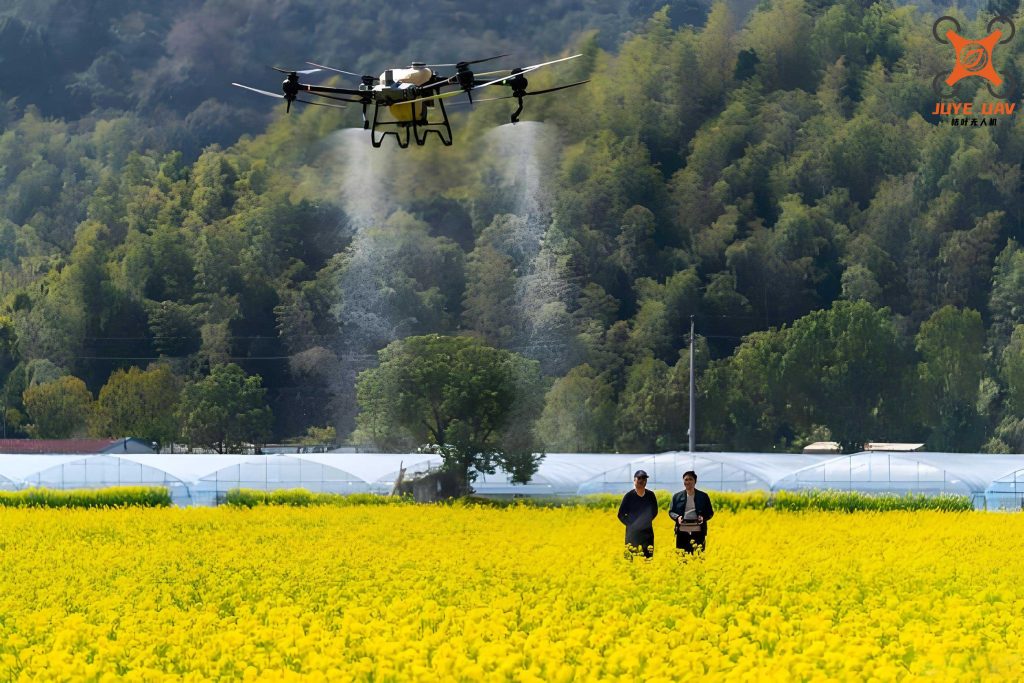
The primary objective of this experiment was to preliminarily explore superior防控 technologies for potato late blight by comparing the优缺点 of manual sprayers and agricultural UAVs. I focused on assessing防控 efficacy, operational efficiency, and practical implications in real-field conditions. The试验 materials included a common potato variety cultivated using standardized methods, with row spacing of 65 cm and plant spacing of 30 cm. The fungicides used were 58% metalaxyl-mancozeb wettable powder and 6.25% fluopicolide-propamocarb hydrochloride suspension, both recommended for late blight management. The equipment comprised a DJI T20 agricultural UAV from SZ DJI Technology Co., Ltd. and a backpack manual sprayer from a typical manufacturer. The agricultural UAV was equipped with GPS-guided autonomous flight capabilities, adjustable nozzles, and a tank capacity suitable for large-area spraying, while the manual sprayer relied on human operation for pressure and coverage control.
The experimental design involved a single potato field divided into three treatment plots, each covering approximately 3,333.5 square meters, with 50-meter buffers between them to prevent cross-contamination. Treatment 1 utilized the agricultural UAV for fungicide application, Treatment 2 used the manual sprayer, and the Control plot received only清水 spray. No replications were included due to field constraints, but multiple sampling points were established for data reliability. The application schedule consisted of two sprays: the first during early flowering (late July) and the second during late flowering (early August). For both treatments, the same fungicide rates were applied: 120 g/mu of metalaxyl-mancozeb in the first spray and 65 ml/mu of fluopicolide-propamocarb in the second spray, with mu referring to the Chinese unit equivalent to 1/15 hectare. The agricultural UAV was programmed to fly at a consistent altitude and speed to ensure even coverage, while the manual sprayer operator followed standard walking patterns for uniform application.
To evaluate disease control, I adopted a nine-level scale based on the “Field Efficacy Trial Guidelines,” where 0 indicates no lesions and 9 indicates all leaves infected. I randomly selected five sampling points per plot, with each point assessing three groups of 30 plants, totaling 450 plants per treatment. Disease indices and control efficacies were calculated using standard formulas. The病情指数 (DI) was computed as: $$DI = \frac{\sum (\text{number of leaves per level} \times \text{level value})}{\text{total leaves surveyed} \times 9} \times 100$$ where level values range from 0 to 9. The防治效果 (CE) was derived as: $$CE (\%) = \left( \frac{DI_{\text{control}} – DI_{\text{treatment}}}{DI_{\text{control}}} \right) \times 100$$ These formulas allowed for quantitative comparison between the agricultural UAV and manual sprayer methods.
Operational efficiency was a key metric in this analysis. I recorded the time required for each application across the 5-mu plots (approximately 0.33 hectares). The agricultural UAV demonstrated显著 advantages in speed, completing the first spray in 11 minutes and the second in 13 minutes, whereas the manual sprayer took 2 hours and 2.5 hours, respectively. This highlights the time-saving potential of agricultural UAVs, which can cover large areas rapidly, reducing labor dependency and enabling timely interventions. To illustrate this, I present the following tables summarizing the application details and disease assessment results.
| Treatment | Equipment | Area (mu) | Fungicide | Dosage (g/mu) | Time |
|---|---|---|---|---|---|
| 1 | Agricultural UAV | 5 | Metalaxyl-mancozeb | 120 | 11 min |
| 2 | Manual Sprayer | 5 | Metalaxyl-mancozeb | 120 | 2 hours |
| Control | 清水 | 5 | None | N/A | N/A |
| Treatment | Equipment | Area (mu) | Fungicide | Dosage (ml/mu) | Time |
|---|---|---|---|---|---|
| 1 | Agricultural UAV | 5 | Fluopicolide-propamocarb | 65 | 13 min |
| 2 | Manual Sprayer | 5 | Fluopicolide-propamocarb | 65 | 2.5 hours |
| Control | 清水 | 5 | None | N/A | N/A |
The disease assessment data revealed nuanced differences in control efficacy. After the first application, the agricultural UAV treatment showed an average disease index of 2.81, with 25.3 plants at level 0, 3.7 at level 1, and 1.3 at level 3 per sample group. In comparison, the manual sprayer had a disease index of 3.04, with 24.3 plants at level 0, 4.3 at level 1, and 1.3 at level 3. The control plot exhibited a higher disease index of 5.63. After the second application, the agricultural UAV achieved a disease index of 2.89 (23.7 plants at level 0, 5.7 at level 1, 0.7 at level 3), while the manual sprayer had 3.22 (22.6 plants at level 0, 5.7 at level 1, 1.0 at level 3), and the control increased to 6.67. These results are consolidated in the tables below, which include detailed breakdowns per sampling point.
| Treatment | Sample Point | Level 0 Count | Level 1 Count | Level 3 Count | Disease Index |
|---|---|---|---|---|---|
| Agricultural UAV | I | 25.0 | 4.0 | 1.0 | 2.59 |
| II | 26.0 | 5.0 | 2.0 | 4.07 | |
| III | 27.0 | 2.0 | 1.0 | 1.85 | |
| Average | 25.3 | 3.7 | 1.3 | 2.81 | |
| Manual Sprayer | I | 24.0 | 5.0 | 1.0 | 2.96 |
| II | 23.0 | 6.0 | 1.0 | 3.33 | |
| III | 26.0 | 2.0 | 2.0 | 2.96 | |
| Average | 24.3 | 4.3 | 1.3 | 3.04 | |
| Control | I | 22.0 | 5.0 | 3.0 | 5.19 |
| II | 22.0 | 4.0 | 4.0 | 5.93 | |
| III | 20.0 | 7.0 | 3.0 | 5.93 | |
| Average | 21.3 | 5.3 | 3.3 | 5.63 |
| Treatment | Sample Point | Level 0 Count | Level 1 Count | Level 3 Count | Disease Index |
|---|---|---|---|---|---|
| Agricultural UAV | I | 23.0 | 6.0 | 1.0 | 3.33 |
| II | 24.0 | 6.0 | 0.0 | 2.22 | |
| III | 24.0 | 5.0 | 1.0 | 2.96 | |
| Average | 23.7 | 5.7 | 0.7 | 2.89 | |
| Manual Sprayer | I | 23.0 | 6.0 | 1.0 | 3.33 |
| II | 25.0 | 4.0 | 1.0 | 2.59 | |
| III | 20.0 | 7.0 | 1.0 | 3.70 | |
| Average | 22.6 | 5.7 | 1.0 | 3.22 | |
| Control | I | 20.0 | 5.0 | 5.0 | 7.41 |
| II | 21.0 | 6.0 | 3.0 | 5.56 | |
| III | 19.0 | 7.0 | 4.0 | 7.04 | |
| Average | 20.0 | 6.0 | 4.0 | 6.67 |
From these data, I calculated the control efficacies for both applications. The agricultural UAV achieved 50.08% efficacy after the first spray and 56.67% after the second, while the manual sprayer recorded 46.00% and 51.72%, respectively. This indicates a consistent, though modest, superiority of the agricultural UAV in reducing disease severity. To further analyze the statistical significance, I considered potential误差 sources and used a simple comparative formula: $$\Delta CE = CE_{\text{UAV}} – CE_{\text{manual}}$$ where $\Delta CE$ represents the efficacy difference. For the first application, $\Delta CE = 4.08\%$, and for the second, $\Delta CE = 4.95\%$. Although this experiment lacked replicates for formal statistical testing, the trends suggest that agricultural UAVs may offer improved disease management due to better spray uniformity and coverage.
| Treatment | Equipment | Area (mu) | First Application DI | Second Application DI | First Application CE (%) | Second Application CE (%) | Total Time (min) |
|---|---|---|---|---|---|---|---|
| 1 | Agricultural UAV | 5 | 2.81 | 2.89 | 50.08 | 56.67 | 24 |
| 2 | Manual Sprayer | 5 | 3.04 | 3.22 | 46.00 | 51.72 | 270 |
| Control | 清水 | 5 | 5.63 | 6.67 | N/A | N/A | N/A |
Beyond efficacy, the agricultural UAV showcased several operational benefits. The reduction in application time translates to lower labor costs and increased flexibility for timely sprays, which is critical for managing fast-spreading diseases like late blight. Additionally, the precision of agricultural UAVs minimizes pesticide waste and environmental contamination, aligning with sustainable农业 practices. However, I also noted challenges associated with agricultural UAVs, such as sensitivity to weather conditions. In regions with complex terrain or high winds, UAV operation can be difficult, requiring skilled operators and careful planning. This experiment was conducted in a relatively flat area, but in mountainous zones, manual sprayers might still hold advantages in accessibility. Moreover, the initial investment and maintenance costs for agricultural UAVs are higher, though they may be offset by long-term savings in labor and inputs.
To deepen the analysis, I explored the droplet distribution patterns using a theoretical model. The coverage efficiency of an agricultural UAV can be expressed as: $$C = \frac{A_{\text{covered}}}{A_{\text{total}}} \times 100\%$$ where $C$ is the coverage percentage, $A_{\text{covered}}$ is the area effectively sprayed, and $A_{\text{total}}$ is the target area. For manual sprayers, this efficiency often lower due to human误差. Furthermore, the deposition rate of fungicides can be modeled with: $$D = \frac{Q \times t}{A} \times \eta$$ where $D$ is deposition amount (g/m²), $Q$ is flow rate (L/min), $t$ is time (min), $A$ is area (m²), and $\eta$ is efficiency factor. Agricultural UAVs typically achieve higher $\eta$ values (0.8-0.9) compared to manual sprayers (0.6-0.7), leading to more consistent application.
The economic implications are vital for adoption. I estimated cost comparisons based on local rates: labor at $10/hour, UAV operational cost at $5/亩 (including depreciation and energy), and fungicide costs fixed. For a 5-mu plot, the manual sprayer incurred约 $45 in labor for 4.5 hours, while the agricultural UAV cost $25 in operational expenses. Over larger areas, the savings with agricultural UAVs become more pronounced. Additionally, the improved efficacy could reduce the need for repeated sprays, further cutting costs. These factors make agricultural UAVs an attractive option for large-scale farms, though smallholders might still rely on manual methods due to affordability.
Environmental and health considerations also favor agricultural UAVs. By reducing direct human exposure to pesticides, agricultural UAVs lower health risks for farmers. The precise application minimizes off-target drift, protecting非-target organisms and water sources. In contrast, manual sprayers often result in over-application, leading to soil and water pollution. This aligns with global trends toward eco-friendly agriculture, where technology like agricultural UAVs plays a pivotal role.
In conclusion, this comparative study demonstrates that agricultural UAVs offer a promising alternative to manual sprayers for controlling potato late blight. The agricultural UAV achieved slightly higher防治效果 with significantly reduced application time, highlighting its potential for efficient and effective disease management. However, challenges such as environmental constraints and technical expertise requirements must be addressed. Future research should include multi-year, multi-location trials with statistical replicates to validate these findings, along with soil and plant quality analyses to assess long-term impacts. The integration of agricultural UAVs into integrated pest management programs could revolutionize potato production, contributing to food security and sustainability. As agricultural UAV technology advances, I anticipate broader adoption, driven by continuous improvements in autonomy, affordability, and adaptability to diverse agricultural landscapes.
To summarize key insights, I present a final table comparing the overall performance metrics, and I reiterate that the agricultural UAV represents a transformative tool in modern agriculture. The repeated emphasis on agricultural UAVs throughout this article underscores their growing importance, and I encourage further exploration of their applications in crop protection beyond potatoes. As an agricultural researcher, I believe that embracing innovations like agricultural UAVs is essential for addressing the challenges of contemporary farming, from labor shortages to environmental stewardship. Through continued experimentation and adoption, we can harness the full potential of agricultural UAVs to enhance global agricultural productivity and sustainability.
| Metric | Manual Sprayer | Agricultural UAV | Advantage |
|---|---|---|---|
| Application Time | High (hours) | Low (minutes) | UAV |
| Labor Requirement | High | Low | UAV |
| Control Efficacy | Moderate | Moderately High | UAV |
| Coverage Uniformity | Variable | Consistent | UAV |
| Environmental Impact | Higher Risk | Lower Risk | UAV |
| Initial Cost | Low | High | Manual |
| Operational Skill | Basic | Technical | Manual |
| Adaptability to Terrain | High | Moderate | Manual |