
In recent years, I have closely observed the rapid adoption and evolution of agricultural UAVs (unmanned aerial vehicles) in modern farming practices. These technological advancements have revolutionized crop protection methods, shifting from traditional manual sprayers to sophisticated autonomous systems. This article aims to provide a detailed examination of the current status, challenges, and future prospects of agricultural UAVs, drawing from extensive field research and data analysis. The integration of agricultural UAVs into precision agriculture represents a significant leap toward sustainable and efficient farming, offering solutions to labor shortages, environmental concerns, and productivity demands. Through this first-person perspective, I will delve into various aspects, supported by tables and mathematical models to summarize key findings.
The proliferation of agricultural UAVs began around 2018, when they were introduced as a game-changer in crop spraying. Initially, farmers relied on backpack sprayers and self-propelled boom sprayers, but the agility and efficiency of agricultural UAVs quickly garnered attention. In the region studied, the number of agricultural UAVs has grown exponentially, with over 120 units deployed by the end of 2020, covering approximately 80,000 hectares annually. This growth trajectory continues, fueled by increasing awareness and technological improvements. The adoption of agricultural UAVs is not just a trend but a transformative shift in agricultural mechanization, enabling farmers to tackle large-scale operations with unprecedented precision. The following table summarizes the market brands and their specifications prevalent in the area, illustrating the diversity and capabilities of these systems.
| Brand | Payload Capacity (kg) | Price Range (USD) | Type | Key Features |
|---|---|---|---|---|
| DJI | 10-16 | 3,000-10,000 | Multi-rotor | High performance, advanced navigation |
| XAG | 10-16 | 4,000-8,000 | Multi-rotor | Precision spraying, long battery life |
| Hanhe | 10 | 3,500-7,000 | Fixed-wing | Stable flight, suitable for large fields |
| Quanfeng | 16 | 5,000-9,000 | Multi-rotor | Durable design, multi-functional |
| TY Brothers | 10 | 3,000-6,000 | Multi-rotor | Cost-effective, user-friendly |
| Gaoke Xinnong | 10-16 | 4,000-8,000 | Multi-rotor | Intelligent control, high efficiency |
The operational efficiency of agricultural UAVs can be quantified using mathematical models. For instance, the daily coverage area (A) in hectares per day is given by:
$$ A = \frac{T_d}{T_f} \times A_f \times N_b $$
where (T_d) is the daily operational time in minutes, (T_f) is the flight time per battery charge in minutes, (A_f) is the area covered per flight in hectares, and (N_b) is the number of batteries available. Assuming typical values: (T_d = 480 \text{ minutes} ) (8 hours), (T_f = 10 \text{ minutes}), (A_f = 0.6 \text{ hectares}), and (N_b = 4), we get:
$$ A = \frac{480}{10} \times 0.6 \times 4 = 115.2 \text{ hectares per day} $$
This demonstrates the superior speed of agricultural UAVs compared to manual methods, which average only 2-3 hectares per day. The efficiency gain is further amplified by reduced labor costs and timely interventions during pest outbreaks.
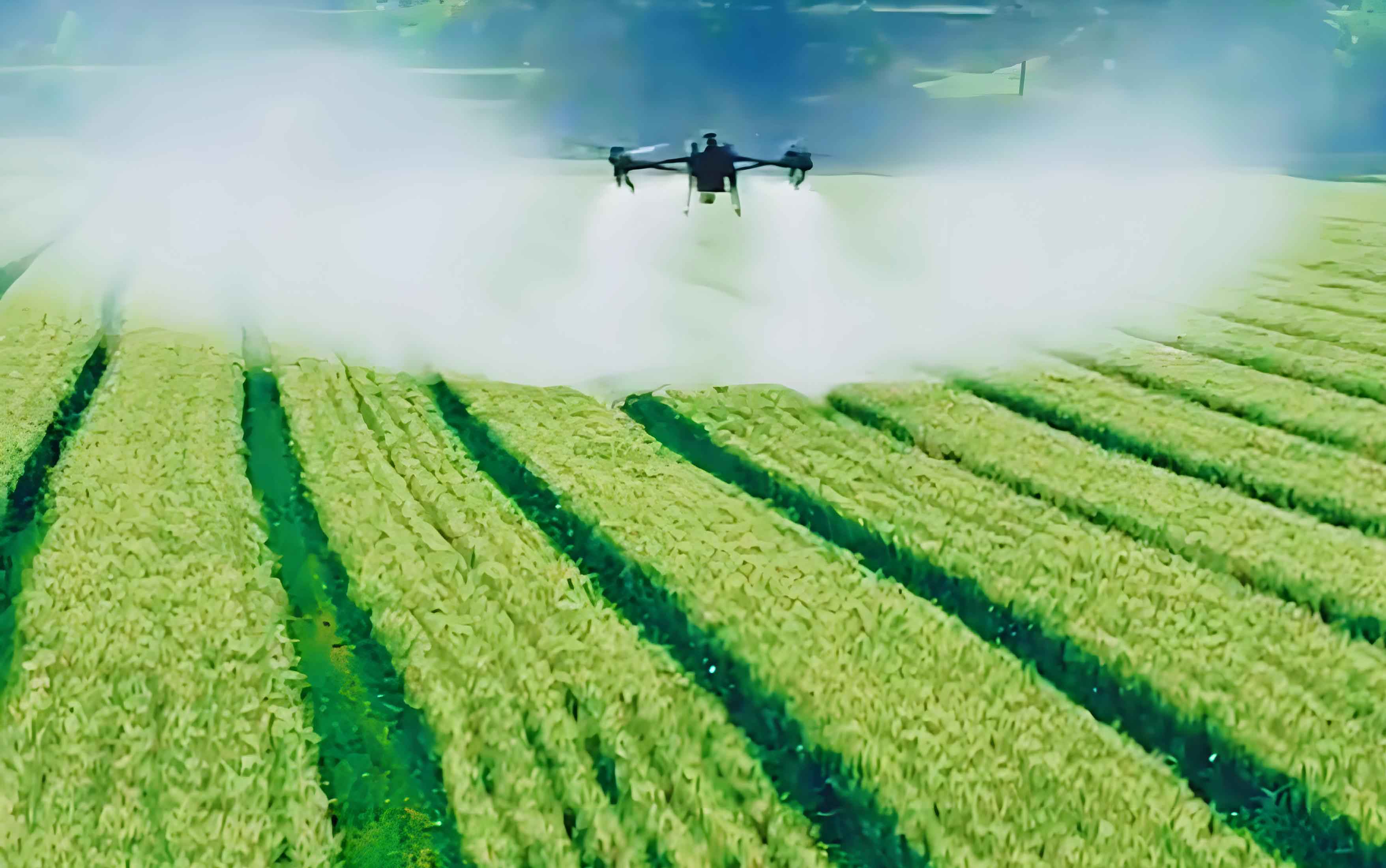
In my analysis, I have identified several new developments and issues arising from the use of agricultural UAVs. Firstly, safety and practicality are paramount. Operators conduct pre-flight checks to ensure all components are functional, then set parameters like flight height, speed, and spray width based on field topography. Advanced agricultural UAVs can autonomously avoid obstacles such as poles and trees, making operations smoother for skilled pilots. Statistics show that a well-maintained agricultural UAV can cover up to 1,000 hectares annually, providing substantial income for owners. Secondly, the speed of aerial spraying enables large-scale unified pest control. During emergencies, like the 2019 pandemic, agricultural UAVs proved invaluable by allowing rapid treatment without human aggregation, preventing pest resurgence and reducing chemical usage. The speed factor is critical; for example, a 10 kg payload agricultural UAV can spray 0.53-0.67 hectares per sortie in 8-10 minutes, translating to 40-60 times faster than manual spraying. This is mathematically expressed as:
$$ \text{Speed Ratio} = \frac{\text{Coverage Rate of UAV}}{\text{Coverage Rate of Manual}} \approx \frac{46.67 \text{ ha/day}}{0.75 \text{ ha/day}} \approx 62.2 $$
Thirdly, the technological sophistication of agricultural UAVs promotes water and pesticide savings. Through remote control and real-time video, operators can monitor spraying accuracy. The downwash generated by rotors enhances pesticide penetration into crop canopies, reaching stems and roots. Water consumption is dramatically lower—about 1/40th of traditional sprayers. For instance, manual sprayers use 40 liters per 0.067 hectares, while a 10-liter agricultural UAV covers 0.53-0.67 hectares. Pesticide usage can be reduced by up to 30% while maintaining efficacy, as shown in the formula for chemical savings (S):
$$ S = \left(1 – \frac{C_u}{C_m}\right) \times 100\% $$
where (C_u) is the pesticide concentration per hectare for agricultural UAVs and (C_m) for manual methods. With typical values, (S \approx 30\%). This aligns with sustainable farming goals, minimizing environmental impact. Fourthly, network informatization enhances management. Mobile apps provide detailed data on field locations, area covered, and flight paths, facilitating precise record-keeping and optimization. The integration of IoT (Internet of Things) in agricultural UAVs allows for real-time data transmission, improving decision-making processes.
Despite these advantages, agricultural UAVs face several challenges that require attention. One major issue is the lack of multifunctionality. Most agricultural UAVs are designed solely for liquid spraying, limiting their utility for tasks like seeding, fertilization, or pollination. To address this, I propose developing interchangeable modules, such as variable tanks or attachments, that can be swapped based on crop needs. For example, a modular agricultural UAV could switch between spraying and granular spreading, expanding its applications. This can be modeled as a cost-benefit analysis:
$$ \text{Net Benefit} = \sum_{i=1}^{n} (R_i – C_i) $$
where (R_i) is the revenue from task (i) (e.g., spraying, seeding) and (C_i) is the cost, including module changes. Another problem is the limitation in pesticide formulations. Powdery agents often clog nozzles, restricting the use of certain chemicals. Improving nozzle design to accommodate diverse formulations is essential. Research into anti-clogging mechanisms, such as self-cleaning nozzles or adjustable apertures, could enhance versatility. Additionally, battery technology remains a bottleneck. Current batteries for agricultural UAVs have short lifespans—typically 200-300 charge cycles—and require frequent recharging (20-30 minutes per charge). This reduces operational continuity during peak seasons. Upgrading to high-capacity, fast-charging batteries with longer lifecycles would significantly boost efficiency. The energy density (E) in Wh/kg can be optimized:
$$ E = \frac{P \times T}{W} $$
where (P) is power in watts, (T) is flight time in hours, and (W) is battery weight in kg. Advancements in lithium-sulfur or solid-state batteries could push (E) beyond 400 Wh/kg, compared to current 200-300 Wh/kg. Furthermore, portability issues arise from bulky designs. I recommend lightweight, foldable frames that minimize storage space and ease transportation, without compromising durability.
To promote the wider adoption of agricultural UAVs, new strategies and measures are necessary. Firstly, enhanced publicity and demonstrations are crucial. In many regions, farmers—particularly older generations—remain skeptical of high-tech solutions due to lack of exposure. Organizing live field demonstrations can showcase the effectiveness of agricultural UAVs, building trust and awareness. For instance, comparative trials between traditional methods and agricultural UAVs can highlight benefits like faster coverage and cost savings. Secondly, training skilled operators is vital. The shortage of proficient pilots hampers scalability; as of 2020, only about 30 expert flyers were available for over 80 agricultural UAVs in the studied area. Establishing training schools, in collaboration with manufacturers and local authorities, can cultivate talent in operation, maintenance, and safety. A curriculum should cover pesticide science, flight mechanics, and troubleshooting. The success rate (SR) of training programs can be expressed as:
$$ SR = \frac{N_s}{N_t} \times 100\% $$
where (N_s) is the number of successful graduates and (N_t) is the total trainees. Targeting (SR > 90\%) would ensure a competent workforce. Thirdly, policy support, such as subsidies for agricultural UAV purchases or insurance schemes, can lower entry barriers for smallholder farmers. Data from pilot projects show that incentive programs increase adoption rates by up to 50% within two years.
The future prospects for agricultural UAVs are promising, driven by technological innovation and increasing agricultural demands. In the analyzed region, with over 100,000 hectares of arable land, the current penetration rate of agricultural UAVs is below 20%, indicating vast growth potential. As land consolidation accelerates, large-scale farms will seek automated solutions for precision agriculture. The need for upgrades and replacements of early-generation agricultural UAVs further fuels market expansion. I anticipate that next-generation agricultural UAVs will incorporate AI (artificial intelligence) and machine learning for autonomous decision-making, such as real-time pest detection and variable-rate spraying. The economic impact can be projected using a growth model:
$$ N(t) = N_0 \times e^{rt} $$
where (N(t)) is the number of agricultural UAVs at time (t), (N_0) is the initial count, and (r) is the growth rate. Assuming (N_0 = 120) and (r = 0.15) (15% annual growth), in 5 years:
$$ N(5) = 120 \times e^{0.15 \times 5} \approx 120 \times e^{0.75} \approx 120 \times 2.117 \approx 254 \text{ agricultural UAVs} $$
This growth will be complemented by advancements in sustainability. Agricultural UAVs contribute to reduced chemical runoff and soil compaction, aligning with global eco-friendly initiatives. Moreover, integration with other smart farming technologies, like drones for monitoring and IoT sensors, will create holistic agricultural systems. The table below summarizes key trends and expected developments in agricultural UAV technology.
| Trend | Description | Expected Timeline | Impact on Efficiency |
|---|---|---|---|
| AI Integration | Autonomous pest detection and spraying | 2023-2025 | Increase coverage by 30% |
| Battery Innovation | Solid-state batteries with longer life | 2024-2026 | Reduce downtime by 50% |
| Modular Design | Interchangeable parts for multi-tasking | 2022-2024 | Expand applications by 40% |
| 5G Connectivity | Real-time data transmission and control | 2023-2025 | Improve accuracy by 25% |
| Environmental Sensors | Monitoring crop health and soil conditions | 2022-2024 | Enhance decision-making by 35% |
In conclusion, my analysis underscores the transformative role of agricultural UAVs in modern agriculture. From improving operational efficiency to promoting environmental stewardship, these systems offer a pathway to sustainable productivity. However, addressing challenges like multifunctionality and battery limitations is essential for unlocking their full potential. Through targeted training, policy support, and continuous innovation, agricultural UAVs will undoubtedly become a cornerstone of precision farming. As I reflect on the data and observations, it is clear that the adoption of agricultural UAVs is not merely a technological shift but a necessary evolution to meet the food security demands of the future. The journey of agricultural UAVs from niche tools to mainstream assets exemplifies the synergy between technology and agriculture, paving the way for a more resilient and efficient farming landscape.