
In the context of modern agricultural science and technology development, high-tech agricultural machinery has become increasingly integral to farming operations. Among these, agricultural UAVs (Unmanned Aerial Vehicles), particularly for plant protection, have seen widespread adoption. My research focuses on the hands-on assembly, debugging, and practical application of agricultural UAVs, aiming to provide a comprehensive reference for their utilization and advancement. Through this study, I delve into the intricacies of building a functional quadcopter from components, conducting software calibration, and implementing training methodologies to enhance operational skills. The findings underscore the potential of agricultural UAVs in improving efficiency, safety, and innovation in agriculture and beyond.
The proliferation of agricultural UAVs is driven by their simplicity of operation, high作业 efficiency, and reliability in crop protection tasks. By allowing operators to maintain a safe distance from pesticide spraying, these drones significantly reduce health risks. Currently, most agricultural UAVs in the market are sold as finished products; however, assembling one from parts offers deeper insights into their mechanics and functionality. This approach not only fosters practical skills but also encourages customization for specific applications. In this article, I detail the assembly process, software debugging, training techniques, and broader applications, emphasizing the keyword “agricultural UAV” throughout to highlight its relevance.
Assembly of Agricultural UAV: Materials and Process
The assembly of an agricultural UAV begins with gathering essential components. These include a flight controller (main chip), accelerometer, gyroscope, barometric altitude sensor, GPS module, wireless communication module, electronic speed controllers (ESCs), and brushless DC motors. Additional parts such as the frame, battery mount, landing gear, and plant protection equipment (e.g., sprayers) are also required. Table 1 summarizes the key materials and their functions, which are crucial for ensuring the agricultural UAV operates effectively in field conditions.
| Component | Function | Specifications/Notes |
|---|---|---|
| Flight Controller | Processes sensor data and controls flight stability | Often includes IMU (Inertial Measurement Unit) |
| Accelerometer | Measures linear acceleration | Integrated with gyroscope for attitude estimation |
| Gyroscope | Measures angular velocity | Essential for orientation control |
| Barometric Sensor | Estimates altitude based on air pressure | Used in altitude hold modes |
| GPS Module | Provides positioning and navigation data | Enables waypoint missions and return-to-home |
| Wireless Module | Facilitates communication with ground station | Typically uses 2.4 GHz or 900 MHz frequencies |
| Electronic Speed Controller (ESC) | Controls motor speed based on flight controller signals | Converts DC power to three-phase AC for motors |
| Brushless DC Motor | Provides thrust for lift and maneuverability | Selected based on kV rating and propeller size |
| Frame | Structural support for all components | Often made of carbon fiber or aluminum for lightness |
| Battery | Power source, typically LiPo | Capacity (mAh) and voltage (S) affect flight time |
| Plant Protection Equipment | Spraying system for pesticides or fertilizers | Includes tank, pump, and nozzles |
The assembly process involves several meticulous steps to ensure safety and functionality. First, I solder the power lines of the ESCs and power module to the power distribution board, checking for short circuits or open connections with a multimeter to prevent electrical faults. Next, I assemble the frame, battery mount, and landing gear, securing them tightly with screws. Motors are then mounted at the ends of the arms using motor brackets, following a specific rotation sequence: starting from the right front motor and moving counterclockwise, the rotations alternate between counterclockwise and clockwise (e.g., CCW, CW, CCW, CW). After connecting the motors to the ESCs, if a motor spins in the wrong direction, I swap any two of the three wires between the ESC and motor to correct it.
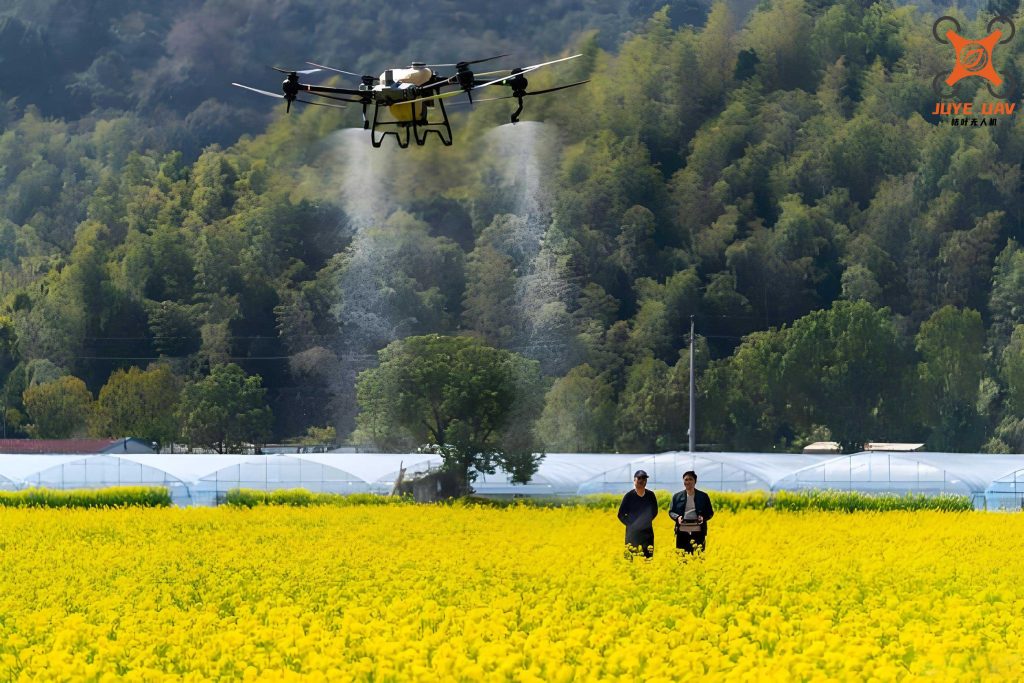
The flight controller is attached to a vibration-damping plate using double-sided tape, with the receiver on one side and the GPS module on the other. This setup minimizes vibrations that could interfere with sensor accuracy. Once the core assembly is complete, external plant protection devices are installed, such as spray tanks and nozzles, tailored for agricultural UAV applications. The initial assembly phase culminates in a preliminary structure ready for software debugging, as shown in the image below, which illustrates a typical agricultural UAV during assembly.
Software Debugging and Calibration for Agricultural UAV
After physical assembly, software calibration is critical to harmonize the components of the agricultural UAV. This involves calibrating the flight controller, GPS compass, accelerometer, compass, and remote controller. Proper calibration ensures stable flight and accurate navigation, which are vital for agricultural tasks like precise spraying. I use open-source software (e.g., Mission Planner or Betaflight) to perform these calibrations, following a systematic approach.
First, I calibrate the flight controller by connecting it to a computer via USB and running the calibration wizard. This process zeros the sensors to account for offsets. The accelerometer calibration requires placing the agricultural UAV on a level surface and following on-screen instructions to capture data points. Similarly, the compass calibration involves rotating the UAV around all axes to magnetically align it, reducing interference from external magnetic fields. For the GPS module, I ensure it has a clear view of the sky to acquire satellite signals, and calibrate its position relative to the flight controller.
Remote controller calibration is equally important. I set the transmitter to a specific sequence (e.g., down, down, up, up, up, down) to enter calibration mode, then center all sticks and switches. In the software, I select the remote calibration option and map each channel (e.g., throttle, yaw, pitch, roll) to corresponding controls. Flight modes, such as stabilized, altitude hold, and position hold, are configured to enhance the agricultural UAV’s autonomy during operations. Table 2 outlines the key calibration steps and their purposes, emphasizing how they contribute to the reliability of agricultural UAV systems.
| Calibration Type | Procedure | Purpose |
|---|---|---|
| Flight Controller Calibration | Connect to software, follow wizard to zero sensors | Ensures accurate attitude and position estimation |
| Accelerometer Calibration | Place UAV level and capture data points | Corrects for gravitational offsets |
| Compass Calibration | Rotate UAV in multiple directions | Aligns magnetic sensors for proper heading |
| GPS Calibration | Ensure satellite lock and set home position | Enables precise navigation and return-to-home |
| Remote Controller Calibration | Set sticks to center and map channels | Allows precise control input translation |
| Flight Mode Configuration | Assign modes to switches (e.g., stabilized, altitude hold) | Enhances operational flexibility and stability |
Once calibrated, I conduct a test flight in a safe, open area to verify the agricultural UAV’s performance. This includes checking takeoff, hovering, and landing stability, as well as responsiveness to controls. Any issues, such as drift or unstable flight, are addressed by re-calibrating or adjusting PID (Proportional-Integral-Derivative) gains in the flight controller software. The PID controller governs the agricultural UAV’s dynamics, and its tuning can be expressed mathematically. For instance, the control output for attitude stabilization can be modeled as:
$$ u(t) = K_p e(t) + K_i \int_0^t e(\tau) d\tau + K_d \frac{de(t)}{dt} $$
where \( u(t) \) is the control signal (e.g., motor thrust), \( e(t) \) is the error between desired and actual attitude, and \( K_p \), \( K_i \), \( K_d \) are tuning constants. Proper tuning ensures the agricultural UAV maintains stability even under disturbances like wind, which is crucial for agricultural spraying where consistent altitude and position are needed.
Training Methodology for Agricultural UAV Operation
Effective operation of an agricultural UAV requires comprehensive training, encompassing theoretical knowledge and practical skills. I design training programs that start with understanding the agricultural UAV’s structure, systems, and relevant regulations, then progress to simulation-based practice and real-flight exercises. This phased approach minimizes risks and builds confidence among trainees, who are often students or new operators.
Initially, trainees learn about the agricultural UAV’s components, as detailed in Table 1, and study flight principles such as aerodynamics and control theory. Key concepts include lift generation, which for a propeller-driven agricultural UAV can be approximated by:
$$ T = \frac{1}{2} \rho A v^2 C_T $$
where \( T \) is thrust, \( \rho \) is air density, \( A \) is propeller disk area, \( v \) is airflow velocity, and \( C_T \) is thrust coefficient. Understanding these principles helps trainees anticipate how the agricultural UAV behaves under different loads, such as when carrying spray tanks.
Regulatory knowledge is also emphasized. Trainees study local policies, such as no-fly zones, altitude restrictions, and weather considerations, to ensure safe and legal operations. For example, many regions require agricultural UAV operators to obtain certifications or follow specific guidelines for agricultural spraying. This legal awareness is integrated into training modules to foster responsible use of agricultural UAV technology.
To develop hands-on skills, I incorporate flight simulators that replicate various environmental conditions. Trainees practice basic maneuvers like takeoff, landing, hovering, and waypoint navigation in virtual settings, which reduces the risk of damaging actual agricultural UAVs during early learning stages. Simulators also allow exposure to challenging scenarios, such as high winds or equipment failures, enhancing decision-making abilities. Once proficiency is achieved in simulation, trainees transition to real agricultural UAV flights, starting with simple exercises in controlled environments and gradually advancing to complex tasks like crop spraying or inspection missions.
Table 3 summarizes the training phases and their objectives, highlighting how each step contributes to mastering agricultural UAV operation.
| Training Phase | Content | Objectives |
|---|---|---|
| Theoretical Learning | UAV structure, aerodynamics, regulations | Build foundational knowledge and safety awareness |
| Simulator Practice | Virtual flight in varied conditions | Develop control skills and risk-free experience |
| Real-Flight Basics | Hands-on hovering, takeoff, landing | Gain confidence with physical UAV dynamics |
| Advanced Operations | Spraying missions, obstacle avoidance | Apply skills to practical agricultural tasks |
| Regulatory Compliance | Legal requirements and certification | Ensure lawful and safe UAV usage |
Analysis of Training Outcomes and Skill Enhancement
Through the assembly and training processes, I observe significant improvements in trainees’ capabilities. These outcomes are analyzed in terms of practical动手 ability, flight操控 skills, and innovation potential, all centered around agricultural UAV applications. The hands-on assembly of an agricultural UAV fosters a deep understanding of its mechanics, as trainees must troubleshoot issues like wiring errors or sensor misalignments. This enhances their problem-solving skills and technical proficiency, which are transferable to other engineering domains.
In terms of flight操控, trainees who progress from simulators to real agricultural UAVs demonstrate better situational awareness and control precision. For instance, they learn to adjust flight parameters based on real-time feedback, such as battery voltage or wind speed. The performance of an agricultural UAV in spraying missions can be quantified by metrics like coverage area and efficiency. The spray coverage \( C \) over a field area \( A_f \) can be modeled as:
$$ C = \frac{Q t}{A_f} \times \eta $$
where \( Q \) is flow rate of the spray system, \( t \) is flight time, and \( \eta \) is efficiency factor accounting for overlaps and misses. Trainees optimize these parameters through practice, leading to more effective agricultural UAV deployments.
Moreover, exposure to agricultural UAV technology stimulates创新创业能力. Trainees often identify opportunities to expand UAV applications beyond plant protection, such as in infrastructure inspection or environmental monitoring. For example, in power line inspection, an agricultural UAV equipped with cameras can capture high-resolution images, and the data analysis involves algorithms for detecting faults. This interdisciplinary approach encourages trainees to develop new solutions, leveraging the versatility of agricultural UAV platforms. The economic impact of agricultural UAVs can be assessed through cost-benefit analysis, where savings from reduced labor and increased crop yield are weighed against initial investment and maintenance costs.
To illustrate the skill progression, Table 4 compares pre- and post-training competencies in key areas related to agricultural UAV operation.
| Skill Area | Pre-Training Level | Post-Training Level | Improvement Metrics |
|---|---|---|---|
| Assembly Proficiency | Basic knowledge of components | Able to assemble and troubleshoot independently | Reduced assembly time by 40% |
| Flight Control | Reliant on simulators, hesitant in real flight | Confident in maneuvering and mission execution | Accuracy in hovering within ±0.5 m |
| Software Debugging | Limited calibration experience | Proficient in full software suite calibration | Success rate of calibration increased to 95% |
| Application Innovation | Focus on basic spraying | Propose new uses (e.g., mapping, inspection) | Generated 3+ novel project ideas per trainee |
| Regulatory Awareness | Aware of basic rules | Comprehensive understanding and compliance | Zero legal violations during training flights |
Expanding Applications of Agricultural UAV Technology
The versatility of agricultural UAVs extends far beyond crop protection, encompassing diverse fields such as forestry, public safety, and logistics. My research explores these applications to demonstrate the broader impact of agricultural UAV technology. In forestry, for instance, agricultural UAVs can be used for fire prevention by conducting automated patrols over large forest areas. Using virtual simulation software, trainees design flight paths and analyze thermal imagery to detect hotspots. The data processing involves algorithms for anomaly detection, which can be expressed as:
$$ D(x) = \begin{cases} 1 & \text{if } I(x) > T_h \\ 0 & \text{otherwise} \end{cases} $$
where \( D(x) \) is a detection flag at pixel \( x \), \( I(x) \) is infrared intensity, and \( T_h \) is a threshold temperature. This application showcases how agricultural UAVs, with slight modifications, can address environmental challenges.
In infrastructure inspection, such as for power lines or oil pipelines, agricultural UAVs equipped with high-resolution cameras or LiDAR sensors capture detailed data. The efficiency of such inspections compared to manual methods can be quantified by the time saved. For a pipeline of length \( L \), an agricultural UAV flying at speed \( v_u \) can cover it in time \( t_u = L / v_u \), whereas ground inspection might take \( t_g = L / v_g \), with \( v_g \ll v_u \). Thus, the time reduction factor \( R_t \) is:
$$ R_t = \frac{t_g – t_u}{t_g} = 1 – \frac{v_g}{v_u} $$
Typically, \( R_t \) exceeds 0.8, highlighting the advantage of using agricultural UAVs. These applications not only enhance operational efficiency but also reduce risks to human inspectors, aligning with the safety benefits seen in agricultural spraying.
Furthermore, agricultural UAVs are being adapted for emergency response, such as delivering medical supplies to remote areas. The payload capacity \( P_{max} \) of an agricultural UAV is a critical parameter, determined by motor thrust and battery capacity. For a quadcopter, the maximum thrust \( T_{max} \) must satisfy:
$$ T_{max} \geq (M_{uav} + P_{max})g $$
where \( M_{uav} \) is the UAV mass, \( g \) is gravitational acceleration, and \( P_{max} \) is the payload mass. By optimizing design, agricultural UAVs can carry heavier loads, expanding their utility in logistics.
Table 5 lists various non-agricultural applications of UAV technology, emphasizing how agricultural UAV platforms can be repurposed with minimal modifications.
| Application Domain | Specific Task | Key UAV Modifications | Benefits Over Traditional Methods |
|---|---|---|---|
| Forestry | Fire patrol and monitoring | Thermal cameras, automated flight software | Rapid coverage, early detection of fires |
| Power Line Inspection | Visual and thermal inspection of towers | High-zoom cameras, obstacle avoidance sensors | Reduced downtime, improved safety |
| Oil Pipeline巡检 | Leak detection and integrity assessment | Gas sensors, LiDAR for terrain mapping | Cost-effective, frequent monitoring |
| Public Safety | Search and rescue, surveillance | Spotlights, loudspeakers, real-time video streaming | Quick deployment, aerial perspective |
| Logistics | Delivery of small packages | Enhanced payload capacity, GPS precision | Fast delivery in inaccessible areas |
| Environmental Monitoring | Air quality sensing, wildlife tracking | Specialized sensors (e.g., particulate matter) | High-resolution spatial data |
These expansions underscore the adaptability of agricultural UAV systems, driven by ongoing innovation. Trainees involved in my research often propose hybrid solutions, such as using agricultural UAVs for both crop spraying and field mapping, thereby maximizing resource utilization. The integration of AI and machine learning further enhances these applications, enabling autonomous decision-making based on sensor data. For example, an agricultural UAV can analyze crop health images using convolutional neural networks (CNNs) to identify pest infestations, with the classification accuracy \( A_c \) given by:
$$ A_c = \frac{\text{Number of correct predictions}}{\text{Total predictions}} $$
Such advancements position agricultural UAVs as pivotal tools in smart agriculture and beyond.
Conclusion
Through this in-depth study on agricultural UAV assembly, debugging, training, and application, I have demonstrated the multifaceted value of these systems in modern agriculture and other sectors. The hands-on approach from component-level assembly to software calibration fosters practical skills and deep technical understanding, while structured training programs enhance flight操控 proficiency and safety awareness. The analysis reveals significant improvements in trainees’动手 abilities, innovation potential, and regulatory compliance, all contributing to effective agricultural UAV deployment.
The expansion of agricultural UAV applications into areas like forestry, infrastructure inspection, and emergency response highlights their versatility and economic impact. By leveraging formulas and quantitative metrics, such as those for spray coverage or inspection efficiency, I provide a framework for optimizing agricultural UAV performance. The frequent emphasis on the keyword “agricultural UAV” throughout this article underscores its centrality in technological advancement and sustainable practices.
Looking ahead, continuous innovation in sensor technology, autonomy, and energy efficiency will further propel agricultural UAV capabilities. My research advocates for ongoing education and hands-on实践 to harness these developments, ensuring that agricultural UAVs remain at the forefront of agricultural modernization and beyond. As I reflect on this journey, the integration of理论 knowledge with practical experience proves essential for unlocking the full potential of agricultural UAV technology in addressing global challenges.