
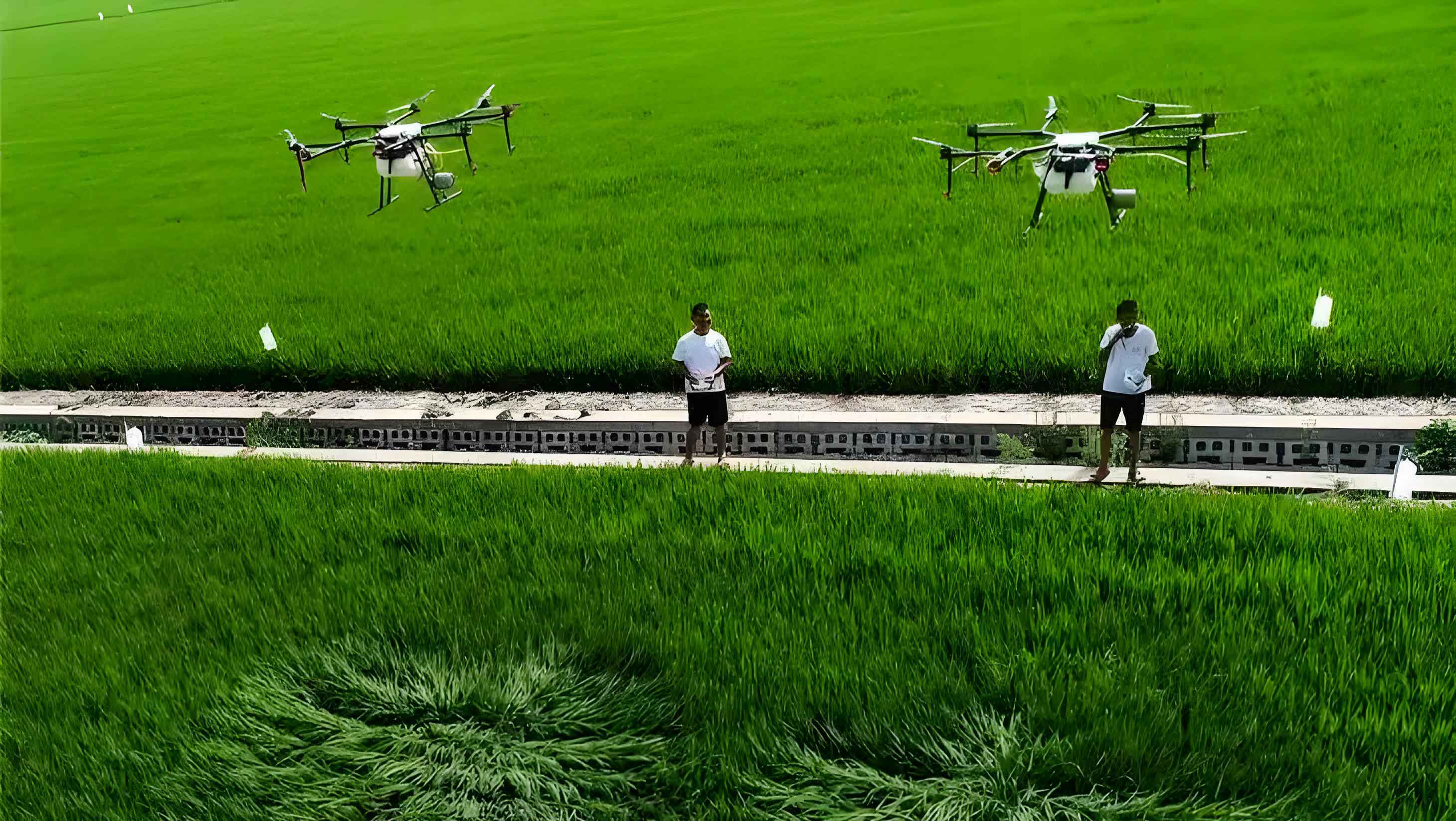
The rapid emergence of low-altitude economies has unlocked transformative potential for unmanned aerial vehicles (UAVs) across industries. Agricultural drones, specifically designed for crop management, have become indispensable tools for enhancing productivity while reducing resource consumption. These aerial systems integrate flight platforms, navigation controls, and precision spraying mechanisms to execute tasks ranging from pesticide application to seeding and fertilization.
Current Application Landscape
Modern agricultural UAVs primarily utilize multi-rotor configurations due to superior maneuverability and terrain adaptability. Key technical parameters governing their performance include:
$$ \text{Spraying Efficiency (ha/h)} = \frac{\text{Flight Speed (m/s)} \times \text{Swath Width (m)} \times 3.6}{\text{Application Rate (L/ha)}} $$
| Drone Type | Market Share (%) | Payload Capacity (kg) | Key Applications |
|---|---|---|---|
| Multi-rotor | 70 | 10-30 | Pesticide spraying, fertilization |
| Fixed-wing | 20 | 15-40 | Large-area seeding, mapping |
| Hybrid VTOL | 10 | 25-50 | Specialized crop monitoring |
In major agricultural regions, these UAVs demonstrate quantifiable advantages over traditional methods:
- Operational efficiency increase ≥30%
- Chemical usage reduction ≈20%
- Labor cost reduction: 40-60%
Development Catalysts in Low-Altitude Economy
Integrated Digital Supervision Platforms
Centralized monitoring systems synchronize agricultural UAV operations with real-time agronomic data. The platform architecture incorporates:
$$ \text{Field Coverage Accuracy} = 1 – \frac{\| \text{Actual Flight Path} – \text{Optimal Path} \|}{\text{Field Perimeter}} $$
| Platform Feature | Technical Specification | Operational Impact |
|---|---|---|
| CMAS Positioning | ±15cm accuracy | 28% chemical cost reduction |
| Digital Twins | 8000+ historical flight datasets | 35% terrain efficiency optimization |
| Human-Machine Scoring | 300,000 min flight analysis | 73% night operation accident reduction |
Standardization Frameworks
National and regional standards govern agricultural UAV specifications and operational protocols. Compliance parameters include:
$$ \text{Sprinkling Uniformity (CV)} = \frac{\sigma}{\mu} \times 100\% < 8\% $$
Mandatory technical requirements enforced through certification:
- Wind resistance: Stable operation at Level 7 winds
- Waterproof rating: ≥IPX5
- Endurance deviation: ≤2%
Specialized Operational Protocols
Regional group standards address microenvironment challenges through parametric adjustments:
$$ \text{Slope Compensation (m)} = \begin{cases}
0 & \theta \leq 15^\circ \\
0.6 & 15^\circ < \theta \leq 25^\circ \\
1.2 & \theta > 25^\circ
\end{cases} $$
| Environmental Factor | Operational Adjustment | Efficacy Improvement |
|---|---|---|
| Slope >30° | Altitude +1.2m | 35% |
| Wind speed 4级 | Spray volume +25% | 32% chemical reduction |
| Altitude >400m | Rotor speed +15% | 28% deposition uniformity |
Financial Incentive Mechanisms
Tiered subsidy structures accelerate agricultural UAV adoption in challenging terrains:
$$ \text{Effective Subsidy Rate} = \text{Base Rate} \times \left(1 + \sum \text{Technical Coefficients}\right) $$
| Subsidy Component | Mountainous Areas | Plains | Economic Outcome |
|---|---|---|---|
| Drone Body | 55% | 35% | Cost reduction: 65% |
| Battery System | 30% | 15% | Daily efficiency: 90% vs plains |
| Insurance Premium | 30% | 10% | Accident claims ↓72% |
The subsidy framework demonstrates multiplicative effects:
- Equipment utilization rate: ↑96%
- Annual service area per agricultural UAV: >8000 acres
- Disease control cost reduction: 40-55%
Future Development Trajectory
Agricultural UAV technology continues evolving through three critical vectors:
- Intelligent Swarm Operations: Synchronized fleet management using:
$$ \text{Swarm Efficiency} = n \times \sqrt{\frac{A_{\text{total}}}{n \times A_{\text{ind}}} $$
where \(n\) = number of drones, \(A\) = coverage area - Multispectral Integration: Real-time crop health analytics through NDVI indices:
$$ \text{NDVI} = \frac{\text{NIR} – \text{Red}}{\text{NIR} + \text{Red}} $$ - Predictive Maintenance: Machine learning models forecasting component failure:
$$ P_{\text{failure}} = 1 – e^{-\lambda t} \quad \lambda = f(\text{vibration}, \text{voltage}, \text{motor heat}) $$
The agricultural drone ecosystem will increasingly leverage AI-driven decision systems that process field data, weather patterns, and crop genetics to optimize every flight path and chemical application. This technological convergence positions agricultural UAVs as the central nervous system of next-generation precision farming.