
As a researcher focused on modern agricultural technologies, I have observed the transformative potential of agricultural drones in addressing critical challenges in farming. China, with its vast agricultural landscape of 1.8 billion mu of farmland, faces increasing demands for intelligent machinery due to land consolidation. While mechanization has been achieved in plowing and harvesting, plant protection remains a weak link, with pesticide utilization rates as low as 36%, leading to significant waste and environmental harm. In 2013, President Xi Jinping emphasized the need to “equip agriculture with the wings of technology,” urging the development of systems for high-yield, high-quality, efficient, ecological, and safe agriculture. Regions like Heilongjiang and southern hilly areas have already adopted agricultural drones for tasks such as seeding, fertilizing, and spraying. However, Gansu Province, an inland region with harsh natural conditions, lags behind due to factors like rugged terrain, water scarcity, and frequent natural disasters. With 51.1293 million mu of arable land, over 70% of which is dryland, Gansu’s agriculture is constrained by its mountainous plateau geography and diverse climate zones, ranging from subtropical humid to alpine and arid areas. This backdrop makes the adoption of agricultural drone technology not just beneficial but essential for sustainable growth.
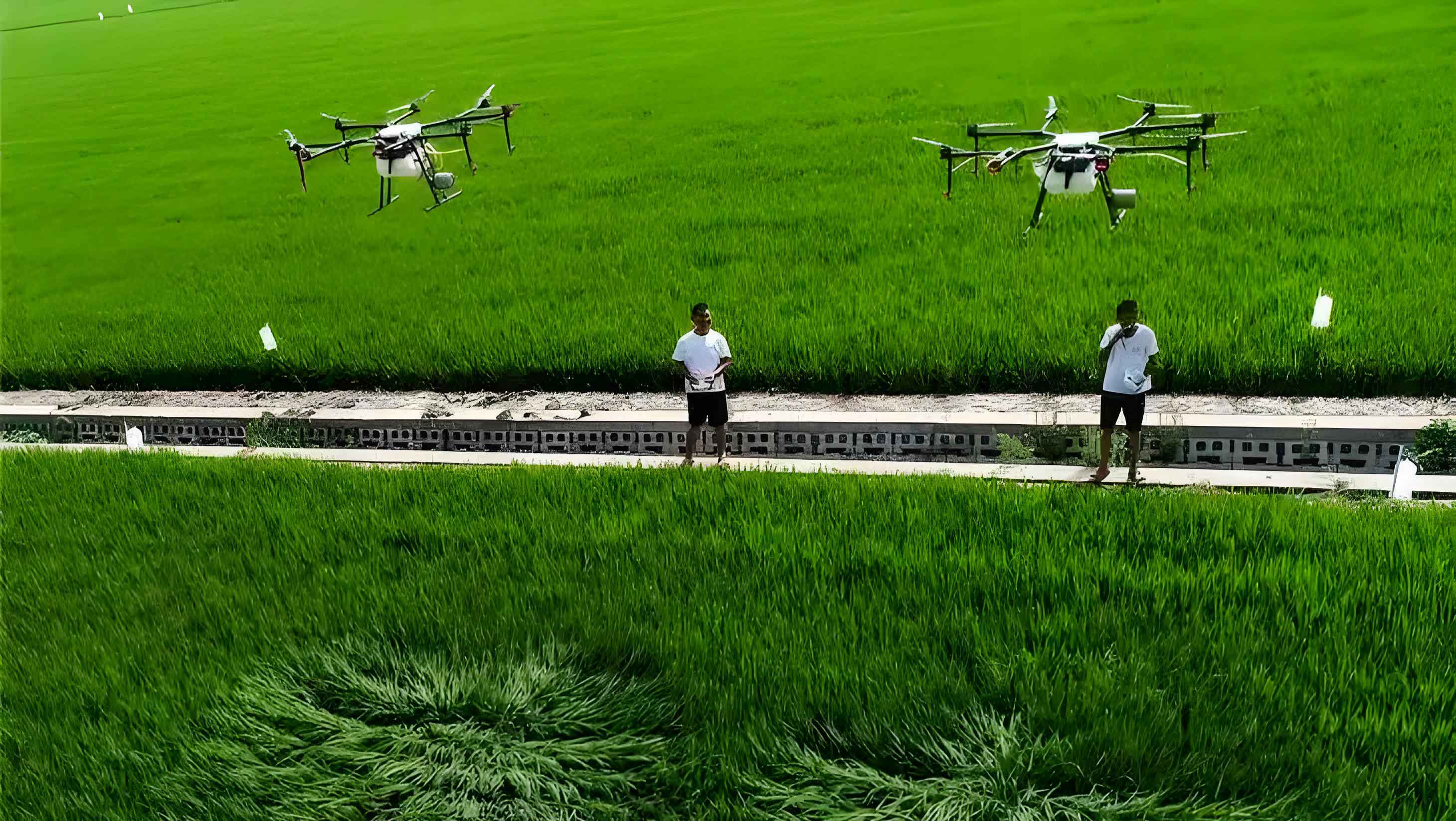
In 2019, Gansu’s summer grain crops covered 13.2201 million mu, yielding 3.2749 million tons, while autumn crops spanned 25.4966 million mu, producing 8.3509 million tons. Key crops included wheat, corn, and potatoes, but pests like wheat rust, corn borer, red spiders, aphids, fall armyworms, and potato late blight were widespread, threatening yields. Without effective control, these pests could cause substantial losses, highlighting the urgency for efficient, low-cost solutions. Agricultural drones, or unmanned aerial vehicles (UAVs), offer a promising alternative by leveraging advanced technology to enhance precision and reduce resource use. In this article, I will explore the feasibility, necessity, adaptability, benefits, and promotion prospects of agricultural drone technology in Gansu, using tables and formulas to summarize key insights. The term “agricultural drone” will be frequently referenced to underscore its centrality in this discussion.
The feasibility and necessity of deploying agricultural drones in Gansu stem from their multifaceted advantages over traditional methods. Traditional manual backpack spraying is labor-intensive, inefficient, and prone to pesticide waste, whereas agricultural drones utilize rotors to generate downward airflow that ensures comprehensive coverage on crop surfaces. This technology improves drug utilization, with drones operating 0.5-2 meters above crops, directing药液 to both sides of leaves and stems. The efficiency can be quantified using formulas for spray coverage and pesticide savings. For instance, the spray efficiency $E$ of an agricultural drone can be expressed as:
$$E = \frac{A}{t} \times U$$
where $A$ is the area covered (in mu), $t$ is the time (in hours), and $U$ is the pesticide utilization rate (as a decimal). Compared to manual spraying, agricultural drones achieve higher $U$ values, often exceeding 50%, due to reduced drift and finer雾滴. A table comparing traditional and drone-based methods illustrates these points:
| Aspect | Traditional Manual Spraying | Agricultural Drone Spraying |
|---|---|---|
| Spray Uniformity | Low, uneven distribution | High, precise targeting |
| Efficiency (mu/hour) | 1-2 mu/hour | 30-180 mu/hour |
| Pesticide Utilization | ~36% | ~60% or higher |
| Labor Cost | High, requires multiple workers | Low, one operator per drone |
| Environmental Impact | High pollution from runoff | Reduced contamination |
| Adaptability to Terrain | Limited to accessible areas | Suitable for hills, plains,梯田 |
Moreover, agricultural drones offer operational flexibility, vertical take-off, and hovering capabilities, making them ideal for Gansu’s varied landscapes, from the Hexi Corridor’s vast fields to the eastern mountainous terraces. The social necessity is reinforced by policy support: in 2018, Gansu launched the “2018-2020 Pilot Implementation Plan for Subsidies on New Agricultural Machinery and Plant Protection UAVs,” providing subsidies for electric multi-rotor agricultural drones. This initiative aims to accelerate the adoption of eco-friendly machinery, driving agricultural modernization and rural revitalization. Thus, the feasibility of agricultural drone technology is high, given its technical merits and alignment with provincial goals.
The adaptability of agricultural drones in Gansu is evident across its diverse regions. In the Hexi Corridor, where farmland is extensive and sparsely populated, agricultural drones can address labor shortages by covering large areas efficiently. For instance, a single agricultural drone can spray over 500 mu per day, equivalent to the work of 30 people. In eastern areas like Dingxi, characterized by梯田 and slopes, agricultural drones eliminate the need for manual water transport, reducing physical strain. Local agricultural departments have promoted this technology, with马铃薯种植基地 adopting models like the T16 and T20 agricultural drones. These drones exemplify how advanced features enhance adaptability. The following table summarizes their specifications:
| Model | T16 Agricultural Drone | T20 Agricultural Drone |
|---|---|---|
| Liquid Capacity | 16 liters | 20 liters |
| Spray Width | 6.5 meters | 7 meters |
| Efficiency (mu/hour) | 150 mu/hour | 180 mu/hour |
| Key Features | AI智能引擎, 3D planning, obstacle avoidance | 全向数字雷达, modular design, long battery life |
| Terrain Adaptability | Slopes, hills, orchards | Large fields,梯田, orchards |
The effectiveness of agricultural drones can be modeled using formulas for area coverage. For example, the area $A_{drone}$ covered by an agricultural drone in a given time $T$ is:
$$A_{drone} = w \times v \times T \times \eta$$
where $w$ is the spray width (in meters), $v$ is the飞行速度 (in meters per second), and $\eta$ is the efficiency factor (accounting for turns and refills). For the T20 agricultural drone, with $w = 7$ m and $v \approx 5$ m/s (typical for spraying), over $T = 1$ hour, $A_{drone}$ can exceed 180 mu, assuming $\eta \approx 0.9$. This surpasses manual methods by orders of magnitude. Additionally, agricultural drones incorporate sensors and GPS for precise navigation, reducing chemical drift and optimizing resource use. In Gansu’s context, where water scarcity is acute, the reduced water consumption of agricultural drones—often 90% less than traditional spraying—is a critical advantage. The adaptability is further enhanced by training programs for operators, creating new job opportunities as agricultural drone pilots, which aligns with rural employment needs.
Benefit analysis of agricultural drone technology reveals significant economic and socio-ecological gains. Economically, agricultural drones lower costs through efficiency and subsidies. A cost-benefit formula can illustrate this: the total cost $C_{total}$ for drone-based spraying includes initial investment, operational expenses, and maintenance, while benefits $B$ come from increased yields and reduced pesticide use. For a typical agricultural drone priced at 40,000 yuan, with a subsidy of 16,000 yuan, the net cost is 24,000 yuan. The return on investment (ROI) can be calculated as:
$$ROI = \frac{B – C_{total}}{C_{total}} \times 100\%$$
Assuming an agricultural drone covers 500 mu/day, with pesticide savings of 30% and yield increases of 10% due to better pest control, $B$ can outweigh $C_{total}$ within a single season. The table below quantifies these economic benefits:
| Economic Factor | Traditional Spraying | Agricultural Drone Spraying |
|---|---|---|
| Initial Cost (yuan) | ~5,000 (manual equipment) | ~40,000 (drone, post-subsidy ~24,000) |
| Operational Cost (yuan/mu) | ~20 (labor + pesticide) | ~10 (electricity + pesticide) |
| Efficiency (mu/day) | ~10 mu/day per worker | ~500 mu/day per drone |
| Pesticide Savings | Low (~0%) | High (~30-40%) |
| Yield Increase Potential | Minimal | Up to 15% from better coverage |
Socio-ecologically, agricultural drones contribute to sustainable agriculture by minimizing chemical runoff and soil contamination. The environmental benefit $E_{env}$ can be expressed as a reduction in pesticide load $P_{reduced}$:
$$E_{env} = P_{reduced} \times \gamma$$
where $\gamma$ is the environmental impact factor (e.g., toxicity reduction). In Gansu, where ecosystems are fragile, this is crucial. Agricultural drones also enhance food safety by ensuring precise application, reducing residues on crops. Socially, they alleviate labor shortages, as rural youth migrate to cities, and foster innovation through skill development. The integration of agricultural drones into local practices, as seen in Dingxi’s potato fields, demonstrates community acceptance and the potential for scalable impact.
The promotion prospects for agricultural drone technology in Gansu are bright, driven by technological advancements and policy tailwinds. As agricultural drones evolve with features like AI and IoT connectivity, their precision and usability will improve, making them more accessible to farmers. The推广前景 can be modeled using diffusion of innovation theory, where adoption rate $A(t)$ follows:
$$A(t) = \frac{M}{1 + e^{-k(t-t_0)}}$$
where $M$ is the maximum adoption potential, $k$ is the growth rate, and $t_0$ is the inflection point. For Gansu, with supportive policies and demonstrated benefits, $k$ could be high, leading to widespread use within 5-10 years. Key strategies for promotion include: expanding subsidy programs, establishing training centers for agricultural drone operators, conducting pilot projects in diverse agro-ecological zones, and fostering public-private partnerships. The role of agricultural drones in climate resilience is also noteworthy; for example, they can be deployed for rapid response to pest outbreaks, reducing crop losses. In the long term, agricultural drones will integrate with precision agriculture systems, using data analytics to optimize inputs and maximize outputs. This aligns with national goals for food security and绿色植保, as emphasized in China’s agricultural policies.
To summarize, agricultural drone technology represents a paradigm shift for Gansu’s agriculture. From feasibility rooted in efficiency gains to adaptability across terrains, and from economic savings to ecological benefits, agricultural drones offer a comprehensive solution to pressing challenges. The promotion of agricultural drones will require concerted efforts in education, infrastructure, and policy support, but the potential rewards—increased yields, reduced environmental footprint, and enhanced rural livelihoods—are substantial. As I reflect on this journey, it is clear that agricultural drones are not just tools but catalysts for modernizing farming practices. By embracing this technology, Gansu can transform its agricultural sector, setting an example for other regions facing similar constraints. The future of farming in Gansu lies in the skies, with agricultural drones leading the way toward a more productive and sustainable era.