
As the agricultural sector embraces technological advancements, the adoption of agricultural drones for crop protection has become increasingly prevalent. In this analysis, I explore the current state, effectiveness, advantages, disadvantages, and future prospects of agricultural drone applications, drawing insights from regional practices. The integration of agricultural drones into pest and disease management represents a paradigm shift, offering precision, efficiency, and sustainability. Throughout this discussion, I will emphasize the role of agricultural drones in transforming traditional farming methods, using data, tables, and formulas to elucidate key points.
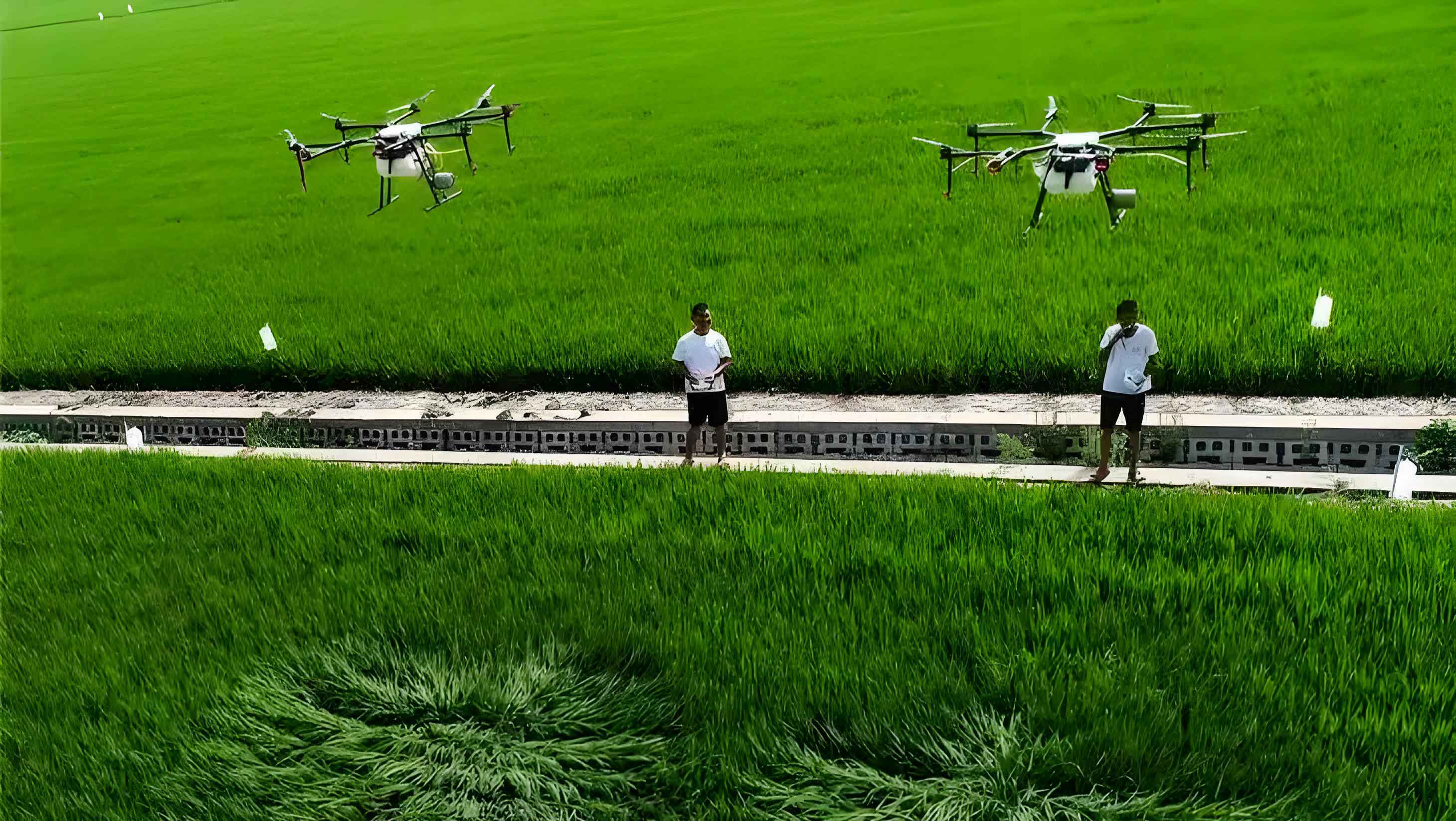
The rapid development of the drone industry has catalyzed the rise of professional-grade agricultural drones for plant protection. These agricultural drones operate via ground-based remote flight control systems combined with onboard GPS autonomous navigation to execute fixed plant protection tasks. Their compact size, lightweight design, ease of transport, operational flexibility, high efficiency, water and pesticide savings, adaptability, and effective control have led to widespread adoption across various regions for managing crop pests and diseases. From 2015 onward, numerous counties and cities have introduced agricultural drones for unified pest and disease control, reflecting a broader trend toward mechanization and smart agriculture. The use of agricultural drones is not just a technological novelty but a practical solution to labor shortages, environmental concerns, and the need for higher productivity. In this analysis, I delve into the specifics of how agricultural drones are deployed, their performance metrics, and the challenges they face, all while highlighting the keyword “agricultural drone” to underscore its centrality in modern agritech.
To quantify the adoption rate, consider the expansion in coverage areas. The application of agricultural drones has grown exponentially, as shown in Table 1, which summarizes the yearly increase in treated land. This growth is driven by the demonstrable benefits of agricultural drones, such as reduced chemical usage and improved coverage. The data indicates a positive correlation between the number of agricultural drones deployed and the area under protection, suggesting scalability. However, this expansion is not uniform, with variations based on local policies, crop types, and farmer acceptance. The agricultural drone ecosystem involves multiple stakeholders, including service providers, farmers, and regulators, each influencing its trajectory. As I proceed, I will break down these elements, using tables to compare yearly trends and formulas to model efficiency gains.
| Year | Number of Counties Using Agricultural Drones | Total Area Treated (hectares) | Primary Crops | Average Efficacy Rate (%) |
|---|---|---|---|---|
| 2015 | 1 | 13.33 | Potato | 85 |
| 2016 | 2 | 120 | Rice | 88 |
| 2017 | 5 | 733.8 | Rice, Potato | 90 |
| 2018 | 8 | 1464.35 | Rice, Garlic, Potato | 92 |
The efficacy of agricultural drones in pest control can be expressed mathematically. For instance, the control efficacy for diseases like rice blast is calculated using the formula: $$ \text{Efficacy} = \left(1 – \frac{\text{Disease index after treatment}}{\text{Disease index before treatment}}\right) \times 100\% $$ In practice, agricultural drones achieve an average efficacy of 94.6% against pests like rice planthoppers and 67.1% to 75.6% for diseases such as rice blast and rice false smut, based on field surveys. This highlights the precision of agricultural drone applications, where droplet deposition and coverage are optimized. The use of agricultural drones enables targeted spraying, minimizing drift and maximizing chemical adherence to crops. To further illustrate, the droplet coverage density (DCD) is a critical parameter, given by: $$ \text{DCD} = \frac{\text{Number of droplets per unit area}}{\text{Application volume}} $$ Agricultural drones typically achieve a DCD of 20-50 droplets/cm², surpassing manual methods. This technical advantage underscores why agricultural drones are gaining traction, despite higher upfront costs.
Beyond efficacy, the operational efficiency of agricultural drones is paramount. The daily coverage area per agricultural drone depends on factors like payload, battery life, and flight speed. A formula to estimate this is: $$ \text{Daily coverage (ha)} = \frac{\text{Payload (kg)} \times \text{Battery life (hours)} \times \text{Number of batteries per day}}{\text{Application rate (kg/ha)}} $$ For example, with a payload of 10 kg, battery life of 0.33 hours (20 minutes), 10 batteries per day, and an application rate of 1 kg/ha, the daily coverage is approximately: $$ \text{Daily coverage} = \frac{10 \times 0.33 \times 10}{1} = 33 \text{ ha} $$ However, real-world data shows variations from 6.67 to 25.33 ha per day due to technical disparities among agricultural drone models. This variability points to the need for standardization in the agricultural drone industry. Table 2 compares different agricultural drone service providers, highlighting their service capabilities and costs. The proliferation of agricultural drone companies has led to diverse pricing models, ranging from $40 to $80 per hectare (equivalent to 270-600 CNY/ha), which includes pesticide costs. This cost is higher than manual methods (around $22 per hectare), posing a barrier to widespread farmer adoption. Nonetheless, the long-term savings in labor and chemicals justify the investment in agricultural drones for large-scale operations.
| Service Provider | Daily Coverage per Drone (hectares) | Service Cost per Hectare (USD) | Pesticide Formulation Used | Droplet Coverage Density (droplets/cm²) |
|---|---|---|---|---|
| Provider A | 25.33 | 80 | Nano-pesticides | 50 |
| Provider B | 20.00 | 60 | Custom blends | 45 |
| Provider C | 15.00 | 50 | Traditional liquids | 30 |
| Provider D | 6.67 | 40 | Various chemicals | 20 |
The pesticide formulations used with agricultural drones vary significantly, affecting both cost and effectiveness. Common formulations include nano-pesticides, which reduce particle size to enhance adhesion and coverage. The effectiveness of these formulations can be modeled using the equation: $$ \text{Deposition efficiency} = \frac{\text{Mass of pesticide on target}}{\text{Total mass sprayed}} \times 100\% $$ Agricultural drones equipped with nano-pesticides achieve deposition efficiencies above 90%, compared to 70-80% for conventional sprays. This is due to the reduced drift and improved penetration facilitated by the downwash from agricultural drone rotors. The rotor-induced airflow accelerates droplet settlement, as described by: $$ v_d = \sqrt{\frac{2mg}{\rho AC_d}} $$ where \( v_d \) is the droplet settling velocity, \( m \) is droplet mass, \( g \) is gravity, \( \rho \) is air density, \( A \) is cross-sectional area, and \( C_d \) is drag coefficient. Agricultural drones optimize these parameters to ensure minimal environmental impact. However, challenges persist, such as the incompatibility of certain pesticides (e.g., emulsifiable concentrates or powders) with agricultural drone systems, limiting the range of control agents. This necessitates collaboration between pesticide manufacturers and agricultural drone producers to develop tailored solutions.
Analyzing the advantages of agricultural drones reveals multiple benefits. First, they offer high efficiency: one operator can manage 13-20 hectares daily, representing a 50% reduction in pesticide usage. This efficiency stems from the autonomous navigation of agricultural drones, which follow pre-programmed routes via GPS. The operational cost savings can be expressed as: $$ \text{Savings} = (\text{Manual cost per hectare} – \text{Drone cost per hectare}) \times \text{Area} $$ Assuming manual cost at $22/ha and agricultural drone cost at $50/ha, for 1000 hectares, savings amount to: $$ \text{Savings} = (22 – 50) \times 1000 = -28,000 \text{ USD} $$ indicating higher direct costs but offset by indirect benefits like labor reduction. Second, agricultural drones enhance safety by minimizing human exposure to chemicals, reducing health risks. Third, they conserve water, using ultra-low volume sprays that require less than 10 liters per hectare versus 100-200 liters for traditional methods. This water savings is crucial in arid regions. Fourth, agricultural drones improve coverage uniformity, leading to better pest control and higher crop yields. These advantages make agricultural drones a cornerstone of precision agriculture, aligning with sustainable development goals.
Conversely, the disadvantages of agricultural drones cannot be overlooked. The high initial investment, ranging from $4,000 to $30,000 per unit, deters small-scale farmers. Maintenance costs add to this burden, as agricultural drones require regular servicing and battery replacements. Battery limitations are a key constraint; with flight times of 15-20 minutes per charge, operational downtime increases. This can be quantified by the availability ratio: $$ \text{Availability} = \frac{\text{Flight time}}{\text{Flight time + Charging time}} $$ For an agricultural drone with 20 minutes of flight and 40 minutes of charging, availability is 33%, reducing effective daily coverage. Additionally, the lack of skilled operators hampers adoption. While agricultural drone technology is advanced, operators need expertise in both aviation and agronomy, which is scarce. Furthermore, farmer skepticism persists due to the perceived complexity and cost of agricultural drones. Most current applications rely on government procurement, highlighting the need for subsidies and training. These challenges underscore the importance of holistic support systems for agricultural drone integration.
Looking ahead, the development of agricultural drones hinges on several factors. First, selecting reliable service providers is critical. Criteria should include technical parameters like droplet spectrum, coverage density, and after-sales support. Pre- and post-application monitoring, as shown in efficacy formulas, ensures accountability. Second, policy support is essential. Subsidies for agricultural drone purchases, similar to those for other farm machinery, can lower barriers. The potential impact of subsidies can be modeled as: $$ \text{Adoption rate} = k \times \frac{\text{Subsidy amount}}{\text{Drone price}} $$ where \( k \) is a constant. Third, industry standards must be established. While technical specifications for agricultural drones exist, pesticide formulations and application protocols need standardization. Nano-pesticides, though effective, are expensive ($80/ha), suggesting a trade-off between cost and performance. Collaborative R&D between drone and chemical companies can yield optimized solutions. Fourth, training programs for agricultural drone operators are vital. Curricula should cover flight skills, pest management, and safety protocols, certification enhance professionalism. Finally, expanding the scope of agricultural drones to crops like fruit trees, using stereoscopic spraying techniques, can unlock new markets. The future of agricultural drones lies in integrating AI, IoT, and remote sensing for fully autonomous operations, as envisioned in smart farming initiatives.
In conclusion, agricultural drones represent a transformative technology in crop protection, with demonstrated benefits in efficiency, safety, and environmental sustainability. However, challenges related to cost, technology, and adoption must be addressed through coordinated efforts. By leveraging data-driven insights, such as those presented in tables and formulas, stakeholders can optimize the deployment of agricultural drones. The continued evolution of agricultural drone technology promises to reshape agriculture, making it more resilient and productive. As I reflect on this analysis, the keyword “agricultural drone” encapsulates the convergence of innovation and practicality, driving the future of farming. The journey ahead involves refining technical specifications, fostering policy frameworks, and empowering farmers to embrace this change, ensuring that agricultural drones become an integral part of global food security strategies.