
In this study, we investigate the aerodynamic interference effects on rotors in a quadcopter during high-speed cruise conditions. The quadcopter, characterized by its tilting rotor mechanism, transitions between helicopter and fixed-wing modes, enabling versatile operations such as logistics and environmental monitoring. However, the unique “H-shaped” configuration often leads to significant rotor-rotor and rotor-wing interactions, particularly affecting rear rotors due to slipstream from front rotors and wing wake. We employ the Multiple Reference Frame (MRF) numerical simulation method to analyze these effects, focusing on parameters like wing airfoil relative thickness, rotor collective pitch, and forward speed. Our goal is to elucidate how these factors influence rotor performance, including thrust coefficients and efficiency, in a quadcopter setup.
The aerodynamic behavior of a quadcopter is complex due to the interplay between multiple rotors and wings. During cruise, the quadcopter operates in fixed-wing mode, where rotors are tilted to provide forward thrust. However, the proximity of rotors to each other and to the wing results in slipstream interference, where the wake from front rotors impacts the aerodynamic efficiency of rear rotors. This can lead to reduced thrust and increased power consumption, potentially exceeding motor limits. Numerical simulations, based on the Navier-Stokes equations, offer a cost-effective alternative to wind tunnel tests for studying these phenomena. In this work, we model a quadcopter with four rotors symmetrically arranged and analyze the effects of varying parameters on rotor aerodynamics, emphasizing the role of slipstream and wing wake.
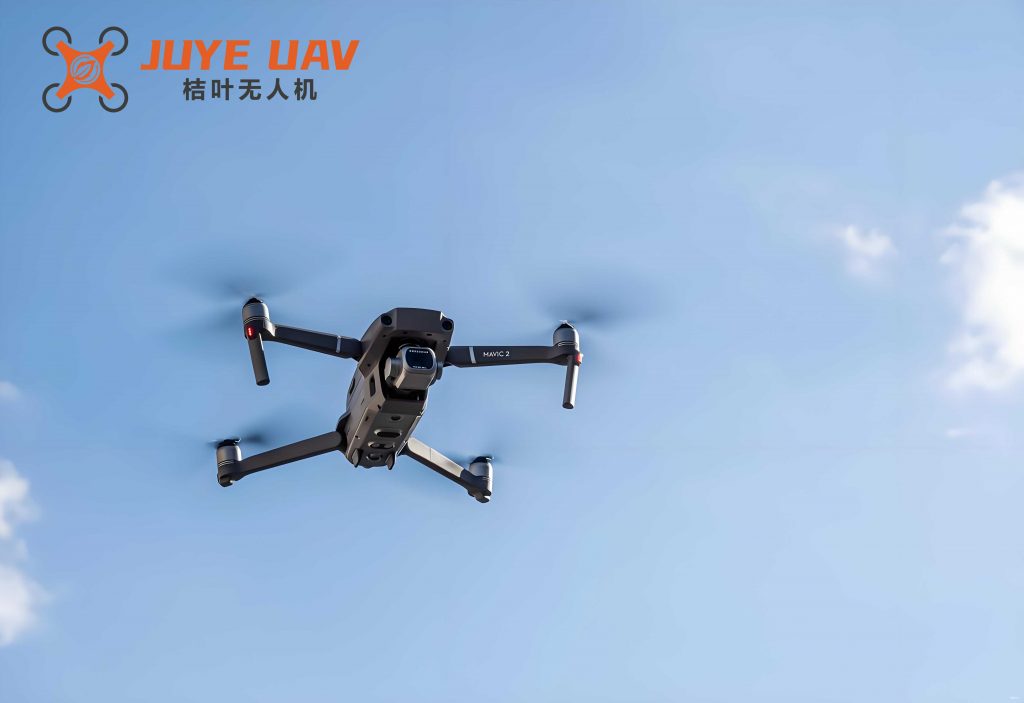
To begin, we describe the geometric model of the quadcopter. The design features a symmetric “H-shaped” layout, with front and rear rotors aligned along the same chordwise axis. This configuration minimizes horizontal stabilizer interference, and a T-tail is adopted for stability. The rotors use the SIKORSKY SC1095 airfoil, while the wings are modeled with NACA4412, NACA4415, and NACA4418 airfoils to examine the impact of relative thickness (12%, 15%, and 18%, respectively). Key parameters of the quadcopter model are summarized in Table 1, including dimensions, rotor specifications, and operational settings. For instance, the rotor diameter is 0.28 m, with a design rotational speed of 535 r/s, and collective pitch angles of 10°, 15°, and 20° are tested to assess performance variations.
For numerical analysis, we use the MRF approach to handle the rotating domains of the quadcopter rotors in a steady-state simulation. This method allows us to model rotor rotation within static grids by defining reference frames for each rotor, reducing computational cost while maintaining accuracy. The computational domain is discretized using unstructured grids, with refined meshes in the rotor regions to capture detailed flow features. The standard k-ε turbulence model is applied to simulate turbulent flows, as it effectively models fully turbulent conditions by solving transport equations for turbulent kinetic energy and dissipation rate. The governing equations are:
$$ \rho \frac{Dk}{Dt} = \frac{\partial}{\partial x_i} \left[ \left( \mu + \frac{\mu_t}{\sigma_k} \right) \frac{\partial k}{\partial x_i} \right] + G_k + G_b – \rho \epsilon – Y_M $$
$$ \rho \frac{D\epsilon}{Dt} = \frac{\partial}{\partial x_i} \left[ \left( \mu + \frac{\mu_t}{\sigma_\epsilon} \right) \frac{\partial \epsilon}{\partial x_i} \right] + C_{1\epsilon} \frac{\epsilon}{k} (G_k + C_{3\epsilon} G_b) – C_{2\epsilon} \rho \frac{\epsilon^2}{k} $$
Here, \( \rho \) is fluid density, \( k \) is turbulent kinetic energy, \( \epsilon \) is dissipation rate, \( \mu \) is dynamic viscosity, \( \mu_t \) is turbulent viscosity, and \( G_k \), \( G_b \), \( Y_M \), \( C_{1\epsilon} \), \( C_{2\epsilon} \), \( C_{3\epsilon} \), \( \sigma_k \), and \( \sigma_\epsilon \) are model constants. To quantify rotor performance, we define the thrust coefficient \( C_T \), torque coefficient \( C_M \), power coefficient \( C_P \), and efficiency \( \eta \) as follows:
$$ C_T = \frac{T}{\frac{1}{2} \rho n^2 R^2 S} $$
$$ C_M = \frac{M}{\rho n^2 D^5} $$
$$ C_P = \frac{P}{\rho n^3 D^5} $$
$$ \eta = \frac{T V_0}{P} $$
In these equations, \( T \) is thrust, \( n \) is rotational speed, \( R \) is rotor radius, \( S \) is rotor disk area, \( M \) is torque, \( D \) is rotor diameter, \( P \) is power, and \( V_0 \) is forward speed. These metrics help us evaluate the aerodynamic characteristics of the quadcopter rotors under different conditions.
| Parameter | Value | Parameter | Value |
|---|---|---|---|
| Fuselage Length (m) | 2.6 | Rotor Radius (m) | 0.28 |
| Wingspan (m) | 2.2 | Rotor Twist Angle (°) | 5 |
| Wing Installation Angle (°) | 6 | Rotor Collective Pitch (°) | 10, 15, 20 |
| Rotor Solidity | 0.084 | Design Rotational Speed (r/s) | 535 |
| Rotor Chordwise Spacing (m) | 0.9 | Rotor Spanwise Spacing (m) | 1.5 |
We now analyze the aerodynamic characteristics of the quadcopter rotors, focusing on the effects of forward speed, wing airfoil thickness, and slipstream interference. The quadcopter operates in cruise mode after transitioning from helicopter mode, where rotors are at high rotational speeds. We simulate forward speeds ranging from 0 to 40 m/s to observe changes in thrust coefficients and efficiency.
First, the impact of forward speed on rotor thrust coefficients is examined. As forward speed increases, the thrust coefficients for both front and rear rotors decrease, as shown in Table 2 for a collective pitch of 20°. This decline is due to reduced angle of attack and dynamic pressure on rotor blades at higher speeds. For example, at \( V_0 = 0 \) m/s, the front rotor thrust coefficient \( C_{T1} \) is approximately 0.030, but it drops to 0.005 at \( V_0 = 40 \) m/s. Similarly, the rear rotor thrust coefficient \( C_{T4} \) follows a comparable trend, though it is generally lower than that of front rotors due to interference effects. The difference in thrust coefficients between front and rear rotors, denoted as \( \Delta C_T = C_{F} – C_{B} \), where \( C_{F} \) is front rotor thrust coefficient and \( C_{B} \) is rear rotor thrust coefficient, highlights the influence of slipstream. At low forward speeds (e.g., 0–9 m/s), \( \Delta C_T \) increases, indicating stronger slipstream interference. However, as speed rises to 22–40 m/s, \( \Delta C_T \) decreases rapidly, suggesting that the slipstream effect weakens with higher forward velocities.
| Forward Speed (m/s) | \( C_{T1} \) (Front Rotor) | \( C_{T4} \) (Rear Rotor) | \( \Delta C_T \) |
|---|---|---|---|
| 0 | 0.030 | 0.025 | 0.005 |
| 10 | 0.022 | 0.018 | 0.004 |
| 20 | 0.015 | 0.012 | 0.003 |
| 30 | 0.008 | 0.006 | 0.002 |
| 40 | 0.005 | 0.004 | 0.001 |
Next, we investigate the effect of wing airfoil relative thickness on rear rotor performance. Using NACA4412, NACA4415, and NACA4418 airfoils, we observe that increasing thickness from 12% to 18% reduces the rear rotor thrust coefficient \( C_{T4} \). Specifically, as shown in Table 3, for a forward speed of 20 m/s and collective pitch of 20°, \( C_{T4} \) decreases from 0.012 for NACA4412 to 0.010 for NACA4418, representing a 17.09% reduction when thickness increases by 6%. This is attributed to the stronger wing wake generated by thicker airfoils, which disturbs the inflow to the rear rotors, increasing pressure differences and reducing thrust. The pressure contours reveal that thicker wings produce larger high-pressure regions behind the wing, further impairing rear rotor aerodynamics. This underscores the importance of wing design in minimizing interference in a quadcopter configuration.
| Wing Airfoil | Relative Thickness (%) | \( C_{T4} \) | Percentage Change |
|---|---|---|---|
| NACA4412 | 12 | 0.012 | Base |
| NACA4415 | 15 | 0.011 | -8.33% |
| NACA4418 | 18 | 0.010 | -17.09% |
The interference from front rotor slipstream on rear rotors is a critical aspect of quadcopter aerodynamics. The slipstream, consisting of accelerated and rotated flow from front rotors, combines with the forward airflow to affect rear rotor inflow conditions. We analyze the thrust coefficient difference \( \Delta C_T \) across different forward speeds and wing airfoils, as summarized in Table 4. At low speeds (e.g., 0–9 m/s), \( \Delta C_T \) increases, peaking around 5.4 × 10^{-3} at 9 m/s, indicating enhanced slipstream effects due to the superposition of flows. As speed increases to 22–40 m/s, \( \Delta C_T \) declines, as the relative influence of slipstream diminishes compared to the dominant forward airflow. This trend is consistent across all wing airfoils, though thicker wings slightly reduce \( \Delta C_T \) due to additional wake interference. The flow streamlines show that at higher speeds, the contraction of the slipstream weakens, reducing its impact on rear rotors. This behavior is crucial for optimizing quadcopter performance during cruise, as it affects power distribution and efficiency.
| Forward Speed (m/s) | \( \Delta C_T \) (NACA4412) | \( \Delta C_T \) (NACA4415) | \( \Delta C_T \) (NACA4418) |
|---|---|---|---|
| 0 | 0.0050 | 0.0048 | 0.0045 |
| 9 | 0.0054 | 0.0052 | 0.0049 | 22 | 0.0040 | 0.0038 | 0.0036 |
| 40 | 0.0010 | 0.0009 | 0.0008 |
Rotor efficiency \( \eta \) is another key parameter in quadcopter performance, representing the ratio of useful thrust power to consumed power. We compute efficiency for front and rear rotors across forward speeds, as shown in Table 5. At low speeds, efficiency is low due to high rotational speeds and significant slipstream losses. For instance, at \( V_0 = 0 \) m/s, front rotor efficiency is around 20%, but it peaks at approximately 58.59% for front rotors and 56.81% for rear rotors at \( V_0 = 28 \) m/s. Beyond this point, efficiency decreases rapidly as thrust diminishes. The higher efficiency at intermediate speeds corresponds to the optimal working condition for the quadcopter rotors, where slipstream interference is minimized, and power losses are primarily due to blade twist. This highlights the trade-off between speed and efficiency in quadcopter operations, emphasizing the need for careful speed management during cruise.
| Forward Speed (m/s) | Front Rotor Efficiency (%) | Rear Rotor Efficiency (%) |
|---|---|---|
| 0 | 20.0 | 18.5 |
| 10 | 35.2 | 33.1 |
| 20 | 50.1 | 47.8 |
| 28 | 58.6 | 56.8 |
| 40 | 45.3 | 43.5 |
In conclusion, our analysis of the quadcopter during cruise reveals significant aerodynamic interference effects on rotors. The thrust coefficients decrease with increasing forward speed, and rear rotors consistently exhibit lower performance due to slipstream and wing wake interference. Increasing wing airfoil relative thickness reduces rear rotor thrust coefficients, with a 6% thickness increase leading to a 17.09% drop. The slipstream from front rotors affects rear rotors most prominently at low to medium forward speeds, with the impact weakening at higher speeds. Rotor efficiency peaks at intermediate speeds, around 28 m/s, highlighting an optimal operating point for the quadcopter. These findings underscore the importance of parameter optimization, such as wing design and speed control, to enhance the aerodynamic performance of quadcopters in cruise conditions. Future work could explore additional factors like rotor rotation direction and advanced control strategies to further mitigate interference effects.