
In the rapidly evolving field of unmanned aerial systems, quadrotor drones have emerged as a versatile platform due to their compact size, agility, and ability to hover and perform vertical take-offs and landings. As applications expand from surveillance and delivery to collaborative missions, the concept of multi-quadrotor drone formation flying has gained significant attention. Formation flight can enhance operational efficiency, but it introduces complex aerodynamic interactions that pose safety risks. Specifically, when quadrotor drones operate in close proximity, the downwash flow from one quadrotor drone can interfere with the aerodynamics of another, potentially leading to performance degradation or loss of stability. This study focuses on investigating these aerodynamic interactions for quadrotor drones in a hovering state, with the aim of establishing safe separation distances. I employ computational fluid dynamics (CFD) simulations to analyze flow field characteristics and aerodynamic parameter variations under different lateral and longitudinal separations. The findings provide insights into minimizing risks in dense formations, ensuring that quadrotor drone operations remain safe and effective.
The core of this investigation lies in understanding how the wake vortices generated by a quadrotor drone affect a following quadrotor drone. Unlike fixed-wing aircraft, quadrotor drones rely on multiple rotating blades to generate lift, creating a complex downwash pattern. This pattern can disrupt the airflow around neighboring quadrotor drones, altering their lift and moment characteristics. In this work, I consider a leader-follower formation with two quadrotor drones, simulating various separation scenarios to quantify aerodynamic effects. By doing so, I aim to contribute to the development of safety protocols for quadrotor drone formations, a critical aspect as regulatory frameworks evolve to accommodate increased drone traffic.
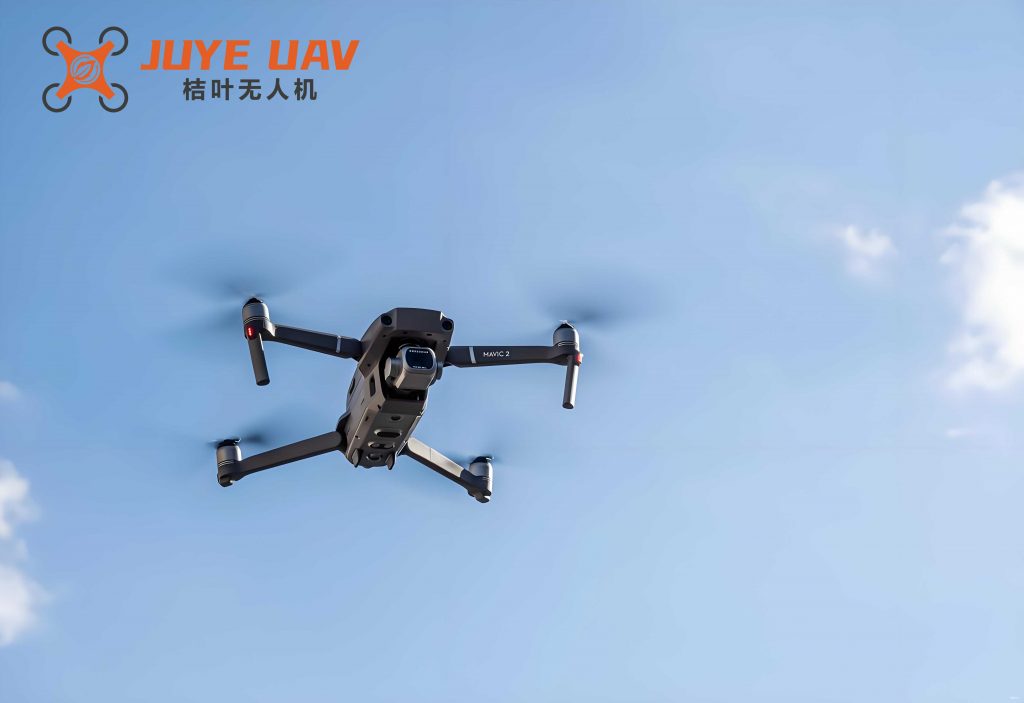
To begin, I describe the numerical methodology used in this study. The quadrotor drone model is based on a popular commercial design, with an X-configuration and four rotors. Each rotor has a diameter \(D = 238 \, \text{mm}\), and the diagonal wheelbase is \(350 \, \text{mm}\). The computational domain is structured to capture the interaction between two quadrotor drones, as illustrated in the setup. For simulations, I define the lateral separation \(X\) (in multiples of \(D\)) and longitudinal separation \(Z\) (also in multiples of \(D\)), ranging from \(0\) to \(2D\) and \(0\) to \(5D\), respectively. This allows me to explore a wide array of formation geometries relevant to practical quadrotor drone operations.
The mesh generation involves a hybrid approach, combining structured and unstructured grids to balance accuracy and computational cost. The rotating domains around each rotor are discretized with tetrahedral cells, totaling approximately 3.2 million elements, while the static domain uses hexahedral cells, adding around 10.6 million elements. Mesh independence was verified to ensure reliable results. For the flow simulation, I solve the three-dimensional Reynolds-averaged Navier-Stokes (RANS) equations, which govern the fluid dynamics. The continuity and momentum equations are expressed as:
$$
\frac{\partial \rho}{\partial t} + \nabla \cdot (\rho \mathbf{V}) = 0
$$
$$
\frac{\partial (\rho \mathbf{V})}{\partial t} + \nabla \cdot (\rho \mathbf{V} \mathbf{V}) = -\nabla p + \nabla \cdot \boldsymbol{\tau}
$$
where \(\rho\) is the air density, \(\mathbf{V}\) is the velocity vector, \(p\) is the pressure, and \(\boldsymbol{\tau}\) is the viscous stress tensor. The energy equation is also considered, but for incompressible hover conditions, the focus is on momentum. The turbulence model selected is the \(k\)-\(\omega\) SST model, which accurately captures shear flows near the rotor blades. The multiple reference frame (MRF) method is employed to handle the rotating rotors within a stationary background, with interfaces for data transfer. The SIMPLE algorithm solves the pressure-velocity coupling, and second-order upwind schemes discretize the terms. Convergence is achieved when residuals drop below \(10^{-4}\) and stabilize.
To validate the CFD approach, I compare results with experimental data from a standard Caradonna-Tung rotor model. The pressure coefficient \(C_p\) distribution along the blade span shows good agreement, with errors within 5% for thrust coefficient \(C_T\) and 9% for torque coefficient \(C_Q\). This confirms the reliability of my simulations for analyzing quadrotor drone aerodynamics. For aerodynamic assessment, I define dimensionless coefficients. The thrust coefficient \(C_T\), torque coefficient \(C_Q\), and pitching moment coefficient \(C_M\) are given by:
$$
C_T = \frac{T}{\rho \pi R^2 (\Omega R)^2}, \quad C_Q = \frac{Q}{\rho \pi R^2 (\Omega R)^2 R}, \quad C_M = \frac{M}{\rho \pi R^2 (\Omega R)^2 R}
$$
where \(T\) is thrust, \(Q\) is torque, \(M\) is pitching moment, \(R\) is rotor radius, and \(\Omega\) is angular velocity. These coefficients allow for a normalized comparison across different quadrotor drone configurations.
Starting with a single quadrotor drone in hover, I analyze the intrinsic aerodynamic interference among its four rotors. The surface pressure distribution reveals symmetric patterns, with low-pressure regions on the upper rotor surfaces due to air acceleration. However, compared to an isolated rotor, each rotor on the quadrotor drone experiences a thrust reduction of approximately 5% and a torque increase of about 10.77%. This is attributed to the mutual downwash interaction between adjacent rotors, which increases the induced velocity and reduces the effective angle of attack. For instance, the thrust coefficient per rotor on the quadrotor drone is \(7.83 \times 10^{-3}\), whereas for an isolated rotor, it is \(8.22 \times 10^{-3}\). This efficiency loss highlights the importance of considering internal interactions when designing quadrotor drone formations.
| Configuration | Thrust Coefficient per Rotor (\(C_T\)) | Torque Coefficient per Rotor (\(C_Q\)) |
|---|---|---|
| Isolated Rotor | \(8.22 \times 10^{-3}\) | \(1.01 \times 10^{-3}\) |
| Rotor on Quadrotor Drone | \(7.83 \times 10^{-3}\) | \(1.12 \times 10^{-3}\) |
The velocity contours on a vertical plane through the rotors show that the downwash flows from the two front rotors converge, accelerating the airflow inward. This phenomenon underscores the complexity of quadrotor drone aerodynamics, even in isolation. As quadrotor drones are often deployed in groups, understanding these baseline effects is crucial for predicting formation behavior.
Moving to two quadrotor drones in a leader-follower formation, I simulate various separation distances to examine external aerodynamic interference. The flow fields are visualized through velocity magnitude plots on vertical sections. For zero lateral separation (\(X = 0D\)), the downwash from the leader quadrotor drone impinges directly on the follower quadrotor drone, maintaining symmetry. The combined downwash exhibits lateral expansion, especially at small longitudinal separations like \(Z = 1D\). As \(Z\) increases to \(5D\), the interference diminishes, with the follower’s rotors experiencing near-normal inflow. This suggests that for directly aligned quadrotor drones, maintaining a longitudinal separation of at least \(5D\) can mitigate thrust losses.
When a lateral separation is introduced, such as \(X = 1D\), the flow symmetry breaks. The follower quadrotor drone’s rotors on the side closer to the leader (e.g., rotors 2 and 3 in my numbering scheme) encounter accelerated downwash, while the opposite side rotors (1 and 4) are less affected. This asymmetry alters the pressure distribution on the follower quadrotor drone, leading to unequal thrust generation. At \(X = 1D\) and \(Z = 1D\), the velocity contours show a contraction of the downwash toward the follower’s centerline, contrasting with the expansion seen at \(X = 0D\). This is due to the opposite rotation directions of the interacting rotors, which affects vortex shedding. For larger lateral separations like \(X = 2D\), the interference weakens significantly, as the follower quadrotor drone lies mostly outside the leader’s strong wake region.
To quantify these effects, I compute the aerodynamic coefficients for the follower quadrotor drone across different separations. The thrust coefficient for each rotor is plotted in a table below, with the leader’s rotor thrust coefficient (\(7.83 \times 10^{-3}\)) as a reference. The total thrust coefficient \(C_{T,\text{total}}\) for the follower quadrotor drone is derived by summing the contributions from all four rotors, and the pitching moment coefficient \(C_M\) is calculated based on thrust imbalances.
| Separation (\(X, Z\)) | Rotor 1 \(C_T\) | Rotor 2 \(C_T\) | Rotor 3 \(C_T\) | Rotor 4 \(C_T\) | Total \(C_{T,\text{total}}\) | Pitching Moment \(C_M\) |
|---|---|---|---|---|---|---|
| \(X=0D, Z=1D\) | \(4.4 \times 10^{-3}\) | \(4.4 \times 10^{-3}\) | \(4.4 \times 10^{-3}\) | \(4.4 \times 10^{-3}\) | \(1.76 \times 10^{-2}\) | \(\approx 0\) |
| \(X=0D, Z=5D\) | \(7.4 \times 10^{-3}\) | \(7.4 \times 10^{-3}\) | \(7.4 \times 10^{-3}\) | \(7.4 \times 10^{-3}\) | \(2.96 \times 10^{-2}\) | \(\approx 0\) |
| \(X=1D, Z=1D\) | \(7.8 \times 10^{-3}\) | \(3.5 \times 10^{-3}\) | \(3.5 \times 10^{-3}\) | \(7.8 \times 10^{-3}\) | \(2.26 \times 10^{-2}\) | \(8.5 \times 10^{-4}\) |
| \(X=1D, Z=5D\) | \(7.8 \times 10^{-3}\) | \(6.0 \times 10^{-3}\) | \(6.0 \times 10^{-3}\) | \(7.8 \times 10^{-3}\) | \(2.76 \times 10^{-2}\) | \(1.0 \times 10^{-4}\) |
| \(X=2D, Z=5D\) | \(7.8 \times 10^{-3}\) | \(7.6 \times 10^{-3}\) | \(7.6 \times 10^{-3}\) | \(7.8 \times 10^{-3}\) | \(3.08 \times 10^{-2}\) | \(\approx 0\) |
The data reveal several key trends. For \(X = 0D\), the follower quadrotor drone suffers a uniform thrust loss that decreases with \(Z\), nearly vanishing at \(Z = 5D\). The pitching moment is negligible due to symmetry, meaning the quadrotor drone can maintain attitude but may require increased rotor speed to compensate for thrust. In contrast, at \(X = 1D\), the thrust asymmetry creates a significant pitching moment, particularly at small \(Z\). For example, at \(X = 1D, Z = 1D\), \(C_M\) is \(8.5 \times 10^{-4}\), which is about 8.5 times higher than at \(Z = 5D\). This moment can induce rolling, posing a rollover risk for the follower quadrotor drone if not corrected by control systems. At \(X = 2D\), the aerodynamic parameters approach those of an isolated quadrotor drone, indicating minimal interference.
These results have direct implications for safe separation distances in quadrotor drone formations. Based on my analysis, I recommend the following guidelines for hovering formations: First, if quadrotor drones are aligned vertically (no lateral offset), a longitudinal separation of at least \(5D\) is advisable to avoid thrust degradation. This ensures that the follower quadrotor drone operates in a relatively undisturbed flow, preserving efficiency. Second, for formations with lateral offsets, a minimum lateral separation of \(2D\) is critical to prevent strong asymmetric interactions. The region between \(0D\) and \(2D\) lateral separation is hazardous, as it can induce substantial pitching moments that challenge the stability of the quadrotor drone. In such cases, the follower quadrotor drone might require advanced control algorithms to counteract disturbances.
To further elucidate the aerodynamic mechanisms, I derive a simplified model for the downwash velocity \(w\) beneath a quadrotor drone. Assuming actuator disk theory, the induced velocity at a point downstream can be approximated as:
$$
w(z) = \frac{T}{2 \rho A} \cdot \frac{1}{\sqrt{1 + (z/R)^2}}
$$
where \(A\) is the rotor disk area and \(z\) is the vertical distance. For two quadrotor drones, the superposition of downwash fields leads to complex interference patterns. My CFD results align with this model, showing that closer proximity increases velocity perturbations. For a quadrotor drone in formation, the effective thrust \(T_{\text{eff}}\) can be expressed as:
$$
T_{\text{eff}} = T_0 – \Delta T(\Delta x, \Delta z)
$$
where \(T_0\) is the nominal thrust, and \(\Delta T\) is the thrust loss function of separations \(\Delta x\) and \(\Delta z\). From my simulations, \(\Delta T\) is significant for \(\Delta x < 2D\) and \(\Delta z < 5D\), emphasizing the need for careful spacing.
The practical applications of this study are vast. As quadrotor drone swarms become more common in logistics, agriculture, and disaster response, understanding aerodynamic interactions is essential for safe operation. For instance, in package delivery by multiple quadrotor drones, maintaining safe separations can prevent collisions or performance drops due to wake encounters. Similarly, in aerial shows or military formations, these insights can inform trajectory planning. I envision that future quadrotor drone designs might incorporate aerodynamic shielding or adaptive rotor speeds to mitigate interference, but until then, separation rules are a straightforward solution.
In conclusion, my investigation into aerodynamic interactions for quadrotor drones in hovering formation reveals critical insights for safety and performance. The internal interference among rotors on a single quadrotor drone reduces thrust and increases torque, highlighting baseline inefficiencies. For two quadrotor drones, the external interference depends strongly on lateral and longitudinal separations. A lateral separation of less than \(2D\) induces asymmetric thrust and significant pitching moments, risking stability, while a longitudinal separation below \(5D\) causes thrust loss even with no lateral offset. Thus, I recommend maintaining a lateral separation of at least \(2D\) and a longitudinal separation of at least \(5D\) for safe hovering formations. These findings contribute to the growing body of knowledge on quadrotor drone aerodynamics, aiding in the development of robust formation flight protocols. Future work could explore dynamic maneuvers or more complex formations involving multiple quadrotor drones, further enhancing safety in collaborative missions.
Throughout this study, the term “quadrotor drone” has been emphasized to underscore the focus on this specific UAV type. The aerodynamic principles discussed apply broadly to multi-rotor systems, but the quadrotor drone’s popularity makes it a relevant case. By integrating CFD simulations with aerodynamic coefficient analysis, I have provided a framework for assessing and mitigating risks in quadrotor drone formations. As technology advances, such research will be pivotal in ensuring that quadrotor drones can operate safely and efficiently in shared airspace, unlocking their full potential for society.