
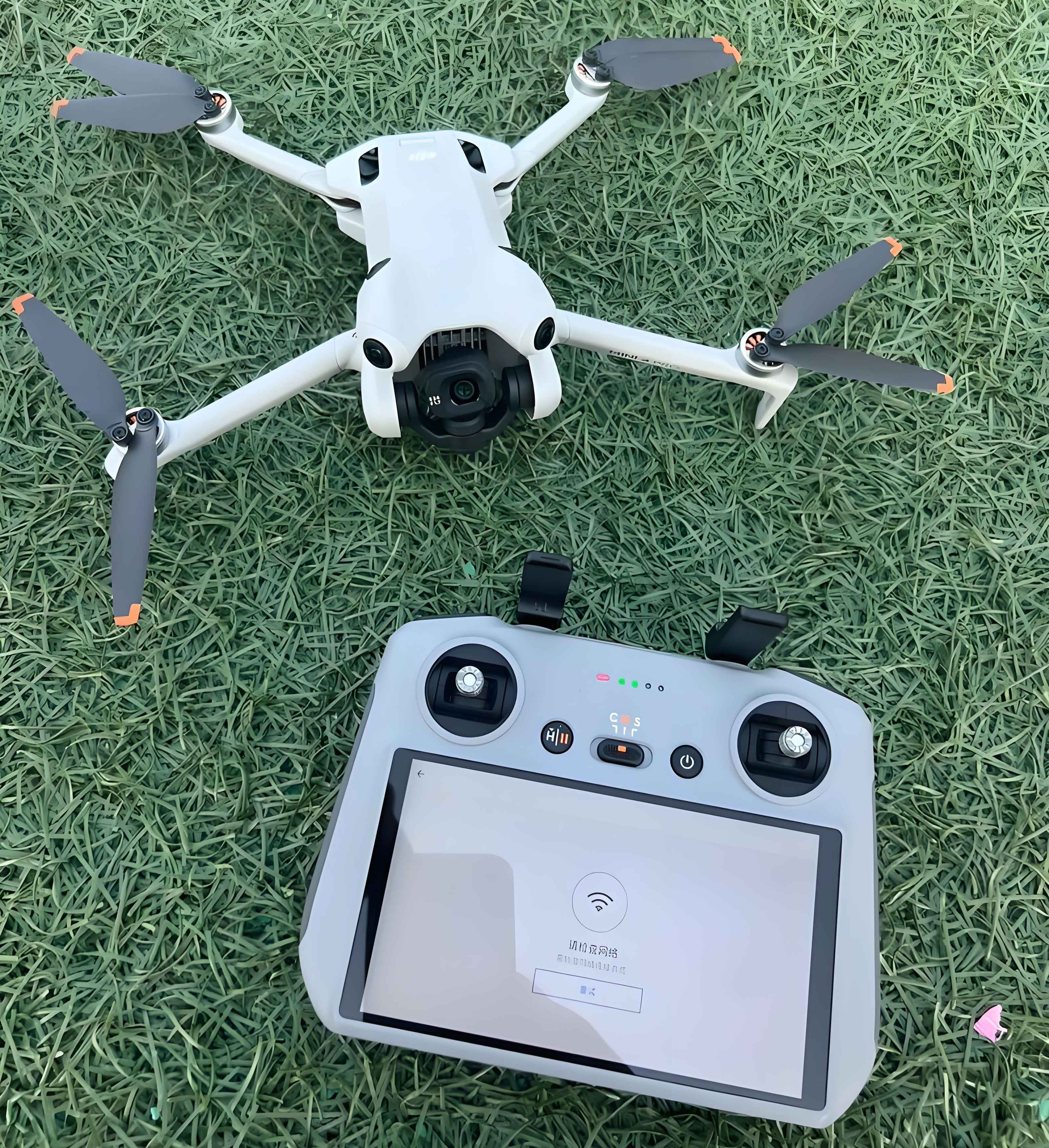
Camera drones, formally designated as Unmanned Aerial Vehicles (UAVs), represent a transformative class of remotely piloted or autonomously controlled aircraft. These camera UAV systems have gained significant traction due to their compact dimensions, cost-effectiveness, operational simplicity, and vertical takeoff/landing capabilities. A critical challenge persists in achieving real-time transmission of aerial footage to ground stations while enabling instantaneous social sharing, which directly impacts the visual experience for aerial photography enthusiasts. To address this, we developed a live-streaming camera drone system leveraging existing quadcopter technology and 4G networks.
System Architecture and Implementation
The camera UAV platform integrates flight control, imaging, and data transmission subsystems. Key components include:
| Component | Specification | Quantity |
|---|---|---|
| Flight Controller | DJI NAZA-M LITE | 1 |
| GPS/Compass Module | DJI NAZA-M LITE | 1 |
| Frame | F450 | 1 |
| Brushless Motors | Xingxda 2216 KV900 | 4 |
| Electronic Speed Controllers | Skywalker 40A | 4 |
| Imaging Unit | SJ4000 Camera | 1 |
| Video Encoder | RTMP Protocol | 1 |
Assembly Protocol
The F450 frame’s dual-layer design enhances stability for camera drone operations. Critical installation guidelines include:
- Position flight controller, PMU power module, and receiver on lower plate
- Mount GPS and battery on upper plate
- Align controller arrow with aircraft heading at center-of-gravity
- Secure motors at arm termini with ESCs mounted above arms
Electrical connections follow strict channel mapping:
| Flight Controller Port | Receiver Channel | Function |
|---|---|---|
| A | 1 | Aileron |
| E | 2 | Elevator |
| T | 3 | Throttle |
| R | 4 | Rudder |
| U | 5 | Flight Mode |
Motor-ESC connections follow counterclockwise sequencing: M1 → front-right, M2 → front-left, M3 → rear-left, M4 → rear-right. GPS installation requires minimum 10cm clearance from motors to prevent magnetic interference, with directional arrow aligned to heading.
Imaging Subsystem
The SJ4000 camera delivers 1080p resolution at <100g payload weight. For stabilized footage during camera UAV maneuvers, the system employs a 3-axis gimbal governed by the stabilization equation:
$$ \theta_{corrected} = K_p \cdot e(t) + K_i \int_0^t e(\tau) d\tau + K_d \frac{de}{dt} $$
Where \( \theta_{corrected} \) represents gimbal correction angle, \( e(t) \) denotes attitude error, and \( K_p \), \( K_i \), \( K_d \) are PID constants optimized for aerial vibration frequencies.
Wireless Transmission Architecture
Our camera drone employs dual-band telemetry:
- Control: 2.4GHz (500m range)
- Video: 5.8GHz TS832S transmitter (2km line-of-sight)
Transmission efficiency follows Shannon-Hartley theorem:
$$ C = B \log_2\left(1 + \frac{S}{N}\right) $$
Where \( C \) = channel capacity (bps), \( B \) = bandwidth (Hz), \( S \) = signal power, \( N \) = noise power. The 5.8GHz band minimizes interference at the cost of increased path loss:
$$ L_p = 20\log_{10}(f) + 20\log_{10}(d) + 92.45 $$
For frequency \( f \) in GHz and distance \( d \) in kilometers. Ground stations incorporate dual receivers: 32″ monitor for command centers and smartphones for mobile operation.
4G Live Streaming Implementation
The RTMP encoder converts HDMI input to H.264 streams, pushing to CDNs via TCP:
$$ T_{latency} = T_{enc} + \frac{F_s}{R_b} + T_{net} $$
Where \( T_{enc} \) = encoding delay (120ms), \( F_s \) = frame size (bits), \( R_b \) = 4G bitrate (50Mbps peak), \( T_{net} \) = network propagation delay. Compared to software-based solutions like OBS, dedicated hardware reduces latency by 400ms through direct kernel-level processing.
Conclusion
This camera UAV system achieves real-time aerial broadcasting through:
- Optimized 5.8GHz/4G dual-channel transmission
- Hardware-accelerated video encoding
- Mechanical stabilization for imaging clarity
Current limitations in image quality stem from budget-constrained components. Future enhancements will integrate 5G NR technology, leveraging millimeter-wave bands for throughput exceeding:
$$ T_{5G} = N_{sc} \times N_{sym} \times \log_2(M) \times C_{code} \times (1 – O_{oh}) $$
Where \( N_{sc} \) = subcarriers, \( N_{sym} \) = symbols/frame, \( M \) = QAM order, \( C_{code} \) = coding rate, \( O_{oh} \) = overhead. As camera drone technology converges with advanced telecommunications, aerial imaging systems will enable unprecedented applications in surveillance, mapping, and immersive broadcasting.