
In recent years, the rapid evolution of drone technology has fundamentally transformed modern warfare, with unmanned aerial vehicles becoming indispensable assets in conflicts worldwide. This shift underscores an urgent need to enhance the cultivation of drone operators, particularly for in-service officers, to maintain tactical superiority. As we engage in drone training initiatives, we recognize that traditional methods—relying on theoretical instruction and physical models—often fall short in bridging the gap between classroom learning and real-world combat scenarios. Moreover, practical training with actual drones is constrained by high costs, limited equipment availability, and safety concerns, prompting us to explore innovative solutions. In this context, drone simulation training systems have emerged as a critical tool, offering a flexible, cost-effective, and risk-free environment to hone essential skills. Our focus here is to delve into the application of these systems in officer drone training, analyzing capability requirements, system design, and evaluation outcomes to foster a more effective training paradigm.
The current landscape of drone training for in-service officers reveals significant challenges. Drones, as advanced technological assets, are integral to missions such as reconnaissance, damage assessment, and fire adjustment, demanding operators with high proficiency. However, traditional training approaches struggle to keep pace with the complexity of modern drone systems. In our experience, we have observed that lectures and static displays fail to replicate the dynamic nature of combat, while hands-on training with actual drones is often impractical due to budgetary and logistical limitations. For instance, drone units face shortages in equipment, lengthy production cycles, and environmental dependencies that hinder consistent training. To address this, we have prioritized the integration of simulation-based drone training, which allows for repetitive, scenario-driven practice without the risks associated with live exercises. This approach not only supplements theoretical knowledge but also accelerates skill acquisition, making it a cornerstone of contemporary military education. As we refine our drone training programs, we aim to align them with实战化 (practical combat) requirements, ensuring officers are prepared for evolving battlefield demands.
To tailor drone training effectively, we first conducted extensive research—including surveys, interviews, and discussions with officers—to identify core competency needs. We synthesized these insights into a structured framework, emphasizing that successful drone operators must possess a blend of思想政治素质 (ideological and political quality), professional knowledge, command abilities, and tactical planning skills. Below, we present a table summarizing these key competencies, which guide our drone training curriculum development.
| Competency Category | Description | Relevance to Drone Training |
|---|---|---|
| Ideological and Political Quality | Loyalty, resilience, and ethical fortitude to withstand combat stresses and make sound decisions under pressure. | Ensures officers uphold values during drone operations, fostering reliability in high-stakes scenarios. |
| Professional Knowledge | Mastery of drone systems (e.g., airframe, ground control, data links, payloads) and related interdisciplinary topics. | Forms the technical foundation for effective drone操控 (control) and maintenance, critical for mission success. |
| Command and Coordination | Ability to lead teams, manage complex joint operations, and handle emergencies in integrated combat environments. | Essential for coordinating drone units with other forces, enhancing overall作战效能 (combat effectiveness). |
| Tactical Planning | Skills in mission design, resource allocation, and adaptive strategy formulation for drone deployment. | Enables officers to optimize drone use in varied scenarios, aligning with实战化 training goals. |
These competencies are not isolated; they interact dynamically during drone training. For example, professional knowledge supports command decisions, while tactical planning relies on ideological steadiness. To quantify training progress, we have developed a simple assessment formula that weights these competencies based on mission priorities. Let \( C \) represent the overall capability score of an officer after drone training, calculated as:
$$ C = w_1 \cdot I + w_2 \cdot K + w_3 \cdot Cmd + w_4 \cdot T $$
where \( I \) denotes ideological quality, \( K \) professional knowledge, \( Cmd \) command ability, and \( T \) tactical planning. The weights \( w_i \) (with \( \sum_{i=1}^{4} w_i = 1 \)) are adjusted per training phase—for instance, in basic drone training, \( w_2 \) might be higher to emphasize technical skills. This model helps us track improvements and customize drone training modules for individual officers.
Building an effective drone simulation training system requires careful consideration of needs, specifications, and architecture. Our design philosophy centers on creating a system that mirrors actual drone equipment in functionality and interface, ensuring seamless skill transfer to real operations. We identified three primary requirements: cost reduction compared to live drills, flexibility for diverse training scenarios, and adaptability to various platforms. The system must also be user-friendly for instructors, minimizing setup time to encourage adoption. Below, we outline the key design criteria in a table format.
| Requirement | Details | Impact on Drone Training |
|---|---|---|
| Functional Fidelity | Simulated controls and outputs must match actual drone systems,包括 (including) telemetry data and payload imagery. | Enables realistic drone training that directly translates to field performance, reducing re-training needs. |
| Platform Portability | Software should run on common operating systems, allowing deployment across different training environments. | Facilitates widespread access to drone training resources, supporting units with varying infrastructure. |
| Ease of Deployment | Minimal configuration effort for instructors, with intuitive interfaces for managing multiple trainee stations. | Increases efficiency in drone training sessions, making simulation a practical choice for regular use. |
Our drone simulation training system features a modular architecture, as illustrated below. It consists of multiple operator stations—such as pilot, payload operator, and mission planner—connected via a local area network (LAN) to enable both individual and collaborative drone training. Each station runs specialized software that emulates specific drone functions, from flight dynamics to intelligence processing. The system integrates a master control station for instructors to monitor and guide exercises, with real-time data displayed on综合显示系统 (comprehensive display systems). This design supports two training modes: time-based simulation, where drone behavior unfolds chronologically, and task-driven scenarios, where officers respond to dynamic指令 (commands). The mathematical representation of drone flight in simulation can be expressed using kinematic equations. For example, the position \( \vec{r}(t) \) of a simulated drone at time \( t \) is given by:
$$ \vec{r}(t) = \vec{r}_0 + \int_0^t \vec{v}(\tau) \, d\tau $$
where \( \vec{v}(t) \) is the velocity vector controlled by trainee inputs. Such models ensure high逼真性 (fidelity), making the drone training experience immersive. We inserted a visual representation of this system to enhance understanding:
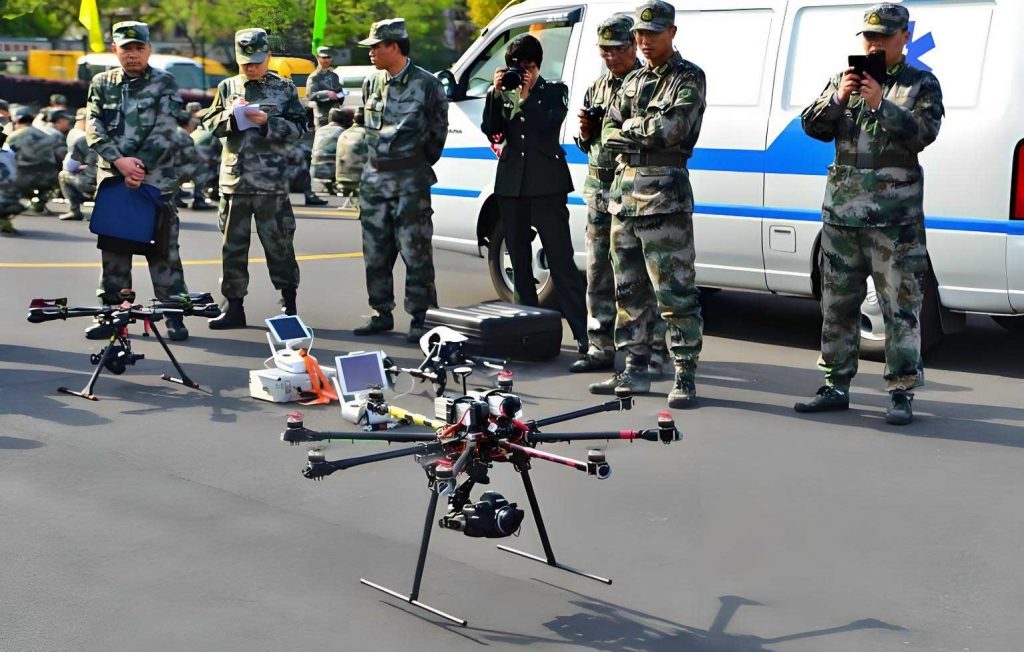
This image depicts a typical drone training setup with multiple stations, highlighting the collaborative nature of our simulation approach. The system’s advantages are manifold: it allows “visible components use real equipment, invisible ones use simulation” training, reducing costs while maintaining realism. Moreover, it enables repetitive practice of emergency procedures—like system failures or enemy engagements—without risking hardware. In our drone training programs, this has proven invaluable for building muscle memory and decision-making speed.
To validate the effectiveness of our drone simulation training system, we implemented it in a series of courses for in-service officers and conducted rigorous evaluations. We gathered feedback from three groups: trainees (officers), instructors, and system administrators, focusing on overall system utility, content design, and learning outcomes. Data was collected via questionnaires and discussions, then analyzed to identify strengths and areas for improvement. The results are summarized in tables below, providing insights into how drone training can be optimized through simulation.
First, we assessed the overall satisfaction with the drone training system. Participants rated aspects such as ease of use, system stability, and exercise workflow. The following table presents the aggregated responses, showing generally positive reception but noting administrative challenges in setup.
| Stakeholder Group | Very Satisfied (%) | Satisfied (%) | Dissatisfied (%) |
|---|---|---|---|
| Trainees (Officers) | 15 | 80 | 5 |
| Instructors | 10 | 85 | 5 |
| Administrators | 10 | 75 | 15 |
As seen, most users found the system beneficial for drone training, though administrators pointed to繁琐 (cumbersome) deployment processes. This feedback has guided us to streamline installation scripts, enhancing usability for future drone training sessions.
Next, we evaluated the design of training content within the drone simulation system. Key questions addressed alignment with job requirements, difficulty levels, and实战化 relevance. The table below captures the perceptions of trainees and instructors, excluding administrators who focus more on technical运维 (operations).
| Stakeholder Group | Very Satisfied (%) | Satisfied (%) | Dissatisfied (%) |
|---|---|---|---|
| Trainees (Officers) | 40 | 55 | 5 |
| Instructors | 25 | 70 | 5 |
Trainees appreciated the comprehensive coverage of drone operational知识点 (knowledge points), while instructors suggested refining content to avoid redundancy and adding self-assessment features. This indicates that drone training modules must balance breadth with specificity, tailored to evolving officer needs.
Finally, we measured learning outcomes from the drone training program. Indicators included knowledge integration, skill transfer to real tasks, and performance improvements. The assessment incorporated both subjective feedback and objective metrics like exam scores. The results are tabulated as follows:
| Stakeholder Group | Very Satisfied (%) | Satisfied (%) | Dissatisfied (%) |
|---|---|---|---|
| Trainees (Officers) | 25 | 70 | 5 |
| Instructors | 15 | 80 | 5 |
| Administrators | 10 | 75 | 15 |
Officers reported that drone training via simulation effectively prepared them for field duties, though some desired more adaptive scenario generation. Instructors noted higher exam scores compared to传统 (traditional) methods, confirming the system’s educational value. To quantify this improvement, we can model learning gain \( G \) as a function of simulation usage time \( t_s \) and prior experience \( E_0 \):
$$ G = \gamma \cdot \ln(1 + t_s) + \delta \cdot E_0 $$
where \( \gamma \) and \( \delta \) are coefficients derived from our drone training data. This formula helps optimize training durations for maximal benefit.
Reflecting on our drone training initiatives, we conclude that simulation systems offer transformative advantages for in-service officer education. Firstly, they drastically lower costs—our system supports up to 20 concurrent trainees at a fraction of the expense of real drones, making intensive drone training feasible for larger cohorts. Secondly, they introduce novel training modalities; for example, officers can switch roles mid-exercise to understand different perspectives, fostering holistic competency development. Thirdly, they empower instructors with customizable tools, enabling targeted drills for weak areas and promoting智慧教学 (smart teaching) reforms. However, we caution against over-reliance on technology: the human elements of mentorship, critical thinking, and teamwork remain irreplaceable in drone training. Our future work will focus on enhancing system intelligence—such as AI-driven difficulty adjustment—and expanding scenarios to cover emerging threats. By continuously integrating feedback, we aim to set a benchmark for drone training excellence, ultimately contributing to a more capable and agile defense force. In summary, drone simulation training is not just a supplement but a cornerstone of modern军事教育 (military education), and its iterative refinement will be key to winning future battles.