
In my years of experience in agricultural technology promotion, I have witnessed a transformative shift in crop protection methods, particularly with the rise of agricultural drones. These unmanned aerial vehicles are revolutionizing farming practices, especially in challenging terrains like hilly and mountainous regions. The integration of agricultural drones into mainstream agriculture is not just a trend but a necessity for enhancing productivity, sustainability, and safety. This article delves into the advantages, challenges, and strategic recommendations for promoting agricultural drone adoption, drawing from real-world observations and data. I will use tables and formulas to summarize key points, ensuring a comprehensive analysis that underscores the critical role of agricultural drones in modern farming.
The advent of agricultural drones has been a game-changer in precision agriculture. These devices, equipped with advanced spraying systems, offer unparalleled efficiency in pesticide and fertilizer application. From my perspective, the shift towards agricultural drones is driven by their ability to address long-standing issues in traditional methods, such as labor intensity, environmental harm, and inefficiency. In regions with complex topography, where manual or ground-based equipment struggles, agricultural drones excel due to their aerial mobility and adaptability. I believe that by leveraging these technologies, we can usher in a new era of smart farming that benefits both farmers and the ecosystem.
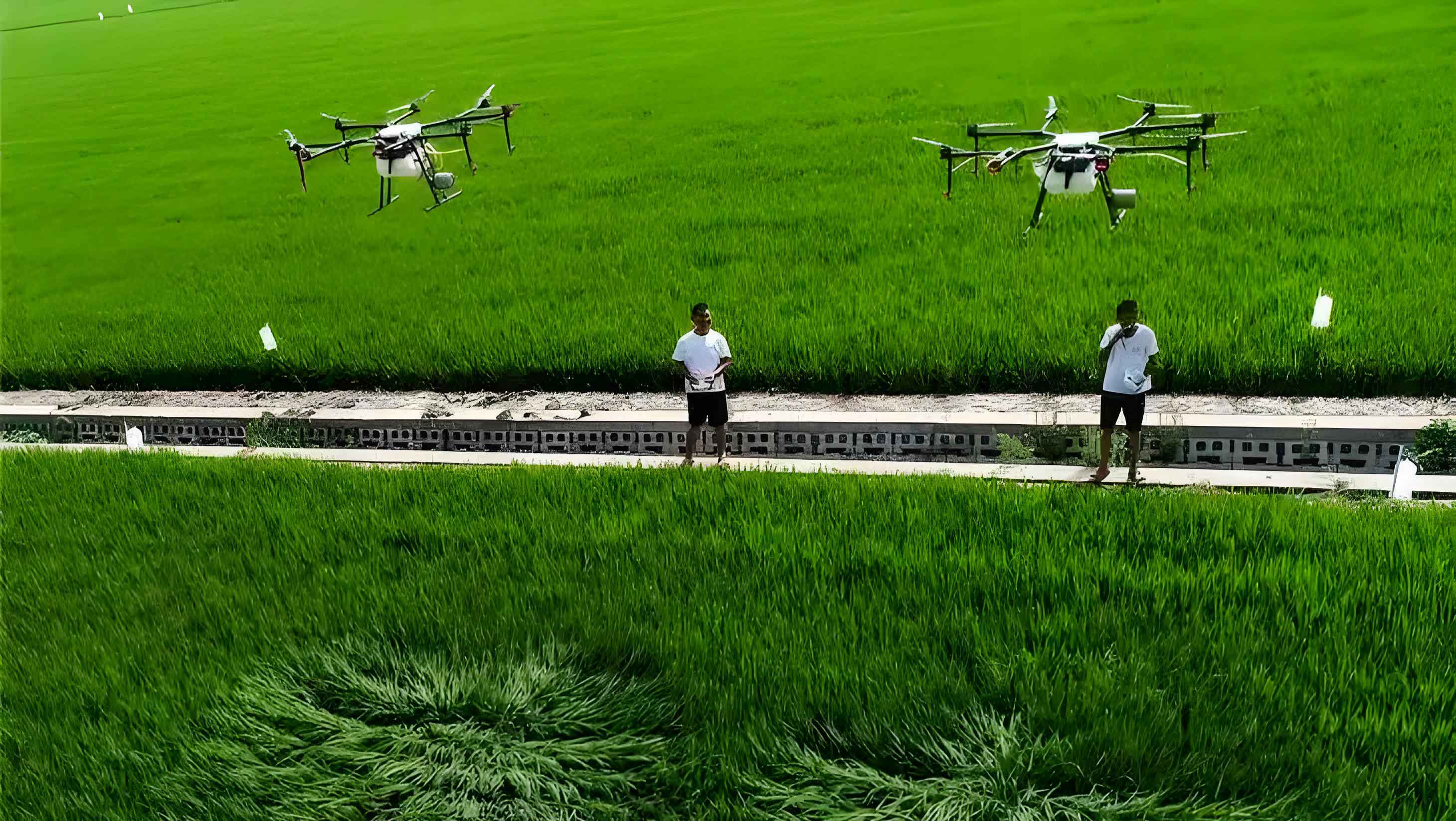
To illustrate the superiority of agricultural drones, consider their operational advantages. Traditional methods, like backpack sprayers, are not only slow but also pose health risks to operators due to chemical exposure. In contrast, agricultural drones operate remotely, minimizing human contact with harmful substances. The efficiency of agricultural drones can be quantified using simple formulas. For instance, the area coverage rate per unit time is a key metric: $$ \text{Coverage Rate} = \frac{A_{\text{sprayed}}}{A_{\text{total}}} \times 100\% $$ where \( A_{\text{sprayed}} \) is the area treated by the agricultural drone and \( A_{\text{total}} \) is the total farmland area. This rate often exceeds 90% for agricultural drones, compared to 50-70% for manual methods. Additionally, the time efficiency can be expressed as: $$ \text{Time Efficiency} = \frac{T_{\text{manual}}}{T_{\text{drone}}} $$ where \( T_{\text{manual}} \) is the time taken for manual spraying and \( T_{\text{drone}} \) is the time for agricultural drone operation. Typically, agricultural drones are 20-30 times faster, making them ideal for large-scale or urgent pest outbreaks.
The benefits of agricultural drones extend beyond speed. They offer significant resource savings, as shown in Table 1, which compares traditional and drone-based methods. Agricultural drones optimize chemical usage through precise spraying, reducing waste and environmental runoff. The droplet penetration and distribution can be modeled using fluid dynamics formulas, such as: $$ \text{Spray Uniformity} = \frac{1}{n} \sum_{i=1}^{n} \left( \frac{C_i – \bar{C}}{\bar{C}} \right)^2 $$ where \( C_i \) is the chemical concentration at point \( i \), \( \bar{C} \) is the average concentration, and \( n \) is the number of sample points. Lower values indicate better uniformity, a strength of agricultural drones due to their controlled airflow and nozzle systems.
| Aspect | Traditional Backpack Sprayer | Agricultural Drone |
|---|---|---|
| Efficiency (hectares/hour) | 0.1 – 0.2 | 2 – 4 |
| Chemical Usage (liters/hectare) | 20 – 30 | 10 – 15 |
| Operator Safety Risk | High | Low |
| Terrain Adaptability | Limited to flat areas | High for hills and slopes |
| Cost per Hectare (USD) | 15 – 25 | 8 – 12 |
| Environmental Impact | Moderate to high runoff | Low due to precision |
Despite these advantages, the adoption of agricultural drones faces several hurdles. From my field visits and discussions with farmers, I have identified key issues that hinder widespread use. First, the high initial investment is a major barrier. An agricultural drone with a payload capacity over 15 liters, including accessories, costs around $10,000 or more, even after subsidies. The cost-benefit analysis can be represented by: $$ \text{Payback Period} = \frac{I_{\text{initial}}}{S_{\text{annual}} – C_{\text{annual}}} $$ where \( I_{\text{initial}} \) is the initial cost, \( S_{\text{annual}} \) is annual savings from using agricultural drones, and \( C_{\text{annual}} \) is annual operational costs. For small-scale farmers, this period often exceeds 3-5 years, dampening enthusiasm. Second, the technical expertise required for operating agricultural drones is substantial. Pilots need certification and training, which adds to the cost and complexity. The skill gap can be quantified as: $$ \text{Skill Gap Index} = \frac{N_{\text{certified}}}{N_{\text{required}}} $$ where \( N_{\text{certified}} \) is the number of certified operators and \( N_{\text{required}} \) is the number needed based on farmland area. In many regions, this index is below 0.2, indicating a severe shortage.
Third, cultural and perceptual factors play a role. Many farmers, accustomed to traditional methods, are skeptical about the efficacy of agricultural drones. They worry about coverage, especially for crops with dense foliage or large leaves. This skepticism is reflected in adoption rates: in some areas, less than 5% of farmers use agricultural drones regularly. Fourth, agronomic compatibility issues arise. For instance, crops like citrus or grapes have leaf structures that reduce spray penetration from agricultural drones. The effectiveness can be modeled as: $$ \text{Effectiveness} = \alpha \cdot \text{Leaf Area Index} + \beta \cdot \text{Spray Pressure} $$ where \( \alpha \) and \( \beta \) are coefficients specific to crop types. Agricultural drones may underperform for high Leaf Area Index crops if not calibrated properly.
To address these challenges, I propose a multi-faceted approach based on practical insights. First, enhancing financial incentives is crucial. Governments should increase subsidies for purchasing agricultural drones and introduce operational subsidies for specific crops. The subsidy impact can be calculated as: $$ \text{Adoption Rate} = k \cdot \frac{S_{\text{subsidy}}}{C_{\text{drone}}} $$ where \( k \) is a constant, \( S_{\text{subsidy}} \) is the subsidy amount, and \( C_{\text{drone}} \) is the drone cost. Higher subsidies correlate with faster adoption. Table 2 outlines a proposed subsidy framework for agricultural drones, tailored to different farm sizes and crops. This would make agricultural drones more accessible to smallholders.
| Farm Size (hectares) | Purchase Subsidy (% of cost) | Operational Subsidy (USD/hectare) | Target Crops |
|---|---|---|---|
| < 1 | 40% | 5 | Rice, vegetables |
| 1 – 5 | 35% | 4 | Sugarcane, maize |
| > 5 | 30% | 3 | Fruits (e.g., grapes, citrus) |
Second, building a robust training ecosystem is essential. I recommend establishing localized training centers that offer short-term courses on agricultural drone operation. The curriculum should cover safety, regulations, and maintenance. The training effectiveness can be measured using: $$ \text{Competency Score} = \sum_{i=1}^{m} w_i \cdot S_i $$ where \( w_i \) are weights for skills like navigation and chemical handling, and \( S_i \) are assessment scores. By certifying more operators, we can create a skilled workforce that drives agricultural drone adoption. Additionally, community-based drone service teams can be formed to provide affordable spraying services, reducing the need for individual ownership.
Third, awareness campaigns are vital to shift perceptions. Through demonstrations and pilot projects, farmers can see firsthand the benefits of agricultural drones. For example, setting up comparison plots where one section is treated with agricultural drones and another with traditional methods can showcase differences in yield and pest control. The impact of such campaigns can be modeled as: $$ \text{Awareness Impact} = \frac{N_{\text{adopters post-campaign}}}{N_{\text{total farmers}}} $$ Regular field days and media coverage can amplify this effect, encouraging more farmers to embrace agricultural drones.
Fourth, integrating agronomic practices with agricultural drone technology is key. This involves optimizing crop spacing and planting patterns to enhance spray coverage. For instance, for dense crops like mulberries, adjusting row spacing can improve agricultural drone efficacy. The relationship can be expressed as: $$ \text{Coverage Efficiency} = f(\text{Row Spacing}, \text{Drone Speed}, \text{Nozzle Angle}) $$ Collaborative research between agronomists and engineers can develop best practices that maximize agricultural drone performance. Table 3 summarizes recommended agronomic adjustments for common crops when using agricultural drones.
| Crop Type | Recommended Row Spacing (meters) | Optimal Drone Flight Height (meters) | Spray Timing |
|---|---|---|---|
| Rice | 0.2 – 0.3 | 2 – 3 | Early morning |
| Sugarcane | 1.0 – 1.5 | 3 – 4 | Late afternoon |
| Citrus | 4.0 – 5.0 | 4 – 5 | During flowering |
| Grapes | 2.5 – 3.0 | 3 – 4 | Pre-harvest |
Looking ahead, the future of agricultural drones is bright, with advancements in AI and automation poised to enhance their capabilities. I envision agricultural drones becoming integral to precision agriculture, enabling real-time monitoring and targeted interventions. The economic viability can be assessed using net present value formulas: $$ \text{NPV} = \sum_{t=0}^{T} \frac{R_t – C_t}{(1 + r)^t} $$ where \( R_t \) are revenues from increased yields due to agricultural drones, \( C_t \) are costs, \( r \) is the discount rate, and \( T \) is the time horizon. Positive NPV values justify investment in agricultural drone technology. Moreover, environmental benefits, such as reduced chemical runoff, contribute to sustainable farming goals.
In conclusion, agricultural drones represent a transformative tool for modern agriculture, particularly in hilly regions where traditional methods fall short. By addressing financial, technical, and perceptual barriers through targeted strategies, we can accelerate their adoption. As an advocate for agricultural innovation, I urge stakeholders—governments, researchers, and farmers—to collaborate in promoting agricultural drones. The integration of tables and formulas in this analysis underscores the data-driven approach needed to unlock the full potential of agricultural drones. With continued effort, agricultural drones will not only boost crop yields but also pave the way for a safer, more efficient farming future.
To further illustrate the operational dynamics, consider the spray deposition pattern of agricultural drones, which can be modeled using Gaussian distribution formulas: $$ D(x,y) = \frac{Q}{2\pi\sigma_x\sigma_y} \exp\left(-\frac{(x-x_0)^2}{2\sigma_x^2} – \frac{(y-y_0)^2}{2\sigma_y^2}\right) $$ where \( D(x,y) \) is the deposition density at coordinates \( (x,y) \), \( Q \) is the total spray volume, \( \sigma_x \) and \( \sigma_y \) are dispersion parameters, and \( (x_0,y_0) \) is the release point. This model helps optimize flight paths for agricultural drones to ensure uniform coverage. Additionally, the cost-effectiveness of agricultural drones over time can be analyzed through lifecycle assessment formulas: $$ \text{Lifecycle Cost} = C_{\text{acquisition}} + \sum_{t=1}^{L} C_{\text{maintenance}, t} + C_{\text{energy}, t} – S_{\text{residual}} $$ where \( L \) is the lifespan of the agricultural drone, and \( S_{\text{residual}} \) is the residual value. Compared to manual labor, agricultural drones often show lower lifecycle costs after the initial payback period.
The scalability of agricultural drone services is another critical aspect. For large-scale farms, fleet management algorithms can optimize multiple agricultural drones working in tandem. The optimization problem can be formulated as: $$ \min \sum_{i=1}^{n} \left( T_i + E_i \right) $$ subject to constraints like battery life and coverage completeness, where \( T_i \) is the time for agricultural drone \( i \) and \( E_i \) is energy consumption. Such advancements will make agricultural drones more accessible and efficient. Furthermore, regulatory frameworks need to evolve to support safe integration of agricultural drones into airspace, involving risk assessment models: $$ \text{Risk Score} = P_{\text{incident}} \times I_{\text{impact}} $$ where \( P_{\text{incident}} \) is the probability of accidents and \( I_{\text{impact}} \) is the potential damage. By mitigating risks, we can build trust in agricultural drone technology.
In my view, the success of agricultural drones hinges on continuous innovation and stakeholder engagement. Through workshops and pilot programs, we can gather feedback to refine agricultural drone designs and operations. The iterative improvement process can be described as: $$ \text{Performance}_{t+1} = \text{Performance}_t + \eta \cdot \text{Feedback} $$ where \( \eta \) is a learning rate. This adaptive approach ensures that agricultural drones meet evolving agricultural needs. Ultimately, embracing agricultural drones is not just about adopting new technology but about fostering a culture of innovation in farming. As we move forward, I am confident that agricultural drones will become a cornerstone of resilient and productive agricultural systems worldwide.