
In recent years, the rapid proliferation of unmanned aerial vehicles (UAVs) in military domains has posed significant challenges to traditional air defense systems. As a researcher focused on emerging defense technologies, I have closely monitored the evolution of counter-UAV measures, particularly the shift toward directed energy weapons (DEWs). These systems, including high-energy lasers (HELs) and high-power microwaves (HPMs), offer unique advantages in anti-drone operations due to their precision, speed, and cost-effectiveness. This article delves into the progress of U.S. directed energy weapons tailored for anti-drone missions, emphasizing technical developments, key projects, and future trends. Through extensive analysis, I aim to provide a comprehensive overview, supported by tables and formulas, to illustrate the transformative potential of these technologies in modern warfare.
The threat posed by drones ranges from surveillance to kinetic attacks, necessitating robust anti-drone solutions. Traditional methods, such as radio jamming or kinetic interceptors, often fall short in terms of efficiency and collateral damage. Directed energy weapons, however, enable “soft-kill” and “hard-kill” capabilities by targeting drone electronics or airframes with focused energy beams. In this context, the U.S. military has prioritized DEWs as a cornerstone of its anti-drone strategy, investing in numerous programs to enhance mobility, power, and integration. From my perspective, the advancement of these systems is not merely incremental but revolutionary, potentially redefining aerial defense paradigms. Throughout this discussion, the term “anti-drone” will be frequently highlighted to underscore the focus on countering UAV threats, a critical aspect of contemporary military operations.
High-Energy Laser Weapons: Core Components and Anti-Drone Applications
High-energy laser weapons generate coherent light beams that can thermally degrade or destroy targets. Their effectiveness in anti-drone roles stems from several factors: rapid engagement speeds (approaching the speed of light), high accuracy, and scalable power levels. A typical HEL system comprises a laser source, adaptive optics for atmospheric correction, a beam control system, and tracking mechanisms. The power output, often measured in kilowatts (kW), directly influences the engagement range and lethality. For instance, the time required to disable a drone can be modeled using the energy deposition formula: $$ E_{dep} = P \cdot t \cdot \eta $$ where \( E_{dep} \) is the energy deposited on the target, \( P \) is the laser power, \( t \) is the exposure time, and \( \eta \) represents the atmospheric transmission efficiency. This relationship underscores the importance of high power and minimal beam divergence for successful anti-drone engagements.
Over the past decade, the U.S. has developed multiple HEL systems specifically for anti-drone missions. These projects demonstrate a trend toward miniaturization, increased power, and multi-platform deployment. Below, I summarize key programs in a table to provide a clear comparison of their capabilities.
| System Name | Platform | Laser Power | Key Anti-Drone Features | Status |
|---|---|---|---|---|
| MEHEL (Mobility-Enhanced High-Energy Laser) | Stryker vehicle | 2 kW to 50 kW (planned) | Modular fiber lasers; tested against multi-rotor and fixed-wing drones | Operational testing; incrementally upgrading power |
| ATHENA (Advanced Test High Energy Asset) | Truck-mounted | 30 kW | Fiber laser combination; demonstrated against 3-meter wingspan drones | Technology demonstrator; potential for naval/air integration |
| HELWS-MRZR | Polaris MRZR all-terrain vehicle | 5 kW to 10 kW | Compact design for airborne deployment; successful against commercial drones | Delivered to military units for field use |
| HELTVD (High-Energy Laser Tactical Vehicle Demonstrator) | Tactical truck | 100 kW | Aimed at rocket, artillery, and drone threats; part of layered defense | Under development; contracts awarded for testing |
| HELIOS (High-Energy Laser with Integrated Optical-dazzler and Surveillance) | Naval destroyers | 60 kW to 150 kW | Combines hard-kill, soft-kill, and ISR functions; targets drones and small boats | Scheduled for deployment in early 2020s |
| SHIELD (Self-protected High-Energy Laser Demonstrator) | Aircraft (e.g., F-15) | 50 kW (planned) | Airborne self-defense against drones and missiles; uses multi-spectral targeting | In testing phase; aims for operational capability by 2021 |
| CLaWS (Compact Laser Weapon System) | Ground tripod or vehicle | 2 kW to 10 kW | Portable system for infantry; effective against Class I/II drones | Deployed with Marine Corps; ongoing evaluations |
Each of these systems represents a step forward in anti-drone technology. For example, MEHEL’s modular design allows for power scaling, which is crucial for adapting to evolving drone threats. In tests, it has engaged dozens of drones, showcasing the potential for area defense. Similarly, HELIOS integrates multiple functions, enabling a single platform to perform surveillance, dazzling, and destruction—a holistic approach to anti-drone warfare. The power density on target, given by $$ P_d = \frac{P}{\pi r^2} $$ where \( r \) is the beam radius, determines the speed of kill. Higher power densities, achieved through advanced beam control, reduce engagement times, making these systems ideal for swarming drone scenarios.
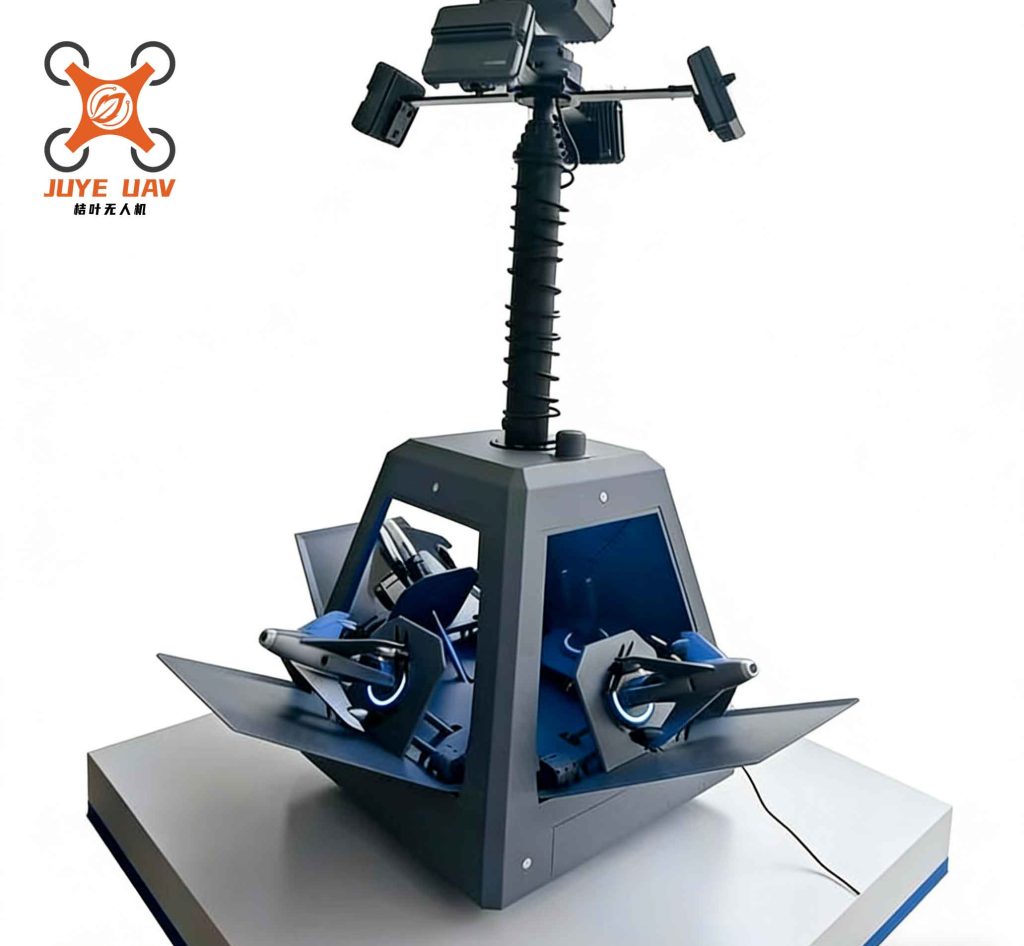
This image illustrates a conceptual deployment of an anti-drone laser system, highlighting the focused beam engagement. In practice, the effectiveness of HELs depends on factors like atmospheric conditions, which can be modeled using the Beer-Lambert law: $$ I = I_0 e^{-\alpha L} $$ where \( I \) is the intensity at range \( L \), \( I_0 \) is the initial intensity, and \( \alpha \) is the attenuation coefficient. Adaptive optics help mitigate these losses, ensuring consistent performance in anti-drone roles. From my analysis, the continuous improvement in laser efficiency (now exceeding 40% for some fiber lasers) and cooling technologies has enabled smaller, more powerful systems that can be fielded on diverse platforms, from all-terrain vehicles to naval ships. This versatility is key to addressing the pervasive drone threat across all domains.
High-Power Microwave Weapons: Principles and Anti-Drone Progress
High-power microwave weapons operate by emitting intense bursts of electromagnetic energy that disrupt or destroy electronic components. Unlike lasers, which require precise aiming, HPMs can engage multiple targets within a wide beam, making them particularly effective against drone swarms. The fundamental mechanism involves inducing high voltages in circuitry, leading to burnout or malfunction. The energy delivered can be expressed as $$ E = \int P(t) \, dt $$ where \( P(t) \) is the time-varying power output. For anti-drone applications, HPM systems often use pulsed power sources to generate peak powers in the gigawatt range, albeit for short durations. This area effect allows a single engagement to neutralize numerous drones simultaneously, a critical advantage in mass raid scenarios.
The U.S. has developed several HPM systems focused on anti-drone missions, each with unique characteristics. Below, I present a table summarizing these initiatives, based on available data and observations.
| System Name | Platform | Power Output | Key Anti-Drone Features | Status |
|---|---|---|---|---|
| Phaser | Vehicle-mounted | Classified (high peak power) | Wide-area coverage; demonstrated against drone clusters and single UAVs | Tested extensively; used in exercises for base defense |
| C-UAS (Counter-Unmanned Aerial System) | UAV-borne | Not specified | Mobile HPM emitter for drone-on-drone engagements; disrupts enemy UAV electronics | In procurement and integration phase |
| THOR (Tactical High-power Operational Responder) | Containerized system | High power pulses | Rapid 360-degree coverage; capable of defeating over 50 drones in one burst | Demonstrated in 2019; undergoing further testing |
| Distributed RF Power | Network of small UAVs/boats | Theoretically extreme (comparable to astrophysical events) | Scalable power via distributed apertures; aims to fry electronics over large areas | Conceptual stage; seeking industry proposals |
These systems highlight the diverse approaches to HPM-based anti-drone warfare. Phaser, for instance, has been tested in exercises where it successfully engaged multiple drone swarms, proving its value for perimeter defense. The effectiveness of such weapons can be analyzed using the Friis transmission equation modified for disruption: $$ P_r = P_t G_t G_r \left( \frac{\lambda}{4\pi R} \right)^2 $$ where \( P_r \) is the power received by the drone’s electronics, \( P_t \) is the transmitted power, \( G_t \) and \( G_r \) are antenna gains, \( \lambda \) is the wavelength, and \( R \) is the range. For anti-drone purposes, engineers optimize \( P_t \) and \( G_t \) to ensure \( P_r \) exceeds the damage threshold of common UAV components, such as GPS receivers or flight controllers.
Moreover, HPM weapons offer a non-kinetic option for anti-drone operations, reducing collateral damage—a significant concern in populated areas. In my view, the integration of HPMs with other sensors, like radar and electro-optical systems, enhances their ability to detect and classify drones before engagement. This synergy is evident in programs like THOR, which uses laptop controls for quick deployment and targeting. The future of HPMs lies in increasing power efficiency and reducing size, enabling installation on more platforms. For example, the Distributed RF Power concept envisions using swarms of small vehicles to create a massive virtual antenna, potentially revolutionizing anti-drone tactics by projecting overwhelming RF energy across battlefields.
Trends in Directed Energy Anti-Drone Technology
Based on my analysis of U.S. programs, several clear trends emerge in the development of directed energy weapons for anti-drone applications. These trends not only reflect technological advancements but also strategic shifts in military doctrine. To encapsulate these, I have formulated a set of key directions, supported by empirical observations from tests and deployments.
First, there is a move from conceptual prototypes to operational systems. Initially, DEWs were seen as futuristic concepts, but recent successes in intercepting drones have accelerated their fielding. For instance, systems like CLaWS are already in the hands of troops, providing immediate anti-drone capabilities. This trend is driven by improvements in reliability and cost reduction, with the cost per engagement for lasers often cited as minimal compared to traditional missiles. The equation for cost-effectiveness can be approximated as $$ C_{DEW} = \frac{C_{system}}{N_{engagements}} + C_{energy} $$ where \( C_{system} \) is the system cost, \( N_{engagements} \) is the number of engagements over lifetime, and \( C_{energy} \) is the energy cost per shot. For anti-drone missions, where drones are cheap and numerous, DEWs offer a favorable ratio, especially when \( N_{engagements} \) is high.
Second, DEWs are becoming central to counter-swarm tactics. Drone swarms present a unique challenge due to their numbers and coordination. Both HELs and HPMs have demonstrated effectiveness against groups: HELs through rapid sequential engagement, and HPMs via broad-area effects. The probability of defeating a swarm with DEWs can be modeled using stochastic formulas. For example, for a laser system, the expected number of drones neutralized in time \( T \) is $$ N_{kill} = \lambda \int_0^T P_{kill}(t) \, dt $$ where \( \lambda \) is the arrival rate of drones, and \( P_{kill}(t) \) is the time-dependent kill probability, influenced by factors like power and tracking accuracy. HPMs simplify this by offering a near-instantaneous coverage area \( A \), with kill probability depending on power density within \( A \).
Third, multi-functionality and intelligence are being integrated. Modern DEW systems often combine “hard-kill” and “soft-kill” modes, along with surveillance functions. This is exemplified by HELIOS, which can dazzle sensors or destroy targets. Additionally, artificial intelligence (AI) is being incorporated for autonomous target recognition and engagement, reducing operator burden. In anti-drone contexts, AI algorithms process data from multiple sensors to classify UAV types and prioritize threats, enhancing response times. The integration can be represented as a feedback loop: $$ \text{Detect} \rightarrow \text{Track} \rightarrow \text{Classify} \rightarrow \text{Engage} \rightarrow \text{Assess} $$ where each step is optimized through machine learning, ensuring efficient use of DEW resources.
Fourth, platform diversification is expanding. While early systems were ground-based, there is now emphasis on deploying DEWs on naval, aerial, and even space platforms. This trend addresses the need for all-domain anti-drone defense. For example, SHIELD aims to put lasers on aircraft, while HELIOS is for ships. The technical challenges involve miniaturization and power supply, but advances in solid-state lasers and compact RF sources are making this feasible. A table below summarizes the platform trends and their anti-drone implications.
| Platform Type | Example Systems | Anti-Drone Advantages | Challenges |
|---|---|---|---|
| Ground Vehicles | MEHEL, HELWS-MRZR, CLaWS | High mobility for tactical units; can be air-dropped | Power and cooling constraints in small formats |
| Naval Vessels | HELIOS | Extended range over water; protects ships from drone swarms | Marine environment durability; integration with ship systems |
| Aircraft | SHIELD | Airborne defense for high-value assets; engages drones at altitude | Size, weight, and power (SWaP) limits; vibration effects |
| Fixed Installations | Phaser, THOR | Base protection; wide-area coverage against sustained threats | Power infrastructure needs; susceptibility to countermeasures |
These trends collectively indicate that directed energy weapons are evolving into mature, versatile tools for anti-drone operations. In my assessment, the ongoing research into higher power levels, such as the 100 kW goals for lasers, and more efficient HPM pulsers, will further enhance their lethality and range. Moreover, the synergy between DEWs and other counter-drone technologies, like electronic warfare and kinetic interceptors, is creating layered defense architectures that are resilient against diverse UAV threats.
Conclusion: The Future of Anti-Drone Warfare with Directed Energy
In conclusion, the progress in U.S. directed energy weapons for anti-drone applications marks a pivotal shift in military technology. Through my examination of high-energy lasers and high-power microwaves, it is evident that these systems offer unparalleled advantages in speed, precision, and cost-efficiency. The development programs highlighted demonstrate a clear path toward operational deployment, with systems already being tested and fielded in real-world scenarios. The emphasis on anti-drone capabilities is reflected in the design choices, such as modular power scaling for lasers and wide-beam effects for microwaves, ensuring they can address both individual drones and swarms.
Looking ahead, I anticipate that directed energy weapons will become integral to air and missile defense networks, providing a scalable solution to the growing drone threat. The trends toward multi-functionality, intelligence integration, and platform diversification will likely accelerate, driven by ongoing investments and technological breakthroughs. For instance, the combination of AI with DEWs could enable fully autonomous anti-drone systems that detect and engage threats within seconds, a critical need in fast-paced combat environments. Furthermore, international interest in similar technologies suggests that anti-drone DEWs will soon be a global standard, necessitating continuous innovation to maintain edge.
As a final note, the ethical and strategic implications of these weapons warrant consideration. Their non-kinetic options reduce collateral damage, aligning with norms of modern warfare. However, the potential for escalation and countermeasures remains, urging responsible development and deployment. In my view, the focused effort on anti-drone directed energy weapons not only enhances national security but also pushes the boundaries of science and engineering, promising a future where aerial threats are neutralized with unprecedented efficiency. The journey from concept to reality, as detailed in this article, underscores the transformative potential of DEWs in safeguarding skies against unmanned intrusions.