
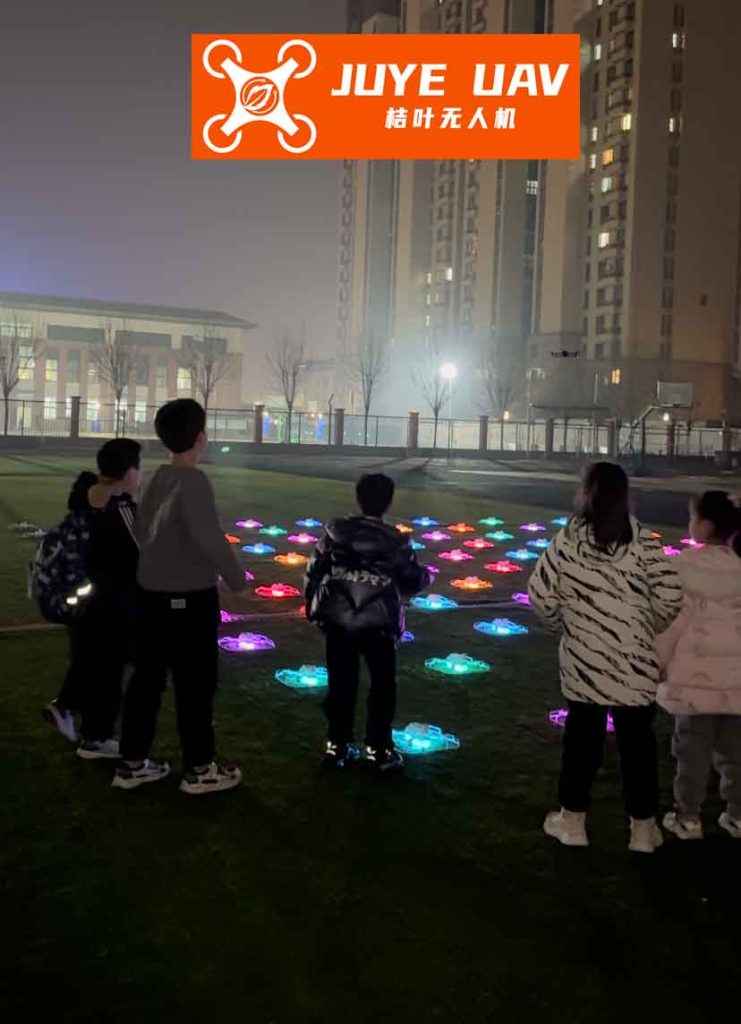
The evolution of unmanned aerial vehicles (UAVs) from solitary platforms to coordinated fleets has unlocked unprecedented capabilities. Among the most visually stunning and technically demanding applications is the large-scale formation drone light show. These spectacles require hundreds, sometimes thousands, of drones to operate in tightly synchronized, dynamic three-dimensional patterns, creating luminous animations in the night sky. The core challenge lies in enabling a swarm to autonomously achieve and maintain a desired geometric configuration while safely navigating through its own fleet and avoiding potential static or dynamic obstacles, all in real-time and with robust reliability.
Traditional control paradigms for multi-UAV systems often rely on centralized architectures, where a single ground station computes trajectories for every agent. While conceptually simple, this approach presents a single point of failure and suffers from scalability and latency issues, making it ill-suited for the agile and expansive requirements of a formation drone light show. Distributed control architectures, where each drone makes decisions based on local information exchanged with neighboring units, offer superior robustness and scalability. Within this distributed framework, the Artificial Potential Field (APF) method has been a popular choice for its computational efficiency and intuitive integration of path planning and reactive obstacle avoidance. The core idea is to superimpose virtual force fields: attractive fields pull drones towards goals or desired formation positions, while repulsive fields push them away from collisions with peers and obstacles.
However, the classical APF method is plagued by significant shortcomings that become critically apparent in complex 3D environments like those required for a formation drone light show. The most notorious issue is the local minimum problem, where a drone becomes trapped in a position where the vector sum of all attractive and repulsive forces equals zero, preventing it from reaching its target. Furthermore, traditional APF formulations are often confined to 2D planes, lacking explicit control over altitude, which is a fundamental axis for creating depth and complex shapes in a formation drone light show. Finally, most APF-based formation controllers do not elegantly incorporate the communication topology of the swarm, treating all neighbors equally regardless of the actual data-link structure.
This article addresses these limitations by proposing a novel, improved 3D-APF algorithm specifically designed for the rigorous demands of autonomous fleet operations. Our contributions are threefold: First, we construct a true 3D potential field by decoupling horizontal plane control from vertical (z-axis) control, enabling prioritized altitude convergence and precise 3D formation shaping. Second, we integrate concepts from consensus theory, such as communication topology and link weights, directly into the potential field functions, creating a distributed formation controller that respects the swarm’s actual information flow. Third, we introduce a sophisticated obstacle repulsion model featuring an auxiliary rotational potential field that effectively eliminates local minima, especially against moving obstacles. The efficacy of this integrated approach is validated through comprehensive numerical simulations, demonstrating its potential as a core technology for the next generation of intelligent, reliable, and spectacular formation drone light show systems.
System Modeling and Problem Formulation
We consider a fleet of n quadrotor UAVs operating in a distributed “leader-follower” structure, a common and effective configuration for a formation drone light show. One drone is designated as the leader, possessing knowledge of the global target or predefined show trajectory. The remaining n-1 drones are followers, responsible for maintaining prescribed relative positions to the leader and to each other based on local communication. The communication network is represented by an undirected graph $\mathcal{G} = (\mathcal{V}, \mathcal{E})$, where $\mathcal{V}={1, 2, …, n}$ is the set of drones (nodes), and $\mathcal{E} \subseteq \mathcal{V} \times \mathcal{V}$ is the set of communication links (edges). The adjacency matrix $\mathbf{A} = [a_{ij}]$ defines the communication weights, where $0 \leq a_{ij} \leq 1$. A non-zero $a_{ij}$ indicates that drones $i$ and $j$ can exchange state information, crucial for a distributed formation drone light show.
The translational dynamics of the i-th quadrotor in the inertial frame are given by:
$$
m_i \ddot{\mathbf{p}}_i = m_i \mathbf{g} + \mathbf{R}_i \mathbf{T}_i – \mathbf{K}_{p,i} \dot{\mathbf{p}}_i
$$
where $\mathbf{p}_i = [x_i, y_i, z_i]^T$ is the position vector, $m_i$ is the mass, $\mathbf{g} = [0, 0, g]^T$ is gravity, $\mathbf{T}_i = [0, 0, T_{i,z}]^T$ is the thrust vector in the body frame, $\mathbf{K}_{p,i}$ is a diagonal matrix of linear drag coefficients, and $\mathbf{R}_i$ is the rotation matrix from the body frame to the inertial frame. The rotational dynamics and the specific form of $\mathbf{R}_i$, dependent on the Euler angles $(\phi_i, \theta_i, \psi_i)$, follow standard quadrotor models. The control objective is to derive a distributed control law that enables the fleet to achieve a desired 3D formation defined by relative position vectors $\mathbf{p}_{ij}^{des} = \mathbf{p}_j^{des} – \mathbf{p}_i^{des}$, while ensuring $||\mathbf{p}_i – \mathbf{p}_j|| > d_{safe}$ for all $i \neq j$ and avoiding collisions with environmental obstacles $o_k$ such that $||\mathbf{p}_i – \mathbf{p}_{o_k}|| > d_{obs}$.
The Proposed Improved 3D-APF Formation and Obstacle Avoidance Algorithm
Our algorithm synthesizes attractive forces for formation keeping and target tracking with repulsive forces for inter-agent and external obstacle avoidance. The total virtual force on drone $i$, $\mathbf{F}_i^{total}$, is the vector sum of these components and is used to generate acceleration commands that are integrated into the low-level flight controller.
1. Enhanced 3D Formation Control via Attractive Fields
We design separate yet cooperative attractive potential fields for the leader and the followers, explicitly extending into the third dimension.
Leader Attraction to Target: The leader drone $L$ is attracted to a moving target point (e.g., the next anchor point in the light show script). Its attractive potential $U_L^{att,tar}$ is designed to prioritize altitude alignment:
$$
U_L^{att,tar} = \frac{1}{2} \left[ k_{1}^{xy} (p_{L,tar}^{xy})^2 + k_{1}^{z} (p_{L,tar}^{z})^2 \right]
$$
where $p_{L,tar}^{xy} = ||\mathbf{p}_L^{xy} – \mathbf{p}_{tar}^{xy}||$ is the horizontal distance, $p_{L,tar}^{z} = |z_L – z_{tar}|$ is the vertical distance, and $k_{1}^{xy}, k_{1}^{z} > 0$ are tunable gain parameters. The corresponding force is the negative gradient:
$$
\mathbf{F}_L^{att,tar} = -\nabla U_L^{att,tar} = – \left( k_{1}^{xy} p_{L,tar}^{xy} \mathbf{n}_{L,tar}^{xy} + k_{1}^{z} p_{L,tar}^{z} \mathbf{n}_{L,tar}^{z} \right)
$$
where $\mathbf{n}$ denotes the unit vector along the direction. This formulation encourages the leader to first match the target’s altitude and then proceed within that horizontal plane, a logical strategy for a structured formation drone light show.
Follower Attraction for Formation Keeping: Followers are attracted to their desired relative positions within the formation. Crucially, we incorporate the communication topology. The formation attraction potential for follower $i$ with respect to a neighbor $j$ is:
$$
U_{i,j}^{att,form} = \frac{a_{ij}}{2} \left[ k_{2}^{xy} (\mathbf{e}_{ij}^{xy})^2 + k_{2}^{z} (e_{ij}^{z})^2 + k_{2}^{v} (\mathbf{v}_{ij} \cdot \mathbf{n}_{ij})^2 \right]
$$
where $\mathbf{e}_{ij} = (\mathbf{p}_i – \mathbf{p}_j) – \mathbf{p}_{ij}^{des}$ is the relative position error, decomposed into horizontal ($\mathbf{e}_{ij}^{xy}$) and vertical ($e_{ij}^{z}$) components. The term $\mathbf{v}_{ij} = \dot{\mathbf{p}}_i – \dot{\mathbf{p}}_j$ is the relative velocity, and its projection along the unit vector $\mathbf{n}_{ij}$ between drones adds damping for smoother convergence. The weight $a_{ij}$ ensures that only connected neighbors influence the potential. The total formation force on follower $i$ is the consensus-based sum over its neighborhood $N_i$:
$$
\mathbf{F}_i^{att,form} = -\sum_{j \in N_i} \nabla U_{i,j}^{att,form} = -\sum_{j \in N_i} a_{ij} \left[ k_{2}^{xy} \mathbf{e}_{ij}^{xy} + k_{2}^{z} e_{ij}^{z} \mathbf{n}_{ij}^{z} + k_{2}^{v} (\mathbf{v}_{ij} \cdot \mathbf{n}_{ij}) \mathbf{n}_{ij} \right]
$$
This distributed calculation allows the entire formation drone light show to cohesively assemble and re-form after disruptions, based on local information exchange.
2. Comprehensive 3D Collision Avoidance via Repulsive Fields
Collision avoidance is paramount, especially in dense formations. We define repulsive fields for both inter-agent and external obstacles.
Inter-Agent Repulsion: A simple but effective repulsive potential prevents drones from getting too close:
$$
U_{i,j}^{rep} = \begin{cases}
\frac{1}{2} a_{ij} \eta \left( \frac{1}{p_{ij}} – \frac{1}{p_0} \right)^2, & \text{if } p_{ij} \leq p_0 \\
0, & \text{if } p_{ij} > p_0
\end{cases}
$$
where $p_{ij} = ||\mathbf{p}_i – \mathbf{p}_j||$, $\eta > 0$ is a gain, and $p_0$ is the radius of the repulsive influence. The corresponding force, $\mathbf{F}_i^{rep,agent} = -\sum_{j \in N_i} \nabla U_{i,j}^{rep}$, pushes drones apart when they enter each other’s safety sphere.
Obstacle Repulsion with Local Minima Escape: This is a key innovation. For an obstacle $o$, we design a composite repulsive field. The primary field is a standard distance-based repulsion, modified by a velocity-dependent scaling factor $g(v_o) = k_3 [1 + 1/(1+v_o)]$ that increases the field strength for faster-moving obstacles:
$$
U_{i,o}^{rep,pri} = \begin{cases}
\frac{1}{2} \zeta g(v_o) \left( \frac{1}{p_{i,o}} – \frac{1}{p_{obs}} \right)^2, & \text{if } p_{i,o} \leq p_{obs} \\
0, & \text{if } p_{i,o} > p_{obs}
\end{cases}
$$
where $p_{i,o}$ is the distance to the obstacle, $p_{obs}$ is its influence range, and $\zeta>0$ is a gain.
To solve the local minimum problem, we introduce an auxiliary rotational potential field $U_{i,o}^{rep,aux}$. This field exerts a force perpendicular to the obstacle’s velocity direction $\mathbf{v}_o$, effectively creating a “sideways push” to guide the drone around a blocking obstacle. Its magnitude depends on the angle $\beta$ between the drone’s approach direction and the obstacle’s velocity.
$$
U_{i,o}^{rep,aux} = \begin{cases}
\frac{1}{2} \zeta \lambda(\beta) \left( \frac{1}{p_{i,o}} – \frac{1}{p_{obs}} \right)^2 \mathbf{A}^T \mathbf{n}_{i,o}, & \text{if } p_{i,o} \leq p_{obs} \\
0, & \text{if } p_{i,o} > p_{obs}
\end{cases}
$$
$$
\text{with } \lambda(\beta) = \frac{k_4}{(1 + e^{-\beta})}, \quad \mathbf{A} = [\cos(\pi/2), \sin(\pi/2)]^T \text{ (for 90° rotation)}
$$
The total obstacle avoidance force is the sum of the gradients of both fields: $\mathbf{F}_i^{rep,obs} = -\nabla (U_{i,o}^{rep,pri} + U_{i,o}^{rep,aux})$. This combined strategy is highly effective for a formation drone light show encountering unexpected dynamic obstacles like birds.
3. Integrated Control Law
The total virtual control force for each drone is the superposition of all relevant attractive and repulsive forces. For the leader:
$$
\mathbf{F}_L^{total} = \mathbf{F}_L^{att,tar} + \mathbf{F}_L^{rep,agent} + \sum_{o} \mathbf{F}_L^{rep,obs}
$$
For a follower $i$:
$$
\mathbf{F}_i^{total} = \mathbf{F}_i^{att,form} + \mathbf{F}_i^{rep,agent} + \sum_{o} \mathbf{F}_i^{rep,obs}
$$
This virtual force $\mathbf{F}_i^{total} = [F_i^x, F_i^y, F_i^z]^T$ is then translated into a desired acceleration for the drone’s dynamic model. To enhance reactivity during obstacle avoidance, the controller’s overall gain can be adaptively scaled based on the magnitude of the repulsive forces.
Simulation Analysis and Performance Evaluation
To validate the proposed algorithm, we conducted a simulation in MATLAB involving a fleet of five quadrotors (1 leader, 4 followers) in a cluttered 3D environment. The initial conditions and desired formation (a compact pyramid) are listed below. The communication topology was a sparse graph where the leader communicates with two followers, and other connections exist among followers, mimicking a realistic distributed network for a formation drone light show.
| UAV Role | Initial Position (x, y, z) [m] | Initial Velocity [m/s] | Desired Offset (from Leader) [m] |
|---|---|---|---|
| Leader (L) | (50, 50, 20) | (4, 4, 0) | (0, 0, 0) |
| Follower 1 (F1) | (33, 37, 8) | (0.5, 1.2, 0) | (5, 5, 0) |
| Follower 2 (F2) | (38, 12, 36) | (0.5, 0.8, 0) | (5, -5, 0) |
| Follower 3 (F3) | (25, 15, 14) | (0, 1.1, 0) | (0, 10, 0) |
| Follower 4 (F4) | (23, 33, 22) | (0, 0, 0) | (0, -10, 0) |
The environment contained three static obstacles (two cylindrical, one spherical) and one dynamic spherical obstacle that began moving at high speed towards the fleet’s path at t = 55s, creating a classic local minimum scenario. Furthermore, at t = 90s, the desired formation was commanded to reconfigure from a compact shape to a wider triangle, testing the algorithm’s formation-switching capability mid-flight—a common requirement in a dynamic formation drone light show.
The simulation results demonstrated the full efficacy of the proposed 3D-APF algorithm. Key performance metrics are summarized below:
| Metric | Observation | Implication |
|---|---|---|
| 3D Formation Achievement | The fleet first aligned to a common altitude (~24.3s) before completing the 2D shape (~39.3s). | Prioritized z-axis control works as designed, ensuring a coherent 3D formation for the light show. |
| Obstacle Avoidance | All drones successfully avoided four obstacles. Minimum distance to the fast-moving obstacle was 1.87m. | The auxiliary rotational field successfully prevented entrapment in local minima, enabling escape from the dynamic threat. |
| Formation Reconfiguration | The fleet smoothly transitioned to the new, wider formation shape at t=90s and stabilized by t=118.5s. | The consensus-based attractive field allows for flexible, real-time reshaping of the formation drone light show pattern. |
| Collision Safety | The minimum inter-agent distance was 1.62m (L and F2), always above the set safety threshold. | Inter-agent repulsion effectively maintained safe separation throughout complex maneuvers. |
| Target Convergence | The entire fleet successfully reached the final target location by t=133.1s. | The integrated control law ensures stable and complete mission execution. |
The trajectories clearly show the fleet cohesively navigating around obstacles, with the dynamic obstacle causing a temporary deformation in the formation that was quickly corrected. The smooth paths and velocity profiles confirm stable and oscillation-free control, which is essential for creating clean, visually appealing trajectories in a formation drone light show.
Conclusion and Application in Formation Drone Light Shows
This article has presented a robust and practical solution for the core control challenge of autonomous drone fleets by developing an improved three-dimensional artificial potential field algorithm. By extending the potential field into the vertical dimension, incorporating the swarm’s communication topology into the force calculations, and designing an innovative rotational auxiliary field for obstacle repulsion, we have simultaneously addressed the key limitations of traditional APF methods: lack of 3D control, poor integration with distributed networks, and susceptibility to local minima.
The algorithm’s performance makes it particularly suitable for the demanding domain of large-scale formation drone light shows. Its ability to manage precise 3D formations, reconfigure shapes in real-time, and reliably avoid both static infrastructure and unexpected dynamic obstacles (like birds or other drones) directly translates to increased safety, reliability, and creative flexibility for show operators. The distributed nature of the control logic enhances scalability, allowing the system to gracefully manage fleets ranging from dozens to thousands of drones without a central computational bottleneck.
Future work will focus on optimizing the algorithm for extreme scale, integrating more sophisticated obstacle perception models (e.g., using onboard vision), and formally analyzing the stability guarantees of the formation under the proposed hybrid potential fields. The pursuit of ever more magnificent and intelligent aerial displays continues to drive innovation in multi-agent control, and the proposed method represents a significant step towards realizing the full potential of synchronized formation drone light shows as a ubiquitous form of artistic and commercial expression.