
As a pivotal component of precision agriculture, crop spraying drone technology has revolutionized pesticide application by offering unparalleled efficiency and flexibility. However, the effectiveness of these spraying UAV systems hinges on the droplet deposition process, which occurs in the complex low-altitude environment near the ground. The journey of droplets from the nozzle to the target is influenced by numerous factors, often leading to uneven distribution and suboptimal deposition. This not only reduces pesticide utilization and compromises pest control efficacy but also poses environmental risks and ecological hazards. In this article, I will explore the characteristics of droplet deposition distribution, analyze the factors affecting deposition outcomes, and propose methods to enhance performance, drawing on recent advancements in the field. The insights shared here aim to support ongoing research and development in crop spraying drone technologies, emphasizing the need for optimized designs and operational strategies.
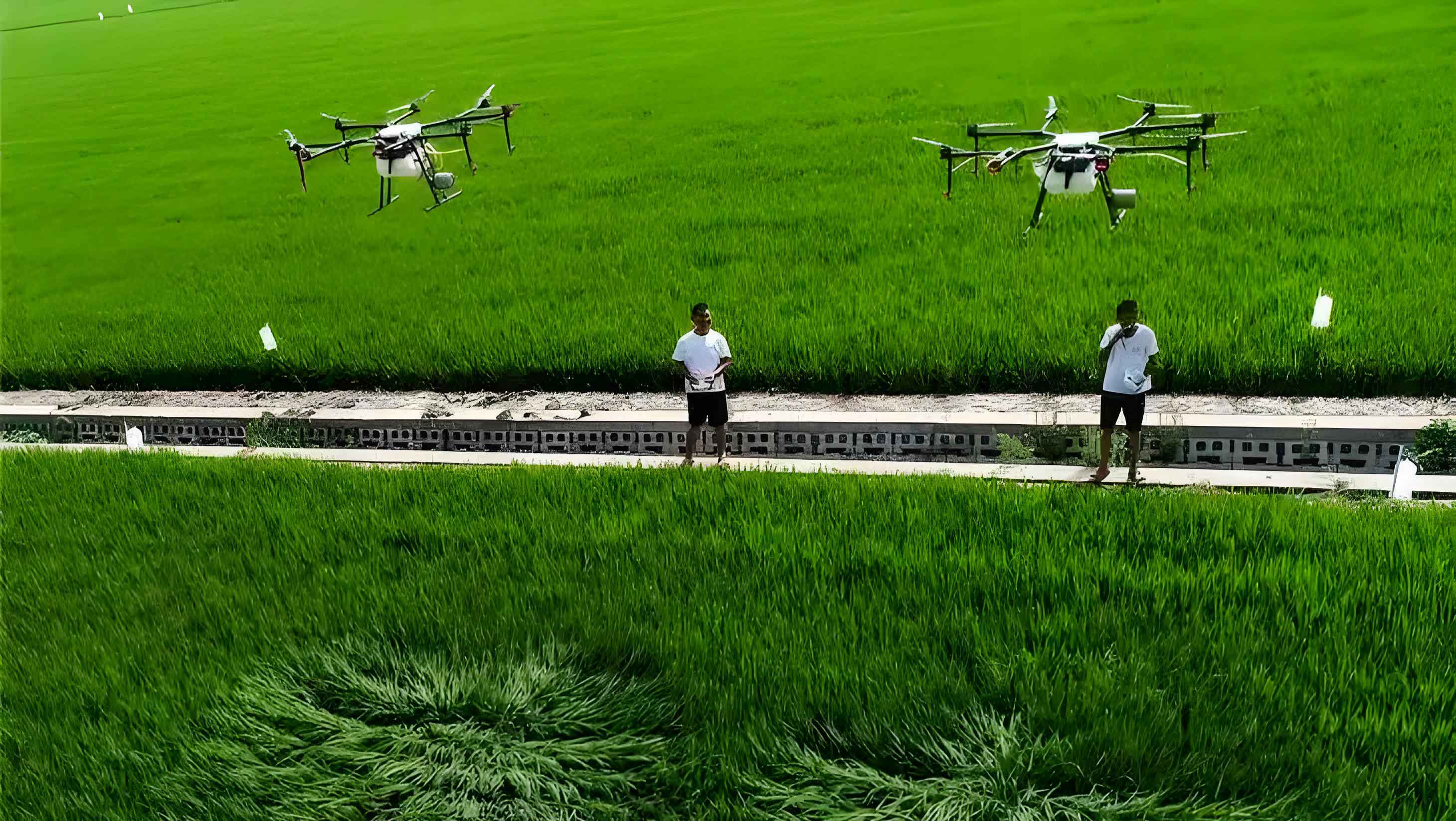
The deposition of droplets from a spraying UAV is primarily governed by the downwash airflow generated by the rotors, resulting in a unique and intricate distribution pattern within the crop canopy. Vertically, deposition typically follows a gradient where the upper layers of the canopy receive the highest droplet density, while penetration diminishes with depth, leading to significantly reduced deposition in the middle and lower regions. This phenomenon can be described by an exponential decay model: $$ D(z) = D_0 e^{-kz} $$ where \( D(z) \) is the deposition at depth \( z \), \( D_0 \) is the deposition at the canopy top, and \( k \) is a decay constant dependent on canopy density and airflow dynamics. Horizontally, deposition is often non-uniform, with the highest density observed directly below the spray swath centerline, tapering off towards the edges. Factors such as flight direction, crosswinds, and terrain variations can introduce asymmetry, further complicating the distribution. For instance, in a typical crop spraying drone operation, the coefficient of variation (CV) for horizontal deposition can exceed 30%, highlighting the challenges in achieving uniformity. Understanding these distribution characteristics is crucial for optimizing spraying UAV systems and minimizing environmental impact.
Factors Influencing Droplet Deposition
The performance of a crop spraying drone is affected by a multitude of variables, each playing a critical role in determining deposition efficacy. Below, I delve into the key factors, supported by theoretical models and empirical data.
Flight Speed
Flight speed directly impacts the residence time of droplets over the target area and the intensity of the downwash airflow. Higher speeds reduce sedimentation time, potentially decreasing effective deposition and increasing drift risks. Conversely, lower speeds prolong exposure but may lead to excessive accumulation on the canopy top, impairing penetration and uniformity. The optimal flight speed for a spraying UAV can be derived from a balance between deposition efficiency and operational throughput. For example, the drift potential \( P_d \) can be modeled as: $$ P_d = \frac{v_s}{v_f} \cdot \frac{1}{H} $$ where \( v_s \) is the settling velocity, \( v_f \) is the flight speed, and \( H \) is the flight height. This relationship underscores the need for speed adjustments based on specific crop and environmental conditions.
Flight Height
Flight height determines the settling distance of droplets and influences wind interference and swath width. Lower heights often result in localized over-deposition on the canopy top, while higher heights increase drift susceptibility and reduce penetration. The ideal height for a crop spraying drone depends on crop architecture and density. A generalized formula for effective swath width \( W_e \) is: $$ W_e = W_0 + 2H \tan(\theta) $$ where \( W_0 \) is the nozzle spread width and \( \theta \) is the spray angle. Adjusting height dynamically can help achieve a compromise between coverage and deposition quality in spraying UAV applications.
Flight Direction
Flight direction affects the trajectory of the droplet cloud and its deposition location. Downwind flight extends drift distances, potentially exceeding intended swaths, whereas upwind flight reduces drift but increases operational complexity. Crosswinds distort the cloud shape, causing offset and asymmetry. The drift distance \( D_{drift} \) under crosswind conditions can be estimated as: $$ D_{drift} = \frac{v_w \cdot t_s}{v_d} $$ where \( v_w \) is the wind velocity, \( t_s \) is the settling time, and \( v_d \) is the droplet velocity. Optimizing flight paths for crop spraying drones involves real-time adjustments to mitigate these effects.
Droplet Size
Droplet size is a critical parameter influencing settling velocity, drift resistance, and adhesion capability. Smaller droplets exhibit better canopy penetration but are prone to drift due to slower settling, while larger droplets settle faster but may bounce off or aggregate on upper surfaces. The settling velocity \( v_s \) for a droplet can be approximated using Stokes’ law for small Reynolds numbers: $$ v_s = \frac{d^2 (\rho_p – \rho_a) g}{18 \mu} $$ where \( d \) is the droplet diameter, \( \rho_p \) and \( \rho_a \) are the droplet and air densities, \( g \) is gravity, and \( \mu \) is the air viscosity. Modern spraying UAV systems employ nozzle technologies to control droplet size distribution, aiming for a balance between penetration and drift control.
Temperature and Humidity
Temperature and humidity indirectly affect deposition by altering evaporation rates. High temperatures and low humidity accelerate evaporation, reducing droplet size before reaching the target, whereas low temperatures and high humidity preserve droplet integrity, enhancing deposition. The evaporation rate \( E \) can be modeled as: $$ E = k_e \cdot (P_s – P_a) $$ where \( k_e \) is an evaporation constant, \( P_s \) is the saturation vapor pressure, and \( P_a \) is the ambient vapor pressure. For crop spraying drones, monitoring environmental conditions is essential to minimize losses.
Environmental Wind Speed
Wind speed is a major external factor dictating droplet cloud movement, drift distance, and deposition distribution. Low winds allow downwash dominance, while high winds elevate drift risks and impair deposition. The critical wind speed \( v_c \) for acceptable drift in a spraying UAV operation can be expressed as: $$ v_c = \frac{v_s \cdot H}{D_{max}} $$ where \( D_{max} \) is the maximum allowable drift distance. Implementing wind compensation algorithms in crop spraying drone systems can enhance accuracy.
| Factor | Impact on Deposition | Optimal Range | Mitigation Strategy |
|---|---|---|---|
| Flight Speed | Reduces deposition at high speeds; increases drift | 3–5 m/s | Adjust based on canopy density and wind |
| Flight Height | Lower height improves penetration but risks unevenness | 1.5–3 m above canopy | Dynamic height control |
| Droplet Size | Small droplets drift easily; large droplets poor penetration | 100–300 μm | Use adjustable nozzles |
| Wind Speed | High winds cause significant drift | <3 m/s | Real-time wind compensation |
| Temperature/Humidity | High temp/low humidity increase evaporation | 15–25°C, >60% RH | Schedule spraying during favorable conditions |
Methods to Enhance Droplet Deposition
To address the challenges in droplet deposition for crop spraying drones, several advanced methods have been developed. These approaches focus on optimizing hardware, integrating novel technologies, and leveraging computational models.
Nozzle and Layout Optimization
Nozzles are central to the spraying system of a crop spraying drone, influencing spray uniformity and droplet spectrum. By optimizing nozzle design—such as spray angle, internal structure, and orifice size—operators can achieve a more desirable droplet distribution that enhances adhesion and reduces drift. For instance, narrower spray angles can concentrate deposition, while wider angles improve coverage. The droplet size distribution \( f(d) \) from a nozzle can be characterized by: $$ f(d) = \frac{1}{\sigma \sqrt{2\pi}} e^{-\frac{(d – \mu_d)^2}{2\sigma^2}} $$ where \( \mu_d \) is the mean droplet size and \( \sigma \) is the standard deviation. Additionally, strategic nozzle layout ensures even coverage across the crop surface. A table comparing nozzle types is provided below:
| Nozzle Type | Droplet Size Range (μm) | Uniformity Index | Best Use Case |
|---|---|---|---|
| Flat Fan | 150–400 | 0.7–0.8 | Broadcast spraying |
| Hollow Cone | 100–250 | 0.8–0.9 | Penetration-focused applications |
| Air Induction | 200–500 | 0.6–0.7 | Drift reduction |
Layout optimization involves spacing nozzles according to crop row spacing and canopy structure. For a crop spraying drone, the optimal nozzle spacing \( S_n \) can be calculated as: $$ S_n = \frac{W_r}{N} $$ where \( W_r \) is the row width and \( N \) is the number of nozzles per row. This ensures that droplet coverage aligns with crop geometry, minimizing gaps and overlaps.
Electrostatic Spraying Technology
Electrostatic spraying enhances droplet deposition by imparting an electric charge to droplets, increasing their attraction to plant surfaces through Coulomb forces. This technology significantly improves adhesion efficiency and reduces drift, especially under windy conditions. The charge-to-mass ratio \( q/m \) is a key parameter: $$ \frac{q}{m} = \frac{C \cdot V}{m} $$ where \( C \) is the capacitance, \( V \) is the voltage, and \( m \) is the droplet mass. Higher ratios enhance deposition but require careful control to avoid discharge issues. In spraying UAV systems, electrode design and field strength are optimized to achieve uniform charging. The deposition efficiency \( \eta_d \) with electrostatic assistance can be modeled as: $$ \eta_d = \eta_0 \left(1 + \alpha \frac{q}{m}\right) $$ where \( \eta_0 \) is the baseline efficiency and \( \alpha \) is a crop-specific constant. This method not only boosts performance but also reduces chemical usage, aligning with sustainable agriculture goals for crop spraying drones.
Spray Drift Modeling
Spray drift models simulate droplet trajectories to predict and minimize drift, enabling optimization of spraying parameters. Computational Fluid Dynamics (CFD) is widely used in spraying UAV research to model complex interactions between airflow and droplets. The governing equations include the Navier-Stokes equations for airflow: $$ \frac{\partial \mathbf{u}}{\partial t} + (\mathbf{u} \cdot \nabla) \mathbf{u} = -\frac{1}{\rho} \nabla p + \nu \nabla^2 \mathbf{u} + \mathbf{g} $$ where \( \mathbf{u} \) is the velocity vector, \( p \) is pressure, \( \rho \) is density, \( \nu \) is kinematic viscosity, and \( \mathbf{g} \) is gravity. For droplet motion, the Lagrangian particle tracking approach is employed: $$ m_d \frac{d\mathbf{v}_d}{dt} = \mathbf{F}_d + \mathbf{F}_g + \mathbf{F}_e $$ where \( m_d \) is droplet mass, \( \mathbf{v}_d \) is droplet velocity, \( \mathbf{F}_d \) is drag force, \( \mathbf{F}_g \) is gravity, and \( \mathbf{F}_e \) is electrostatic force (if applicable). The drag force is given by: $$ \mathbf{F}_d = \frac{1}{2} C_d \rho_a A |\mathbf{u} – \mathbf{v}_d| (\mathbf{u} – \mathbf{v}_d) $$ with \( C_d \) as the drag coefficient and \( A \) as the cross-sectional area. CFD simulations allow for multi-variable analysis, helping to identify optimal settings for flight height, speed, and nozzle configuration in crop spraying drones. By integrating real-time data, these models support adaptive spraying strategies that enhance deposition accuracy and reduce environmental footprint.
| Parameter | Description | Typical Value Range |
|---|---|---|
| Airflow Velocity | Downwash and environmental wind | 1–10 m/s |
| Droplet Diameter | Initial size from nozzles | 50–500 μm |
| Turbulence Intensity | Measure of airflow disorder | 5–20% |
| Simulation Domain | Volume for CFD analysis | 10 m × 10 m × 5 m |
Conclusion and Future Outlook
In summary, optimizing droplet deposition remains a central challenge for crop spraying drone technologies, with factors such as flight parameters, droplet size, and environmental conditions playing pivotal roles. Through nozzle optimization, electrostatic spraying, and advanced drift modeling, significant improvements in deposition efficiency and uniformity can be achieved. The integration of these methods into spraying UAV systems promises enhanced pesticide utilization, reduced environmental impact, and better crop protection. Looking ahead, the convergence of multi-sensor fusion, intelligent path planning, and artificial intelligence will drive the next generation of crop spraying drones. Future research should focus on dynamic coupling mechanisms, enabling real-time perception, decision-making, and adjustment. This will pave the way for smart spraying UAV ecosystems that contribute to global food security and ecological sustainability, solidifying the role of crop spraying drones as indispensable tools in modern agriculture.