
As an agricultural technologist, I have witnessed the transformative impact of crop spraying drones in modern farming practices. These spraying UAVs are revolutionizing maize pest and disease management by offering precision, efficiency, and safety. In this article, I will delve into the core aspects of using crop spraying drones for maize pest control, highlighting key operational points, enhancement strategies, and practical insights. Through detailed explanations, tables, and mathematical models, I aim to provide a comprehensive guide for maximizing the benefits of these technologies.
The integration of crop spraying drones into agriculture has addressed longstanding challenges in pest control, such as uneven pesticide distribution and high labor costs. For maize, a staple crop globally, effective pest management is crucial to ensure yield and quality. Spraying UAVs equipped with advanced sensors and control systems enable targeted applications, reducing environmental impact and operational time. In my experience, adopting these drones has led to significant improvements in farm productivity. Below, I outline the fundamental principles and advancements in this field.
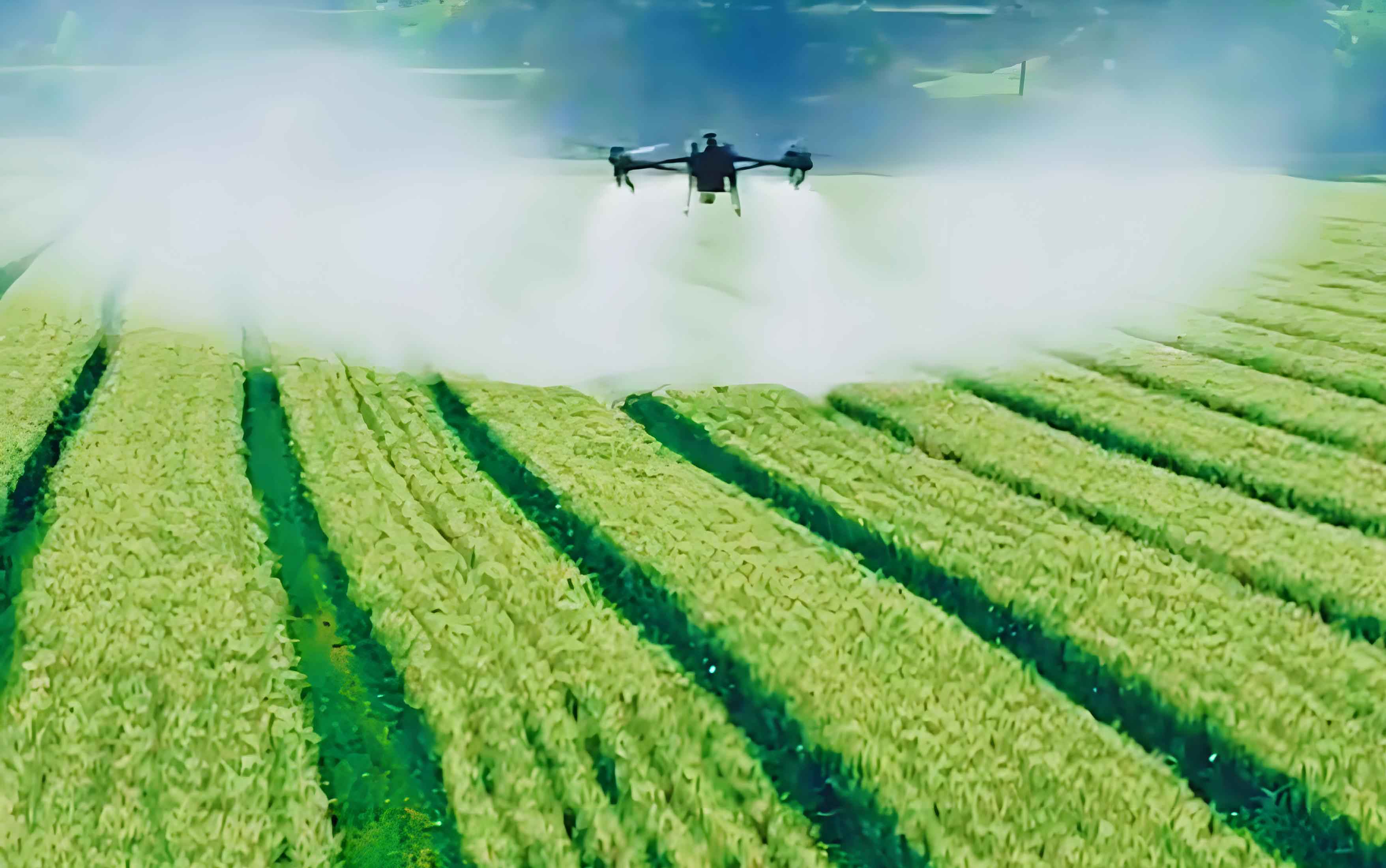
One of the primary advantages of crop spraying drones is their ability to cover large areas quickly. Traditional methods often involve manual labor or ground-based equipment, which can be time-consuming and inefficient. In contrast, a spraying UAV can operate autonomously, following pre-defined paths to ensure uniform coverage. For instance, the flight parameters of a crop spraying drone, such as altitude and speed, directly influence the deposition of pesticides. The relationship between these factors can be expressed using the following formula for deposition efficiency: $$ DE = \frac{A_s \times V_d}{H \times S} $$ where \( DE \) is the deposition efficiency, \( A_s \) is the spray area, \( V_d \) is the droplet volume, \( H \) is the flight height, and \( S \) is the飞行速度. This equation highlights how optimizing these variables enhances the effectiveness of pest control.
To better illustrate the benefits, I have compiled a table comparing traditional methods and crop spraying drones in maize pest management:
| Aspect | Traditional Methods | Crop Spraying Drones |
|---|---|---|
| Spraying Efficiency | Low, due to manual labor and equipment limitations | High, with autonomous coverage of up to 10 hectares per hour |
| Safety | Risky, as operators are exposed to pesticides | Enhanced, with remote operation reducing human contact |
| Cost | High, involving labor and excessive pesticide use | Reduced, through precise application and lower labor needs |
| Environmental Impact | Significant, due to drift and over-spraying | Minimized, with targeted spraying reducing chemical runoff |
In my work, I have found that the application value of spraying UAVs extends beyond mere efficiency. They facilitate real-time monitoring of maize fields, allowing for adaptive responses to pest outbreaks. For example, using multispectral cameras, a crop spraying drone can detect early signs of infestation, such as discoloration or leaf damage. This data-driven approach enables proactive management, which is critical for preventing yield losses. The following formula models the pest detection probability: $$ P_d = 1 – e^{-\lambda \times C_r} $$ where \( P_d \) is the detection probability, \( \lambda \) is the infestation rate, and \( C_r \) is the camera resolution. By integrating such models, farmers can optimize their spraying schedules.
When it comes to operational要点, several key points must be considered to ensure successful deployment of crop spraying drones. First,前期准备 involves selecting the appropriate drone model based on field conditions. I always recommend evaluating factors like payload capacity, battery life, and sensor accuracy. For maize fields, which can be dense and tall, a spraying UAV with high maneuverability is essential. Additionally, assessing the terrain and weather conditions beforehand prevents operational failures. A well-planned flight path is crucial; I use GPS mapping to define routes that avoid obstacles and maximize coverage. The path planning can be optimized using algorithms that minimize energy consumption, expressed as: $$ E_c = \sum_{i=1}^{n} (d_i \times p_i) $$ where \( E_c \) is the energy consumption, \( d_i \) is the distance per segment, and \( p_i \) is the power required. This ensures that the crop spraying drone operates efficiently over large areas.
Another critical aspect is药剂的选择与使用. Not all pesticides are suitable for aerial application; I advise choosing formulations that are compatible with the drone’s nozzles and tanks. The concentration and mixture ratios must be calibrated based on pest severity. For instance, in cases of severe corn borer infestations, a higher concentration might be necessary. The optimal dosage can be calculated using: $$ D_o = \frac{A_i \times R_r}{E_f} $$ where \( D_o \) is the optimal dosage, \( A_i \) is the infestation area, \( R_r \) is the recommended rate, and \( E_f \) is the efficiency factor of the spraying UAV. To simplify this, I often refer to the following table for common maize pests:
| Pest Type | Recommended Pesticide | Optimal Dosage (liters/hectare) | Spraying UAV Settings |
|---|---|---|---|
| Corn Borer | Chlorantraniliprole | 0.5 – 1.0 | Low altitude (1.5-2m), slow speed (3m/s) |
| Leaf Blight | Azoxystrobin | 0.8 – 1.2 | Medium altitude (2-2.5m), moderate speed (4m/s) |
| Armyworm | Spinosad | 1.0 – 1.5 | High altitude (2.5-3m), fast speed (5m/s) |
影像采集与防治效果巡检 is another area where crop spraying drones excel. By capturing high-resolution images during flight, these spraying UAVs provide valuable data for assessing pest damage and treatment efficacy. I frequently use this imagery to generate maps of infestation hotspots, which guide subsequent spraying missions. The data analysis can involve machine learning algorithms to classify pest levels, but a simpler approach uses the normalized difference vegetation index (NDVI) calculated as: $$ NDVI = \frac{(NIR – Red)}{(NIR + Red)} $$ where \( NIR \) is near-infrared reflectance and \( Red \) is red light reflectance. Values below 0.3 often indicate stress in maize plants, signaling the need for intervention. This integration of remote sensing with crop spraying drones enhances precision agriculture.
无人机操控与喷洒作业 requires skilled operation to maintain safety and effectiveness. I emphasize the importance of training for operators, as improper handling can lead to drift or uneven coverage. Key parameters include flight height, speed, and spray swath width. For maize, I typically set the crop spraying drone to fly at 1.8-2.5 meters above the crop canopy, with a speed of 3-6 m/s, to ensure droplet penetration. The spray swath can be adjusted based on nozzle type, and the coverage uniformity is given by: $$ U_c = 1 – \frac{\sigma_d}{\bar{d}} $$ where \( U_c \) is the uniformity coefficient, \( \sigma_d \) is the standard deviation of droplet density, and \( \bar{d} \) is the mean droplet density. Achieving high uniformity minimizes gaps in pest control.
To further improve the use of crop spraying drones, several enhancement strategies can be implemented. First,全面强化政府扶持 is vital for widespread adoption. Governments can subsidize the purchase of spraying UAVs and fund training programs. In my advocacy, I have seen that financial incentives reduce the barrier for small-scale farmers. Additionally, public awareness campaigns highlight the benefits of crop spraying drones, leading to increased uptake. A supportive policy framework can include tax breaks or grants, which I model as: $$ B_a = S \times A_p $$ where \( B_a \) is the adoption benefit, \( S \) is the subsidy amount, and \( A_p \) is the adoption probability. This encourages more farmers to invest in this technology.
Second,加强技术培训与专业人才培养 ensures that operators can maximize the potential of spraying UAVs. I have developed training modules that cover both theoretical knowledge and hands-on practice. For instance, sessions on pest biology, drone mechanics, and data interpretation are essential. The following table outlines a sample training curriculum:
| Module | Content | Duration (hours) |
|---|---|---|
| Introduction to Crop Spraying Drones | Basics of spraying UAV operations and safety protocols | 4 |
| Pest Identification | Common maize pests and symptoms | 6 |
| Flight Planning | GPS mapping, obstacle avoidance, and path optimization | 8 |
| Practical Exercises | Hands-on flying and spraying in field conditions | 10 |
Third,精准把控植保无人机施药技术 involves fine-tuning the application process based on real-time data. I recommend using sensors to monitor environmental conditions, such as wind speed and humidity, which affect spray drift. The drift potential can be estimated with: $$ D_p = k \times W_s \times H $$ where \( D_p \) is the drift potential, \( k \) is a constant, \( W_s \) is wind speed, and \( H \) is flight height. By adjusting parameters dynamically, a crop spraying drone can minimize off-target deposition. Moreover, integrating IoT devices allows for continuous data streaming, enabling adaptive control strategies that respond to changing field conditions.
Fourth,保证植保无人机施药作业的安全性 is paramount to protect both operators and the environment. I always enforce the use of personal protective equipment (PPE) and adhere to guidelines for safe pesticide handling. For example, operating the spraying UAV upwind reduces exposure risks. The optimal operating time is during early morning or late evening when temperatures are cooler, as this enhances pesticide efficacy and reduces evaporation. Battery management is also critical; I use the following formula to estimate flight time: $$ T_f = \frac{C_b}{P_d} $$ where \( T_f \) is the flight time, \( C_b \) is the battery capacity, and \( P_d \) is the power draw. Regular maintenance checks prevent accidents, such as motor failures or battery drains.
In conclusion, the adoption of crop spraying drones represents a significant leap forward in maize pest control. As I have detailed, these spraying UAVs offer unparalleled efficiency, safety, and precision. By focusing on proper preparation, path planning, pesticide selection, and operator training, farmers can harness the full potential of this technology. The integration of mathematical models and data-driven approaches further enhances outcomes. Moving forward, continued innovation in crop spraying drone designs and supportive policies will drive even greater advancements in sustainable agriculture. Through my experiences, I am confident that spraying UAVs will play a central role in ensuring food security and economic prosperity for maize growers worldwide.