
In my analysis of contemporary military technology, I have dedicated significant effort to understanding the rapid evolution of anti-drone capabilities. The proliferation of unmanned aerial systems (UAS) across state and non-state actors has presented unprecedented challenges to national security. As a researcher focused on defense systems, I observe that the U.S. Department of Defense is vigorously developing anti-drone solutions to counter these threats. This article explores the strategic, technological, and operational aspects of anti-drone systems, emphasizing their critical role in modern warfare. Through first-hand perspective, I will delve into the methodologies, innovations, and future trajectories shaping the anti-drone landscape.
The urgency for robust anti-drone measures stems from the accessibility and affordability of drone technology. Adversaries can leverage drones for intelligence, surveillance, reconnaissance, and even direct attacks, often at low cost. Small drones, with their compact size, low radar cross-section, and ability to fly at low altitudes, can evade traditional air defense systems. Incidents such as the use of commercial drones by non-state groups for explosive deliveries highlight the tangible risks. Consequently, the development of versatile anti-drone systems has become a priority. In my assessment, anti-drone initiatives are not merely reactive but are integral to maintaining tactical superiority.
Strategically, the approach to anti-drone defense involves a unified framework to avoid fragmented efforts. Historically, disjointed development across military branches led to inefficiencies and interoperability issues. The establishment of a centralized office has streamlined anti-drone projects, ensuring cohesive investment and standardization. This strategic pivot underscores the commitment to enhancing anti-drone readiness. From my viewpoint, such consolidation is essential for rapid deployment and integration of anti-drone technologies across diverse operational environments.
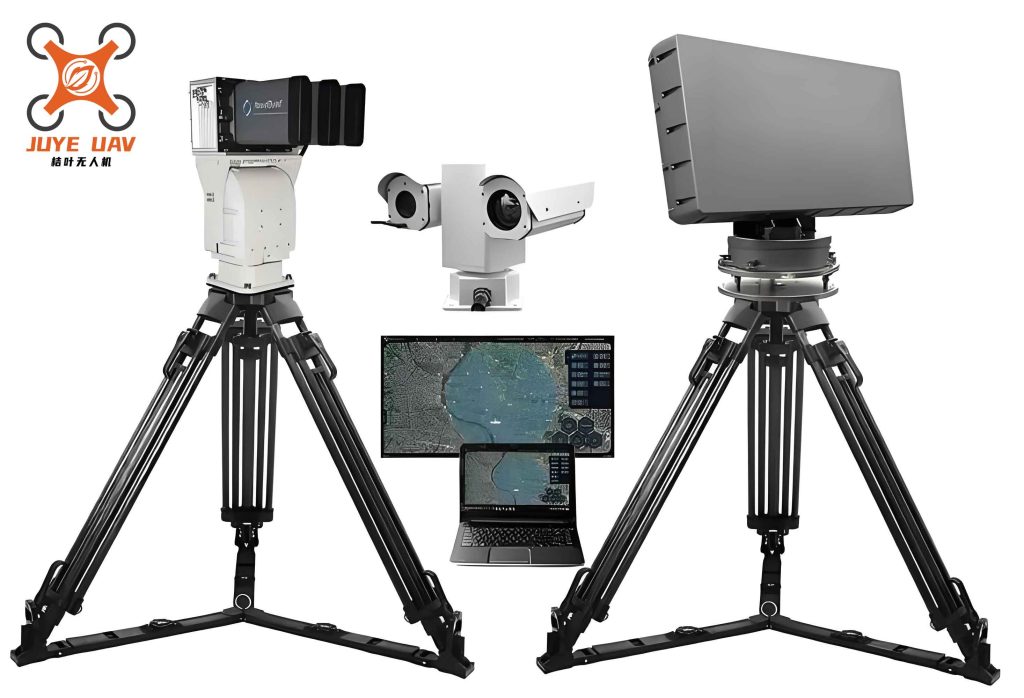
Technologically, anti-drone systems hinge on two core phases: detection and neutralization. Detection is the cornerstone, as drones must be identified before engagement. I have studied multiple detection modalities, each with distinct advantages and limitations. The table below summarizes key anti-drone detection technologies:
| Detection Method | Principle | Advantages | Limitations | Relevance to Anti-Drone |
|---|---|---|---|---|
| Electro-Optical/Infrared (EO/IR) | Uses visual or thermal signatures | High resolution, effective in daylight/thermal imaging | Weather-dependent, limited range | Critical for visual identification in anti-drone operations |
| Acoustic Sensors | Detects sound emissions from drones | Passive, low cost, good for low-altitude | Background noise interference, short range | Supplements other anti-drone sensors in urban areas |
| Radar Systems | Emits radio waves and analyzes echoes | Long-range, all-weather capability | Challenging for small drones due to low RCS | Foundation for wide-area anti-drone surveillance |
| RF Sensors | Monitors communication and control signals | Can identify drone type and operator location | May fail if drones use encrypted or autonomous modes | Key for electronic warfare in anti-drone tactics |
In practice, a layered anti-drone detection network combines these methods to improve accuracy and reliability. The probability of detecting a drone, \(P_d\), can be modeled using a fusion of sensor inputs. For instance, if we consider radar and EO/IR systems, the combined detection probability might be expressed as:
$$P_d = 1 – \prod_{i=1}^{n} (1 – P_{d,i})$$
where \(P_{d,i}\) is the detection probability of sensor \(i\). This formula highlights how multi-sensor integration enhances anti-drone capabilities by reducing blind spots.
Once detected, neutralization of drones involves either soft-kill or hard-kill mechanisms. Soft-kill methods, such as electronic jamming, disrupt the communication between the drone and its operator. The effectiveness of jamming depends on factors like signal strength and frequency. The jamming-to-signal ratio (J/S) is a key metric in anti-drone electronic warfare, given by:
$$J/S = \frac{P_j G_j R_d^2}{P_d G_d R_j^2}$$
Here, \(P_j\) is the jammer power, \(G_j\) is the jammer antenna gain, \(R_d\) is the distance from drone to receiver, \(P_d\) is the drone transmitter power, \(G_d\) is the drone antenna gain, and \(R_j\) is the distance from jammer to drone. Achieving a high J/S ratio is crucial for successful anti-drone jamming operations.
Hard-kill methods physically destroy or disable the drone. These include kinetic interceptors, directed energy weapons (DEWs) like lasers and microwaves, and even unconventional means. In my research, I have categorized anti-drone systems into several types based on their neutralization approach. The following table outlines prominent anti-drone system categories:
| Anti-Drone System Type | Neutralization Method | Key Features | Examples (Generalized) | Anti-Drone Effectiveness |
|---|---|---|---|---|
| Portable Jamming Systems | RF interference to disrupt control links | Man-portable, quick deployment, non-kinetic | Drone-defender guns, handheld jammers | High against commercial drones; limited against autonomous systems |
| Integrated Soft/Hard-Kill Systems | Combines jamming with kinetic firepower | Mounted on vehicles, multi-layered defense | Mobile air defense units with guns and EW suites | Versatile for various drone threats in field operations |
| High-Energy Laser (HEL) Systems | Concentrated laser beams to thermally destroy drones | Speed-of-light engagement, precision, low cost per shot | Laser weapons on ground vehicles or ships | Effective for point defense; challenges with weather and power requirements |
| High-Power Microwave (HPM) Systems | Broadcast microwaves to fry electronic circuits | Area effect, can engage multiple drones simultaneously | Containerized microwave emitters for base defense | Excellent against drone swarms; potential collateral damage |
| Anti-Swarm Solutions | AI-driven interception and swarm tactics | Networked sensors and effectors, adaptive responses | AI-based command systems coordinating multiple interceptors | Critical for future drone swarm threats; still in development |
The evolution of anti-drone systems reflects a shift from kinetic to directed energy solutions. High-energy lasers, for instance, offer a scalable anti-drone option. The energy delivered by a laser, \(E_{\text{laser}}\), to a target drone can be approximated as:
$$E_{\text{laser}} = \frac{P_{\text{laser}} \cdot t_{\text{engage}} \cdot \eta}{A_{\text{spot}}}}$$
where \(P_{\text{laser}}\) is the laser power, \(t_{\text{engage}}\) is the engagement time, \(\eta\) is the atmospheric transmission efficiency, and \(A_{\text{spot}}\) is the laser spot area on the target. Optimizing these parameters is vital for effective anti-drone laser systems, especially against fast-moving or armored drones.
Similarly, high-power microwave systems leverage electromagnetic pulses to incapacitate drones. The power density \(S\) at a distance \(R\) from a microwave emitter is given by:
$$S = \frac{P_{\text{HPM}} G_{\text{HPM}}}{4\pi R^2}$$
where \(P_{\text{HPM}}\) is the peak power and \(G_{\text{HPM}}\) is the antenna gain. For an anti-drone microwave system to be effective, \(S\) must exceed the susceptibility threshold of the drone’s electronics. This makes HPM systems particularly suited for area denial against multiple drones, a growing concern in anti-drone strategy.
In addition to technological advancements, organizational changes have propelled anti-drone capabilities. The creation of a joint office has facilitated standardized training and doctrine development. From my perspective, training is as crucial as hardware; soldiers must be proficient in operating anti-drone systems across varied scenarios. Future training academies aim to institutionalize anti-drone expertise, ensuring that personnel can adapt to evolving drone threats.
Looking ahead, the anti-drone landscape will be shaped by several trends. First, the integration of artificial intelligence (AI) will enhance detection and response speeds. AI algorithms can analyze sensor data in real-time to distinguish drones from clutter, reducing false alarms in anti-drone networks. The use of machine learning for predictive threat assessment is becoming a cornerstone of next-generation anti-drone systems.
Second, the convergence of laser and microwave technologies offers a hybrid approach. Combining the precision of lasers with the wide-area coverage of microwaves could create versatile anti-drone platforms. Research into adaptive beamforming and frequency agility will further refine these directed energy anti-drone solutions.
Third, countering drone swarms remains a paramount challenge. Swarm tactics leverage numbers and coordination to overwhelm defenses. Anti-swarm strategies involve networked systems that can coordinate multiple effectors. The effectiveness of an anti-swarm system can be modeled using game theory, where the defender (anti-drone system) and attacker (drone swarm) engage in dynamic interactions. For example, the probability of neutralizing a swarm of \(N\) drones might be expressed as:
$$P_{\text{swarm}} = 1 – \left(1 – p_{\text{kill}}\right)^N$$
where \(p_{\text{kill}}\) is the kill probability per engagement. Improving \(p_{\text{kill}}\) through faster engagement cycles or area effects is key to robust anti-drone swarm capabilities.
Moreover, international collaboration is expanding the anti-drone ecosystem. Allies share best practices and co-develop technologies, fostering interoperability. In my view, such partnerships are essential for addressing global drone threats, as anti-drone systems must function seamlessly in coalition operations.
To quantify the progress in anti-drone development, consider the investment trends. Annual funding for anti-drone research and procurement has seen steady increases, reflecting priority status. The table below summarizes hypothetical investment areas in anti-drone technology (based on general trends):
| Investment Category | Focus Areas | Expected Outcomes | Impact on Anti-Drone Capability |
|---|---|---|---|
| Detection and Sensing | Advanced radar, EO/IR fusion, AI processing | Reduced false alarms, longer detection ranges | Enhances early warning for anti-drone systems |
| Directed Energy Weapons | Laser power scaling, microwave efficiency | Lower cost per shot, increased engagement range | Provides sustainable anti-drone firepower |
| Electronic Warfare | Jamming resilience, spoofing techniques | Ability to counter autonomous drones | Strengthens soft-kill anti-drone options |
| Command and Control | Interoperable frameworks, cloud-based analytics | Faster decision-making, multi-domain integration | Unifies anti-drone efforts across platforms |
| Testing and Evaluation | Live trials, simulation environments | Validation of system performance under stress | Ensures reliability of fielded anti-drone systems |
The mathematical modeling of anti-drone systems also involves reliability analysis. For instance, the mean time between failures (MTBF) for an anti-drone system component can influence overall availability. If a system consists of \(k\) components in series, the system reliability \(R_s(t)\) is:
$$R_s(t) = \prod_{i=1}^{k} R_i(t)$$
where \(R_i(t)\) is the reliability of component \(i\). High reliability is critical for anti-drone systems operating in continuous surveillance or defense roles.
In conclusion, as a observer of military innovations, I assert that anti-drone systems are evolving rapidly to meet asymmetric threats. The synergy of detection technologies, neutralization methods, and strategic organization underpins modern anti-drone capabilities. Future advancements will likely emphasize speed, scalability, and intelligence, ensuring that anti-drone defenses stay ahead of adversarial drone technologies. The ongoing research into directed energy and AI-driven solutions promises to redefine anti-drone warfare, making it more effective and adaptable. Ultimately, the development of robust anti-drone systems is not just a technical endeavor but a strategic imperative for security in an increasingly automated battlespace.
Throughout this discussion, the term “anti-drone” has been emphasized to underscore its centrality. From portable jammers to high-energy lasers, each anti-drone system contributes to a layered defense architecture. As drone technology advances, so must anti-drone countermeasures, driven by continuous innovation and cross-disciplinary collaboration. In my assessment, the future of anti-drone systems will be characterized by greater integration, autonomy, and resilience, solidifying their role as indispensable assets in national defense.