
In recent years, the rapid advancement of agricultural technology has positioned crop spraying drones as a pivotal component in modern farming practices. These spraying UAVs offer unparalleled efficiency, precision, and safety, transforming traditional crop protection methods. Based on my extensive research and field investigations conducted over the past three years in a major agricultural region, I have gathered substantial data on the application of crop spraying drones. This article delves into the current state of spraying UAV utilization, examining aspects such as model configurations, service patterns,防治 effectiveness, and policy incentives. I will also address the key challenges faced and propose actionable recommendations to optimize the use of crop spraying drones, thereby supporting the broader goals of agricultural modernization.
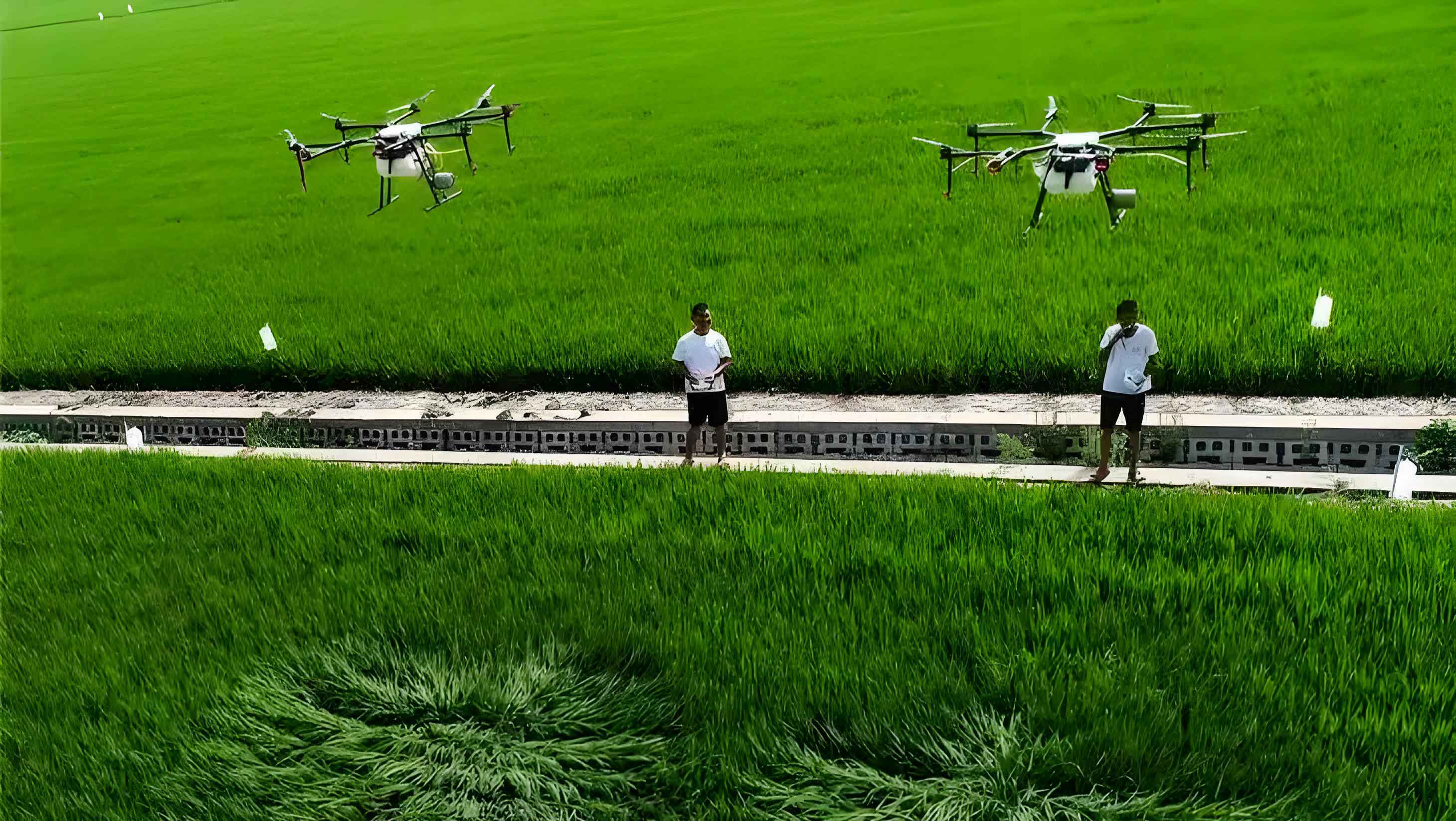
The adoption of crop spraying drones has surged due to their ability to mitigate labor shortages and enhance operational efficiency. In my analysis, I focused on rice cultivation, where traditional pest control methods are labor-intensive and environmentally taxing. Since the introduction of spraying UAVs in 2015, their prevalence has grown exponentially. For instance, the number of crop spraying drones and the area they cover have doubled annually, highlighting their integral role in contemporary agriculture. These drones are equipped with advanced spraying systems capable of applying pesticides, fertilizers, and even seeds, though pesticide application remains the dominant use. Through surveys of local farms and service organizations, I have compiled detailed insights into the practical implementation of these spraying UAVs.
Current Application Status of Crop Spraying Drones
My investigations reveal a dynamic landscape in the deployment of crop spraying drones. The region under study hosts a total of 112 operational spraying UAVs, with 88 owned by individual farms and 24 managed by specialized service organizations. The rapid technological evolution is evident in the dominance of models from leading manufacturers like DJI and XAG. For example, DJI’s T30, T40, T50, and T60 models constitute 94% of the privately owned fleet, while service organizations utilize a mix of brands including DJI, Zhonghang Xinsheng, Hanhe, and XAG. These crop spraying drones typically feature tank capacities ranging from 30 to 40 liters, with some models reaching up to 50 liters, enabling extensive coverage per flight. The efficiency of these spraying UAVs can be modeled using the formula for operational area coverage: $$ A = v \times w \times t $$ where \( A \) is the area covered, \( v \) is the飞行速度, \( w \) is the spray width, and \( t \) is the time spent spraying. This underscores the high throughput of crop spraying drones compared to manual methods.
| Brand | Model | Quantity | Percentage |
|---|---|---|---|
| DJI | T30 | 31 | 94% |
| T40 | 15 | ||
| T50 | 17 | ||
| T60 | 20 | ||
| XAG | P100 | 3 | 6% |
| XP2020 | 2 | ||
| Total (Private Ownership) | 88 | 100% | |
| Service Organizations | DJI (T40, T50, T60) | 12 | 50% |
| Zhonghang Xinsheng (Black Bee HF-22) | 8 | 33% | |
| Hanhe (Venus 25, 30) | 2 | 8% | |
| XAG (XP2020) | 2 | 8% | |
| Total (Service Organizations) | 24 | 100% | |
Regarding防治 effectiveness, data from the past three years indicate a significant increase in the area treated by crop spraying drones. In 2022, the cumulative area reached 247,025 mu, accounting for 32.8% of the total treated area. By 2023, this figure rose to 403,464 mu (53.2%), and in 2024, it surged to 486,879 mu (63.5%). This represents a growth of 21.6% from 2023 to 2024 and a remarkable 98.6% increase from 2022. The expansion can be expressed using a compound annual growth rate (CAGR) formula: $$ \text{CAGR} = \left( \frac{A_f}{A_i} \right)^{\frac{1}{n}} – 1 $$ where \( A_f \) is the final area, \( A_i \) is the initial area, and \( n \) is the number of years. For the period 2022-2024, the CAGR for spraying UAV coverage is approximately 40.3%, demonstrating rapid adoption. Additionally, during each of the five major annual防治 campaigns, the proportion of area treated by crop spraying drones exceeded 50% for the first four campaigns, peaking at 74.4% in the second campaign of 2024. However, later campaigns saw reduced usage due to recommendations against spraying UAVs for pests like brown planthopper and sheath blight, where precision targeting is challenging.
| Service Type | Area Treated (mu) | Percentage of Total |
|---|---|---|
| Owned Drones (Self-Operation) | 58,912 | 12.31% |
| Local Outsourcing (In-Region Services) | 298,017 | 60.19% |
| External Outsourcing (Out-of-Region Services) | 129,950 | 27.51% |
| Total | 486,879 | 100% |
Service models for crop spraying drones vary widely. My survey shows that 12.31% of the area is treated by farmers using their own spraying UAVs, while 60.19% relies on local outsourcing services, and 27.51% on external providers. This indicates a strong preference for professional services, likely due to expertise and efficiency. The cost of services ranges from $8 to $15 per mu for organized teams, whereas self-operating farmers report costs of $5 to $12 per mu. Importantly, 91% of private owners hold operational certificates for crop spraying drones, underscoring a baseline of competency. However, the reliance on outsourcing highlights gaps in self-sufficiency and raises questions about service quality and accountability.
Policy incentives play a crucial role in promoting spraying UAV adoption. Subsidies are available under regional agricultural machinery programs, requiring operators to possess certifications, maintain insurance, and complete a minimum of 1,000 mu of作业. Additionally, standardized service awards incentivize proper management and integration of crop spraying drones into local agricultural systems. For instance, points are allocated based on drone retention and service area, with deductions for non-compliance. Despite these measures, configuration standards suggest an imbalance; some areas have reached saturation, while others remain underserved. The optimal drone density can be calculated using the formula: $$ D = \frac{A}{S} $$ where \( D \) is the number of drones, \( A \) is the total area, and \( S \) is the standard coverage per spraying UAV (e.g., 2,500 mu per unit). This reveals disparities in resource allocation that need addressing.
Advantages of Crop Spraying Drones
From my observations, crop spraying drones offer multifaceted benefits that justify their widespread adoption. Firstly, their efficiency is unparalleled. A single spraying UAV can cover 400 to 600 mu per day, with models like the DJI T30 achieving speeds of 240 mu per hour due to a 30-liter tank, 8 L/min flow rate, and 9-meter spray width. This efficiency is dozens of times higher than conventional methods. The operational throughput can be modeled as: $$ E = \frac{C \times R}{T} $$ where \( E \) is efficiency (area per time), \( C \) is tank capacity, \( R \) is coverage rate, and \( T \) is time. This allows for rapid response during critical防治 windows, reducing the risk of pest outbreaks.
Secondly, crop spraying drones enhance safety and environmental sustainability. By enabling remote operation and minimizing human contact with pesticides, they significantly reduce health risks. The environmental impact can be quantified using a drift reduction factor: $$ \text{Drift} = k \times \frac{1}{v^2} $$ where \( k \) is a constant and \( v \) is wind speed, emphasizing the importance of calm conditions for spraying UAVs. Moreover, their ability to operate in diverse terrains—including rice paddies and tall crops—makes them versatile tools for integrated pest management.
Thirdly, these spraying UAVs alleviate labor shortages and reduce costs. With an aging agricultural workforce, the automation provided by crop spraying drones attracts younger generations to farming. The labor savings can be expressed as: $$ L_s = \frac{H_m}{H_d} $$ where \( L_s \) is labor savings, \( H_m \) is hours required manually, and \( H_d \) is hours required with a drone. In practice, this translates to lower operational expenses and improved profitability for farmers.
Challenges in Crop Spraying Drone Applications
Despite the advantages, my research identifies several critical issues. Climate sensitivity is a major constraint for spraying UAVs. Wind speeds above 3 m/s cause significant droplet drift, reducing靶标 deposition. The drift potential can be modeled as: $$ D_p = \frac{\rho \times d^2 \times u}{18 \mu} $$ where \( D_p \) is drift potential, \( \rho \) is air density, \( d \) is droplet diameter, \( u \) is wind velocity, and \( \mu \) is dynamic viscosity. High temperatures exacerbate evaporation, diminishing pesticide efficacy. For example, at 35°C, droplet evaporation rates increase exponentially, necessitating restricted operating hours (e.g., 06:00–10:00 and 16:00–19:00). This limits the flexibility of crop spraying drones during urgent防治 periods, potentially compromising crop health.
Another issue is the lack of专业化 among operators. While most hold certificates, many lack expertise in agronomy and pest management. Incorrect parameters—such as spray volume below 1.2 L/mu in early growth stages or insufficient flight height adjustments—lead to uneven coverage and reduced efficacy. The relationship between spray volume and coverage can be described by: $$ C_v = \frac{Q}{A} \times \eta $$ where \( C_v \) is coverage effectiveness, \( Q \) is liquid volume, \( A \) is area, and \( \eta \) is efficiency factor. Inadequate training often results in poor chemical mixing, nozzle clogging, and suboptimal outcomes for crop spraying drones.
Service irregularities further hamper progress. Informal agreements between farmers and service providers lack enforceability, making it difficult to address issues like phytotoxicity or underperformance. The economic motivation of some operators leads to practices such as reducing spray volumes to maximize profit, adversely affecting防治 quality. A governance gap exists, with no standardized protocols for auditing spraying UAV services.
Lastly, operational inefficiencies persist. The current fleet of crop spraying drones is insufficient to meet demand during peak periods. With a daily capacity of 20–40 hm² per drone, the existing 112 units cannot cover the entire region within the ideal 3-day防治 window. The deficit can be calculated as: $$ \text{Shortfall} = \frac{A_r}{C_d} – N_d $$ where \( A_r \) is required area, \( C_d \) is daily capacity per drone, and \( N_d \) is number of drones. This underscores the need for strategic expansion and better resource management for spraying UAVs.
Recommendations for Enhancing Crop Spraying Drone Applications
To address these challenges, I propose the establishment of professional spraying UAV service teams at the local level. These teams should be trained and certified, with mandated protocols for pre-operation agreements, real-time tracking, and post-operation reporting. For instance, using digital tools to log flight paths and spray data can ensure accountability and optimize resource use. The effectiveness of such teams can be evaluated using a performance index: $$ P_i = \frac{S_c \times A_q}{T_d} $$ where \( P_i \) is performance index, \( S_c \) is service compliance, \( A_q \) is application quality, and \( T_d \) is time delay.
Additionally, technical standards for spraying UAVs must be refined. This includes developing guidelines for flight parameters (e.g., height, speed) and spray volumes tailored to different crop growth stages. Research into adjuvant compatibility can enhance droplet adhesion and reduce drift, modeled as: $$ \text{Adhesion} = \frac{\sigma \times \cos \theta}{r} $$ where \( \sigma \) is surface tension, \( \theta \) is contact angle, and \( r \) is droplet radius. Collaborative efforts between agronomists and engineers are essential to formulate comprehensive specifications for crop spraying drones.
Training programs should be intensified to bridge knowledge gaps. Regular workshops on pest identification, chemical handling, and equipment maintenance will empower operators to maximize the potential of spraying UAVs. Integrating these programs with digital platforms can facilitate continuous learning and adherence to best practices.
Conclusion
In conclusion, crop spraying drones represent a transformative force in agriculture, driven by their efficiency, safety, and adaptability. My analysis confirms their growing prevalence and impact in rice cultivation, yet highlights persistent challenges related to climate, expertise, service quality, and capacity. By implementing structured service teams, refining technical norms, and enhancing training, we can unlock the full potential of spraying UAVs. As agricultural systems evolve, the continued innovation and integration of crop spraying drones will be vital for achieving sustainable and productive farming outcomes. The journey toward optimized spraying UAV applications requires collaborative efforts from policymakers, researchers, and farmers alike.