
The synchronization and precise control of multiple unmanned aerial vehicles (UAVs) has transcended its military and surveillance roots to become a cornerstone of modern spectacle, most notably in large-scale formation drone light shows. These breathtaking aerial displays, involving hundreds or thousands of UAVs moving as a cohesive unit to create complex, dynamic shapes in the night sky, represent one of the most demanding applications of multi-agent robotics. However, the very factors that make these formation drone light shows so visually stunning—their outdoor environments, tight formation requirements, and reliance on numerous individual agents—also make them exceptionally vulnerable to performance degradation and failure.
Each drone in a formation drone light show is a highly nonlinear, underactuated system susceptible to a confluence of disruptive forces. These include unpredictable external wind gusts, inherent system coupling and parameter uncertainties, and, critically, actuator faults such as motor wear or propeller damage. In a tightly choreographed formation drone light show, a failure or significant deviation in even a single “leader” drone can propagate through the swarm, leading to a cascading loss of the intended pattern. Therefore, the foundation of a reliable and spectacular formation drone light show lies in the robust control of each individual agent against these “lumped disturbances” (a term encompassing both external disturbances and internal faults), coupled with a cooperative control strategy that maintains the geometric integrity of the fleet.
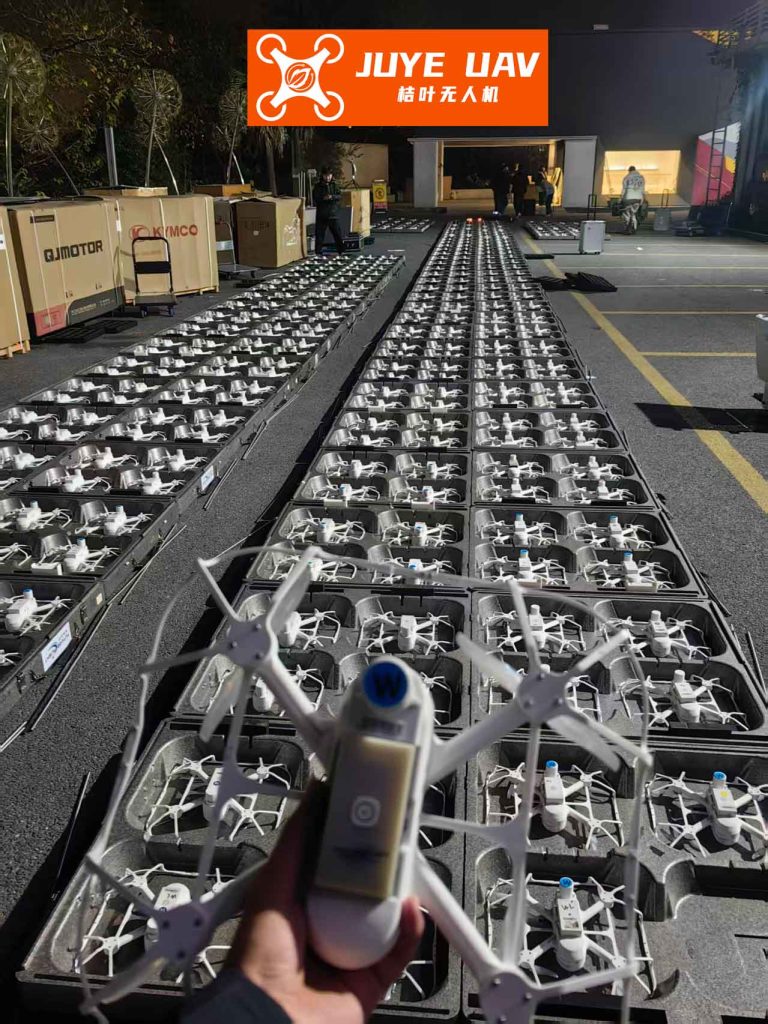
This article addresses the core control challenge for enabling resilient formation drone light shows. We propose a novel, hierarchical control architecture. At the agent level, we develop a robust flight controller that combines a high-precision Compensation Function Observer (CFO) with an Inverse Hyperbolic Tangent Sliding Mode Controller (IHTSMC). This combination allows each drone to accurately estimate and actively compensate for lumped disturbances in real-time. At the swarm level, we employ a leader-follower strategy integrated with sliding mode theory to achieve precise formation-keeping. The ultimate goal is to ensure that a formation drone light show can execute its pre-programmed maneuvers with high precision and stability, even when individual drones experience faults or environmental interference.
1. Dynamic Modeling of a Quadrotor UAV with Actuator Faults and Disturbances
To design an effective controller, we first establish a mathematical model of a quadrotor UAV, which is the standard unit in a formation drone light show. We consider two coordinate frames: the inertial earth frame $O_G(X_G, Y_G, Z_G)$ and the body-fixed frame $O_b(x_b, y_b, z_b)$. The control inputs are the thrusts $F_i$ generated by four rotors. The attitude is defined by the roll ($\phi$), pitch ($\theta$), and yaw ($\psi$) angles.
In a real-world formation drone light show, actuators are prone to failures. We model an actuator fault as:
$$
U_r = \delta_\epsilon U_{ra} + f_r
$$
where $r = 1,2,3,4$ and $\epsilon = z, \phi, \theta, \psi$; $U_{ra}$ is the normal control input, $U_r$ is the faulty input, $0 < \delta_\epsilon \le 1$ is an effectiveness factor, and $f_r$ is a bias fault. The case $\delta_\epsilon = 1, f_r \ne 0$ represents a bias fault, which is a primary focus.
Applying the Newton-Euler formalism, the nonlinear dynamics of a quadrotor subject to these faults and external disturbances $d_i$ are:
$$
\begin{aligned}
\ddot{x} &= \frac{(\text{c}\phi\text{s}\theta\text{c}\psi + \text{s}\phi\text{s}\psi)}{m} (\delta_1 U_{1a} + f_1) – \frac{k_x}{m}\dot{x} + d_1 \\
\ddot{y} &= \frac{(\text{c}\phi\text{s}\theta\text{s}\psi – \text{s}\phi\text{c}\psi)}{m} (\delta_1 U_{1a} + f_1) – \frac{k_y}{m}\dot{y} + d_2 \\
\ddot{z} &= \frac{\text{c}\phi\text{c}\theta}{m} (\delta_1 U_{1a} + f_1) – g – \frac{k_z}{m}\dot{z} + d_3 \\
\ddot{\phi} &= \frac{I_{yy} – I_{zz}}{I_{xx}} \dot{\theta}\dot{\psi} + \frac{(\delta_\phi U_{2a} + f_2)}{I_{xx}} – \frac{k_\phi}{I_{xx}}\dot{\phi} + \frac{J_r}{I_{xx}} \dot{\theta} \lambda + d_4 \\
\ddot{\theta} &= \frac{I_{zz} – I_{xx}}{I_{yy}} \dot{\phi}\dot{\psi} + \frac{(\delta_\theta U_{3a} + f_3)}{I_{yy}} – \frac{k_\theta}{I_{yy}}\dot{\theta} + \frac{J_r}{I_{yy}} \dot{\phi} \lambda + d_5 \\
\ddot{\psi} &= \frac{I_{xx} – I_{yy}}{I_{zz}} \dot{\phi}\dot{\theta} + \frac{(\delta_\psi U_{4a} + f_4)}{I_{zz}} – \frac{k_\psi}{I_{zz}}\dot{\psi} + d_6
\end{aligned}
$$
where $m$ is mass, $g$ is gravity, $I_{xx}, I_{yy}, I_{zz}$ are moments of inertia, $k$ terms are drag coefficients, and $J_r$ is rotor inertia.
2. Robust Agent Control: CFO-based Inverse Hyperbolic Tangent Sliding Mode Control
The performance of a formation drone light show depends fundamentally on the stability of each drone. We decouple the system into an outer position loop and an inner attitude loop. For each loop, we design a Compensation Function Observer (CFO) to estimate the total lumped disturbance, followed by a custom sliding mode controller to compensate for it.
2.1 Design of the Compensation Function Observer (CFO)
Traditional observers like the Extended State Observer (ESO) can estimate disturbances but may suffer from lower estimation precision and slower convergence. The CFO offers a superior alternative for the high-fidelity demands of a formation drone light show. It is a Type-III system (two orders higher than a typical ESO), providing zero-steady-state error estimation of a lumped disturbance under certain conditions, leading to faster and more accurate disturbance rejection.
Consider the roll ($\phi$) channel dynamics, which can be rewritten in a state-space form where the total lumped disturbance $f_{\sim \phi}$ aggregates coupling terms, actuator fault effects $g_\phi f_2$, and external disturbance $d_4$:
$$
\begin{aligned}
\dot{x}_{\phi 1} &= x_{\phi 2} \\
\dot{x}_{\phi 2} &= f_{\sim \phi} + U_{2a} g_\phi
\end{aligned}
$$
The proposed CFO for this subsystem is:
$$
\begin{aligned}
\dot{z}_{\phi 1} &= z_{\phi 2} \\
\dot{z}_{\phi 2} &= L e + z_{\phi 3} + f_{\sim \phi} + b_\phi U_{2a} \\
\dot{z}_{\phi 3} &= \lambda L e \\
\hat{f}_{\sim \phi} &= L e + z_{\phi 3}
\end{aligned}
$$
Here, $z_{\phi 1}$, $z_{\phi 2}$, and $\hat{f}_{\sim \phi}$ are the estimates of $x_{\phi 1}$, $x_{\phi 2}$, and $f_{\sim \phi}$, respectively. $L = [l_2, l_1]$ is the tunable gain vector, $\lambda$ is a filter parameter, and $e = [x_{\phi 1} – z_{\phi 1}, x_{\phi 2} – z_{\phi 2}]^T$ is the estimation error vector. The structure ensures exponential stability and high-precision estimation, which is crucial for maintaining the tight tolerances required in a formation drone light show.
| Feature | Extended State Observer (ESO) | Compensation Function Observer (CFO) |
|---|---|---|
| System Type | Type-I | Type-III |
| Estimation Principle | State Expansion | Tracking & Compensation |
| Steady-State Error | Non-zero for ramp-type disturbances | Zero for disturbances up to 2nd order derivative |
| Convergence Speed | Good | Faster due to higher type |
| Precision in Chattering | Lower, can lag | Higher, tracks sharp changes better |
2.2 Position Loop Controller Design
The control objective for the position $(x, y, z)$ is to track desired trajectories $x_d, y_d, z_d$. We define virtual control inputs $u_{1x}, u_{1y}, u_{1z}$. The $x$-position subsystem can be expressed as:
$$
\begin{aligned}
\dot{\xi}_1 &= \xi_2 \\
\dot{\xi}_2 &= \alpha \xi_2 + \beta \mu + \Gamma_x
\end{aligned}
$$
where $\Gamma_x$ is the lumped disturbance (fault + external disturbance). We assume $\Gamma_x$ is bounded. The control design uses the backstepping technique combined with a sliding mode strategy. First, define the tracking error $e_x = x_d – \xi_1$. Choose a Lyapunov function $V_1 = \frac{1}{2}e_x^2$. To ensure $\dot{V}_1 \le 0$, we design a sliding manifold:
$$
s_x = \dot{e}_x + c_x e_x
$$
where $c_x > 0$. A composite Lyapunov function $V_2 = V_1 + \frac{1}{2}s_x^2$ is then considered. Its derivative leads to the design of the final control law. To mitigate the inherent chattering problem of standard sliding mode control—which is unacceptable for the smooth motions in a formation drone light show—we replace the discontinuous sign function with a smooth hyperbolic tangent function.
The resulting Inverse Hyperbolic Tangent Sliding Mode Controller (IHTSMC) for the $x$-position, integrated with the CFO estimate, is:
$$
u_{1x} = \ddot{x}_d + c_x \dot{e}_x + \frac{k_x}{m} x + e_x + \eta_x s_x + \lambda_x \tanh\left(\frac{s_x}{\gamma_x}\right) – \hat{f}_{\sim x}
$$
where $\eta_x, \lambda_x, \gamma_x > 0$ are controller gains, and $\hat{f}_{\sim x}$ is the disturbance estimate from the $x$-channel CFO. The $\tanh(\cdot)$ function provides a smooth, continuous approximation of the switch, drastically reducing control chattering while maintaining strong robustness. The stability of the closed-loop system can be proven via Lyapunov analysis, showing that tracking errors converge to zero.
Controllers for $y$ and $z$ channels, $u_{1y}$ and $u_{1z}$, are derived similarly. From these virtual controls, the desired roll ($\phi_d$) and pitch ($\theta_d$) angles for the inner loop are computed:
$$
\begin{aligned}
\phi_d &= \arctan\left( \frac{\sin\psi_d \cdot u_{1x} – \cos\psi_d \cdot u_{1y}}{u_{1z}} \cos\theta_d \right) \\
\theta_d &= \arctan\left( \frac{\cos\psi_d \cdot u_{1x} + \sin\psi_d \cdot u_{1y}}{u_{1z}} \right) \\
U_{1a} &= \frac{m}{cos\phi_d cos\theta_d} u_{1z}
\end{aligned}
$$
2.3 Attitude Loop Controller Design
The inner loop’s objective is to track the desired angles $\phi_d, \theta_d, \psi_d$ derived from the outer loop. Following the same CFO-IHTSMC methodology, the control laws for the roll, pitch, and yaw moments are:
$$
\begin{aligned}
u_{2} &= I_{xx}\left( \ddot{\phi}_d + c_\phi \dot{e}_\phi + e_\phi + \eta_\phi s_\phi + \lambda_\phi \tanh\left(\frac{s_\phi}{\gamma_\phi}\right) – \hat{f}_{\sim \phi} \right) \\
u_{3} &= I_{yy}\left( \ddot{\theta}_d + c_\theta \dot{e}_\theta + e_\theta + \eta_\theta s_\theta + \lambda_\theta \tanh\left(\frac{s_\theta}{\gamma_\theta}\right) – \hat{f}_{\sim \theta} \right) \\
u_{4} &= I_{zz}\left( \ddot{\psi}_d + c_\psi \dot{e}_\psi + e_\psi + \eta_\psi s_\psi + \lambda_\psi \tanh\left(\frac{s_\psi}{\gamma_\psi}\right) – \hat{f}_{\sim \psi} \right)
\end{aligned}
$$
where $e_\phi = \phi_d – \phi$, $s_\phi = \dot{e}_\phi + c_\phi e_\phi$, etc., and $\hat{f}_{\sim \phi}, \hat{f}_{\sim \theta}, \hat{f}_{\sim \psi}$ are the CFO estimates for the lumped disturbances in each attitude channel.
| Parameter | Symbol | Value |
|---|---|---|
| Mass | $m$ | 1.2 kg |
| Roll Inertia | $I_{xx}$ | 9.1e-3 N·m·s²/rad |
| Gravity | $g$ | 9.81 m/s² |
| CFO Gain 1 | $l_1$ | 54 |
| CFO Gain 2 | $l_2$ | 432 |
| Sliding Gain | $c_x, c_\phi,…$ | 1.5 |
| Tanh Scaling | $\gamma_x, \gamma_\phi,…$ | 0.5 |
3. Formation Coordination Control: Leader-Follower Strategy
For a formation drone light show to display shapes, the individually stabilized drones must cooperate. We adopt a leader-follower strategy, which is intuitive and effective for choreographed patterns. The formation control problem is thus transformed into a tracking control problem for each follower relative to its leader.
We consider a 2D plane simplification relevant to many formation drone light show patterns. The kinematics for drone $j$ (leader $L$ or follower $F$) are:
$$
\begin{aligned}
\dot{x}_j &= v_{xj}\cos\psi_j – v_{yj}\sin\psi_j \\
\dot{y}_j &= v_{xj}\sin\psi_j + v_{yj}\cos\psi_j \\
\dot{\psi}_j &= \Omega_j
\end{aligned}
$$
The relative distance between leader and follower in the leader’s body frame is defined by $d^{LF}_x$ (longitudinal) and $d^{LF}_y$ (lateral). The formation tracking errors are:
$$
\begin{aligned}
e^{LF}_x &= d^{LF}_{xd} – d^{LF}_x \\
e^{LF}_y &= d^{LF}_{yd} – d^{LF}_y \\
e^{LF}_{\psi} &= \psi_F – \psi_L
\end{aligned}
$$
where $d^{LF}_{xd}$ and $d^{LF}_{yd}$ are the desired formation offsets. The error dynamics can be written in state-space form: $\dot{\boldsymbol{x}} = E(\boldsymbol{\chi}) + Q(\boldsymbol{\chi})\boldsymbol{u}^*$, where $\boldsymbol{x} = [e^{LF}_x, e^{LF}_y, e^{LF}_{\psi}]^T$ and $\boldsymbol{u}^* = [v_{xF}, v_{yF}, \Omega_F]^T$ is the follower’s velocity control input.
To achieve robust formation-keeping, we design an integral sliding mode controller for the follower. Define the sliding manifold:
$$
\boldsymbol{S}_{L-F} = \boldsymbol{\chi} + \Upsilon \int \boldsymbol{\chi} \, dt
$$
where $\Upsilon$ is a positive definite gain matrix. The derivative leads to the formation control law. Again, we employ the hyperbolic tangent function to minimize chattering, ensuring smooth formation transitions vital for a visually pleasing formation drone light show. The final cooperative controller is:
$$
\boldsymbol{u}^* = Q(\boldsymbol{\chi})^{-1} \left( -E(\boldsymbol{\chi}) – \zeta_1 \boldsymbol{S}_{L-F}^{\frac{1}{2}} \tanh\left(\frac{\boldsymbol{S}_{L-F}}{\gamma_{LF}}\right) – \zeta_2 \int \tanh\left(\frac{\boldsymbol{S}_{L-F}}{\gamma_{LF}}\right) dt – \Upsilon \boldsymbol{\chi} \right)
$$
where $\zeta_1, \zeta_2, \gamma_{LF} > 0$ are controller gains. A Lyapunov stability proof shows that this controller drives the formation errors $\boldsymbol{x}$ to zero, guaranteeing that the follower maintains its prescribed position relative to the leader, even as the leader itself maneuvers or rejects disturbances using its CFO-IHTSMC agent controller.
4. Simulation Analysis and Performance Evaluation
The proposed integrated system—CFO-based agent control (CFO-IHTSMC) and sliding mode formation control—was simulated in a MATLAB/Simulink environment to validate its performance for a formation drone light show application. A scenario with one leader and two followers was created, with desired offsets of -6 meters in both x and y directions. The leader was commanded to follow a 3D helical trajectory: $x_d = 3\cos(t), y_d = 3\sin(t), z_d = 2 + 0.5t$, with a constant yaw $\psi_d = 0.5$ rad.
Disturbance and Fault Scenario: To simulate a harsh condition for a formation drone light show, a significant “lumped disturbance” (combining sinusoidal external wind gusts and actuator bias faults) was injected into all channels of the leader drone at $t = 8$ seconds.
Comparison Benchmarks: The proposed CFO-IHTSMC was compared against two other advanced methods:
1. ESO-based Inverse Hyperbolic Tangent SMC (ESO-IHTSMC).
2. CFO-based standard SMC with sign function (CFO-SMC).
4.1 Agent Control Performance (Leader Drone)
The results demonstrate the superiority of the proposed method for ensuring the stability of a key agent in a formation drone light show.
Trajectory Tracking: The CFO-IHTSMC controller showed the fastest convergence to the desired trajectory in all position (x, y, z) and attitude ($\phi$, $\theta$) channels, typically settling within 1-2 seconds, compared to 3-4 seconds for CFO-SMC. More importantly, upon the introduction of the lumped disturbance at t=8s, the CFO-IHTSMC-controlled drone exhibited the smallest deviation and the quickest recovery. The amplitude of oscillation was markedly lower than with ESO-IHTSMC, and the response was smoother than with the chattering-prone CFO-SMC.
Disturbance Estimation: A critical advantage was observed in the performance of the CFO versus the ESO. The CFO estimated the lumped disturbance with higher precision and faster convergence. As shown in the estimation plots, the CFO accurately tracked the sharp onset of the disturbance at t=8s with minimal lag and overshoot, whereas the ESO exhibited a slower and less accurate estimation response. This superior estimation directly translates to more effective compensation by the controller.
Chattering Suppression: The use of the $\tanh$ function in IHTSMC completely eliminated the high-frequency chattering visible in the CFO-SMC (which used the $\text{sgn}$ function). This results in smoother motor commands, reduced wear, and more graceful motion—a non-negotiable requirement for a high-quality formation drone light show.
| Metric | ESO-IHTSMC | CFO-SMC | Proposed CFO-IHTSMC |
|---|---|---|---|
| Convergence Time | Fast | Slow | Fastest |
| Steady-State Tracking Error | Small | Medium | Smallest |
| Overshoot after Disturbance | High | Medium | Low |
| Recovery Time after t=8s | ~1.8s | ~2.5s | ~1.2s |
| Control Signal Chattering | Low (tanh) | High (sgn) | Low (tanh) |
| Disturbance Estimation Precision | Good | Excellent | Excellent |
4.2 Formation Coordination Performance
The formation-level results confirmed the effectiveness of the integrated design. The relative distance and velocity errors between the leader and each follower converged to zero within approximately 3.1 seconds from simulation start and remained at zero thereafter. Crucially, when the leader experienced the major lumped disturbance at t=8s, its robust CFO-IHTSMC agent controller minimized its own trajectory deviation. Consequently, the formation-level sliding mode controller was able to maintain the prescribed formation geometry with negligible error. The followers smoothly adjusted their paths to stay in formation, demonstrating the resilience of the entire formation drone light show system to agent-level faults and disturbances.
5. Conclusion and Future Work
This article has presented a comprehensive solution for the robust control of quadrotor UAV formations, with a focused application towards enabling fault-tolerant and high-precision formation drone light shows. The core contributions are threefold. First, we introduced the high-performance Compensation Function Observer (CFO), which provides more accurate and faster estimation of lumped disturbances (external winds + actuator faults) compared to conventional observers like the ESO. Second, we developed an Inverse Hyperbolic Tangent Sliding Mode Controller (IHTSMC) that leverages these estimates for robust compensation while using a smooth $\tanh$ function to eliminate harmful control chattering. Third, we integrated this robust agent controller with a leader-follower-based cooperative control scheme using sliding mode theory, ensuring stable formation flight even when key drones are under duress.
Simulation results validated that the proposed CFO-IHTSMC method offers superior trajectory tracking precision, faster convergence, stronger robustness against compound disturbances, and smoother control action compared to other advanced methods. This directly translates to a more reliable and visually stable formation drone light show, capable of performing under real-world challenging conditions.
Future work will focus on extending this framework to address more complex, large-scale formation drone light show scenarios. This includes investigating distributed communication protocols to replace the centralized leader-follower approach, designing fault-tolerant formation controllers that can handle simultaneous faults in multiple drones and communication delays, and testing the algorithms in more realistic wind field environments and with different types of actuator and sensor faults. The ultimate goal is to create a scalable, resilient control system that can guarantee the spectacular success of any formation drone light show, regardless of scale or environmental adversity.