
In recent years, the rapid advancement of drone technology has revolutionized various fields, including agriculture, surveillance, and logistics. Unmanned Aerial Vehicles (UAVs), particularly quadrotors, are widely adopted due to their maneuverability and versatility. However, controlling the attitude of a quadrotor UAV under unbalanced load conditions remains a significant challenge due to nonlinear dynamics and external disturbances. This article presents a novel approach combining Long Short-Term Memory (LSTM) neural networks and Model Predictive Control (MPC) to enhance attitude control precision for UAVs carrying unbalanced payloads. The integration leverages LSTM’s predictive capabilities for attitude changes and MPC’s optimization for dynamic input adjustments, addressing the complexities introduced by load imbalances. Through detailed mathematical modeling, simulations, and real-world testing, this method demonstrates superior performance in stabilizing drone technology under demanding conditions.
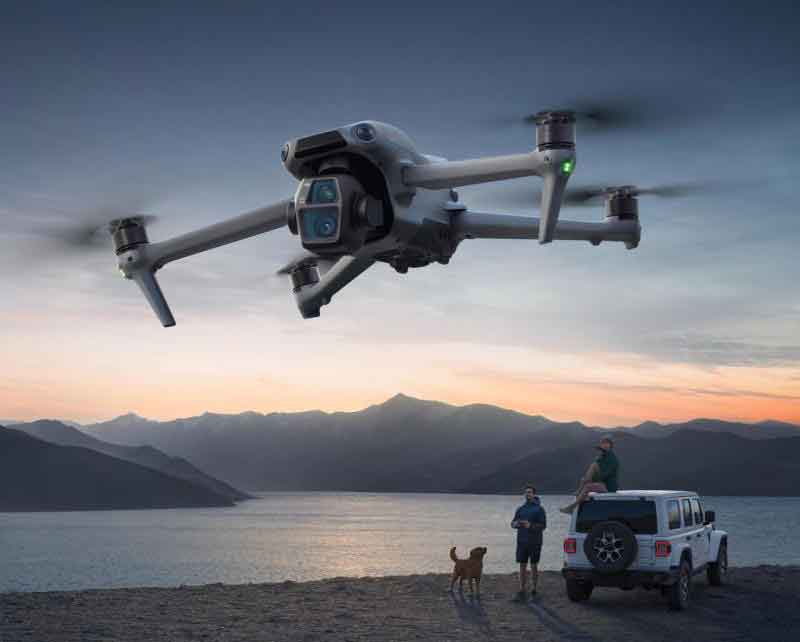
The foundation of effective drone technology lies in accurate mathematical modeling of UAV dynamics. For a quadrotor UAV, the attitude dynamics are derived from Newton-Euler equations, considering the rotational motions around the body-fixed axes. The general attitude dynamics without load can be expressed as:
$$ \dot{\phi} = \frac{M_x – (J_y – J_z)\dot{\theta}\dot{\psi}}{J_x} $$
$$ \dot{\theta} = \frac{M_y – (J_z – J_x)\dot{\phi}\dot{\psi}}{J_y} $$
$$ \dot{\psi} = \frac{M_z – (J_x – J_y)\dot{\phi}\dot{\theta}}{J_z} $$
where $\phi$, $\theta$, and $\psi$ represent the roll, pitch, and yaw angles, respectively; $\dot{\phi}$, $\dot{\theta}$, and $\dot{\psi}$ are their angular velocities; $M_x$, $M_y$, and $M_z$ denote the moments around the x, y, and z axes; and $J_x$, $J_y$, $J_z$ are the moments of inertia. When an unbalanced load is attached, the dynamics become more complex due to shifts in the center of mass and additional moments. The coupled system’s moment of inertia $J_C$ is given by:
$$ J_C = J_Q + m_L (\|d_L\|^2 I_3 – d_L d_L^T) $$
Here, $J_Q$ is the UAV’s moment of inertia, $m_L$ is the load mass, $d_L$ is the offset vector of the load’s center of mass relative to the UAV’s centroid, and $I_3$ is the 3×3 identity matrix. The load-induced moment $M_L$ in the body frame is calculated as $M_L = d_L m_L g$, where $g$ is gravitational acceleration. Thus, the augmented attitude dynamics for the UAV with unbalanced load are:
$$ \dot{\phi}_C = \frac{M_x + M_{Lx} – (J_{Cy} – J_{Cz})\dot{\theta}\dot{\psi}}{J_{Cx}} $$
$$ \dot{\theta}_C = \frac{M_y + M_{Ly} – (J_{Cz} – J_{Cx})\dot{\phi}\dot{\psi}}{J_{Cy}} $$
$$ \dot{\psi}_C = \frac{M_z + M_{Lz} – (J_{Cx} – J_{Cy})\dot{\phi}\dot{\theta}}{J_{Cz}} $$
These equations highlight the nonlinear couplings and disturbances that complicate control in drone technology applications. The LSTM-MPC strategy aims to mitigate these issues by predicting future states and optimizing control inputs accordingly.
The LSTM neural network component of the strategy is designed to forecast attitude changes based on historical data. It processes input sequences including current attitude angles ($\phi$, $\theta$, $\psi$), angular velocities ($\dot{\phi}$, $\dot{\theta}$, $\dot{\psi}$), and moments ($M_{Cx}$, $M_{Cy}$, $M_{Cz}$) to predict next-step attitudes ($\phi_{\text{next}}$, $\theta_{\text{next}}$, $\psi_{\text{next}}$). The LSTM model comprises an input layer, LSTM layers with gating mechanisms (input, forget, and output gates), fully connected layers, and an output layer. This structure enables the capture of long-term dependencies in time-series data, crucial for handling the nonlinearities in Unmanned Aerial Vehicle dynamics. For instance, the LSTM’s update equations for a cell state $c_t$ and hidden state $h_t$ at time $t$ are:
$$ i_t = \sigma(W_i \cdot [h_{t-1}, x_t] + b_i) $$
$$ f_t = \sigma(W_f \cdot [h_{t-1}, x_t] + b_f) $$
$$ o_t = \sigma(W_o \cdot [h_{t-1}, x_t] + b_o) $$
$$ \tilde{c}_t = \tanh(W_c \cdot [h_{t-1}, x_t] + b_c) $$
$$ c_t = f_t \odot c_{t-1} + i_t \odot \tilde{c}_t $$
$$ h_t = o_t \odot \tanh(c_t) $$
where $i_t$, $f_t$, and $o_t$ are the input, forget, and output gates; $\sigma$ is the sigmoid function; $\odot$ denotes element-wise multiplication; and $W$ and $b$ are weight matrices and biases. This allows the drone technology to anticipate errors and adjust proactively.
Meanwhile, the MPC component formulates a control optimization problem. It uses a discrete-time state-space model of the UAV system:
$$ x(k+1) = A x(k) + B u(k) $$
$$ y(k) = C x(k) + D u(k) $$
where $x(k)$ is the state vector, $u(k)$ is the input vector, $y(k)$ is the output vector, and $A$, $B$, $C$, $D$ are system matrices. The MPC minimizes a cost function $J$ over a prediction horizon:
$$ J = \sum_{k=0}^{n-1} \left[ (y(k) – y_{\text{ref}}(k))^T Q (y(k) – y_{\text{ref}}(k)) + u(k)^T R u(k) \right] $$
Here, $y_{\text{ref}}(k)$ is the reference trajectory, $Q$ and $R$ are weighting matrices for state errors and control efforts, and $n$ is the horizon length. By solving this optimization online, MPC computes optimal control sequences that respect constraints, enhancing the robustness of Unmanned Aerial Vehicle operations under unbalanced loads.
The integration of LSTM and MPC creates a synergistic control strategy. The LSTM network predicts future attitude states, which are fed into the MPC as a reference for optimization. This combination allows for real-time adjustments and improved tracking accuracy. The workflow involves: MPC generating control inputs based on LSTM predictions, system outputs being measured, and errors being fed back to correct predictions. This closed-loop approach ensures that the drone technology can handle uncertainties effectively.
To validate the LSTM-MPC strategy, extensive training and testing were conducted using datasets collected from UAV simulations. The data included attitude angles, angular velocities, and moments under various load conditions. The dataset was split into training and testing sets with a 7:3 ratio. Performance metrics such as coefficient of determination ($R^2$), root mean square error ($E_{\text{RMSE}}$), and mean absolute error ($E_{\text{MAE}}$) were used to evaluate the model. The formulas for these metrics are:
$$ R^2 = 1 – \frac{\sum_{i=1}^{m} (y_i – \hat{y}_i)^2}{\sum_{i=1}^{m} (y_i – \bar{y})^2} $$
$$ E_{\text{RMSE}} = \sqrt{\frac{1}{m} \sum_{i=1}^{m} (y_i – \hat{y}_i)^2} $$
$$ E_{\text{MAE}} = \frac{1}{m} \sum_{i=1}^{m} |y_i – \hat{y}_i| $$
where $y_i$ are actual values, $\hat{y}_i$ are predicted values, $\bar{y}$ is the mean of actual values, and $m$ is the number of samples. The following table summarizes the evaluation results for the training and testing sets, demonstrating high predictive accuracy and generalization capability for drone technology applications.
| Dataset | Attitude Angle | $R^2$ | $E_{\text{RMSE}}$ (rad) | $E_{\text{MAE}}$ (rad) |
|---|---|---|---|---|
| Training | Roll ($\phi$) | 0.9926 | 0.0103 | 0.0084 |
| Pitch ($\theta$) | 0.9853 | 0.0187 | 0.0140 | |
| Yaw ($\psi$) | 0.9934 | 0.0085 | 0.0073 | |
| Testing | Roll ($\phi$) | 0.9838 | 0.0148 | 0.0127 |
| Pitch ($\theta$) | 0.9776 | 0.0202 | 0.0149 | |
| Yaw ($\psi$) | 0.9869 | 0.0134 | 0.0115 |
The results indicate that the LSTM-MPC strategy achieves high $R^2$ values close to 1 and low errors, confirming its effectiveness in predicting attitude changes for Unmanned Aerial Vehicles. The minimal degradation in performance from training to testing highlights the model’s robustness, which is crucial for real-world drone technology deployments.
Simulation experiments were performed in MATLAB to compare the LSTM-MPC strategy with traditional methods like fuzzy PID and standard MPC. The scenario involved a quadrotor UAV carrying a 0.9 kg unbalanced load positioned at coordinates (0.15 m, 0.15 m, 0.05 m) in the body frame. The control strategies were evaluated based on their ability to track desired attitude trajectories. The table below presents the root mean square errors (RMSE) for roll, pitch, and yaw angles, showcasing the superior performance of LSTM-MPC in drone technology control systems.
| Control Strategy | Roll RMSE (rad) | Pitch RMSE (rad) | Yaw RMSE (rad) |
|---|---|---|---|
| Fuzzy PID | 0.0121 | 0.0229 | 0.0021 |
| MPC | 0.0120 | 0.0195 | 0.0018 |
| LSTM-MPC | 0.0104 | 0.0171 | 0.0016 |
The LSTM-MPC strategy reduces the RMSE for roll angle by 14.05% compared to fuzzy PID and 13.33% compared to MPC. For pitch angle, the reductions are 25.33% and 12.31%, respectively, and for yaw angle, 23.81% and 11.11%. These improvements underscore the advantage of integrating predictive neural networks with model predictive control in drone technology for handling nonlinearities and unbalanced loads.
Further analysis through simulations involved evaluating the time-domain responses. The attitude tracking errors for LSTM-MPC were consistently lower, with average errors of 0.0049 rad for roll, 0.0103 rad for pitch, and 0.0011 rad for yaw. In contrast, fuzzy PID had average errors of 0.0074 rad, 0.0147 rad, and 0.0015 rad, and MPC had 0.0059 rad, 0.0121 rad, and 0.0013 rad. The LSTM-MPC’s ability to anticipate and compensate for disturbances results in smoother and more stable control, which is essential for advanced Unmanned Aerial Vehicle applications.
To validate the practical applicability of the LSTM-MPC strategy, real-world flight tests were conducted using a commercial F450 quadrotor UAV platform. The UAV was equipped with a 0.6 kg unbalanced load attached at the same body-frame coordinates. The flight control system included an IMU and GPS for real-time data acquisition, and the Mission Planner ground station was used for monitoring. The test comprised three phases: a 20-second flight, a 20-second hover, and another 20-second flight, totaling 60 seconds. Attitude tracking performance was assessed by comparing actual outputs to desired values.
The results demonstrated that the LSTM-MPC strategy achieved average errors of 3.91% for roll angle, 5.31% for pitch angle, and 1.10% for yaw angle. These low errors indicate enhanced stability and control precision, even under the influence of unbalanced loads. The successful implementation in a physical Unmanned Aerial Vehicle highlights the scalability and robustness of the proposed method for real-world drone technology scenarios.
In conclusion, the LSTM-MPC strategy represents a significant advancement in drone technology for managing unbalanced load conditions in UAVs. By combining the predictive power of LSTM neural networks with the optimization capabilities of MPC, this approach addresses the nonlinearities and disturbances that challenge traditional control methods. Mathematical modeling, simulations, and flight tests confirm its superiority in reducing attitude tracking errors and improving stability. As drone technology continues to evolve, such integrated control strategies will play a pivotal role in expanding the capabilities of Unmanned Aerial Vehicles in complex environments, from agricultural spraying to aerial mapping. Future work could explore adaptive learning mechanisms to further enhance performance under varying operational conditions.