
The coordinated operation of a drone formation, where multiple Unmanned Aerial Vehicles (UAVs) act as a cohesive system, represents a paradigm shift in aerial operations. This approach significantly amplifies mission效能 and enhances battlefield situational awareness. For penetration and strike missions, a drone formation can execute saturation attacks on a single target from multiple angles and dimensions, dramatically increasing the success rate of penetration and the overall strike effectiveness compared to a single platform. Simultaneously, a drone formation can engage multiple enemy targets at once, effectively overwhelming and disrupting adversarial air defense systems. In highly contested environments, cooperative positioning and navigation mechanisms within the drone formation enable the establishment and maintenance of an autonomous, reliable spatiotemporal reference framework, providing stable and precise navigation and timing services. Furthermore, multi-UAV formations can synergistically perform reconnaissance tasks; their wide coverage area ensures comprehensive surveillance of a region, allowing mission completion in a single sortie and vastly improving reconnaissance efficiency.
However, the realization of a robust and safe drone formation hinges on solving several intertwined technical challenges. A cornerstone technology is the design of formation control laws that utilize relative state information to guarantee collision avoidance. Collision avoidance algorithms are broadly categorized into optimization-based and rule-based methods. The former typically formulates the avoidance problem as a constrained optimization problem, which is then solved using numerical techniques. For instance, Mixed Integer Linear Programming (MILIP) has been employed to address collision-free formation flight problems. On the other hand, rule-based avoidance algorithms, which are inherently distributed, offer advantages such as flexible parameter selection, clear structure, and well-defined physical meaning. The potential function method, belonging to this category, has been extensively applied in collision avoidance control for drone formations. Recent works have combined potential functions with dynamic surface control, fast non-singular terminal sliding modes, and adaptive control strategies for fixed-wing UAVs and satellite formations. Other approaches integrate potential functions with optimal consensus protocols or flocking-inspired behaviors for distributed multi-UAV control.
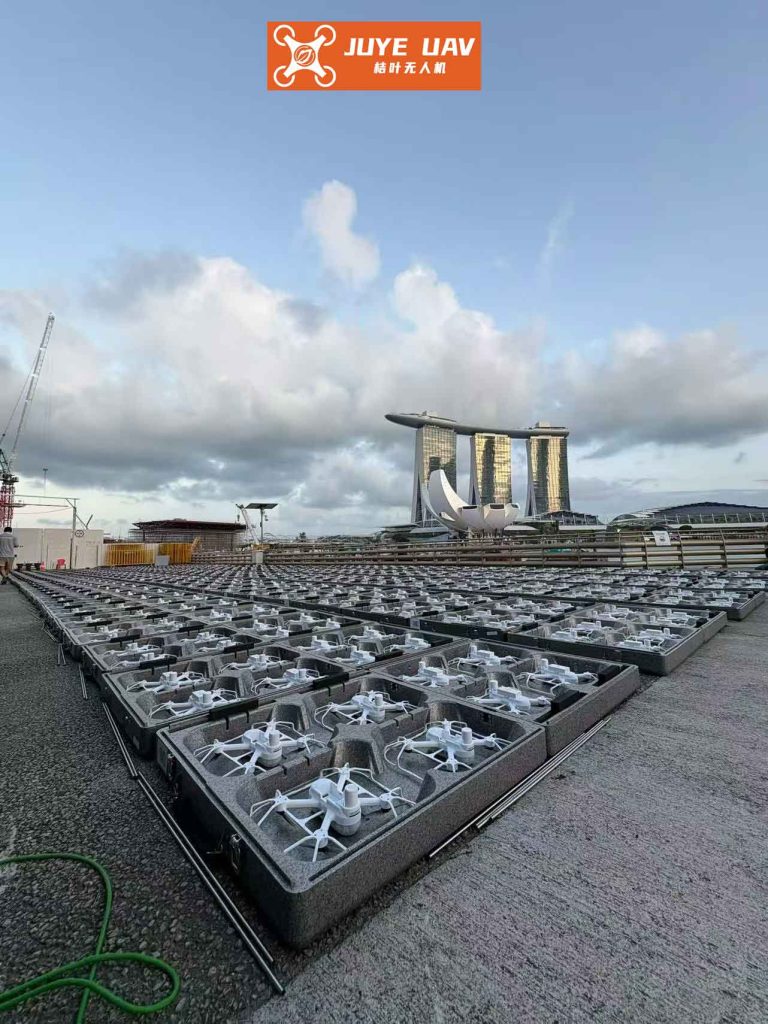
A critical, ever-present challenge in real-world flight is the influence of external disturbances, such as wind gusts. These unknown perturbations pose a severe threat to the stability and precision of drone formation control. To counteract this, the Extended State Observer (ESO), a core component of Active Disturbance Rejection Control (ADRC), can be introduced to estimate and compensate for these disturbances in real-time. Researchers have designed finite-time and fixed-time convergence ESOs to estimate disturbances and uncertainties in quadrotor formations, proposed disturbance-rejection time-varying formation control methods, and utilized ESOs to estimate compounded disturbances including neural network approximation errors and external forces for robust flight control.
Practical implementation of drone formation control must also account for inherent system constraints. A primary constraint is input saturation, arising from the physical limitations of the propulsion system where the engine can only provide a finite amount of thrust. Control algorithms must be designed to respect these saturation limits to avoid performance degradation or instability. Furthermore, the information exchange within the drone formation is subject to communication delays, which can significantly degrade control performance and even lead to system instability. While many existing works assume constant time delays, practical networks often exhibit time-varying delays, presenting a more complex challenge that requires robust control solutions.
This article addresses the integrated problem of controlling a fixed-wing drone formation with guaranteed collision avoidance, in the presence of external disturbances, input saturation, and time-varying communication delays. The main contributions are threefold: 1) The design of an Extended State Observer to accurately estimate and compensate for external disturbances, with a rigorous stability analysis proving the exponential convergence of estimation errors to a small neighborhood of the origin. 2) The synthesis of a formation control law that integrates artificial potential functions for collision avoidance with an anti-windup compensator to handle input saturation, ensuring both velocity synchronization and safe separation among all UAVs. 3) The explicit consideration and compensation for time-varying communication delays in the control algorithm and stability proof, extending beyond the common assumption of constant delays.
1. System Modeling and Preliminaries
1.1 Fixed-Wing UAV Formation Dynamics
Consider a drone formation consisting of \( n \) fixed-wing UAVs. For the \( i \)-th UAV, its kinematic equations are given by:
$$
\begin{align}
\dot{x}_i &= V_i \cos \chi_i \cos \gamma_i \\
\dot{y}_i &= V_i \sin \chi_i \cos \gamma_i \\
\dot{z}_i &= V_i \sin \gamma_i
\end{align}
$$
where \( \mathbf{p}_i = [x_i, y_i, z_i]^T \) denotes the position vector in the inertial frame, \( V_i \) is the airspeed, \( \chi_i \) is the heading angle, and \( \gamma_i \) is the flight path angle. The corresponding dynamics are:
$$
\begin{align}
\dot{V}_i &= \frac{T_i – D_i + d_{V_i}}{m_i} – g \sin \gamma_i \\
\dot{\chi}_i &= \frac{L_i \sin \phi_i + d_{\chi_i}}{m_i V_i \cos \gamma_i} \\
\dot{\gamma}_i &= \frac{L_i \cos \phi_i – m_i g \cos \gamma_i + d_{\gamma_i}}{m_i V_i}
\end{align}
$$
Here, \( T_i \) is engine thrust, \( L_i \) and \( D_i \) are lift and drag forces, \( d_{V_i}, d_{\chi_i}, d_{\gamma_i} \) are unknown external disturbances (e.g., from wind), \( m_i \) is mass, \( g \) is gravity, and \( \phi_i \) is the bank angle.
To facilitate control design, we define the control input vector \( \mathbf{F}_i = [T_i, L_i \sin \phi_i, L_i \cos \phi_i]^T \), the velocity vector \( \mathbf{v}_i = \dot{\mathbf{p}}_i \), and the combined disturbance vector \( \mathbf{d}_{i0} = [d_{V_i}, d_{\chi_i}, d_{\gamma_i}]^T \). The equations can be consolidated into a more compact form:
$$
\begin{align}
\dot{\mathbf{p}}_i &= \mathbf{v}_i \\
m_i \dot{\mathbf{v}}_i &= \boldsymbol{\alpha}_i + m_i \boldsymbol{\varepsilon}_i + \mathbf{R}_i \mathbf{F}_i + \mathbf{d}_i
\end{align}
$$
where \( \mathbf{d}_i = \mathbf{R}_i \mathbf{d}_{i0} \), and the matrices/vectors are defined as:
$$
\boldsymbol{\alpha}_i = \begin{bmatrix} -D_i \cos \chi_i \cos \gamma_i \\ -D_i \sin \chi_i \cos \gamma_i \\ -D_i \sin \gamma_i \end{bmatrix}, \quad
\boldsymbol{\varepsilon}_i = \begin{bmatrix} 0 \\ 0 \\ g \end{bmatrix},
$$
$$
\mathbf{R}_i = \begin{bmatrix}
\cos \chi_i \cos \gamma_i & -\sin \chi_i & -\sin \gamma_i \cos \chi_i \\
\sin \chi_i \cos \gamma_i & \cos \chi_i & -\sin \chi_i \sin \gamma_i \\
\sin \gamma_i & 0 & \cos \gamma_i
\end{bmatrix}.
$$
The matrix \( \mathbf{R}_i \) is invertible, with \( \mathbf{R}_i^{-1} = \mathbf{R}_i^T \).
1.2 Graph Theory for Formation Communication
The information exchange topology within the drone formation is modeled using a weighted directed graph \( \mathcal{G} = (\mathcal{V}, \mathcal{E}, \mathcal{C}) \). The node set \( \mathcal{V} = \{1, 2, …, n\} \) represents the UAVs. The edge set \( \mathcal{E} \subseteq \mathcal{V} \times \mathcal{V} \) defines communication links; an edge \( (j, i) \in \mathcal{E} \) exists if UAV \( j \) can transmit information to UAV \( i \). The weighted adjacency matrix \( \mathcal{C} = [c_{ij}] \in \mathbb{R}^{n \times n} \) is defined with elements \( c_{ij} > 0 \) if \( (j, i) \in \mathcal{E} \), and \( c_{ij} = 0 \) otherwise. The Laplacian matrix \( \mathbf{L} = [l_{ij}] \in \mathbb{R}^{n \times n} \) is defined as \( l_{ii} = \sum_{k=1}^{n} c_{ik} \) and \( l_{ij} = -c_{ij} \) for \( i \neq j \).
Lemma 1: For any strongly connected directed graph, there exists a positive vector \( \boldsymbol{\gamma} = [\gamma_1, \gamma_2, …, \gamma_n]^T \) (with \( \gamma_i > 0 \)) such that \( \boldsymbol{\gamma}^T \mathbf{L} = \mathbf{0} \).
1.3 Control Objectives
The primary control objectives for the drone formation are:
- Collision Avoidance: Ensure a minimum safe distance \( d_{ij} \) between any pair of UAVs \( i \) and \( j \) at all times:
$$ \| \mathbf{p}_i(t) – \mathbf{p}_j(t) \| > d_{ij}, \quad \forall t \ge 0, \quad \forall i \neq j. $$ - Velocity Synchronization (Formation Stability): Achieve consensus on velocity, leading to stable coordinated flight:
$$ \lim_{t \to \infty} (\mathbf{v}_i(t) – \mathbf{v}_j(t)) = \mathbf{0}, \quad \forall i, j. $$
These objectives must be met while compensating for disturbances \( \mathbf{d}_i \), respecting input saturation \( \|\mathbf{F}_i\| \le F_{i_{max}} \), and being robust to time-varying communication delays \( T_{ij}(t) \).
2. Extended State Observer Design for Disturbance Estimation
To actively compensate for the external disturbances affecting the drone formation, we design an Extended State Observer (ESO). Let \( \hat{\mathbf{p}}_i \), \( \hat{\mathbf{v}}_i \), and \( \hat{\mathbf{d}}_i \) be the estimates of \( \mathbf{p}_i \), \( \mathbf{v}_i \), and \( \mathbf{d}_i \), respectively. Assume the disturbance’s rate of change is bounded, i.e., \( \| \dot{\mathbf{d}}_i \| \le \epsilon \).
Define the estimation error \( \mathbf{e}_{pi} = \mathbf{p}_i – \hat{\mathbf{p}}_i \). The ESO is proposed as:
$$
\begin{align}
\dot{\hat{\mathbf{p}}}_i &= \hat{\mathbf{v}}_i + l_1 \delta \, \mathbf{e}_{pi} \\
\dot{\hat{\mathbf{v}}}_i &= \mathbf{f}_i + \frac{1}{m_i} \hat{\mathbf{d}}_i + l_2 \delta^2 \, \mathbf{e}_{pi} \\
\dot{\hat{\mathbf{d}}}_i &= l_3 \delta^3 \, \mathbf{e}_{pi}
\end{align}
$$
where \( \mathbf{f}_i = \frac{1}{m_i}(\boldsymbol{\alpha}_i + m_i \boldsymbol{\varepsilon}_i + \mathbf{R}_i \mathbf{F}_i) \), \( \delta > 0 \) is the observer bandwidth, and \( l_1, l_2, l_3 > 0 \) are gain parameters. To analyze stability, define scaled estimation errors:
$$
\mathbf{e}_{i1} = \frac{1}{\delta^2}(\mathbf{p}_i – \hat{\mathbf{p}}_i), \quad \mathbf{e}_{i2} = \frac{1}{\delta}(\mathbf{v}_i – \hat{\mathbf{v}}_i), \quad \mathbf{e}_{i3} = \mathbf{d}_i – \hat{\mathbf{d}}_i.
$$
The error dynamics can be derived as:
$$
\begin{align}
\delta \dot{\mathbf{e}}_{i1} &= \mathbf{e}_{i2} – l_1 \mathbf{e}_{i1} \\
\delta \dot{\mathbf{e}}_{i2} &= \frac{1}{m_i} \mathbf{e}_{i3} – l_2 \mathbf{e}_{i1} \\
\delta \dot{\mathbf{e}}_{i3} &= \delta \dot{\mathbf{d}}_i – l_3 \mathbf{e}_{i1}
\end{align}
$$
Let \( \mathbf{x}_i = [\mathbf{e}_{i1}^T, \mathbf{e}_{i2}^T, \mathbf{e}_{i3}^T]^T \). The error system is:
$$
\delta \dot{\mathbf{x}}_i = (\mathbf{M}_i \otimes \mathbf{I}_3) \mathbf{x}_i + \delta \bar{\mathbf{B}} \dot{\mathbf{d}}_i
$$
where \( \otimes \) denotes the Kronecker product, \( \bar{\mathbf{B}} = [\mathbf{0}, \mathbf{0}, \mathbf{I}_3]^T \), and
$$
\mathbf{M}_i = \begin{bmatrix}
-l_1 & 1 & 0 \\
-l_2 & 0 & \frac{1}{m_i} \\
-l_3 & 0 & 0
\end{bmatrix}.
$$
Lemma 2: If \( l_1, l_2, l_3 > 0 \) are chosen such that \( l_1 l_2 – \frac{l_3}{m_i} > 0 \), then the matrix \( \mathbf{M}_i \) is Hurwitz. For a heterogeneous drone formation with varying masses \( m_i \), selecting parameters satisfying \( l_1 l_2 – \frac{l_3}{\min_i\{m_i\}} > 0 \) ensures all \( \mathbf{M}_i \) are Hurwitz.
Theorem 1 (Stability of ESO): For the ESO defined by the system, if the gains are selected such that \( \mathbf{M}_i \) is Hurwitz for all \( i \), then the estimation errors \( \mathbf{e}_{i1}, \mathbf{e}_{i2}, \mathbf{e}_{i3} \) converge exponentially to a small neighborhood around the origin. The size of this neighborhood and the convergence rate can be tuned by the observer bandwidth \( \delta \) and gains \( l_1, l_2, l_3 \).
Proof Sketch: Since \( \mathbf{M}_i \) is Hurwitz, \( \mathbf{M}_i \otimes \mathbf{I}_3 \) is also Hurwitz. Therefore, for any positive definite matrix \( \mathbf{Q}_i \), there exists a unique positive definite matrix \( \mathbf{P}_i \) satisfying the Lyapunov equation \( (\mathbf{M}_i \otimes \mathbf{I}_3)^T \mathbf{P}_i + \mathbf{P}_i (\mathbf{M}_i \otimes \mathbf{I}_3) = -\mathbf{Q}_i \). Consider the Lyapunov function candidate \( V_{0i} = \delta \mathbf{x}_i^T \mathbf{P}_i \mathbf{x}_i \). Its time derivative along the error dynamics leads to an inequality of the form:
$$ \dot{V}_{0i} \le -\frac{\lambda_{min}(\mathbf{Q}_i) – \frac{1}{\theta^2}}{\delta \lambda_{max}(\mathbf{P}_i)} V_{0i} + \bar{\epsilon}_i $$
where \( \theta \) is a positive constant and \( \bar{\epsilon}_i \) is a bounded term related to \( \epsilon \). By choosing parameters such that \( \lambda_{min}(\mathbf{Q}_i) > 1/\theta^2 \), it follows that \( V_{0i} \) converges exponentially to a bounded set, guaranteeing the boundedness and ultimate convergence of the estimation errors.
3. Integrated Formation Controller with Collision Avoidance
We now design the integrated control law for the drone formation that addresses collision avoidance, input saturation, and time-varying communication delays, while utilizing the disturbance estimate from the ESO.
3.1 Input Saturation and Anti-Windup Compensator
The actual control input \( \mathbf{F}_i \) applied to the UAV is subject to saturation:
$$ \mathbf{F}_i = \text{sat}(\mathbf{u}_i) = \text{sgn}(\mathbf{u}_i) \cdot \min(F_{max}, \|\mathbf{u}_i\|) \cdot \frac{\mathbf{u}_i}{\|\mathbf{u}_i\|} $$
where \( \mathbf{u}_i \) is the desired control signal computed by the controller, and \( F_{max} \) is the maximum allowable force magnitude. Define the control deficiency due to saturation as \( \Delta \mathbf{F}_i = \mathbf{u}_i – \mathbf{F}_i \). To mitigate the adverse effects of saturation (integrator windup), an anti-windup compensator with state \( \boldsymbol{\xi}_i \) is introduced:
$$ \dot{\boldsymbol{\xi}}_i = \frac{\boldsymbol{\xi}_i}{\|\boldsymbol{\xi}_i\|^2} \mathbf{v}_i^T (-k_{i1} \boldsymbol{\xi}_i + \mathbf{R}_i \Delta \mathbf{F}_i) $$
where \( k_{i1} > 0 \) is a gain. This compensator helps to adjust the control command when saturation occurs, improving transient performance.
3.2 Potential Function for Collision Avoidance
A pairwise artificial potential function \( W_{ij}(\|\mathbf{p}_{ij}\|) \), where \( \mathbf{p}_{ij} = \mathbf{p}_i – \mathbf{p}_j \), is employed to enforce collision avoidance. This function must satisfy:
- \( W_{ij}(r) \) is continuously differentiable for \( r > d_{ij} \).
- \( W_{ij}(r) \to +\infty \) as \( r \to d_{ij}^+ \).
- \( W_{ij}(r) \) attains a minimum at a desired separation distance \( r = r_0 > d_{ij} \).
A common choice is the Lennard-Jones-type function:
$$ W_{ij}(\|\mathbf{p}_{ij}\|) = \frac{K_{a}}{(\|\mathbf{p}_{ij}\|^2 – d_{ij}^2)^2} $$
where \( K_a > 0 \). The gradient \( \nabla_{\mathbf{p}_i} W_{ij} \) provides a repulsive force that pushes UAVs apart when they are too close.
3.3 Distributed Control Law with Delay Compensation
Assume the communication from UAV \( j \) to UAV \( i \) experiences a time-varying delay \( T_{ij}(t) \geq 0 \). It is assumed that \( \dot{T}_{ij}(t) \leq h_{ij} < 1 \) and that delays vanish asymptotically, i.e., \( \lim_{t \to \infty} T_{ij}(t) = 0 \). The distributed control law for UAV \( i \) is proposed as:
$$
\begin{align}
\mathbf{u}_i &= \mathbf{R}_i^{-1} \Bigg[ -\boldsymbol{\alpha}_i – m_i \boldsymbol{\varepsilon}_i – \sum_{j=1}^{n} c_{ij}\big(\mathbf{v}_i(t) – \mathbf{v}_j(t – T_{ij}(t))\big) \\
&\quad – k_{i2} \sum_{j=1}^{n} \nabla_{\mathbf{p}_i} W_{ij} + k_{i1} \boldsymbol{\xi}_i \Bigg] + \hat{\mathbf{d}}_i
\end{align}
$$
where \( k_{i2} > 0 \) is a formation gain. This controller has several key components:
- \( -\boldsymbol{\alpha}_i – m_i \boldsymbol{\varepsilon}_i \): Feedback linearization of known dynamics.
- \( -\sum c_{ij}(\mathbf{v}_i – \mathbf{v}_j(t-T_{ij})) \): A consensus term using delayed neighbor velocities to achieve synchronization.
- \( -k_{i2} \sum \nabla_{\mathbf{p}_i} W_{ij} \): The collision avoidance force derived from the potential field.
- \( +k_{i1} \boldsymbol{\xi}_i \): The anti-windup compensation term.
- \( + \hat{\mathbf{d}}_i \): The disturbance estimate from the ESO for active compensation.
Substituting the controller into the dynamics and using the fact that \( \hat{\mathbf{d}}_i \approx \mathbf{d}_i \) after the ESO converges, the closed-loop dynamics become:
$$
m_i \dot{\mathbf{v}}_i \approx -\sum_{j=1}^{n} c_{ij}\big(\mathbf{v}_i – \mathbf{v}_j(t – T_{ij})\big) – k_{i2} \sum_{j=1}^{n} \nabla_{\mathbf{p}_i} W_{ij} + k_{i1} \boldsymbol{\xi}_i – \mathbf{R}_i \Delta \mathbf{F}_i.
$$
3.4 Stability Analysis of the Closed-Loop Drone Formation
Theorem 2 (Main Result): Consider the drone formation system under Assumptions 1 (no initial collisions) and 2 (properties of potential function), with a strongly connected communication graph \( \mathcal{G} \). Suppose the time-varying delays satisfy \( \dot{T}_{ij}(t) \leq h_{ij} < 1 \) and \( \lim_{t \to \infty} T_{ij}(t) = 0 \). Then, under the action of the ESO and the integrated control law, the closed-loop system achieves the control objectives: collision avoidance is guaranteed for all time, and the velocities of all UAVs asymptotically synchronize.
Proof Sketch: Consider the following Lyapunov-Krasovskii functional candidate:
$$
\begin{align}
V &= \frac{1}{2}\sum_{i=1}^{n} \gamma_i m_i \mathbf{v}_i^T \mathbf{v}_i + \sum_{i=1}^{n} \sum_{j>i}^{n} \gamma_i k_{i2} W_{ij}(\|\mathbf{p}_{ij}\|) \\
&\quad + \frac{1}{2}\sum_{i=1}^{n} \gamma_i \boldsymbol{\xi}_i^T \boldsymbol{\xi}_i + \frac{1}{2}\sum_{i=1}^{n}\sum_{j=1}^{n} \rho \gamma_i c_{ij} \int_{t-T_{ij}(t)}^{t} \mathbf{v}_j^T(\tau)\mathbf{v}_j(\tau) d\tau
\end{align}
$$
where \( \boldsymbol{\gamma} = [\gamma_1,…,\gamma_n]^T \) is the positive left eigenvector of the Laplacian \( \mathbf{L} \) (from Lemma 1), and \( \rho > 0 \) is a constant chosen such that \( \rho(1 – h_{ij}) \geq 1 \).
Taking the time derivative of \( V \) and substituting the closed-loop dynamics and the compensator dynamics leads, after significant algebraic manipulation and application of Young’s inequality, to:
$$ \dot{V} \leq -\frac{1}{2}\sum_{i=1}^{n}\sum_{j=1}^{n} \gamma_i c_{ij} \big(\mathbf{v}_i – \mathbf{v}_j(t-T_{ij})\big)^T \big(\mathbf{v}_i – \mathbf{v}_j(t-T_{ij})\big) \leq 0. $$
Since \( V \geq 0 \) and \( \dot{V} \leq 0 \), \( V(t) \) is bounded. This boundedness, coupled with the property of \( W_{ij}(r) \to \infty \) as \( r \to d_{ij}^+ \), directly implies that \( \|\mathbf{p}_{ij}(t)\| > d_{ij} \) for all time, proving collision avoidance.
From \( \dot{V} \leq 0 \) and the boundedness of \( V(0) \), we have that the integral of the negative term is finite, implying \( \mathbf{v}_i – \mathbf{v}_j(t-T_{ij}) \in \mathcal{L}_2 \). Furthermore, using Barbalat’s lemma and the assumptions on the delays (\( T_{ij}(t) \to 0 \) and \( \dot{T}_{ij}(t) \) bounded), we can conclude that \( \mathbf{v}_i(t) – \mathbf{v}_j(t) \to \mathbf{0} \) as \( t \to \infty \). This proves asymptotic velocity synchronization for the entire drone formation.
4. Simulation Analysis and Performance Evaluation
To validate the proposed control framework for the drone formation, a numerical simulation with ten fixed-wing UAVs (\( n=10 \)) was conducted. The system parameters and controller gains are summarized below.
| Parameter Category | Symbol | Value / Description |
|---|---|---|
| UAV Model | \( m_i \) | \( 200 + 5i \) kg, \( i=1,…,10 \) |
| \( g \) | 9.81 m/s² | |
| Wing Area (\( S \)) | 1.37 m² | |
| Drag Coeff. (\( C_{D0}, k_d \)) | 0.02, 0.1 | |
| Formation & Safety | Min. Distance \( d_{ij} \) | 10 m |
| Potential Function \( W_{ij} \) | \( K_a / (\|\mathbf{p}_{ij}\|^2 – 100)^2 \), \( K_a=1 \) | |
| Topology \( \mathcal{G} \) | Strongly connected directed graph | |
| ESO Parameters | Bandwidth \( \delta \) | 0.2 |
| Gains \( l_1, l_2, l_3 \) | 2.0, 0.1, 0.1 | |
| Initial Estimates | \( \hat{\mathbf{p}}_i(0)=\hat{\mathbf{v}}_i(0)=\hat{\mathbf{d}}_i(0)=\mathbf{0} \) | |
| Disturbance Bound \( \epsilon \) | Bounded (simulated as gusts) | |
| Controller Parameters | Saturation Limit \( F_{max} \) | 50 N |
| Gains \( k_{i1}, k_{i2} \) | 0.5, 100 | |
| Anti-windup Init. \( \boldsymbol{\xi}_i(0) \) | [1, 1, 1]^T | |
| Delays \( T_{ij}(t) \) | Mix: \(0.2e^{-0.4t}\), 2s (const.), \(2e^{0.01t}\), etc. |
The performance of the drone formation is evaluated using the following metrics:
- Disturbance Estimation Error: \( \|\mathbf{e}_{i3}(t)\| = \|\mathbf{d}_i(t) – \hat{\mathbf{d}}_i(t)\| \).
- Inter-Agent Distance: \( E_{ij}(t) = \|\mathbf{p}_i(t) – \mathbf{p}_j(t)\| \). Must satisfy \( E_{ij}(t) > 10 \) m.
- Velocity Synchronization Error: \( e_{ij}(t) = \|\mathbf{v}_i(t) – \mathbf{v}_j(t)\| \).
- Global Formation Sync Error: \( \mu(t) = \frac{1}{45} \sum_{i=1}^{10} \sum_{j>i}^{10} \|\mathbf{v}_i(t) – \mathbf{v}_j(t)\|^2 \).
The simulation results confirm the efficacy of the proposed strategy. The ESO successfully estimates the external disturbances, with the norm of the estimation error \( \|\mathbf{e}_{i3}\| \) converging rapidly to a very small value near zero. The 3D trajectories of the UAVs show a coordinated maneuver from their initial scattered positions into a stable, moving drone formation. Crucially, the inter-agent distances \( E_{ij}(t) \) remain strictly above the minimum safe distance of 10 meters for all time and for all agent pairs, validating the collision avoidance guarantee. Finally, both the pairwise velocity errors \( e_{ij}(t) \) and the global synchronization index \( \mu(t) \) converge to zero, demonstrating that the drone formation achieves asymptotic velocity consensus as proved theoretically.
| Challenge | Solution Component | Mechanism / Purpose | Key Feature |
|---|---|---|---|
| External Disturbances | Extended State Observer (ESO) | Estimates total disturbance \( \mathbf{d}_i \) in real-time for feedforward compensation. | Exponential convergence of estimation error; model-agnostic. |
| Collision Avoidance | Artificial Potential Functions \( W_{ij} \) | Generates repulsive forces \( -\nabla W_{ij} \) when UAVs are too close. | Formally guarantees \( \|\mathbf{p}_{ij}\| > d_{ij} \); decentralized. |
| Input Saturation | Anti-Windup Compensator \( \boldsymbol{\xi}_i \) | Adjusts control command based on saturation deficiency \( \Delta \mathbf{F}_i \). | Preserves stability and performance when actuator limits are reached. |
| Time-Varying Comm. Delays | Delay-Dependent Consensus Term & Lyapunov-Krasovskii Functional | Uses \( \mathbf{v}_j(t-T_{ij}(t)) \) in feedback; functional includes integral of past states. | Handles bounded, vanishing delays \( T_{ij}(t) \); proof of asymptotic stability. |
| Velocity Synchronization | Distributed Consensus Protocol | \( -\sum c_{ij}(\mathbf{v}_i – \mathbf{v}_j(t-T_{ij})) \) drives velocities to agreement. | Works over directed, strongly connected graphs with delays. |
5. Conclusion
This article has presented a comprehensive and robust control solution for a fixed-wing drone formation operating under realistic practical constraints. The proposed framework integrates an Extended State Observer for accurate estimation and compensation of external disturbances like wind gusts. A distributed control law synergistically combines artificial potential functions for guaranteed collision avoidance, an anti-windup compensator to handle actuator saturation limits, and a delay-tolerant consensus protocol for velocity synchronization. The rigorous stability analysis, employing a novel Lyapunov-Krasovskii functional, proves that the closed-loop system ensures safe separation between all UAVs at all times and achieves asymptotic velocity consensus, even in the presence of time-varying communication delays. Numerical simulations validate the theoretical results and demonstrate the effectiveness of the approach in guiding a drone formation through complex coordinated maneuvers. Future work will focus on extending this framework to include fault-tolerant control capabilities to handle actuator failures, and on experimental validation with physical UAV platforms.