
This paper presents an adaptive hierarchical control method for a fixed-wing drone, addressing the coupled challenges of underactuated dynamics and parametric uncertainty. The approach transforms the original fixed-wing drone model into a virtual integrator and a linear parameterized form using a unicycle model. A composite control framework is then established by integrating backstepping, fixed-time control theory, and a regulation-triggered batch identifier based on spectral decomposition. The proposed method ensures tracking error convergence, maintains the boundedness of linear regression equations, and eliminates parametric uncertainty through a finite number of parameter updates. Numerical simulations validate the efficacy of the proposed scheme for a fixed-wing drone under non-persistent excitation conditions.
1. Introduction
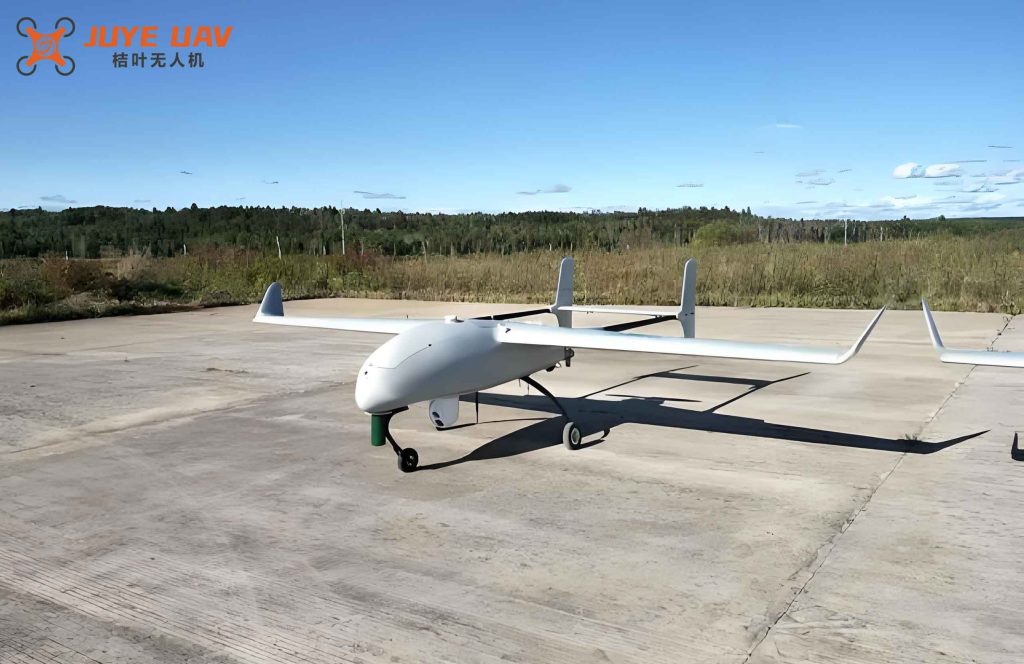
The fixed-wing drone is widely utilized in strategic reconnaissance, environmental monitoring, and mapping due to its long endurance and stable flight characteristics. However, the inherent underactuation of the fixed-wing drone model, where fewer control inputs are available than degrees of freedom, complicates the design of high-precision trajectory tracking controllers. Furthermore, parametric uncertainty in the aerodynamic and actuator models degrades control performance and poses safety risks.
Existing works have addressed underactuation through various strategies. For instance, inner-outer loop control using model predictive control (MPC) and game theory achieves attitude tracking but does not guarantee full-state convergence. Other methods transform the underactuated system into cascaded forms for sliding mode or backstepping control, though they often fail to handle dynamic trajectory tracking. Adaptive control methods have been employed to handle parametric uncertainty. Conventional model reference adaptive control (MRAC) and Lyapunov-based methods ensure stability but do not guarantee parameter convergence without persistent excitation (PE). Data-driven approaches, such as concurrent learning and composite learning, relax excitation requirements but often suffer from unbounded regression equations or insufficient handling of directional excitation richness.
This paper proposes a unified framework to overcome these limitations for the fixed-wing drone. The key innovations are:
- Underactuation is resolved via a unicycle model transformation combined with a backstepping and fixed-time hierarchical control law, ensuring tracking error converges to zero.
- A linear regression equation is constructed using spectral decomposition, integrating directional forgetting to maintain boundedness while accounting for excitation richness in different directions.
- A regulation-triggered batch identifier is designed to eliminate parametric uncertainty through a finite number of updates, decoupling the effects of underactuation and parameter uncertainty.
2. System Modeling and Problem Formulation
2.1 Kinematic and Dynamic Model of a Fixed-Wing Drone
The planar kinematic model of the fixed-wing drone is given by:
$$
\begin{aligned}
\dot{x} &= v \cos \phi, \\
\dot{y} &= v \sin \phi, \\
\dot{v} &= a, \\
\dot{\phi} &= \omega_y,
\end{aligned}
$$
where $\mathbf{p} = [x, y]^T$ denotes the position, $\phi$ is the yaw angle, $v$ is the linear velocity, $a$ is the linear acceleration, and $\omega_y$ is the yaw angular velocity.
The dynamic model of the fixed-wing drone is expressed as:
$$
\begin{aligned}
m \dot{v} &= T – \frac{1}{2} \rho_a v^2 S C_D, \\
I_z \dot{\omega}_y &= \frac{1}{2} \rho_a v S b C_n \delta_r,
\end{aligned}
$$
where $m$ is mass, $\rho_a$ is air density, $S$ is wing area, $C_D$ is drag coefficient, $I_z$ is moment of inertia, $b$ is wingspan, $C_n$ is rudder moment coefficient, $T$ is thrust, and $\delta_r$ is rudder deflection. The control input $\mathbf{u} = [T_c, \delta_{rc}]^T$ is related to actual inputs via $T = k_1 T_c$ and $\delta_r = k_2 \delta_{rc}$, with $k_1, k_2$ being unknown positive constants.
The dynamic model can be linearly parameterized as:
$$
\dot{\mathbf{s}} = \mathbf{\Psi}^T(\mathbf{s}, \mathbf{u}) \boldsymbol{\theta},
$$
where $\mathbf{s} = [v, \omega_y]^T$, and the unknown parameter vector is $\boldsymbol{\theta} = [\theta_1, \theta_2, \theta_3]^T$ with:
$$
\theta_1 = -\frac{\rho_a S C_D}{2m},\quad \theta_2 = \frac{k_1}{m},\quad \theta_3 = \frac{k_2 \rho_a S b C_n}{2 I_z}.
$$
The nonlinear regression matrix $\mathbf{\Psi}(\mathbf{s}, \mathbf{u})$ is defined as:
$$
\mathbf{\Psi}^T(\mathbf{s}, \mathbf{u}) = \begin{bmatrix} v^2 & T_c & 0 \\ 0 & 0 & v^2 \delta_{rc} \end{bmatrix}.
$$
2.2 Problem Statement
The fixed-wing drone system has three outputs $(x, y, \phi)$ but only two control inputs $(T_c, \delta_{rc})$, making it a typical underactuated nonlinear system. Parametric uncertainty further complicates the control design. The objective is to design an adaptive flight controller such that:
- The fixed-wing drone’s position tracks a reference trajectory with zero steady-state error.
- All spectral information of the regression matrix is collected into a bounded linear regression equation.
- The effect of parametric uncertainty is eliminated after a finite number of parameter updates.
3. Controller Design
3.1 Model Transformation
To address underactuation, the kinematic model is transformed into a virtual unicycle model. Define the velocity vector $\boldsymbol{\upsilon} = [v_x, v_y]^T$ and virtual control input $\mathbf{u}_v = [u_x, u_y]^T$. The transformation yields:
$$
\dot{\mathbf{p}} = \boldsymbol{\upsilon}, \quad \dot{\boldsymbol{\upsilon}} = \mathbf{u}_v,
$$
with the relationship between $\mathbf{u}_v$ and $(\omega_y, a)$ given by:
$$
\omega_y = \frac{-u_x \sin \phi + u_y \cos \phi}{v}, \quad a = u_x \cos \phi + u_y \sin \phi.
$$
Since $v \neq 0$ during flight, the singularity is avoided. This transformation allows two control inputs to regulate the two outputs $(x, y)$, effectively resolving the underactuation issue for the fixed-wing drone.
3.2 Backstepping and Fixed-Time Control
The control design follows a backstepping procedure. Let $\mathbf{p}_r$ be the reference trajectory. Define tracking errors:
$$
\mathbf{z}_1 = \mathbf{p} – \mathbf{p}_r, \quad \mathbf{z}_2 = \boldsymbol{\upsilon} – \boldsymbol{\alpha},
$$
where $\boldsymbol{\alpha}$ is a stabilizing function. The virtual control law is designed as:
$$
\boldsymbol{\alpha} = -c_1 \mathbf{z}_1 + \dot{\mathbf{p}}_r,
$$
and the desired virtual input $\mathbf{u}_{vr}$ is:
$$
\mathbf{u}_{vr} = -c_2 \mathbf{z}_2 – \mathbf{z}_1 – c_1 \dot{\mathbf{z}}_1 + \ddot{\mathbf{p}}_r,
$$
with $c_1, c_2 > 0$. The desired yaw rate and acceleration are obtained via the inverse transformation.
For the angular velocity tracking, define $z_3 = \omega_y – \omega_{yr}$. The desired angular acceleration $\alpha_{yr}$ is designed using fixed-time theory:
$$
\alpha_{yr} = -c_3 \text{sgn}(z_3) |z_3|^{\beta_1} – c_4 \text{sgn}(z_3) |z_3|^{\beta_2} + \dot{\omega}_{yr},
$$
where $c_3, c_4 > 0$, $0 < \beta_1 < 1$, $\beta_2 > 1$. The actual control input is computed as:
$$
\mathbf{u} = \begin{bmatrix} T_c \\ \delta_{rc} \end{bmatrix} = \begin{bmatrix} \frac{m a_r + \hat{\theta}_1 v^2}{\hat{\theta}_2} \\ \frac{2 \alpha_{yr}}{\rho_a v S b \hat{\theta}_3} \end{bmatrix}.
$$
The estimated parameters $\hat{\boldsymbol{\theta}}$ are provided by the regulation-triggered batch identifier.
3.3 Linear Regression Equation
To collect excitation information, a spectral decomposition-based linear regression equation is constructed. The excitation matrix $\mathbf{W}(t)$ satisfies:
$$
\dot{\mathbf{W}} = \boldsymbol{\Psi} \boldsymbol{\Psi}^T – \sum_{i=1}^{h(t)} \rho(\lambda_i) \lambda_i \mathbf{E}_i,
$$
$$
\dot{\mathbf{Z}} = \boldsymbol{\Psi} \dot{\mathbf{s}} – \sum_{i=1}^{h(t)} \rho(\lambda_i) \lambda_i \mathbf{E}_i \mathbf{Z}.
$$
The initial conditions are $\mathbf{W}(0) = \mathbf{0}$, $\mathbf{Z}(0) = \mathbf{0}$. The forgetting factor $\rho(\lambda_i)$ is designed as:
$$
\rho(\lambda_i) = \begin{cases} 0, & \lambda_i \leq \sigma_{\min}, \\ \text{sat}\left( \frac{\lambda_i – \mu}{\eta} \right) \frac{\lambda_{\max}(\boldsymbol{\Psi}\boldsymbol{\Psi}^T)}{\lambda_i}, & \text{otherwise}, \end{cases}
$$
where $\mu = (\sigma_{\max}+\sigma_{\min})/2$, $\eta = (\sigma_{\max}-\sigma_{\min})/2$. The regressor $\boldsymbol{\Psi}$ is assumed bounded. This construction ensures that the regression equation remains bounded while preserving excitation richness in all directions.
| Feature | Standard Integration | Standard Forgetting | Directional Forgetting | Spectral Decomposition (This Work) |
|---|---|---|---|---|
| Excitation Richness | High | Low | Low | High |
| Boundedness of Regression | No | Yes | Yes | Yes |
| Directional Consideration | No | No | Yes | Yes |
3.4 Regulation-Triggered Batch Identifier
The parameter update law is executed at discrete triggering instants $\tau_i$:
$$
\hat{\boldsymbol{\theta}}(\tau_i) = \arg \min_{\boldsymbol{\Theta} \in \mathbb{R}^3 \cap \mathcal{B}} \| \boldsymbol{\Theta} – \hat{\boldsymbol{\theta}}(\tau_{i-1}) \|_2^2, \quad \text{s.t.} \quad \mathbf{Z}(\tau_i) = \mathbf{W}(\tau_i) \boldsymbol{\Theta},
$$
where $\mathcal{B}$ is a known set excluding zero coefficients to avoid singularity. The parameter estimate remains constant between updates:
$$
\hat{\boldsymbol{\theta}}(t) = \hat{\boldsymbol{\theta}}(\tau_i), \quad \forall t \in [\tau_i, \tau_{i+1}).
The triggering condition combines three criteria:
- Performance-based: $V_3(\tau_i) \geq \chi_i$, with $\chi_i = \gamma_1 V_3(\tau_{i-1}) + \gamma_2$.
- Periodic: $\tau_i = \tau_{i-1} + T$.
- Excitation-based: $\text{rank}(\mathbf{W}(\tau_i)) > \text{rank}(\mathbf{W}(\tau_{i-1}))$.
Here, $V_3 = \frac{1}{2}z_3^2$ is the Lyapunov function for angular velocity tracking. The threshold parameters satisfy $\gamma_1 \geq 0, \gamma_2 > 0$.
4. Stability Analysis
Theorem 1
Consider the fixed-wing drone model (1)-(4) and (11)-(12) under Assumptions 1-2, with the control law (26) and parameter update law (38)-(40). The following statements hold:
- The number of parameter updates is bounded by 3.
- For all $t \geq \tau_k$, where $\tau_k$ is the final update instant, $\boldsymbol{\Psi}^T(\mathbf{s}(t), \mathbf{u}(t)) \tilde{\boldsymbol{\theta}}(t) \equiv 0$, i.e., the effect of parametric uncertainty is eliminated.
- Closed-loop stability is guaranteed, and tracking errors converge to zero.
- Zeno behavior is avoided.
Proof Outline
1. Finite updates: The dimension of the excited subspace $\dim[R(\mathbf{W})]$ increases by at least 1 at each update triggered by new excitation. Since $\dim[N(\mathbf{W}(0))] = 3$, the number of updates is at most 3.
2. Uncertainty elimination: At the final update $\tau_k$, $\hat{\boldsymbol{\theta}}(\tau_k)$ satisfies $\mathbf{Z}(\tau_k) = \mathbf{W}(\tau_k)\hat{\boldsymbol{\theta}}(\tau_k)$. Since no new excitation occurs afterwards, $\boldsymbol{\Psi}^T \tilde{\boldsymbol{\theta}} \equiv 0$ for all $t \geq \tau_k$.
3. Stability: After uncertainty elimination, the fixed-time control law ensures $z_3$ converges to zero in fixed time. Subsequently, $\mathbf{u}_v$ equals $\mathbf{u}_{vr}$, ensuring exponential convergence of $\mathbf{z}_1$ and $\mathbf{z}_2$.
4. No Zeno behavior: The three triggering types have minimum inter-execution times: performance-based updates are finite in number, excitation-based updates are finite, and periodic updates have a fixed minimum interval $T > 0$.
These results demonstrate that the fixed-wing drone achieves robust tracking with exact parameter identification under mild excitation conditions.
5. Simulation Results
5.1 Simulation Setup
Simulations validate the proposed method for a fixed-wing drone. Parameters are: $m = 0.55$ kg, $\rho_a = 1.225$ kg/m³, $S = 0.21$ m², $b = 1.37$ m. Controller gains: $c_1 = 0.8$, $c_2 = 0.8$, $c_3 = 1$, $c_4 = 1$, $\beta_1 = 0.6$, $\beta_2 = 1.2$. Trigger parameters: $\gamma_1 = 5$, $\gamma_2 = 1.5$, $T = 3$ s. Unknown parameters: $\boldsymbol{\theta} = [-0.015, 4.0, 0.3]^T$, initial estimate $\hat{\boldsymbol{\theta}}(0) = [-0.03, 3.0, 0.5]^T$. The reference trajectory is $x_r = 5 – 10\cos(0.7t)$, $y_r = -10\sin(0.7t)$.
5.2 Tracking Performance
The fixed-wing drone’s actual trajectory rapidly converges to the reference, as shown in Figure 2 (qualitatively). The tracking errors in $x$ and $y$ directions converge to zero, demonstrating effective underactuation handling.
5.3 Control Inputs
The normalized control inputs $T_c \in [0,1]$ and $\delta_{rc} \in [-1,1]$ remain within acceptable bounds after saturation, maintaining stability and tracking accuracy.
5.4 Parameter Estimation
Parameter estimates converge to their true values after three updates. The batch update law successfully eliminates the effect of parametric uncertainty.
| Parameter | True Value | Initial Estimate | Final Estimate | Updates Required |
|---|---|---|---|---|
| $\theta_1$ | -0.015 | -0.03 | -0.015 | 3 |
| $\theta_2$ | 4.0 | 3.0 | 4.0 | 3 |
| $\theta_3$ | 0.3 | 0.5 | 0.3 | 3 |
5.5 Velocity Profile
The linear velocity $v$ stabilizes at approximately 7 m/s, consistent with trajectory requirements.
6. Comparative Analysis
6.1 Comparison with Existing Adaptive Methods
The following table compares the proposed method with existing approaches for the fixed-wing drone adaptive tracking problem.
| Method | Excitation Condition | Update Mechanism | Convergence | Uncertainty Handling |
|---|---|---|---|---|
| Standard MRAC [15] | Persistent Excitation | Continuous | Asymptotic | Partial |
| Concurrent Learning [7] | Weak Persistent Excitation | Continuous | Exponential | Partial |
| Composite Learning [9] | Interval Excitation | Continuous | Exponential | Partial |
| This Work | Non-Persistent Excitation | Discrete, Finite Updates | Fixed-Time + Exponential | Exact, Finite |
6.2 Comparison of Excitation Collection Approaches
| Method | Excitation Richness | Boundedness | Directional Handling |
|---|---|---|---|
| Pure Integrator [7-16] | Rich | Unbounded | No |
| Generic Forgetting [17-18] | Poor | Bounded | No |
| Directional Forgetting [19-21] | Poor | Bounded | Yes |
| Spectral Decomposition | Rich | Bounded | Yes |
7. Conclusion
This paper presents a comprehensive adaptive control framework for a fixed-wing drone, addressing the dual challenges of underactuation and parametric uncertainty. By transforming the underactuated model into a virtual unicycle system, the backstepping and fixed-time control layers achieve precise trajectory tracking. A spectral decomposition-based linear regression equation collects all excitation information while maintaining boundedness and respecting directional excitation richness. The regulation-triggered batch identifier eliminates the effect of parametric uncertainty within at most three updates, ensuring the fixed-wing drone operates robustly under non-persistent excitation conditions. Future work will extend this framework to multi-agent systems and incorporate external disturbance rejection.