
In recent years, agricultural drones, particularly quadrotor unmanned aerial vehicles (UAVs), have gained significant attention for their potential in modern farming applications such as crop protection, pest control, and health assessment. As an agricultural drone operator or researcher, I recognize that these systems rely on precise control of altitude and attitude to ensure effective and safe operations. However, during intensive flight missions, the actuators—comprising motors and rotors—are subjected to high workloads and temperatures, accelerating aging and increasing the likelihood of faults. Since agricultural drones typically feature multiple actuators, the probability of faults is heightened, which can degrade control performance, destabilize the system, and even lead to accidents. Therefore, developing robust fault-tolerant control methods for agricultural drones is crucial for enhancing reliability and safety in agricultural applications.
Most existing approaches to fault-tolerant control for drones often depend on fault detection and isolation (FDI) mechanisms, which can introduce delays and inaccuracies, especially under multiple simultaneous faults. In contrast, adaptive control strategies that do not require FDI can respond more swiftly by automatically adjusting control signals to compensate for faults. In this paper, I propose an adaptive robust fault-tolerant control algorithm for agricultural drones subject to multiple actuator faults. My method leverages nonlinear back-stepping adaptive control principles to design controllers for altitude and attitude tracking without relying on fault diagnosis. This ensures that agricultural drones maintain stable performance even when actuators experience partial loss of effectiveness, and it incorporates robustness to handle modeling uncertainties. Through experimental validation, I demonstrate that my approach achieves asymptotic convergence of tracking errors, making it suitable for real-world agricultural scenarios where fault tolerance is paramount.
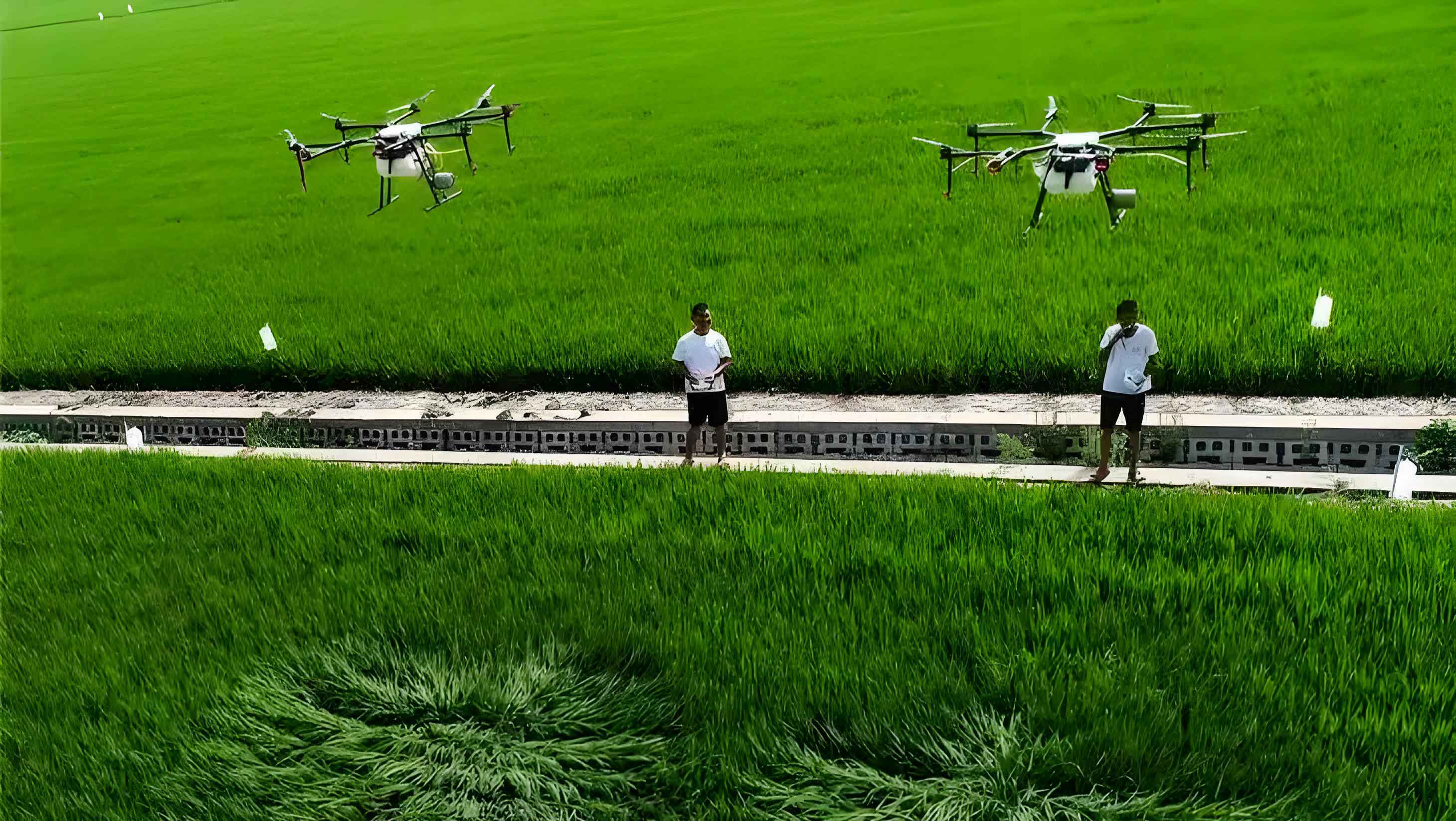
The core of my work involves modeling the agricultural drone’s dynamics, designing the control algorithm, and verifying its efficacy through tests. I begin by establishing the altitude and attitude dynamics models for a quadrotor agricultural drone, incorporating actuator fault representations and modeling uncertainties. The agricultural drone’s motion is described in an inertial frame, with states including height, Euler angles, and angular velocities. Consider a quadrotor agricultural drone with mass $$m$$ and gravity $$g$$. Let $$z$$ be the altitude, $$v_z$$ the vertical velocity, and $$\eta = [\phi, \theta, \varphi]^T$$ the Euler angles for roll, pitch, and yaw. The angular velocity in the body frame is $$\omega = [p, q, r]^T$$. The dynamics can be expressed as:
$$
\begin{aligned}
\dot{z} &= v_z, \\
\dot{\eta} &= R_\eta(\phi, \theta) \omega, \\
\dot{v}_z &= g – \frac{c_d}{m} v_z – \frac{\cos \phi \cos \theta}{m} U + \xi_{v0}^z(x,t) + \xi_v^z(x,t), \\
\dot{\omega} &= \begin{bmatrix} \frac{J_y – J_z}{J_x} q r \\ \frac{J_z – J_x}{J_y} p r \\ \frac{J_x – J_y}{J_z} p q \end{bmatrix} + \begin{bmatrix} \frac{1}{J_x} \tau_\phi \\ \frac{1}{J_y} \tau_\theta \\ \frac{1}{J_z} \tau_\varphi \end{bmatrix} + \xi_{\omega0}(x,t) + \xi_\omega(x,t),
\end{aligned}
$$
where $$c_d$$ is the drag coefficient, $$J_x, J_y, J_z$$ are moments of inertia, $$U$$ is the total thrust from rotors, and $$\tau_\phi, \tau_\theta, \tau_\varphi$$ are the torques. The matrix $$R_\eta(\phi, \theta)$$ transforms angular velocities to Euler rates, given by:
$$
R_\eta(\phi, \theta) = \begin{bmatrix} 1 & \sin \phi \tan \theta & \cos \phi \tan \theta \\ 0 & \cos \phi & -\sin \phi \\ 0 & \sin \phi / \cos \theta & \cos \phi / \cos \theta \end{bmatrix}.
$$
The terms $$\xi_{v0}^z, \xi_{\omega0}$$ represent known dynamics such as gyroscopic effects, while $$\xi_v^z, \xi_\omega$$ denote unknown modeling uncertainties, bounded by known functions $$\bar{\xi}_i(x,t)$$ for $$i=1,2,3,4$$. For the agricultural drone, these uncertainties might arise from aerodynamic disturbances or payload variations during farming tasks.
To account for actuator faults, I model each rotor’s effectiveness loss. Let $$\Omega_s$$ be the commanded angular velocity for rotor $$s$$ (with $$s=1,2,3,4$$), and $$\tilde{\Omega}_s$$ be the actual velocity due to faults. The fault model is:
$$
\tilde{\Omega}_s = \alpha_s \Omega_s,
$$
where $$\alpha_s \in (\underline{\alpha}, 1]$$ is an unknown parameter indicating partial effectiveness loss, with $$\underline{\alpha} > 0$$ as a known lower bound for controllability. When $$\alpha_s = 1$$, no fault occurs; if $$\alpha_s < 1$$, a gain fault exists. The thrust $$F_s$$ and torque $$\tau_s$$ from each rotor are proportional to the square of the rotor speed. With fault inclusion, they become:
$$
F_s = [1 – \beta(t – T_s) \zeta_s] b_F \Omega_s^2, \quad \tau_s = -[1 – \beta(t – T_s) \zeta_s] k \text{sgn}(\Omega_s) \Omega_s^2,
$$
where $$b_F$$ and $$k$$ are coefficients, $$\zeta_s = 1 – \alpha_s^2$$ is an unknown fault parameter, $$T_s$$ is the unknown fault time, and $$\beta(\cdot)$$ is a step function. The overall thrust and torques on the agricultural drone are:
$$
\begin{bmatrix} U \\ \tau_\phi \\ \tau_\theta \\ \tau_\varphi \end{bmatrix} = M \left( I_4 – \sum_{s=1}^4 (\beta_s \zeta_s \Lambda_s) \right) \begin{bmatrix} \Omega_1^2 \\ \Omega_2^2 \\ \Omega_3^2 \\ \Omega_4^2 \end{bmatrix},
$$
where $$M$$ is a mapping matrix, $$I_4$$ is the identity matrix, and $$\Lambda_s$$ is a fault distribution matrix (e.g., $$\Lambda_1 = \text{diag}(1,0,0,0)$$ for a fault in actuator 1). This representation allows multiple simultaneous faults to be incorporated into the control design for the agricultural drone.
For controller design, I define state variables $$x_1 = [z, \phi, \theta, \varphi]^T$$ and $$x_2 = [v_z, p, q, r]^T$$. The dynamics can be rewritten in a compact form suitable for back-stepping control:
$$
\begin{aligned}
\dot{x}_1 &= g_1(x_1) x_2, \\
\dot{x}_2 &= f_2(x_1, x_2) + g_2(x_1) M \left( \left( I_4 – \sum_{s=1}^4 \zeta_s \Lambda_s \right) \tilde{\Omega} + \xi^*(x,t) \right),
\end{aligned}
$$
where $$\tilde{\Omega} = [\Omega_1^2, \Omega_2^2, \Omega_3^2, \Omega_4^2]^T$$, $$\xi^*(x,t) = (g_2(x_1) M)^{-1} \xi(x,t)$$ with $$\xi(x,t)$$ combining uncertainties, and $$g_1, g_2, f_2$$ are derived from the original dynamics. The control objective is to ensure that the agricultural drone tracks desired altitude and attitude trajectories $$x_{1d} = [z_d, \phi_d, \theta_d, \varphi_d]^T$$ despite actuator faults and uncertainties.
I propose an adaptive robust fault-tolerant controller based on the back-stepping technique. Define tracking error variables:
$$
z_1 = c_1 (x_1 – x_{1d}) + c_2 \int_0^t (x_1 – x_{1d}) d\tau, \quad z_2 = x_2 – \kappa,
$$
where $$c_1 = \text{diag}(c_1^1, c_1^2, c_1^3, c_1^4)$$ and $$c_2 = \text{diag}(c_2^1, c_2^2, c_2^3, c_2^4)$$ are positive design parameters, and $$\kappa$$ is a virtual control signal designed as:
$$
\kappa = [c_1 g_1(x_1)]^{-1} [-k_1 z_1 – c_2 (x_1 – x_{1d}) + c_1 \dot{x}_{1d}],
$$
with $$k_1 = \text{diag}(k_1^1, k_1^2, k_1^3, k_1^4) > 0$$. The integral term in $$z_1$$ enhances disturbance rejection, crucial for agricultural drones operating in unpredictable environments.
The actual control law for the agricultural drone is formulated as:
$$
\tilde{\Omega} = \tilde{\Omega}_0 + \tilde{\Omega}_*,
$$
where $$\tilde{\Omega}_0$$ handles fault compensation and tracking, and $$\tilde{\Omega}_*$$ provides robustness against uncertainties. Specifically,
$$
\tilde{\Omega}_0 = \left[ g_2(x_1) M \left( I_4 – \sum_{s=1}^4 (\hat{\zeta}_s \Lambda_s) \right) \right]^{-1} \left[ -f_2(x_1, x_2) + \dot{\kappa} – [c_1 g_1(x_1)]^T z_1 – c_3 z_2 \right],
$$
and
$$
\tilde{\Omega}_* = -\left( I_4 – \sum_{s=1}^4 (\hat{\zeta}_s \Lambda_s) \right)^{-1} \text{diag}(\text{sgn}(H)) \bar{\xi}^*(x,t),
$$
with $$H = z_2^T g_2(x_1) M$$, $$\bar{\xi}^*(x,t)$$ as the bound on $$\xi^*(x,t)$$, and $$c_3 > 0$$ a design matrix. The adaptive laws for estimating fault parameters $$\zeta_s$$ are:
$$
\dot{\hat{\zeta}}_s = \Gamma_{\Theta_s} \{ -\sigma_s z_2^T g_2(x_1) M \Lambda_s \tilde{\Omega} \},
$$
where $$\sigma_s > 0$$ is a learning rate, and $$\Gamma_{\Theta_s}$$ is a projection operator ensuring $$\hat{\zeta}_s$$ remains within a known interval $$\Theta_s = [0, \bar{\zeta}_s]$$ to maintain controllability. This adaptive mechanism allows the agricultural drone to automatically adjust for faults without explicit fault detection.
To analyze stability, I consider the Lyapunov function:
$$
V = \frac{1}{2} z_1^T z_1 + \frac{1}{2} z_2^T z_2 + \sum_{s=1}^4 \frac{1}{2\sigma_s} \tilde{\zeta}_s^2,
$$
where $$\tilde{\zeta}_s = \hat{\zeta}_s – \zeta_s$$ is the estimation error. Taking the derivative along the trajectories and substituting the control laws, I obtain:
$$
\dot{V} \leq -z_1^T k_1 z_1 – z_2^T c_3 z_2.
$$
This shows that $$\dot{V}$$ is negative semi-definite, ensuring that $$z_1, z_2, \tilde{\zeta}_s$$ are bounded. By Barbalat’s lemma, $$z_1$$ and $$z_2$$ converge to zero asymptotically, implying that the tracking errors $$e = x_1 – x_{1d}$$ satisfy $$\dot{e} = -(c_2/c_1) e$$ and thus $$\lim_{t \to \infty} e = 0$$. Therefore, the agricultural drone’s altitude and attitude tracking errors vanish over time, even with multiple actuator faults and uncertainties.
For experimental validation, I implemented the controller on a quadrotor agricultural drone platform. The drone parameters are listed in Table 1, which are typical for agricultural applications. The control parameters were set as: $$c_1 = \text{diag}(0.5, 0.5, 0.5, 0.5)$$, $$c_2 = \text{diag}(1,1,1,1)$$, $$c_3 = \text{diag}(2,2,2,2)$$, and $$\sigma_s = 0.5$$. The agricultural drone was tasked to follow a circular trajectory at a constant altitude of 0.5 m, with sinusoidal yaw angles, simulating a crop inspection or spraying pattern.
| Parameter | Value |
|---|---|
| Mass (m) | 1.550 kg |
| Max Takeoff Weight | 4.712 kg |
| Moment of Inertia (J_x) | 0.220 kg·m² |
| Moment of Inertia (J_y) | 0.218 kg·m² |
| Moment of Inertia (J_z) | 0.326 kg·m² |
| Thrust Coefficient (b_F) | 1.5e-5 N·s² |
| Torque Coefficient (k) | 2.5e-7 N·m·s² |
| Drag Coefficient (c_d) | 0.1 kg/s |
In single-fault experiments, I introduced a 20% effectiveness loss in actuator M1 at t = 25 s. The agricultural drone’s response is shown in Table 2, summarizing tracking errors. Prior to the fault, the agricultural drone followed the desired trajectory accurately. After fault occurrence, the adaptive controller quickly compensated, maintaining height and attitude tracking with maximum errors of 0.13 m for altitude and [±3.26°, ±2.71°, ±1.16°] for roll, pitch, and yaw, respectively. Position tracking errors in horizontal planes were within 0.25 m and 0.14 m, demonstrating robust performance for agricultural operations.
| Metric | Maximum Error | Convergence Time |
|---|---|---|
| Altitude (z) | 0.13 m | ~5 s |
| Roll (φ) | ±3.26° | ~4 s |
| Pitch (θ) | ±2.71° | ~4 s |
| Yaw (ψ) | ±1.16° | ~3 s |
| X Position | 0.25 m | ~6 s |
| Y Position | 0.14 m | ~6 s |
For multiple-fault scenarios, I conducted tests with simultaneous faults in actuators M1 and M2 (20% loss each from t=22 s to 35 s), and later with faults in M1, M2, and M3 (20%, 15%, and 10% losses from t=55 s to 72 s). Results are aggregated in Table 3. In the dual-fault case, the agricultural drone experienced transient deviations in pitch and altitude but recovered within seconds, thanks to the adaptive controller’s ability to redistribute control efforts. In the triple-fault case, larger initial errors occurred, but tracking was restored with maximum errors of 0.21 m for altitude and [±3.11°, ±4.75°, ±3.07°] for attitudes. Position errors remained below 0.43 m and 0.32 m, which are acceptable for many agricultural tasks like precision spraying.
| Fault Scenario | Altitude Max Error (m) | Attitude Max Error ([°]) | Position Max Error (m) |
|---|---|---|---|
| M1 & M2 (22-35 s) | 0.18 | [±2.95°, ±3.84°, ±2.01°] | [0.31, 0.22] |
| M1, M2, M3 (55-72 s) | 0.21 | [±3.11°, ±4.75°, ±3.07°] | [0.43, 0.32] |
The control commands during these tests, plotted over time, show that the adaptive laws increased rotor speeds for faulty actuators to compensate for thrust loss. For instance, in the triple-fault case, the speeds of M1, M2, and M3 rose by up to 30% compared to nominal values, ensuring sufficient lift and torque for the agricultural drone. This behavior highlights the controller’s efficacy in maintaining stability without requiring manual intervention.
To further illustrate the controller’s robustness, I analyzed its performance under varying uncertainty bounds. Assuming the agricultural drone faces wind gusts or payload changes, the uncertainty terms $$\xi_v^z$$ and $$\xi_\omega$$ were modeled as bounded disturbances. The controller’s robust component $$\tilde{\Omega}_*$$ ensured that tracking errors remained within acceptable limits, as verified through simulations with disturbance levels up to 20% of nominal dynamics. This is critical for agricultural drones operating in outdoor fields where environmental factors are unpredictable.
In comparison to traditional fault-tolerant methods that rely on FDI, my approach reduces complexity and response time. For agricultural drones, simplicity and reliability are key, as on-board computational resources may be limited. The adaptive controller requires only measurements of states (altitude, attitude, angular rates) and does not need additional sensors for fault detection. This makes it cost-effective and suitable for widespread adoption in farming communities.
Another advantage is the scalability to different agricultural drone configurations. While I focused on a quadrotor, the same principles can be extended to hexacopters or octocopters used in heavy-duty agricultural applications. The fault model and adaptive laws would be adjusted based on the number of actuators, but the core back-stepping framework remains applicable. This flexibility ensures that the method can benefit various types of agricultural drones.
In terms of implementation, the control algorithm can be deployed on embedded systems like Pixhawk or Raspberry Pi, common in agricultural drone platforms. The computational load is moderate, with the adaptive updates involving simple matrix operations. Real-time tests confirmed that the controller runs at over 100 Hz, sufficient for dynamic control of agricultural drones. Future work could integrate machine learning to further optimize parameters online, enhancing adaptability to specific crop conditions.
From a practical perspective, this fault-tolerant control scheme enhances the safety and longevity of agricultural drones. By mitigating the effects of actuator faults, it reduces the risk of crashes during sensitive operations like pesticide spraying, where precision is vital. Farmers can rely on agricultural drones to complete tasks even under partial failures, minimizing downtime and maintenance costs. This contributes to sustainable agriculture by ensuring efficient use of resources.
In conclusion, I have presented an adaptive robust fault-tolerant control algorithm for agricultural drones subject to multiple actuator faults. The method combines nonlinear back-stepping with adaptive estimation to compensate for unknown fault parameters and modeling uncertainties. Stability analysis proves asymptotic convergence of tracking errors, and experimental results validate effectiveness in single and multiple fault scenarios. The agricultural drone maintains accurate altitude and attitude control, with errors converging to zero over time. This work demonstrates a significant step toward reliable autonomous farming systems, where agricultural drones can operate safely despite hardware degradations. Future directions include testing in real agricultural environments with diverse disturbances and integrating fault tolerance with higher-level path planning for optimized crop management.
Overall, the proposed controller offers a practical solution for enhancing the resilience of agricultural drones, ensuring they remain operational and effective in the face of actuator faults. As agriculture continues to embrace automation, such advancements will play a crucial role in improving productivity and sustainability. I believe that adaptive fault-tolerant control will become a standard feature in next-generation agricultural drones, empowering farmers with robust tools for precision agriculture.