
In recent years, the use of detection equipment in underground mines has become a crucial tool for rescue teams following mining accidents. These systems are designed to monitor environmental parameters in post-disaster scenarios, ensuring that rescue operations are conducted safely and effectively, thereby minimizing human casualties. The quadcopter UAV, with its compact size, low cost, absence of personnel risk, and high flexibility, has seen widespread application in various fields such as target tracking, emergency communication, and environmental monitoring. This research focuses on the development of an intrinsically safe multi-parameter wireless sensor system calibrated for accuracy and deployed on a quadcopter UAV for real-time detection in mine tunnels. The system monitors critical data including temperature, humidity, smoke, O2, CO, CO2, HCl concentrations, and the location of injured personnel, providing early warnings. These data are transmitted in real-time to rescue command centers via Wi-Fi 6 and Mesh networking-based wireless transmission technologies, offering decision-makers reliable information to reduce the likelihood of casualties.
The challenges in mine rescue operations are multifaceted. Firstly, the complex and unstable spatiotemporal evolution of environmental parameters in underground mines poses significant risks to rescue personnel entering hazardous areas. Historical data indicate numerous incidents where rescue teams have suffered casualties due to secondary explosions or exposure to toxic gases. Secondly, rapid acquisition of disaster-related information after events like floods or fires is essential for effective emergency response. However, sending human teams into dangerous zones not only endangers lives but may also delay rescue efforts. Deploying a quadcopter UAV to collect environmental data in these areas allows for scientific command and efficient rescue operations without direct human exposure.
This paper is structured as follows: Section 1 introduces the multi-parameter wireless monitoring technology for mine environments, including sensor calibration and integration. Section 2 explores wireless transmission technologies in confined mine spaces, such as Wi-Fi 6 and Mesh networking. Section 3 details the design of the quadcopter UAV for confined spaces, covering propulsion, power systems, perception, and flight control. Section 4 concludes with a summary and future research directions. Throughout, the term ‘quadcopter’ is emphasized to highlight its central role in this adaptive detection system.
Multi-Parameter Wireless Monitoring Technology for Mine Environments
The intrinsically safe multi-parameter wireless monitoring system for mine environments comprises various sensors, including those for temperature, humidity, smoke, O2, CO, CO2, and HCl, along with LoRa wireless modules, infrared remote control, RF antennas, microprocessors, power supplies, OLED displays, and sensor calibration modules. The hardware architecture of this system is illustrated in Figure 1, which shows the integration of these components for robust data acquisition and transmission.
The detection module incorporates electrochemical sensors for HCl, CO, and O2, which output signals amplified and converted to digital via A/D circuits. Temperature and humidity sensors provide digital outputs using I2C bus communication, while the CO2 non-dispersive infrared sensor transmits data via TTL level to the processor module. These sensors are mounted on the quadcopter and support LoRa wireless networks and serial communication, enabling the formation of a self-organizing, self-healing, multi-hop wireless Mesh network. This network topology offers scalability, redundancy, and robustness for integrated monitoring of smoke, gas, and temperature in mine disaster areas.
Calibration of the sensors is critical to ensure accuracy. Using Keil5 software, calibration programs are written for the STM32 microcontroller and flashed into the chip. An upper-computer software assists in data precision correction to mitigate errors from sensor response signals due to internal and external factors. Sensor errors primarily include data value and sensitivity deviations. The calibration process involves three steps:
- Zero-point calibration: Nitrogen from a standard gas cylinder is introduced to set the sensor baseline. The STM32 microcontroller is connected to a computer via ST-Link for data alignment, adjusting the initial value to zero.
- Concentration calibration: A gas distribution system introduces concentrations at 20%, 40%, 60%, 80%, and 100% of full scale. The sensor readings and actual concentrations are recorded at each step.
- Error correction: The STM32 chip is connected to the computer to modify gas error correction values, deriving a high-fit linear function. This function is converted into programming language and written into the microcontroller to reduce inherent sensor errors.
The linear relationship can be expressed as: $$ y = mx + c $$ where \( y \) is the sensor output, \( x \) is the actual concentration, \( m \) is the sensitivity, and \( c \) is the offset. For instance, during CO sensor calibration, the values are adjusted to minimize deviation, ensuring reliable detection in mine environments. Table 1 summarizes the calibration results for a typical CO sensor, showing the actual concentration versus sensor output before and after calibration.
| Actual Concentration (ppm) | Sensor Output Before Calibration (ppm) | Sensor Output After Calibration (ppm) | Error Reduction (%) |
|---|---|---|---|
| 20 | 22 | 20.1 | 8.6 |
| 40 | 43 | 40.2 | 6.5 |
| 60 | 64 | 60.1 | 6.3 |
| 80 | 85 | 80.3 | 5.5 |
| 100 | 106 | 100.2 | 5.4 |
This calibration process enhances the reliability of the quadcopter-mounted sensors, enabling precise monitoring of hazardous gases in real-time. The integration of these sensors with the quadcopter UAV allows for adaptive detection in dynamic mine environments, where conditions can change rapidly.
Wireless Transmission Technology in Confined Mine Spaces
Wireless transmission in mine tunnels faces challenges due to confined spaces, complex geometries, and potential interference. This research investigates the use of Wi-Fi 6 dedicated wireless systems and Mesh networking to facilitate reliable data communication. The Wi-Fi 6 system, coupled with underground 10-gigabit fiber optic rings, supports various wireless services for intelligent mine operations. Given the harsh underground conditions, such as humidity, fire risks, and explosive atmospheres, the wireless equipment must meet intrinsic safety standards, resist interference, and operate stably.
In mine tunnels, Wi-Fi 6 access points (APs) are deployed every 300–400 meters, each assigned a unique SSID. Based on these SSIDs, VLANs are partitioned, and different QoS levels are allocated to prioritize control data, voice data, and video data. The APs are connected via segmented fiber cascading or fiber optic rings, forming small wireless local area networks that converge into the underground 10-gigabit fiber ring. This setup enables information exchange with the central control room, as illustrated in Figure 3, which depicts the wireless network topology.
The Mesh self-organizing communication system, based on LTE wireless standards, employs OFDM and MIMO technologies. It supports multiple bandwidth allocations and a flat system architecture to reduce latency and improve transmission capacity. Key features include long transmission range, high data throughput, and strong anti-interference capabilities. The system can connect up to 32 nodes, sharing 100 Mb/s bandwidth, and supports video, audio, and control data from UAVs and ground robots. Resources are reused beyond two hops, with support for up to 31 hops and a delay of 10 ms per hop. This allows any two nodes to communicate via multi-hop routing, enabling long-distance and obstructed communication. Frequency hopping technology prevents interference, and the subnet supports splitting and fusion for scalable multi-layer networks. Security is enhanced with identity authentication and encryption methods like ZUC, SNOW3G, and AES.
For electromagnetic wave transmission in the UHF band, higher frequencies result in lower attenuation losses in tunnels. Larger tunnel cross-sections favor wave propagation, and the impact of polarization diminishes with increasing frequency. However, tunnel inclination increases attenuation, particularly at higher frequencies. Table 2 outlines the key parameters of the Mesh networking system.
| Parameter | Specification |
|---|---|
| Maximum Nodes | 32 |
| Bandwidth | 100 Mb/s shared |
| Maximum Hops | 31 |
| Delay per Hop | 10 ms |
| Frequency Bands | 2,408–2,480 MHz, 1,430–1,444 MHz, 806–825 MHz |
| Encryption | ZUC, SNOW3G, AES |
| Communication Modes | Mesh, Point-to-Point, Point-to-Multipoint |
When the quadcopter UAV moves within the mine tunnel, it connects to the nearest node, and communication signals are relayed through adjacent nodes back to the server, enabling remote control of the UAV and robots. This adaptive wireless infrastructure ensures continuous data transmission even in challenging environments, supporting the real-time monitoring capabilities of the quadcopter.
Design of Quadcopter UAV for Confined Spaces
The quadcopter UAV is designed specifically for operation in confined mine spaces, integrating a propulsion system, power distribution, perception systems, and flight control to enable environmental perception and provide wide-field, first-person perspective information for emergency rescue. The compact and agile nature of the quadcopter makes it ideal for navigating narrow tunnels and hazardous areas where human access is limited.
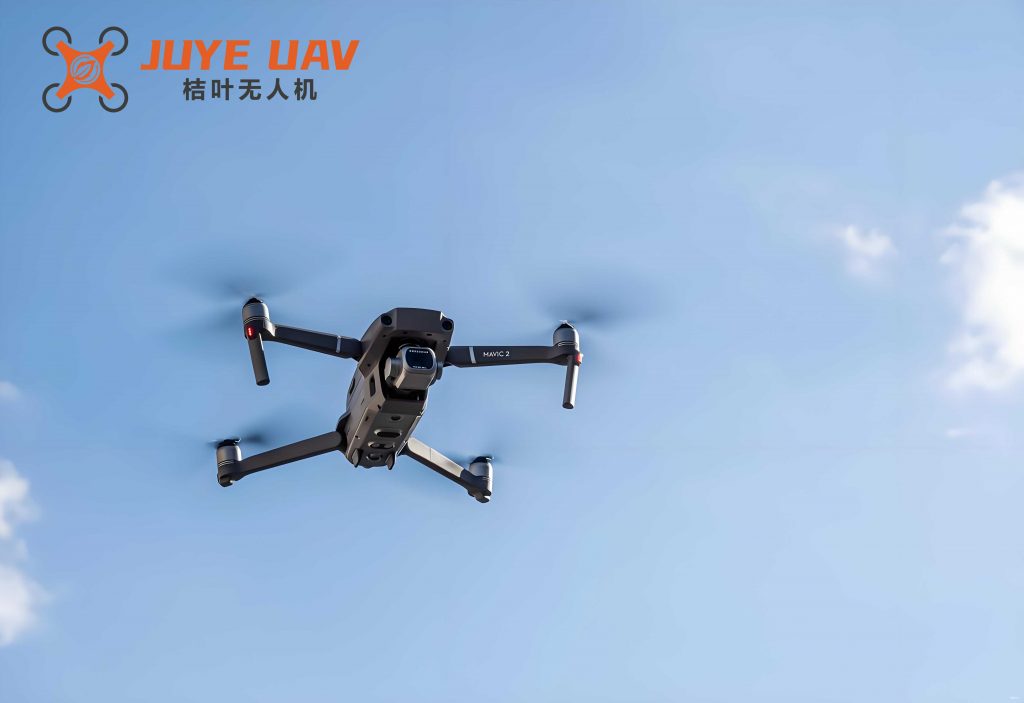
The propulsion system includes propellers, motors, and electronic speed controllers (ESCs). The propellers generate lift to maintain balance, while the motors drive the propellers to provide thrust. The ESCs control motor speed, and all components are modified for intrinsic safety to meet mine explosion-proof requirements, ensuring safe flight in underground confined spaces.
The power distribution system is based on high-capacity, double-suppression explosion-proof batteries. Power from the propulsion system is distributed to the flight control system, dual-light pan-tilt camera, perception system, and communication system. All circuits are adapted for intrinsic safety, ensuring overall system compliance with safety standards.
The perception system consists of an air quality monitoring module, an image acquisition system, and a data processing unit. The air quality module detects hazardous gases like methane and CO, as well as dust concentrations. The image system uses visible-light and infrared thermal imaging cameras mounted on a pan-tilt mechanism for flexible viewing angles. The data processing unit handles image fusion, target detection, and air quality data analysis, enabling hazard prediction.
The flight control system maintains the quadcopter’s attitude balance during flight and transmits real-time status information to the backend monitoring system via the communication system. Operators can send control commands to adjust the camera angles, capture images, and navigate the UAV. For localization and mapping in GPS-denied environments, SLAM (Simultaneous Localization and Mapping) technology is employed, fusing data from multiple sensors like LiDAR and IMU to achieve centimeter-level positioning indoors.
The SLAM process involves three core steps: preprocessing, matching, and map fusion. Initially, environmental data from LiDAR are optimized by filtering out noise or problematic data. Then, current point cloud data are matched to the existing map, with matching accuracy directly impacting map precision. Finally, new LiDAR data are integrated into the map to update it. The mathematical model for point cloud matching can be represented using the Iterative Closest Point (ICP) algorithm, which minimizes the error between point clouds: $$ E(R, t) = \sum_{i=1}^{n} || (R p_i + t) – q_i ||^2 $$ where \( R \) is the rotation matrix, \( t \) is the translation vector, \( p_i \) are source points, and \( q_i \) are target points. This enables the quadcopter to build accurate maps of unknown environments in real-time.
Table 3 summarizes the key components of the quadcopter UAV system.
| Component | Description | Function |
|---|---|---|
| Propulsion System | Propellers, Motors, ESCs | Generate lift and control flight |
| Power System | Explosion-proof Batteries, Distributor | Supply power to all subsystems |
| Perception System | Gas Sensors, Cameras, Processor | Monitor environment and detect hazards |
| Flight Control | IMU, SLAM Algorithms | Maintain stability and enable navigation |
| Communication | Wi-Fi 6, Mesh Modules | Transmit data to command center |
By leveraging these technologies, the quadcopter UAV can autonomously navigate mine tunnels, collect critical data, and provide real-time insights for rescue operations, significantly enhancing safety and efficiency.
Conclusion
This research presents an adaptive detection system based on a quadcopter UAV for mine disaster environments, integrating multi-parameter wireless sensors, advanced wireless transmission, and autonomous navigation. The system addresses the challenges of hazardous mine conditions by enabling real-time monitoring of environmental parameters without risking human lives. The quadcopter’s flexibility and the robustness of the wireless network ensure reliable data acquisition and transmission, supporting informed decision-making in rescue operations.
Future work will focus on enhancing the quadcopter’s autonomy through improved AI algorithms for hazard prediction and path planning. Additionally, expanding the sensor suite to include more parameters and optimizing the Mesh network for larger-scale deployments will further increase the system’s effectiveness. The continuous development of quadcopter-based solutions holds great promise for revolutionizing mine safety and emergency response.