
In recent years, unmanned systems have gradually replaced humans in performing specific tasks. Particularly in the military field, quadrotor UAVs have achieved remarkable success and are poised to become core weapons in future warfare, with immeasurable development prospects. Multi-quadrotor UAV formation is a prominent representative of unmanned systems, playing a crucial role in both military and civilian fields. Over the past decade, multi-quadrotor UAV collaboration has been applied in many areas. Among these, quadrotor UAV formation plays a key role in completing complex tasks, such as cooperative reconnaissance, target tracking, and coordinated operations in combat scenarios. In localized conflict scenarios, deploying large aircraft alongside small quadrotor UAV formations in carefully planned airspace and maintaining tight cooperative formation operations is a critical strategy. This tactical layout not only enables efficient task allocation but also lays a solid foundation for precise target strikes. Quadrotor UAV formation tracking refers to multiple UAVs tracking a target or reference trajectory in real-time while maintaining a pre-defined formation configuration. This is an important aspect of multi-quadrotor UAV cooperative control and a current research hotspot, widely used in military and civilian applications, such as bombing missions in military operations and material transport in rescue missions.
Quadrotor UAV formation control often employs various algorithms, including leader-follower, virtual structure, and behavior-based methods. However, many existing approaches only consider tracking accuracy and robustness, while formation maintenance requires further research. This paper addresses issues such as model uncertainties, external disturbances, and formation maintenance in quadrotor UAV formation control by proposing a multi-UAV formation control algorithm. A multi-directional communication structure is designed, where follower UAVs communicate with multiple surrounding UAVs and use weighted summation to compute their desired paths. Each quadrotor UAV employs an identical controller, divided into inner and outer loop control. The outer loop is a position loop that uses an adaptive RBF neural network sliding mode controller to approximate and compensate for total system disturbances, enhancing robustness. The inner loop is an attitude loop that employs a super-twisting sliding mode controller to eliminate chattering and ensure UAV stability. Simulation results demonstrate that the proposed algorithm effectively maintains quadrotor UAV formation shape while performing trajectory tracking tasks, with excellent formation stability and tracking performance.
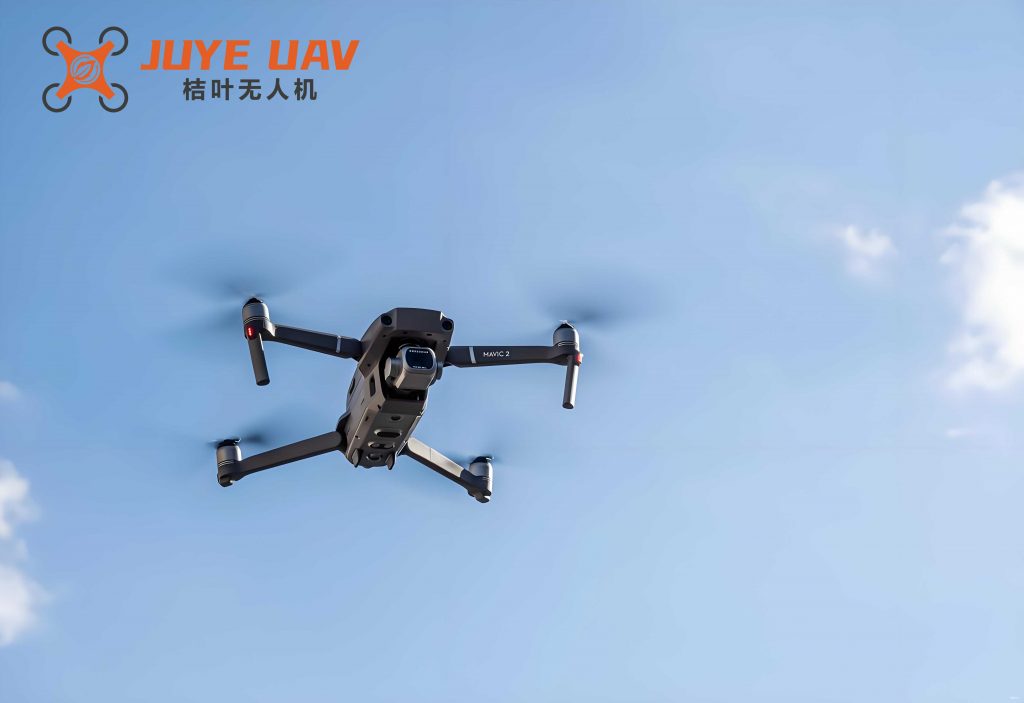
The quadrotor UAV physical model consists of four inputs, corresponding to the lift forces $F_1$ to $F_4$ generated by the four rotors $R_1$ to $R_4$, and six degrees of freedom, including the position vector $(x, y, z)$ in the inertial frame $O_e$ and the attitude vector $(\phi, \theta, \psi)$ in the body frame $O_b$. Using the Newton-Euler equations, the mathematical model of the quadrotor UAV is derived as:
$$
\begin{aligned}
\ddot{x} &= \frac{1}{m} U_1 (\cos \phi \sin \theta \cos \psi + \sin \phi \sin \psi) + f_x \\
\ddot{y} &= \frac{1}{m} U_1 (\cos \phi \sin \theta \sin \psi – \sin \phi \cos \psi) + f_y \\
\ddot{z} &= \frac{1}{m} (U_1 \cos \phi \cos \theta – m g) + f_z \\
\ddot{\phi} &= \frac{1}{I_x} [U_2 + (I_y – I_z) \dot{\theta} \dot{\psi}] \\
\ddot{\theta} &= \frac{1}{I_y} [U_3 + (I_z – I_x) \dot{\phi} \dot{\psi}] \\
\ddot{\psi} &= \frac{1}{I_z} [U_4 + (I_x – I_y) \dot{\phi} \dot{\theta}]
\end{aligned}
$$
where $m$ is the mass of the quadrotor, $I_x$, $I_y$, $I_z$ are the moments of inertia about the body axes, $g$ is the gravitational acceleration, $f_x$, $f_y$, $f_z$ represent external disturbance forces in the $x$, $y$, $z$ directions, $U_1$ is the position control input, and $U_2$, $U_3$, $U_4$ are the attitude control inputs. For controller design, virtual control inputs $u_x$, $u_y$, $u_z$ are defined to simplify the position subsystem:
$$
\begin{aligned}
u_x &= \frac{1}{m} U_1 (\cos \phi \sin \theta \cos \psi + \sin \phi \sin \psi) \\
u_y &= \frac{1}{m} U_1 (\cos \phi \sin \theta \sin \psi – \sin \phi \cos \psi) \\
u_z &= \frac{1}{m} U_1 \cos \phi \cos \theta
\end{aligned}
$$
Thus, the position subsystem model simplifies to:
$$
\begin{aligned}
\ddot{x} &= u_x + f_x \\
\ddot{y} &= u_y + f_y \\
\ddot{z} &= u_z + f_z – g
\end{aligned}
$$
For the quadrotor UAV formation model, a communication topology based on graph theory and leader-follower algorithms is designed. For example, in a formation of four quadrotor UAVs, UAV 1 is the leader, and UAVs 2-4 are followers. The leader UAV follows a desired trajectory and transmits its position information to the followers, while followers communicate with each other to compute their desired positions. The desired position for a follower UAV $i$, denoted as $D_i(x_i, y_i, z_i)$, is calculated using a weighted sum:
$$
D_i = p_L D_L + p_G \frac{1}{m-2} \sum_{K=1}^{m-2} D_K
$$
where $D_L(x_L, y_L, z_L)$ is the position desired by the leader for UAV $i$, $D_K(x_K, y_K, z_K)$ is the position desired by other followers, $p_G$ is the follower weight, $p_L$ is the leader weight, and $p_L + p_G = 1$. This multi-directional communication structure enhances robustness and flexibility. The formation considers direction, meaning the formation orientation aligns with the movement direction. Given a reference point $A(x_a, y_a, z_a)$ with velocity direction angle $\gamma$ relative to $X_e$, and relative position coordinates $(x_l, y_l, z_l)$, the desired position $B(x_b, y_b, z_b)$ is computed as:
$$
\begin{aligned}
x_b &= x_l \cos \gamma – y_l \sin \gamma + x_a \\
y_b &= x_l \sin \gamma + y_l \cos \gamma + y_a \\
z_b &= z_l + z_a
\end{aligned}
$$
The control system for each quadrotor UAV is divided into inner and outer loops. The outer loop is the position loop, which uses an adaptive RBF neural network sliding mode controller. Define position errors:
$$
\begin{aligned}
e_x &= x_d – x \\
e_y &= y_d – y \\
e_z &= z_d – z
\end{aligned}
$$
Sliding mode functions are defined as:
$$
\begin{aligned}
s_x &= c_x e_x + \dot{e}_x \\
s_y &= c_y e_y + \dot{e}_y \\
s_z &= c_z e_z + \dot{e}_z
\end{aligned}
$$
where $c_x$, $c_y$, $c_z$ are positive constants. The reaching laws are:
$$
\begin{aligned}
\dot{s}_x &= -\eta_x \text{sat}(s_x) – k_x s_x \\
\dot{s}_y &= -\eta_y \text{sat}(s_y) – k_y s_y \\
\dot{s}_z &= -\eta_z \text{sat}(s_z) – k_z s_z
\end{aligned}
$$
where $\text{sat}(\cdot)$ is the saturation function, and $\eta_x$, $\eta_y$, $\eta_z$, $k_x$, $k_y$, $k_z$ are positive constants. The control laws are derived as:
$$
\begin{aligned}
u_x &= \eta_x \text{sat}(s_x) + k_x s_x + c_x \dot{e}_x + \ddot{x}_d – \hat{f}_x \\
u_y &= \eta_y \text{sat}(s_y) + k_y s_y + c_y \dot{e}_y + \ddot{y}_d – \hat{f}_y \\
u_z &= \eta_z \text{sat}(s_z) + k_z s_z + c_z \dot{e}_z + \ddot{z}_d – \hat{f}_z + g
\end{aligned}
$$
where $\hat{f}_x$, $\hat{f}_y$, $\hat{f}_z$ are estimates of the disturbances. The total thrust $U_1$ is computed as:
$$
U_1 = \sqrt{u_x^2 + u_y^2 + u_z^2}
$$
To enhance disturbance rejection and reduce chattering, an RBF neural network is incorporated for disturbance estimation. For estimating $f_x$, a “2-5-1” network structure is used, with inputs $x_r$, hidden layer outputs $h_{xj}$, and output $\hat{f}_x$. The Gaussian basis function is:
$$
h_{xj} = \exp\left( -\frac{\|x_r – c_{xj}\|^2}{2b_x^2} \right), \quad j = 1, 2, 3, 4, 5
$$
where $c_{xj}$ is a constant vector and $b_x$ is a constant scalar. The output is:
$$
\hat{f}_x = \hat{w}_x^T h_x
$$
with the adaptive law:
$$
\dot{\hat{w}}_x = -\beta_x s_x h_x
$$
where $\beta_x$ is a positive constant. Similarly, $\hat{f}_y$ and $\hat{f}_z$ are estimated. The stability of the position subsystem is analyzed using Lyapunov theory. Define the Lyapunov function:
$$
V_x = \frac{1}{2} s_x^2 + \frac{(\hat{w}_x – W_x)^T (\hat{w}_x – W_x)}{2\beta_x}
$$
where $W_x$ is the ideal weight. The derivative is:
$$
\dot{V}_x = s_x \dot{s}_x + \frac{(\hat{w}_x – W_x)^T \dot{\hat{w}}_x}{\beta_x}
$$
Substituting the expressions, it can be shown that $\dot{V}_x \leq 0$, ensuring stability. The same applies to the $y$ and $z$ directions.
The inner loop is the attitude loop, which uses a super-twisting sliding mode controller to eliminate chattering. The desired roll angle $\phi_d$ and pitch angle $\theta_d$ are derived from the position control outputs and desired yaw angle $\psi_d$:
$$
\begin{aligned}
\tan \theta_d &= \frac{u_x \cos \psi_d + u_y \sin \psi_d}{u_z} \\
\tan \phi_d &= \frac{(u_x \sin \psi_d – u_y \cos \psi_d) \cos \theta_d}{u_z}
\end{aligned}
$$
Define attitude errors:
$$
\begin{aligned}
e_\phi &= \phi_d – \phi \\
e_\theta &= \theta_d – \theta \\
e_\psi &= \psi_d – \psi
\end{aligned}
$$
Sliding mode functions are:
$$
\begin{aligned}
s_\phi &= c_\phi e_\phi + \dot{e}_\phi \\
s_\theta &= c_\theta e_\theta + \dot{e}_\theta \\
s_\psi &= c_\psi e_\psi + \dot{e}_\psi
\end{aligned}
$$
The super-twisting reaching laws are:
$$
\begin{aligned}
\dot{s}_\xi &= -\eta_\xi |s_\xi|^{1/2} \tanh(s_\xi) – v_\xi – k s_\xi \\
\dot{v}_\xi &= \alpha_\xi \tanh(s_\xi) \\
\dot{\eta}_\xi &=
\begin{cases}
\frac{\omega \sigma}{2} \tanh(s_\xi – \mu) & \text{if } s_\xi > s_m \\
0 & \text{if } s_\xi \leq s_m
\end{cases} \\
\alpha_\xi &= \eta_\xi \varepsilon + \frac{1}{2} (\tau + 4\varepsilon^2)
\end{aligned}
$$
where $\xi = \phi, \theta, \psi$, and $k$, $\omega$, $\sigma$, $\mu$, $s_m$, $\varepsilon$, $\tau$ are positive constants. The control laws are:
$$
\begin{aligned}
U_2 &= I_x \left( c_\phi \ddot{\phi}_d + \eta_\phi |s_\phi|^{1/2} \tanh(s_\phi) + v_\phi + k s_\phi – \frac{(I_y – I_z) \dot{\theta} \dot{\psi}}{I_x} \right) \\
U_3 &= I_y \left( c_\theta \ddot{\theta}_d + \eta_\theta |s_\theta|^{1/2} \tanh(s_\theta) + v_\theta + k s_\theta – \frac{(I_z – I_x) \dot{\phi} \dot{\psi}}{I_y} \right) \\
U_4 &= I_z \left( c_\psi \ddot{\psi}_d + \eta_\psi |s_\psi|^{1/2} \tanh(s_\psi) + v_\psi + k s_\psi – \frac{(I_x – I_y) \dot{\phi} \dot{\theta}}{I_z} \right)
\end{aligned}
$$
Stability proof for the attitude controller follows existing literature on super-twisting algorithms.
Simulation studies are conducted to validate the proposed control algorithm for quadrotor UAV formation. The formation consists of four quadrotor UAVs with identical parameters and controllers, in a “line” formation. The leader UAV is on the left, followed by three followers. The quadrotor parameters and disturbances are summarized in Table 1.
| Parameter | Value |
|---|---|
| Mass $m$ (kg) | 1 |
| Gravity acceleration $g$ (m/s²) | 9.8 |
| Moments of inertia $I_x$, $I_y$ (kg·m²) | 0.004 |
| Moment of inertia $I_z$ (kg·m²) | 0.008 |
| Disturbance parameters $f_x$, $f_y$, $f_z$ (N) | $\sin t$ |
| Leader desired trajectory | $x_d = 2\sin t$, $y_d = 2\cos t$, $z_d = t$ |
| UAV spacing (m) | 0.4 |
| Desired yaw angle $\psi_d$ (rad) | $\sin t$ |
Controller parameters are set as follows: position controller parameters $c = 0.6$, $\eta = 5$, $k = 2$. RBF neural network parameters $c_x = c_y = c_z = [1, 1]^T [-1, -0.5, 0, 0.5, 1]$, $b_x = b_y = b_z = 5$, $\beta_x = \beta_y = \beta_z = 4$. Attitude controller parameters $c_\phi = c_\theta = c_\psi = 50$, $k = 30$, $\omega = 1$, $\sigma = 2$, $\mu = 0.1$, $s_m = 0.01$, $\varepsilon = 1.25$, $\tau = 8.25$. Initial positions and attitudes of the quadrotor UAV formation are shown in Table 2.
| Parameter | Leader | Follower 1 | Follower 2 | Follower 3 |
|---|---|---|---|---|
| Position (m) | (2, 2, 0) | (1.7, 1.7, 0) | (1.25, 1.25, 0) | (0.85, 0.85, 0) |
| Velocity (m/s) | (0, 0, 0) | (0.3, 0.3, 0) | (0.2, 0.2, 0) | (0.1, 0.1, 0) |
| Attitude angles (°) | (0, 0, 0) | (10, 10, 10) | (20, 20, 20) | (30, 30, 30) |
| Angular velocity (°/s) | (0, 0, 0) | (0, 0, 0) | (0, 0, 0) | (0, 0, 0) |
The RBF neural network disturbance prediction results for accelerations in $x$, $y$, $z$ directions show that the network achieves accurate prediction within 2 seconds. Follower quadrotor UAV position tracking results indicate that all followers accurately track the trajectory within 2.5 seconds. The formation flight trajectory demonstrates that the quadrotor UAV formation maintains the desired shape. Attitude tracking curves show that all UAVs achieve accurate attitude tracking within 2.5 seconds, with roll and pitch angles oscillating within approximately ±10°, ensuring stable flight. Controller outputs remain smooth without significant chattering, validating the effectiveness of the control algorithm in suppressing chattering. The distances between follower quadrotor UAVs during flight stabilize after 10 seconds, indicating excellent formation maintenance compared to existing methods where distances continuously fluctuate.
In conclusion, this paper addresses model uncertainties, external disturbances, and formation maintenance in quadrotor UAV formation control by proposing a multi-UAV formation control algorithm. A multi-directional communication structure reduces the negative impact of individual UAV deviations on the overall formation. Position control incorporates an adaptive RBF neural network with sliding mode control for precise position control and compensation of uncertainties and disturbances. The attitude loop uses a super-twisting sliding mode controller to eliminate chattering and ensure quadrotor stability. Simulation results verify that the proposed formation algorithm enables multi-quadrotor UAVs to maintain formation shape while performing trajectory tracking, with excellent formation maintenance and tracking performance, and stable flight for each UAV.