
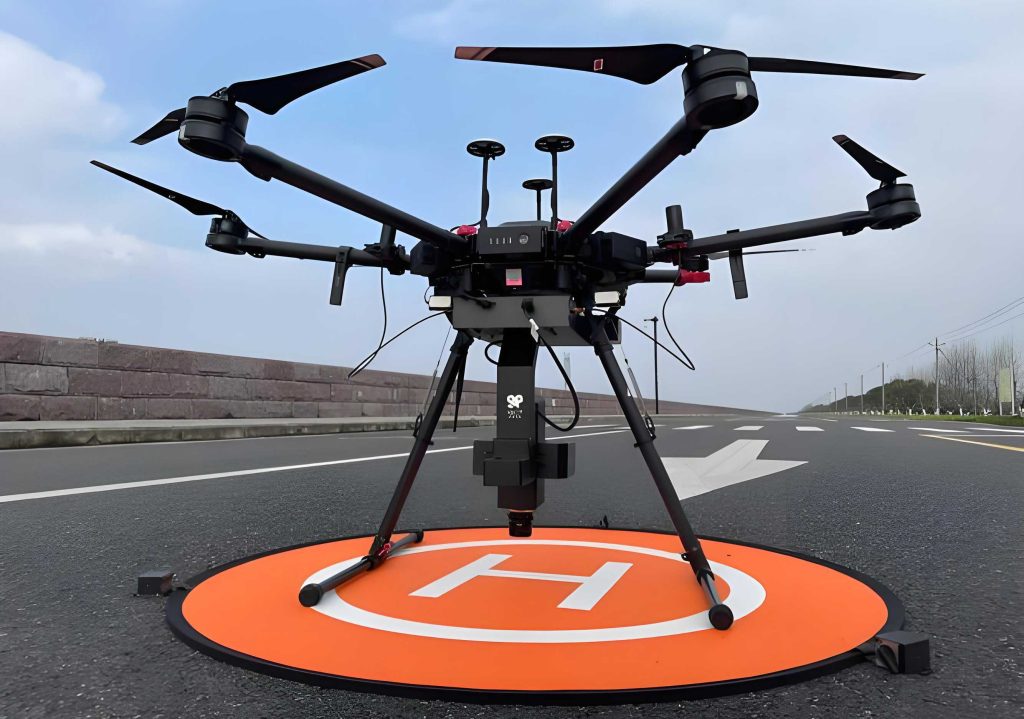
The rapid ascent of the low-altitude economy, propelled by technological convergence and strategic policy initiatives, has positioned civilian UAV drones as quintessential carriers of this new economic form. These systems, representing a deep fusion of artificial intelligence and aviation technology, are unlocking unprecedented applications across logistics, agriculture, emergency response, and infrastructure inspection. However, this rapid expansion brings to the fore a critical and complex challenge: the governance of risks associated with UAV drone high-altitude falls. Unlike traditional torts, the侵权liability stemming from a falling UAV drone presents a multi-layered, cascading risk architecture that spans from individual harms to threats against national security. This paper argues that the governance of UAV drone fall risks necessitates a paradigm shift beyond traditional, reactive legal liability models. It proposes a proactive, integrated “Technology-Law-Insurance” trinity governance framework, anchored in the dynamic equilibrium between safety and innovation, to foster the secure and high-quality development of the low-altitude economy.
I. The Tripartite Risk Architecture of UAV Drone High-Altitude Falls
The侵权consequences of a UAV drone plummeting from the sky are not monolithic; they propagate through three distinct yet interconnected tiers of legal interests and societal values. This creates a “personal-public-national” and “personality rights-property rights-national security” progressive risk architecture.
A. Infringement of Personality Rights: Compound Impact on Life and Health
The kinetic energy of a falling UAV drone, governed by the physics of mass and velocity, poses a severe threat to human life and bodily integrity. Even lighter-weight consumer UAV drone models can attain dangerous momentum. The potential harm ranges from lacerations and fractures to catastrophic, life-threatening injuries. Furthermore, a UAV drone fall in a crowded public space can trigger mass panic and stampedes, transforming a single equipment failure into a public safety incident, thereby infringing upon the collective right to public safety.
B. Infringement of Property Rights: Cascading Crisis for Low-Altitude Infrastructure
The property damage from a UAV drone fall is threefold, as summarized in the table below:
| Damage Type | Description | Example |
|---|---|---|
| Internal Property Loss | Destruction of the UAV drone itself and loss of collected data. | UAV drone解体and loss of aerial survey data. |
| Direct External Property Loss | Damage to ground-based assets (private property, public infrastructure). | A UAV drone crashing into a vehicle, building window, or power line. |
| Indirect Consequential Loss | Financial losses arising from the direct damage (business interruption, loss of profits). | Closure of a sports stadium after a UAV drone crash, leading to event cancellations and revenue loss. |
The potential for chain-reaction failures, especially involving critical infrastructure, elevates the property risk profile of UAV drone operations significantly.
C. Compound Threats to National Security
The most profound risk escalation occurs when a UAV drone fall intersects with sensitive domains. A UAV drone falling into a nuclear facility, a military base, or causing a mid-air collision with a manned aircraft constitutes a direct threat to national security and sovereignty. Moreover, the data payload of a fallen UAV drone—containing geospatial imagery, sensor data, or communications—can compromise state secrets or critical infrastructure information. The unpredictability of such incidents also tests national emergency response and crisis management capabilities, encompassing aspects of airspace sovereignty, data security, and public order.
II. Governance Dilemmas in Mitigating UAV Drone Fall Risks
The traditional侵权law framework, built on identifiable human actors and linear causation, struggles to adapt to the novel challenges posed by intelligent, autonomous UAV drone systems. The core governance dilemmas manifest across the four elements of侵权liability.
A. Subject of Liability: The Trilemma in the Age of Autonomy
Identifying the liable party is complicated by the “human-machine separation” and the intervention of “black-box” AI algorithms. The liable entity could be the remote pilot/owner (the operator), the manufacturer of the UAV drone hardware, the developer of the flight control software/algorithm, or the data service provider. Current laws like civil codes and aviation statutes typically point to the “operator” or “owner,” but this becomes ambiguous when an algorithm’s erroneous decision—not the pilot’s input—causes the fall. The “control theory” and “benefit theory” offer conflicting guidance when control is shared or ceded to autonomous systems.
B. Object of Infringement: Doctrinal Contention Over Airspace Rights
The legal nature of the airspace through which a UAV drone flies is itself a subject of debate, affecting liability foundations. The primary doctrines are:
- Public Resource Doctrine: Airspace is a public resource owned by the state on behalf of the people.
- Spatium Usus Doctrine (Easement): Airspace rights are usufructuary, granting temporary usage rights.
- Dynamic Property Rights Doctrine: Airspace rights are a bundle of dynamically allocated use rights.
This ambiguity complicates the legal basis for a UAV drone‘s right to fly and the nature of the legal interest infringed upon when it falls. Furthermore, the UAV drone as a data-gathering platform creates conflicts with new legal interests like data privacy and trade secrets, adding layers of complexity to the侵权object.
C. Act of Infringement: Time Compression and Attribution Challenges
The act of a UAV drone falling is often the result of a complex, instantaneous failure chain involving hardware malfunction, software bug, communication link loss, or algorithmic error. This “time compression effect” contrasts sharply with traditional torts, where acts and consequences are more protracted and directly traceable to human fault. The table below highlights key differences:
| Aspect | Traditional Tort (e.g., Building Collapse) | UAV Drone Fall Tort |
|---|---|---|
| Primary Cause | Human negligence (poor maintenance, flawed design). | Complex system failure (hardware/software/network/algorithm). |
| Intervention of AI | Minimal or none. | Central; algorithmic decision-making can be primary cause. |
| Predictability & Prevention | Regular inspection and maintenance are effective. | Prevention requires rigorous technical standards and testing; inspections are less effective for real-time software faults. |
Legislative lag exacerbates this. Regulations heavily focus on public law aspects (airspace classification, registration) but lack detailed private law rules for damage quantification, causation, and liability apportionment specific to UAV drone falls.
D. Causation: Multi-Causal Chains and the Burden of Proof Reconstruction
Establishing a direct, proximate causal link between a specific actor’s conduct and the fall is extraordinarily difficult. The causation chain may involve: Pilot error + Signal interference + Algorithmic failure in emergency procedure. The victim faces a near-insurmountable evidentiary burden to unravel this “black box.” Should the burden shift to the UAV drone operator or manufacturer under a strict liability or presumptive fault rule? Current judicial practice lacks uniformity. The problem is compounded when claiming damages for business interruption or loss of public infrastructure utility, where valuation standards are unclear.
III. The Trinity Governance Paradigm: Technology, Law, and Insurance
To overcome these dilemmas and steward the low-altitude economy towards secure innovation, a synergistic paradigm integrating three pillars is essential. This paradigm is guided by the core principle of maintaining a dynamic balance between safety and innovation.
A. Technology Governance: Digital Airspace and Intelligent Risk Prevention
Technology must be leveraged to govern technology. This involves encoding legal and safety requirements into the UAV drone system’s very operation.
1. Enhanced Technical Supervision Paths: Implement a unified, mandatory national registration system for all UAV drones above a minimal risk threshold, using unique digital identifiers (akin to VINs for cars). Integrate technologies like Beidou Grid Codes for precise, real-time location tracking and post-incident forensic analysis. This enables swift linking of a fallen UAV drone to its registered owner/operator.
2. Regulatory Sandboxes for Innovation: Establish controlled testing environments in designated areas. Companies can trial new UAV drone technologies, flight patterns, and risk-mitigation systems under regulatory supervision. This allows for evidence-based policy evolution and standard-setting before widespread deployment.
3. Standardization and “Lawification” of Technical Standards: Develop comprehensive, mandatory technical standards covering not only hardware durability but also software reliability, algorithm robustness (e.g., fail-safe behaviors), and data security. A critical step is the “lawification” of these standards—elevating key technical specifications into legally binding requirements to bridge the gap between engineering norms and judicial enforcement.
B. Legal Governance: Dynamic Adaptation of the Liability Framework
The law must evolve from static rules to a dynamic framework that adapts to the “low, slow, small, and numerous” characteristics of UAV drones.
1. Building a Dynamic Safety Concept Guided by Legal Governance: Move beyond one-size-fits-all regulation. Adopt a risk-based, classified management approach for UAV drones, similar to data classification. Flight permissions and operational constraints should be proportionate to the UAV drone‘s risk level (based on weight, speed, operational purpose, and technical capabilities). This balances open access for low-risk applications (e.g., micro-drones in rural areas) with strict control for high-risk operations.
2. Refining the Liability and Proof Framework:
- For Operators/Pilots: Apply a presumption of fault. The operator is presumed liable for a fall unless they can prove they adhered to all regulations, maintained the UAV drone properly, and the incident was due to a latent defect or force majeure. This is represented as:
$$ L_o = \begin{cases} 0, & \text{if } P_{compliance} \land (P_{defect} \lor P_{forcemajeure}) \\ 1, & \text{otherwise} \end{cases} $$
Where $L_o$ is operator liability (1=liable, 0=not), $P_{compliance}$ is proof of regulatory compliance, $P_{defect}$ is proof of product defect, and $P_{forcemajeure}$ is proof of force majeure. - For Manufacturers/Developers: Apply strict liability under product liability law. They are liable for defects in design, manufacturing, or algorithm that cause the fall, with very limited defenses. Their liability $L_m$ is triggered by the existence of a defect $D$ causing harm $H$:
$$ L_m = 1 \quad \text{if} \quad D \rightarrow H $$
3. Algorithmic Accountability and “Black-Box” Access: Legislatively mandate that developers of autonomous UAV drone systems maintain and provide, upon court order, “explainability logs” or access to simulation environments to help reconstruct the algorithm’s decision-making process prior to a crash.
C. Economic Leverage: Risk Socialization through Insurance and Funds
Financial mechanisms are crucial for distributing risk costs across society, ensuring victim compensation, and maintaining industry viability.
1. Differentiated Insurance Products: Develop a spectrum of insurance products tailored to UAV drone risks, moving beyond basic hull and liability insurance. Key products should include:
| Insurance Type | Coverage Focus | Targeted Risk |
|---|---|---|
| Mandatory Third-Party Liability | Bodily injury & property damage to third parties. | Core public risk from any UAV drone operation. |
| Cyber/Data Breach Liability | Losses from data compromise after a UAV drone fall. | Privacy and data security infringement. |
| Business Interruption | Lost profits for businesses damaged by a fall. | Indirect consequential losses. |
| “Counter-UAV” Operations Liability | Damage caused during lawful interception of rogue drones. | Risks from enforcing airspace security. |
Premiums should be risk-adjusted based on UAV drone type, operator track record, and operational environment.
2. National Compensation Fund: Establish a state-backed fund, financed by levies on UAV drone manufacturers, operators, and service providers. This fund acts as a financial backstop for catastrophic incidents where damages exceed insurance coverage or where the liable party is insolvent. It also serves as an “innovation accelerator,” providing grants or subsidies for R&D in safety-critical technologies like parachute systems or geo-fencing. The fund’s role $F$ can be modeled as covering residual loss $R$ after insurance $I$:
$$ F = max(0, R – I) $$
3. Complementary Insurance-Fund Model: The system should be designed for complementarity. Commercial insurance handles predictable, quantifiable risks, fostering market discipline. The national fund addresses systemic, catastrophic, or uninsurable risks, ensuring societal resilience and embodying the protective function of the state within the new举国体制for strategic industries.
Conclusion
The high-altitude fall of a civilian UAV drone is a paradigmatic risk of the low-altitude economy era, characterized by high technological dependence, high public relevance, and high governance complexity. Traditional, siloed approaches to risk management are inadequate. This analysis has delineated the tripartite risk architecture and the multifaceted governance dilemmas concerning liability subjects, objects, acts, and causation. In response, a forward-looking, integrated governance paradigm is proposed. This “Technology-Law-Insurance” trinity framework operates on the principle of dynamic safety-innovation equilibrium. It seeks to harden safety through technical governance, ensure justice and adaptability through dynamic legal governance, and guarantee economic resilience and promote innovation through risk-socializing economic governance. The synergistic operation of these three pillars is essential to navigate the inherent tensions of the low-altitude economy, safeguarding individual rights, public safety, and national security while unlocking the immense socio-economic potential of UAV drone technology.