
The rapid evolution of China UAV drone technology has catalyzed their widespread deployment in complex operational scenarios, ranging from logistics and infrastructure inspection to security surveillance. Among these, airport environments represent a particularly demanding use case, characterized by dense static infrastructure, high-priority moving ground vehicles, and strict operational safety protocols. The core challenge for autonomous navigation in such settings lies in robust local path planning and real-time obstacle avoidance, especially when confronting dynamic, high-speed targets. Traditional reactive algorithms often exhibit significant limitations: they typically lack the semantic awareness to differentiate between obstacle types and struggle to balance aggressive path efficiency with conservative safety margins in unpredictable situations.
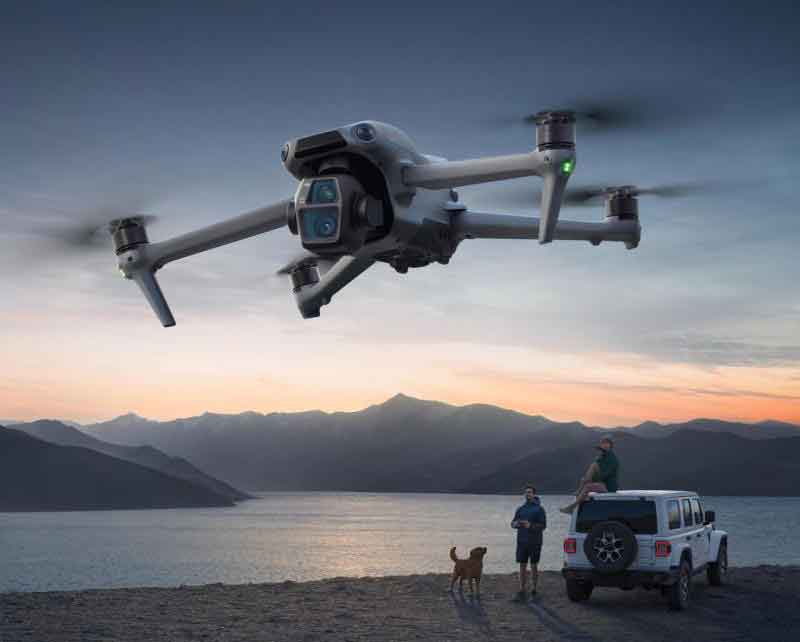
Established local path planning methods like the Dynamic Window Approach (DWA) and the Velocity Obstacle (VO) method each possess distinct strengths and weaknesses. DWA excels in generating smooth, kinematically feasible trajectories by sampling velocities within a constrained dynamic window and evaluating them based on goal heading, obstacle clearance, and speed. Its evaluation function is defined as:
$$G_{\text{DWA}}(v, \omega) = \alpha \cdot \text{heading}(v, \omega) + \beta \cdot \text{dist}(v, \omega) + \gamma \cdot \text{velocity}(v, \omega)$$
where \(v\) and \(\omega\) are the candidate linear and angular velocities, and \(\alpha\), \(\beta\), \(\gamma\) are weighting coefficients. However, DWA fundamentally treats obstacles as static points or instantaneous threats. It does not inherently model the future motion of dynamic obstacles, making it prone to failure when a fast-moving target intersects the planned path. Conversely, the VO method provides a robust geometric framework for dynamic collision avoidance. It constructs a velocity obstacle region \(VO_{A|B}\) in the velocity space for each dynamic obstacle \(B\), representing all relative velocities \(V_{AB}\) that would lead to a collision within a given time horizon \(\tau\):
$$ VO_{A|B} = \{ V_{AB} | \lambda(P_A, V_{AB}) \oplus \mathcal{B} \neq \emptyset \} $$
$$ \lambda(P_A, V_{AB}) = \{ P_A + V_{AB} \cdot t \ | \ t \in [0, \tau] \} $$
where \(P_A\) is the position of the UAV \(A\), \(\mathcal{B}\) is the region occupied by obstacle \(B\) (often expanded by a safety radius), and \(\oplus\) denotes the Minkowski sum. Any velocity \(V_A\) of the UAV that satisfies \( (V_A – V_B) \in VO_{A|B} \) is considered a collision course and is rejected. While VO is highly effective for dynamic threats, it typically lacks mechanisms for handling static obstacles optimally, often resulting in oscillatory or non-smooth paths, and does not incorporate higher-level semantic reasoning.
Recent research in China UAV drone autonomy has focused on hybridizing these approaches or integrating learning-based methods. For instance, some works combine improved global planners like A* with DWA for better long-term guidance, while others integrate Artificial Potential Field (APF) concepts into DWA’s evaluation function. Similarly, modifications to the VO algorithm for 3D environments or multi-agent scenarios have been explored. However, a significant gap remains: most existing frameworks apply uniform safety rules to all obstacles, disregarding the critical semantic differences present in regulated environments like airports. A servicing China UAV drone must respond very differently to a slowly moving ground cart versus a taxiing aircraft, not just in terms of reactive maneuver but in proactive strategy, priority respect, and safety distance maintenance.
To address these limitations, this paper proposes a novel integrated path planning algorithm that synergistically combines a DWA-VO fusion core with a semantic risk-grading mechanism and a strategic yielding protocol. The primary contributions are threefold: First, we establish a tight coupling between DWA and VO, where VO acts as a pre-filter within DWA’s velocity sampling stage, dynamically eliminating velocities that would lead to future collisions with moving obstacles, thereby enhancing DWA’s dynamic responsiveness. Second, we introduce a formal semantic risk model that classifies obstacles based on a quadruple feature set (Type, Velocity, Priority, Predictability), enabling context-aware and differentiated threat assessment. Third, we devise a strategic yielding mechanism where, upon detecting a high-risk semantic target on a collision course, the UAV can proactively choose to hover or slow down, yielding right-of-way without erratic directional changes, thus increasing planning stability and safety redundancy. This approach is particularly designed for the nuanced demands of China UAV drone operations in complex, rule-intensive domains such as airport surface management.
Methodology
1. Foundation: Traditional DWA and Its Limitations
The traditional DWA algorithm operates in two main stages: admissible velocity window generation and optimal trajectory selection via an evaluation function. The admissible velocity set \(V_r\) is the intersection of three constraints:
1.1 Kinematic Constraints: Defined by the UAV’s maximum achievable velocities.
$$V_s = \{ (v, \omega)\ |\ v \in [0, v_{\text{max}}],\ \omega \in [\omega_{\text{min}}, \omega_{\text{max}}] \}$$
1.2 Dynamic Constraints: Defined by acceleration limits over a simulation interval \(\Delta t\).
$$V_d = \{ (v, \omega)\ |\ v \in [v_c – \dot{v}_{\text{max}}\Delta t,\ v_c + \dot{v}_{\text{max}}\Delta t],\ \omega \in [\omega_c – \dot{\omega}_{\text{max}}\Delta t,\ \omega_c + \dot{\omega}_{\text{max}}\Delta t] \}$$
1.3 Safety Constraint: Ensures the UAV can stop before hitting the nearest obstacle.
$$V_a = \{ (v, \omega)\ |\ v \leq \sqrt{2 \cdot \text{dist}(v,\omega) \cdot \dot{v}_{\text{max}}},\ \omega \leq \sqrt{2 \cdot \text{dist}(v,\omega) \cdot \dot{\omega}_{\text{max}}} \}$$
Thus, \(V_r = V_s \cap V_d \cap V_a\). From this set, trajectories are simulated forward for a short duration, and the one maximizing the evaluation function \(G_{\text{DWA}}(v, \omega)\) is selected. The critical weakness is that \(\text{dist}(v,\omega)\) only computes the minimum distance to the obstacle’s current position, not its future positions. This makes DWA inherently myopic to dynamic threats.
2. Core Integration: DWA-VO Fusion
To overcome DWA’s dynamic obstacle blindness, we integrate the Velocity Obstacle principle directly into its velocity sampling loop. For every candidate velocity pair \((v, \omega)\) in the initially admissible window \(V_r\), the corresponding trajectory is projected. For each dynamic obstacle \(B_i\) with velocity \(V_{B_i}\), the relative velocity \(V_{AB_i} = V_A – V_{B_i}\) is computed, where \(V_A = (v \cos\theta, v \sin\theta)\) is the UAV’s velocity vector. This candidate is invalidated if:
$$ V_{AB_i} \in VO_{A|B_i} $$
This check is performed for all dynamic obstacles, resulting in a collision-free velocity subset \(V_{\text{cf}} \subseteq V_r\). Only velocities in \(V_{\text{cf}}\) are passed to the subsequent evaluation stage. This fusion ensures that the UAV never selects a trajectory that is predicted to collide with a known moving obstacle, effectively adding a predictive layer to DWA’s reactive core.
3. Semantic Risk-Grading Mechanism
For a China UAV drone operating in a semantically rich environment like an airport, treating all obstacles uniformly is suboptimal and unsafe. We propose a semantic model where each obstacle \(O_i\) is annotated with a feature quadruple:
$$ \mathcal{F}(O_i) = (T_i, V_i, P_i, \Theta_i) $$
- \(T_i\): Type (e.g., Aircraft, Ground Vehicle, Personnel, Static Structure).
- \(V_i\): Velocity Level (e.g., Stationary, Low, Medium, High).
- \(P_i\): Priority based on operational rules (e.g., taxiing aircraft has highest priority).
- \(\Theta_i\): Predictability (e.g., moving on a planned route vs. erratic movement).
Based on these features, each obstacle is assigned a Semantic Risk Grade (SRG) and a corresponding Risk Weight \(k_i \geq 1.0\). This weight directly scales the obstacle’s effective safety radius used in both the VO and distance calculations. The semantic risk grading framework is summarized in Table 1.
| Risk Grade | Type Examples | Risk Weight (\(k_i\)) | Rationale & Description |
|---|---|---|---|
| Grade 1 (High Risk) | Taxiing Aircraft | 1.5 | Large inertia, highest operational priority, catastrophic collision consequence. |
| Grade 2 (Medium-High Risk) | Ground Service Vehicle | 1.3 | Moderate speed, predictable path, significant collision risk. |
| Grade 3 (Medium Risk) | Airport Personnel | 1.1 | Low speed, less predictable, non-rigid body. |
| Grade 4 (Low Risk) | Static Equipment, Signage | 1.0 | No motion, fully predictable, constitutes a passive barrier. |
The effective safety radius \(R’_{B_i}\) for obstacle \(O_i\) used in geometric calculations (e.g., in the VO formulation \(\mathcal{B} \oplus R’_{B_i}\)) is then:
$$ R’_{B_i} = R_{B_i} + d_{s,i} $$
$$ d_{s,i} = k_i \cdot d_{\text{base}} $$
where \(R_{B_i}\) is the physical radius, \(d_{\text{base}}\) is a baseline safety distance, and \(d_{s,i}\) is the semantic-aware safety margin. This means a high-risk aircraft (\(k=1.5\)) commands a 50% larger safety buffer than a static sign (\(k=1.0\)), forcing the UAV to plan a wider, more cautious avoidance maneuver.
4. Strategic Yielding Mechanism
Even with the DWA-VO fusion and risk-scaled distances, situations can arise where a high-priority dynamic obstacle (e.g., a taxiing plane) occupies the conflict zone, and all feasible bypassing velocities in \(V_{\text{cf}}\) are either too risky or lead to significant path deviation. In such high-risk semantic conflict scenarios, a strategic yielding behavior is triggered.
When an obstacle with SRG 1 or 2 is detected on a collision course (validated by VO), and the size of the remaining feasible velocity set \(V_{\text{cf}}\) is below a threshold, the algorithm proactively injects two special candidate trajectories into the evaluation pool:
- Hover: \((v=0, \omega=0)\)
- Creep: \((v=\epsilon, \omega=0)\), where \(\epsilon\) is a minimal forward speed (e.g., 0.1 m/s).
These options allow the UAV to cede right-of-way by stopping or nearly stopping while maintaining its heading, letting the higher-priority entity pass safely. To encourage this behavior in appropriate contexts, the evaluation function \(G_{\text{DWA}}(v, \omega)\) is extended to become \(G_{\text{Integrated}}(v, \omega)\):
$$ G_{\text{Integrated}}(v, \omega) = \alpha \cdot G_{\text{heading}} + \beta \cdot G_{\text{dist}} + \gamma \cdot G_{\text{velocity}} + \delta \cdot G_{\text{semantic}} + \lambda \cdot G_{\text{yield}} $$
The new terms are:
- \(G_{\text{semantic}}\): Rewards trajectories that maintain greater clearance from higher-risk-grade obstacles, proportional to their \(k_i\).
- \(G_{\text{yield}}\): A discrete reward term activated during a yielding-triggered scenario. It assigns a high positive score to the “hover” or “creep” options and a penalty to other velocities that ignore the high-priority conflict, formally defined as:
$$
G_{\text{yield}} =
\begin{cases}
+ \xi_{\text{reward}}, & \text{if } (v, \omega) \in \{(0,0), (\epsilon, 0)\} \text{ and yielding is triggered} \\
– \xi_{\text{penalty}}, & \text{if yielding is triggered and obstacle clearance is below threshold} \\
0, & \text{otherwise}
\end{cases}
$$
This mechanism transforms the planner from a purely “find-a-way-around” agent to a socially aware entity that understands operational hierarchy, significantly boosting safety and reliability for China UAV drone operations in shared spaces. The complete algorithmic workflow is illustrated in the following conceptual flowchart.
5. Parameter Configuration for Simulation
To validate the proposed method, a series of simulation experiments were designed. The core parameters for the simulated UAV are configured as shown in Table 2, representing a typical mid-sized quadcopter platform used in China UAV drone applications.
| Parameter | Symbol | Value | Unit |
|---|---|---|---|
| Maximum Linear Velocity | \(v_{\text{max}}\) | 1.5 | m/s |
| Maximum Angular Velocity | \(\omega_{\text{max}}\) | 1.0 | rad/s |
| Maximum Linear Acceleration | \(\dot{v}_{\text{max}}\) | 0.5 | m/s² |
| Maximum Angular Acceleration | \(\dot{\omega}_{\text{max}}\) | 1.0 | rad/s² |
| Simulation Time Step | \(\Delta t\) | 0.1 | s |
| Trajectory Simulation Time | \(t_{\text{sim}}\) | 3.0 | s |
| Obstacle Detection Radius | \(R_{\text{detect}}\) | 5.0 | m |
| Baseline Safety Distance | \(d_{\text{base}}\) | 2.0 | m |
| Creep Speed | \(\epsilon\) | 0.1 | m/s |
| Evaluation Weights | \((\alpha, \beta, \gamma, \delta, \lambda)\) | (0.15, 0.55, 0.15, 0.10, 0.05) | – |
Simulation Experiments and Results Analysis
The proposed Semantic DWA-VO algorithm was evaluated in MATLAB R2022a across three increasingly complex simulation scenarios: a static obstacle field, a dynamic obstacle field, and a multi-semantic mixed environment. In each scenario, its performance was compared against two baseline algorithms: the traditional DWA and a basic DWA-VO fusion without semantic grading. Each experiment was run for over 30 independent trials with randomized initial conditions to ensure statistical significance. Performance was measured using the following metrics:
- Path Length (L): Total length of the executed trajectory.
- Minimum Safety Distance (D_min): The smallest Euclidean distance between the UAV and any obstacle during the mission.
- Boundary Overlap Ratio (BOR): Percentage of simulation time steps where the UAV’s position infringed upon the expanded safety radius \(R’_{B_i}\) of any obstacle.
- Success Rate (P): Percentage of trials where the UAV reached the goal without collision. \(P = (N_{\text{success}} / N_{\text{total}}) \times 100\%\).
- Response Distance (D_resp): For dynamic scenes, the distance to the nearest dynamic obstacle when the first avoidance maneuver is initiated (average over successful trials).
- Average Mission Time (T_avg): Time taken to reach the goal.
1. Experiment 1: Static Obstacle Environment
This experiment validates the baseline static obstacle avoidance capability. The environment (50m x 50m) contained 9 static circular obstacles. All obstacles were assigned a uniform semantic weight \(k_i = 1.0\) for a fair comparison with baselines.
Results: All three algorithms achieved high success rates. The traditional DWA produced a longer, more cautious path. The basic DWA-VO, with no dynamic obstacles present, performed similarly to DWA. The Semantic DWA-VO, while having a slightly longer path than basic DWA-VO, maintained a significantly larger minimum safety distance (2.11m vs 1.63m) and reduced the boundary overlap ratio to nearly zero (0.4%), demonstrating its inherent bias towards safer clearance even in static settings due to the semantic distance evaluation term \(G_{\text{semantic}}\).
| Algorithm | Path Length (m) | Min. Safety Distance (m) | Boundary Overlap Ratio (%) | Avg. Mission Time (s) | Success Rate (%) |
|---|---|---|---|---|---|
| Traditional DWA | 71.2 | 1.12 | 2.3 | 68.2 | 96.0 |
| Basic DWA-VO | 66.5 | 1.63 | 1.1 | 59.8 | 98.2 |
| Semantic DWA-VO (Proposed) | 67.7 | 2.11 | 0.4 | 61.1 | 98.7 |
2. Experiment 2: Dynamic Obstacle Environment
This experiment tests pure dynamic obstacle responsiveness. Seven dynamic obstacles moved at constant velocities along set paths. They were treated uniformly (\(k_i = 1.2\)) for baseline comparison.
Results: The limitation of traditional DWA became starkly apparent, with its success rate dropping to 81.5% due to collisions with fast-moving targets it failed to anticipate. The Basic DWA-VO fusion successfully avoided collisions, improving the success rate to 92.3%, with a better response distance and safety margin than DWA. The proposed Semantic DWA-VO performed best, achieving the highest success rate (96.1%), the largest minimum safety distance (1.98m), and the longest response distance (2.75m). The longer response distance indicates earlier and more proactive initiation of avoidance maneuvers, a direct benefit of the integrated risk-aware planning. The boundary overlap ratio was minimized to 1.0%, showcasing superior stability.
| Algorithm | Path Length (m) | Min. Safety Distance (m) | Boundary Overlap Ratio (%) | Response Distance (m) | Success Rate (%) |
|---|---|---|---|---|---|
| Traditional DWA | 64.1 | 0.78 | 7.9 | 1.20 | 81.5 |
| Basic DWA-VO | 62.4 | 1.49 | 3.4 | 1.95 | 92.3 |
| Semantic DWA-VO (Proposed) | 65.9 | 1.98 | 1.0 | 2.75 | 96.1 |
3. Experiment 3: Multi-Semantic Mixed Environment
This comprehensive experiment mimics a realistic airport apron scenario. The environment contained 3 dynamic obstacles (simulating a taxiing aircraft (k=1.5), a service vehicle (k=1.3), and a worker (k=1.1)) and 5 static obstacles (k=1.0).
Results: This scenario highlighted the full advantage of the semantic framework. Traditional DWA failed frequently (69.5% success), being “blind” to dynamic threats. Basic DWA-VO handled dynamics better (86.0% success) but treated all obstacles equally, sometimes passing too close to the high-risk aircraft. The proposed algorithm excelled. Its trajectory showed an early, wide arc around the high-risk aircraft area, and in several trials, it triggered the yielding mechanism, briefly slowing down to let the service vehicle pass. This intelligent behavior resulted in the highest success rate (95.2%), the largest minimum safety distance (2.1m), and a drastically reduced boundary overlap ratio (0.8%). The response distance of 3.1m demonstrates exceptional situational awareness and early planning.
| Algorithm | Path Length (m) | Min. Safety Distance (m) | Boundary Overlap Ratio (%) | Response Distance (m) | Success Rate (%) |
|---|---|---|---|---|---|
| Traditional DWA | 70.8 | 1.0 | 9.8 | 1.2 | 69.5 |
| Basic DWA-VO | 64.6 | 1.6 | 3.0 | 2.1 | 86.0 |
| Semantic DWA-VO (Proposed) | 69.9 | 2.1 | 0.8 | 3.1 | 95.2 |
4. Comparative Analysis with Related Work
To contextualize our results beyond the immediate baselines, we provide a high-level comparison with recent representative works in China UAV drone and robot path planning. As exact replication is infeasible due to differing experimental setups, we compare based on reported algorithmic traits and outcomes.
- Hybrid A*/DWA Methods: These methods improve global optimality but often retain DWA’s weakness in handling dynamic obstacles unless specifically modified, unlike our direct VO integration.
- APF-Integrated DWA: Methods like [5] replace DWA’s distance function with an APF. While improving smoothness, they can still suffer from local minima and lack explicit, predictive dynamic obstacle modeling.
- Improved VO for UAVs: Works like [8,10] focus on 3D extensions or specific conflict resolution for UAVs but often do not seamlessly integrate with a trajectory optimizer like DWA for smooth, kinematically feasible paths, nor do they incorporate semantic rules.
- Deep Reinforcement Learning (DRL): DRL methods [12,13] offer great flexibility and can implicitly learn complex behaviors. However, they require extensive training, lack explicit safety guarantees, and their decision-making process is often a “black box,” which is a critical barrier for certification in safety-regulated environments like airports where the China UAV drone operates.
Our proposed method occupies a valuable middle ground: it is a model-based, rule-augmented approach that combines the predictability and safety verifiability of classical geometry (VO) and optimization (DWA) with the high-level reasoning of semantic rules. It achieves robust performance in complex mixed environments without the data/training demands of DRL, making it a strong candidate for practical, deployable systems in the near-term evolution of China UAV drone applications.
Conclusion
This paper presented a novel integrated path planning algorithm for unmanned aerial vehicles that addresses the critical challenges of dynamic obstacle avoidance and semantic reasoning in complex environments. The core of the method is a tight fusion of the Dynamic Window Approach and the Velocity Obstacle method, where VO serves as a predictive filter within DWA’s velocity sampling loop, effectively eliminating trajectories that would lead to future collisions. This fusion preserves the smooth, kinematically feasible path generation of DWA while radically improving its responsiveness to moving threats.
The key innovation is the introduction of a formal semantic risk-grading model. By classifying obstacles based on Type, Velocity, Priority, and Predictability, the algorithm can assign context-aware risk weights. These weights dynamically scale safety distances and influence the planning evaluation, ensuring that high-risk entities like taxiing aircraft command a much larger clearance than low-risk static objects. Furthermore, the strategic yielding mechanism allows the UAV to exhibit cooperative, rule-compliant behavior by proactively choosing to hover or slow down when confronted with an unavoidable high-priority conflict, thereby enhancing safety and operational harmony.
Extensive simulations in static, dynamic, and multi-semantic mixed scenarios demonstrated the superiority of the proposed Semantic DWA-VO algorithm over traditional DWA and a basic DWA-VO fusion. It consistently achieved higher success rates, maintained larger minimum safety distances, initiated avoidance maneuvers earlier (longer response distance), and minimized boundary violations. These results validate its effectiveness in emulating intelligent, safety-conscious navigation suitable for demanding applications like airport surface operations for China UAV drone platforms.
The current work focuses on a 2D planning environment, which is highly relevant for ground-level operations in airports or warehouses. Future research will extend this framework into full 3D space to address general aerial navigation challenges, including overflight and complex volumetric obstacles. Additionally, integrating real-time uncertainty estimation for obstacle prediction and refining the semantic model with online learning techniques could further enhance the robustness and adaptability of China UAV drone autonomous systems in the evolving landscape of low-altitude airspace utilization.