
In recent years, multirotor drones have gained significant attention due to their unique capabilities, such as vertical takeoff and landing, hovering, and agile maneuvering. These features make them ideal for various maritime applications, including offshore wind turbine inspections, marine exploration, and naval operations. However, the autonomous landing of multirotor drones on unmanned offshore platforms remains a critical challenge. The complex and unpredictable marine environment, characterized by low visibility, strong winds, turbulent flows, and dynamic deck motions, poses substantial risks during landing operations. If a multirotor drone collides with the deck and overturns or sustains damage during landing, it can lead to system failure and significant losses. Therefore, ensuring safe and autonomous landing is essential for fully unmanned operations in maritime settings.
Current research on autonomous landing for multirotor drones primarily focuses on three areas: flight control algorithms based on deck motion information, vision-guided landing algorithms, and landing assistance devices. While vision-based methods and control algorithms have shown promise in low-sea conditions, they often fall short in high-sea states where deck motions are more severe. Additionally, these algorithmic approaches do not address the risk of post-landing collisions caused by continuous platform movements. Existing landing devices, such as the “harpoon-grid” system used in manned helicopters or arrestor hooks for fixed-wing drones, are either too complex, heavy, or unsuitable for small multirotor drones. Some designs, like parachute recovery systems, require manual intervention and cannot support repeated autonomous operations. Thus, there is a pressing need for a lightweight, cost-effective, and reusable landing device tailored for multirotor drones.
In this study, we propose a novel “V-foot–net” landing device inspired by the “harpoon-grid” concept. This device consists of V-shaped feet attached to the multirotor drone and a corresponding net installed on the platform deck. The V-shaped feet are designed to engage with the net’s holes upon landing, providing collision absorption and stability through their inclined arms and energy-absorbing properties. The net’s grid pattern offers high docking redundancy, allowing the multirotor drone to land safely even with slight misalignments. The device is lightweight, made from materials like photosensitive resin for the feet and iron for the net, and can be reused without human intervention. Our goal is to enhance the safety and reliability of autonomous landings for multirotor drones in offshore environments.
To evaluate the safety of the proposed landing device, we developed a multi-rigid body dynamics model of the multirotor drone and deck system. The deck’s motion is simplified to roll motion, described by a sinusoidal function: $$G(t) = A \sin\left(\frac{2\pi}{T} t\right),$$ where \(A\) is the roll amplitude and \(T\) is the roll period. We assume the multirotor drone undergoes free-fall from a height of 100 mm with no initial velocity, simulating a scenario where rotors are shut off shortly before landing. The forces acting on the multirotor drone include gravity \(F_g\), contact forces \(f_n\) between the V-feet and net, and friction forces \(f_t\). The contact force is modeled using Hertzian contact theory: $$f_n = k \delta^e + c \dot{\delta},$$ where \(k\) is the contact stiffness, \(\delta\) is the penetration depth, \(e\) is the force exponent, and \(c\) is the damping coefficient. The friction force is based on a velocity-dependent model: $$f_\tau = \mu(v_r) f_n,$$ with the friction coefficient \(\mu(v_r)\) defined as:
$$\mu(v_r) =
\begin{cases}
-\text{sgn}(v_r) \mu_d, & |v_r| > v_d \\
-\text{sgn}(v_r) \text{step}(|v_r|, v_d, \mu_d, v_s, \mu_s), & v_s \leq |v_r| \leq v_d \\
\text{step}(v_r, -v_s, \mu_s, v_s, -\mu_s), & |v_r| < v_s
\end{cases}$$
Here, \(\mu_s\) and \(\mu_d\) are the static and dynamic friction coefficients, respectively, and \(v_s\) and \(v_d\) are the transition velocities. The step function is given by:
$$\text{step}(x, x_0, h_0, x_1, h_1) =
\begin{cases}
h_0, & x < x_0 \\
h_0 + (h_1 – h_0) \left( \frac{x – x_0}{x_1 – x_0} \right)^2 \left( 3 – 2 \frac{x – x_0}{x_1 – x_0} \right), & x_0 \leq x \leq x_1 \\
h_1, & x > x_1
\end{cases}$$
The equations of motion for the multirotor drone are derived using the Newton-Euler method. In the ground coordinate system \(O-XYZ\), the drone’s position is \([X, Y, Z]^T\), and its orientation is defined by pitch angle \(\theta\), roll angle \(\phi\), and yaw angle \(\varphi\). The transformation matrix from the body frame \(o-xyz\) to the ground frame is:
$$R_b^n =
\begin{bmatrix}
\cos\theta \cos\varphi & \sin\theta \sin\phi \cos\varphi – \sin\varphi \cos\phi & \sin\varphi \sin\phi + \sin\theta \cos\phi \cos\varphi \\
\sin\varphi \cos\theta & \cos\phi \cos\varphi + \sin\theta \sin\phi \sin\varphi & \sin\theta \sin\varphi \cos\phi – \sin\phi \cos\varphi \\
-\sin\theta & \sin\phi \cos\theta & \cos\theta \cos\phi
\end{bmatrix}$$
The translational dynamics are:
$$\begin{align*}
F_X &= M \ddot{X} \\
F_Y &= M \ddot{Y} \\
F_Z &= M \ddot{Z}
\end{align*}$$
and the rotational dynamics are:
$$\begin{align*}
M_x &= I_{xx} \dot{p} + r q (I_{zz} – I_{yy}) \\
M_y &= I_{yy} \dot{q} + p r (I_{xx} – I_{zz}) \\
M_z &= I_{zz} \dot{r} + p q (I_{yy} – I_{xx})
\end{align*}$$
where \(p, q, r\) are the angular velocities in the body frame, and \(I\) represents the moments of inertia. The relationship between angular velocities and Euler angles is:
$$\begin{bmatrix} p \\ q \\ r \end{bmatrix} =
\begin{bmatrix}
\dot{\phi} – \dot{\varphi} \sin\theta \\
\dot{\theta} \cos\phi + \dot{\varphi} \sin\phi \cos\theta \\
-\dot{\theta} \sin\phi + \dot{\varphi} \cos\phi \cos\theta
\end{bmatrix}$$
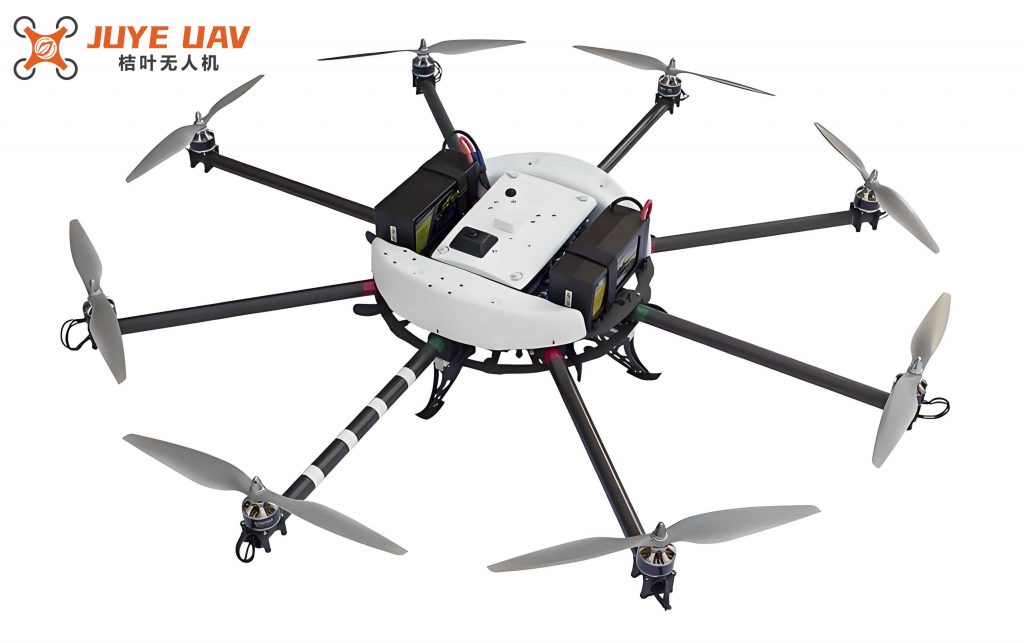
We implemented this dynamics model in ADAMS software to simulate the landing process of the multirotor drone. The simulations were conducted under various roll amplitudes (1° to 20°) and periods, focusing on the critical landing phase where the multirotor drone contacts the deck. The multirotor drone model was based on the DJI F450 platform, with parameters summarized in Table 1.
| Parameter | Value |
|---|---|
| Wheelbase (mm) | 450 |
| Structural Weight (g) | 1200 |
| Body Dimensions (cm) | 35 × 45 × 23 |
| Propeller Size (cm) | 22.86 |
The “V-foot–net” device parameters are listed in Table 2. The V-feet are made of photosensitive resin, and the net is constructed from iron, with square holes designed to accommodate the V-feet.
| Net Parameter | Value | V-foot Parameter | Value |
|---|---|---|---|
| Hole Size (mm) | 40 × 40 | Density (kg/m³) | 1116.7 |
| Wire Diameter (mm) | 2 | Young’s Modulus (MPa) | 1827 |
| Material | Iron | Poisson’s Ratio | 0.395 |
| Density (kg/m³) | 7801 | Single Weight (g) | 24.47 |
| Young’s Modulus (MPa) | 2.07 × 10⁵ | – | – |
| Poisson’s Ratio | 0.29 | – | – |
Through simulations, we identified four distinct landing states for the multirotor drone: rapid stabilization, slow stabilization, non-stabilization, and overturning. These states depend on the roll period and amplitude. In rapid stabilization, the multirotor drone achieves stability within 1 second after contact, with synchronized motion between the drone and net. Slow stabilization involves a longer stabilization time (1–5 seconds), during which the multirotor drone experiences significant oscillations. Non-stabilization occurs when stabilization takes over 5 seconds, and overturning leads to irreversible damage. We define the critical period as the minimum roll period before failure, and the safety boundary as the critical period across different roll amplitudes.
To assess the safety of the “V-foot–net” device, we compared it with a conventional landing device (flat feet on a plain deck) under identical conditions. The simulation results, summarized in Table 3, show the critical periods and stabilization times for both devices across roll amplitudes from 1° to 20°.
| Roll Amplitude (°) | “V-foot–net” Critical Period (s) | “V-foot–net” Stabilization Time (s) | Conventional Device Critical Period (s) | Conventional Device Stabilization Time (s) |
|---|---|---|---|---|
| 1 | 0.1 | 0.41 | 0.3 | 0.65 |
| 2 | 0.1 | 0.40 | 0.3 | 0.76 |
| 3 | 0.1 | 0.41 | 0.4 | 1.16 |
| 4 | 0.1 | 0.49 | 0.4 | 2.22 |
| 5 | 0.1 | 0.60 | 0.5 | 1.53 |
| 6 | 0.2 | 0.48 | 0.6 | 2.11 |
| 7 | 0.2 | 0.48 | 0.7 | 2.15 |
| 8 | 0.2 | 0.47 | 0.8 | 2.12 |
| 9 | 0.2 | 0.50 | 0.9 | 2.09 |
| 10 | 0.3 | 0.56 | 1.0 | 1.98 |
| 11 | 0.3 | 0.85 | 1.1 | 2.19 |
| 12 | 0.5 | 0.85 | 1.2 | 2.32 |
| 13 | 0.5 | 1.10 | 1.3 | 2.24 |
| 14 | 0.6 | 1.31 | 1.4 | 2.35 |
| 15 | 0.6 | 1.01 | 1.5 | 2.46 |
| 16 | 0.7 | 1.10 | 1.6 | 2.60 |
| 17 | 0.7 | 1.50 | 1.7 | 2.48 |
| 18 | 0.7 | 1.56 | 1.7 | 2.25 |
| 19 | 0.8 | 1.83 | 1.9 | 2.75 |
| 20 | 0.8 | 2.16 | 2.0 | 3.38 |
The data indicate that both critical period and stabilization time increase with roll amplitude for both devices, reflecting reduced landing safety under more severe conditions. However, the “V-foot–net” device consistently outperforms the conventional device, with lower critical periods and shorter stabilization times across all amplitudes. For instance, at a roll amplitude of 20°, the “V-foot–net” device has a critical period of 0.8 s and stabilization time of 2.16 s, compared to 2.0 s and 3.38 s for the conventional device. This demonstrates the superior safety and adaptability of the “V-foot–net” device for multirotor drone landings.
We also investigated the effect of the angle between the multirotor drone’s rotor arms and the net’s grid lines on landing performance. Simulations were conducted at angles of 0°, 10°, 30°, and 45°, and results showed no significant impact on stabilization time or critical period. This confirms the high docking redundancy of the “V-foot–net” device, as the multirotor drone can land safely regardless of orientation.
In conclusion, we have developed a novel “V-foot–net” landing device for multirotor drones that enhances safety during autonomous landings on offshore platforms. The device offers high docking redundancy, energy absorption, and stability, making it suitable for harsh marine environments. Through dynamics modeling and simulations, we established safety boundaries using critical period and stabilization time as key metrics. The results confirm that the “V-foot–net” device allows multirotor drones to land safely under smaller roll periods and larger amplitudes compared to conventional devices. This work provides a foundation for improving the reliability of autonomous multirotor drone operations in maritime applications, and future research will focus on experimental validation and optimization of the device for various multirotor drone models.