
The proliferation of unmanned aerial vehicles (UAVs), particularly “low, slow, and small” (LSS) drones and swarms, poses a significant asymmetric threat to modern air defense systems. Conventional weapons often struggle with cost-effectiveness and saturation against such targets. High-energy laser (HEL) weapons, characterized by their light-speed engagement, high precision, and low cost-per-shot, have emerged as a promising countermeasure. As these systems transition from development to deployment, robust and accurate methods for evaluating their operational effectiveness in anti-drone missions become paramount. This review provides a systematic analysis of the operational context, current evaluation methodologies, and critical challenges in assessing laser weapon performance against UAV threats.
Operational Analysis of Anti-Drone Laser Weapon Systems
Damage Mechanism Against UAVs
The core of laser weapon effectiveness lies in its damage mechanism, which is fundamentally thermal. A high-intensity, coherent laser beam is directed at the target, where its energy is absorbed by the surface material. This rapid energy deposition causes a steep temperature rise, leading to a sequence of physical effects: melting, vaporization, thermal decomposition, and potentially plasma ignition or thermal-mechanical failure. For composite materials common in drones, this process involves complex thermo-mechanical coupling where heat conduction weakens the material structure, inducing stress, delamination, and eventual loss of structural integrity or function.
The time-to-kill (TTK) or functional defeat depends on the laser fluence (energy per unit area) delivered to the target. Key parameters governing this include laser power, beam quality (which affects focus), atmospheric transmission losses, and the target’s absorption coefficient, thermal conductivity, and damage threshold. The fundamental relationship can be expressed as the energy balance required to raise the target surface to its failure temperature:
$$ E_{required} = \frac{\rho \cdot c_p \cdot (T_{fail} – T_{ambient}) \cdot V_{eff}}{\alpha} $$
where \( \rho \) is material density, \( c_p \) is specific heat, \( T_{fail} \) is failure temperature, \( T_{ambient} \) is ambient temperature, \( V_{eff} \) is the effective volume of material to be heated, and \( \alpha \) is the absorption coefficient at the laser wavelength.
The actual power density on target, \( I_{target} \), is the critical metric and is degraded by range and atmosphere:
$$ I_{target} = \frac{P_{laser} \cdot \tau_{atm}(R) \cdot K}{A_{spot}(R)} $$
where \( P_{laser} \) is laser output power, \( \tau_{atm}(R) \) is the atmospheric transmission over range \( R \), \( K \) is a factor for beam control and jitter losses, and \( A_{spot}(R) \) is the area of the focused spot at range \( R \), which increases with range and beam divergence.
Operational Modes: Soft-Kill vs. Hard-Kill
Laser anti-drone engagements are broadly categorized into two modes, defined by the intended effect and required energy level, as summarized in Table 1.
| Mode | Mechanism | Target | Key Metric | Advantage | Limitation |
|---|---|---|---|---|---|
| Soft-Kill | Overload or damage optoelectronic sensors (e.g., cameras, seekers). | UAV mission payload. | Task Abort Rate, Functional Suppression Time. | Lower power requirement; reversible in some cases; low collateral damage. | Effect may be temporary; requires precise aiming at sensors. |
| Hard-Kill | Thermo-mechanical destruction of airframe or critical components. | UAV structural integrity. | Kill Probability (Pk), Time-to-Kill (TTK). | Permanent target negation. | Higher power requirement; susceptible to atmospheric effects; requires longer dwell time. |
The choice between modes depends on rules of engagement, threat level (surveillance vs. attack drone), available laser power, and environmental conditions. A comprehensive effectiveness evaluation framework must account for both.
Key Operational Process and Enabling Technologies
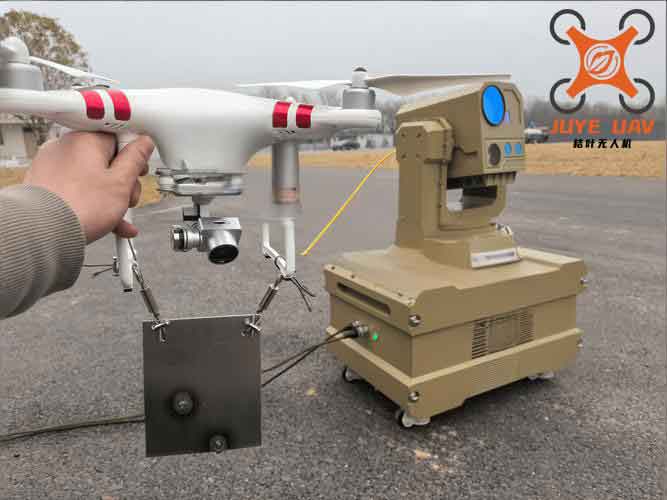
The end-to-end anti-drone engagement sequence for a laser weapon system typically involves: 1) Detection & Tracking, 2) Threat Evaluation & Weapon Assignment, 3) Beam Pointing & Tracking, 4) Laser Engagement & Damage, and 5) Battle Damage Assessment (BDA). Each phase introduces performance parameters that critically impact overall system effectiveness, as analyzed in Table 2.
| Phase | Enabling Technology | Key Performance Parameters | Impact on Effectiveness Evaluation |
|---|---|---|---|
| Detection/Tracking | Multi-sensor Fusion (Radar, EO/IR, RF) | Probability of Detection (Pd), False Alarm Rate, Track Accuracy | Determines engagement timeline and initial conditions; low Pd for small drones is a major bottleneck. |
| Beam Control | High-bandwidth Servos, Fine Tracking Loops | Beam Pointing Error, Jitter, Stabilization Bandwidth | Directly reduces on-target power density (\(I_{target}\)); increases required dwell time; critical for hitting small, agile drones. |
| Laser Engagement | High-Power Laser Source, Beam Combining | Output Power (\(P_{laser}\)), Beam Quality (M²), Wall-plug Efficiency | Sets upper limit of potential damage capability; efficiency affects system size, weight, and power (SWaP) and sustained operation. |
| Atmospheric Compensation | Adaptive Optics (AO) | Strehl Ratio Improvement, Correctable Bandwidth | Mitigates atmospheric turbulence, increasing effective \(I_{target}\) and effective range; performance degrades with stronger turbulence. |
| Sustained Operation | Thermal Management System | Heat Rejection Capacity, Cooling Time Constant | Dictates duty cycle (firing cadence) and ability to handle saturation attacks; a key constraint often overlooked in simple models. |
The systemic nature of these dependencies means that a laser weapon’s operational effectiveness is not simply its advertised power but the integrated performance of this chain under realistic battlefield conditions.
State-of-the-Art in Operational Effectiveness Evaluation
Current research on evaluating anti-drone laser weapon effectiveness can be categorized into three interrelated levels: physics-based damage modeling, combat simulation for dynamic engagement, and multi-criteria decision-making for integrated assessment.
Level 1: Physics-Based Damage Modeling
This foundational level focuses on high-fidelity modeling of the “laser-atmosphere-target” interaction to generate basic performance data (e.g., TTK, lethal range).
- Atmospheric Effects: Advanced models move beyond constant attenuation coefficients. Research incorporates detailed radiative transfer codes to model wavelength-dependent absorption and scattering by molecules and aerosols. Crucially, the impact of optical turbulence, described by the refractive index structure constant \(C_n^2\), is modeled using wave optics or phase screen methods to predict beam spreading and scintillation, which degrades \(I_{target}\). Models like the Hufnagel-Valley profile for \(C_n^2\) are often used: $$ C_n^2(h) = A \exp(-h/H_A) + B \exp(-h/H_B) + C h^{10} \exp(-h/H_C) $$ where \(h\) is altitude and A, B, C, HA, HB, HC are model parameters.
- Target Damage Modeling: Studies employ finite element analysis (FEA) to simulate the transient thermal and structural response of UAV materials (e.g., carbon-fiber composites, plastics). Models solve the heat conduction equation with a laser source term: $$ \rho c_p \frac{\partial T}{\partial t} = \nabla \cdot (k \nabla T) + \alpha I_{target}(x,y,t) $$ coupled with equations for material phase change (melting/vaporization) and thermo-elastic stress. This yields precise predictions of failure initiation and propagation.
Limitation: While highly accurate for a single shot under defined conditions, these computationally intensive models are impractical for evaluating many-on-many engagements or system-level trade-offs in dynamic scenarios.
Level 2: Combat Simulation for Dynamic Assessment
This level uses simulation to assess “process effectiveness” within a dynamic, often multi-target, engagement context. Two primary approaches are used, summarized in Table 3.
| Approach | Methodology | Typical Metrics | Strengths | Weaknesses |
|---|---|---|---|---|
| Analytical/Statistical Simulation | Queuing theory, Markov chains, or Monte Carlo methods. | System service rate, average queue length, overall kill probability (PK). | Computationally fast; good for high-level capacity analysis and saturation studies. | Oversimplifies target behavior and tactics; lacks spatial and temporal dynamics. |
| Agent-Based Simulation (ABS) | Models autonomous agents (drones, launchers, C2) with defined rules interacting in a simulated environment. | Engagement timeline, swarm attrition rate, resource utilization. | Captures emergent behavior and complex tactics (e.g., swarm evasive maneuvers); good for comparing CONOPs. | Computationally heavier; fidelity depends heavily on agent behavior rule accuracy; often simplifies physical models. |
For example, a simple Markov model for a laser weapon state might include: Searching, Tracking, Firing, and Cooling states. Transition probabilities between states depend on detection probability, tracking stability, kill probability per shot, and thermal management limits. The steady-state probability of being in the Firing state relates directly to the system’s sustainable engagement rate against a drone swarm.
Level 3: Comprehensive Decision-Making Assessment
This level synthesizes various performance indicators from lower-level models and simulations into an overall effectiveness score or ranking. It involves constructing an evaluation index system and determining the weight of each indicator.
- Index System Construction: A hierarchical index system is typically built. For an anti-drone laser system, a first-level index might include: Detection & Tracking Capability (CDT), Engagement Capability (CE), Survivability & Mobility (CSM), and Cost-Effectiveness (CCE). Each decomposes into second-level metrics (e.g., CE includes Hard-Kill PK, Soft-Kill Effectiveness, Effective Range, Duty Cycle).
- Weight Assignment & Synthesis: This is a critical and challenging step.
- Subjective Methods: e.g., Analytic Hierarchy Process (AHP). Experts pairwise compare indicators to derive weights. Prone to bias but incorporates valuable domain knowledge.
- Objective Methods: e.g., CRITIC (Criteria Importance Through Intercriteria Correlation). Weights are calculated based on the contrast intensity and conflict between indicator data. Data-driven but can yield counter-intuitive weights if data is unrepresentative.
- Hybrid/Dynamic Methods: The trend is towards combining methods (e.g., FAHP-CRITIC) or developing dynamic weighting models where weights adapt based on real-time battlefield context (e.g., target type, swarm density, weather). A dynamic weight \(w_i(t)\) for indicator \(i\) at time \(t\) might be a function of threat assessment: $$ w_i(t) = f(\text{Threat Level}, \text{Target Priority}, \text{Environmental State}) $$
- Comprehensive Scoring: Finally, techniques like TOPSIS (Technique for Order Preference by Similarity to Ideal Solution) or weighted sum models are used to aggregate normalized indicator scores into a final effectiveness value \(E\): $$ E = \sum_{i=1}^{n} w_i \cdot \text{Score}_i $$ where \( \sum w_i = 1 \).
Critical Challenges and Future Directions
Despite progress, significant gaps remain in the field of anti-drone laser weapon effectiveness evaluation.
Identified Challenges
- Insufficient Fidelity in Modeling Complex Couplings: Many models treat the atmosphere with static transmission, ignore the laser’s thermal management constraints during sustained firing, or fail to unify soft-kill and hard-kill effects within a single engagement model. This leads to overly optimistic assessments, especially for swarm defense scenarios.
- Lack of Dynamic and Context-Aware Weighting: While dynamic weighting is recognized as important, most proposed mechanisms are reactive and based on pre-defined rules. They lack the predictive, intelligent adaptation required for real-time command support. Furthermore, index systems are often generic and not tailored to specific mission contexts (e.g., point defense vs. mobile convoy protection).
- Data Dependency and Validation Shortfall: Evaluation models are heavily reliant on simulation data or limited field test results. There is a severe lack of open, high-quality real-world engagement data for validation. Furthermore, the potential of multi-source data fusion (especially incorporating space-based surveillance for wide-area tracking and Battle Damage Assessment) into the evaluation feedback loop is largely unexplored in open literature.
Future Research Directions
- Developing High-Fidelity, Coupled System-of-Systems Models: Future models must tightly integrate environment (dynamic atmosphere, EW), platform (thermal state, mobility), and threat (adaptive drone/swarm tactics). This requires embedding high-resolution physics models (e.g., adaptive optics performance, transient thermal models of the laser) within agent-based combat simulations to create a “digital twin” of the anti-drone engagement.
- Advancing Towards AI-Enabled, Dynamic Decision-Support Evaluation: Research should focus on using reinforcement learning (RL) to train intelligent weighting agents. These agents would learn optimal weight configurations directly from simulated combat outcomes against adaptive red-team swarms, enabling context-sensitive effectiveness prediction. The evaluation system should evolve from an assessment tool to a “evaluate-predict-optimize” decision support system, suggesting optimal force deployment and target prioritization.
- Establishing a Data-Fusion-Driven Evaluation and Validation Paradigm: A new paradigm leveraging heterogeneous data is needed. Future work should explore:
- Fusing real-time data from ground sensors, airborne platforms, and space-based assets to create a more objective ground truth for model validation.
- Developing AI/ML algorithms that can directly infer effectiveness metrics (e.g., mission kill, attrition rate) from fused multi-modal data streams (radar tracks, IR video, signals intelligence), reducing dependency on intermediate parametric models and increasing assessment agility and robustness for anti-drone operations.
In conclusion, the operational effectiveness evaluation of anti-drone laser weapons is a complex, multi-disciplinary challenge that sits at the intersection of laser physics, systems engineering, and combat modeling. Moving beyond simplistic power-based assessments to holistic, dynamic, and validated evaluation frameworks is essential for informed procurement, tactical development, and successful deployment of these transformative weapons systems against evolving drone threats.