
In recent years, the rapid evolution of Unmanned Aerial Systems has fundamentally reshaped the modern battlespace, introducing new operational domains and concepts. This proliferation has rendered traditional, single-point defense systems increasingly inadequate. Consequently, the development and deployment of integrated, networked anti-drone systems have become a critical priority for defense forces worldwide. The effectiveness of such a system does not stem from any single piece of equipment but from the synergistic interactions between diverse assets—sensors, command nodes, kinetic and non-kinetic effectors. A pressing challenge, therefore, is to quantify the value or “contribution” of individual equipment within this complex web of interactions to inform both procurement decisions and tactical employment. This article addresses this challenge by proposing a systematic, network-centric methodology for evaluating the system contribution rate of equipment within an anti-drone combat architecture.
The core of our approach is the Combat Loop theory, which abstracts the “observe, orient, decide, act” (OODA) cycle into a formal network model. An effective anti-drone engagement can be conceptualized as a closed loop connecting a target (T), a reconnaissance/sensing node (S), a decision/command node (D), and an attack/influence node (A). The path T→S→D→A→T constitutes a basic combat loop. Modern anti-drone systems are heterogeneous networks comprising multiple such nodes, where a single physical platform may serve multiple functional roles (e.g., a command vehicle with integrated sensors). Evaluating such a system requires modeling all possible loops that can be formed to engage threats.
The construction of the combat network model is a three-step process. First, the operational mission and the anti-drone targets (e.g., large UAVs, small drone swarms) are defined. Second, all available assets are abstracted into functional node sets (S, D, A) and the target set (T). Critically, a node represents a *function*, not necessarily a unique platform. A single platform with multiple capabilities will appear as multiple interconnected nodes within the network. The directed interactions between nodes—such as detection feeds, command orders, and engagement actions—form the edge set E of the network. Third, a topological graph is drawn based on these nodes and edges, visually representing the anti-drone system’s architecture.
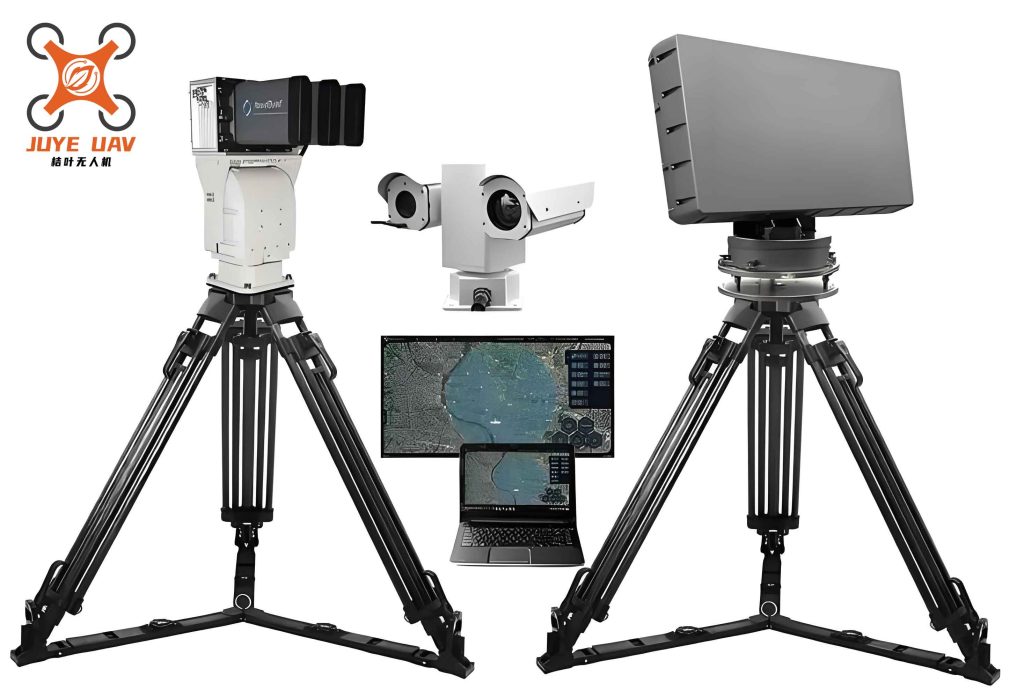
A key innovation of our method lies in quantifying the strength or reliability of these interactions. Each directed edge in the network is assigned a weight, representing the probability of successful information flow or action execution along that link. Determining this weight is non-trivial due to the fuzzy and complex nature of combat environments. We employ a Fuzzy Comprehensive Evaluation (FCE) method to calculate these edge weights. The process involves: (1) Identifying influencing factors for the edge’s function (e.g., for a D→A command link, factors may include communication latency, data integrity, and protocol compatibility). (2) Defining a qualitative evaluation set (e.g., Excellent, Good, Fair, Poor). (3) Using the Analytic Hierarchy Process (AHP) to determine the weight vector for the factors. (4) Constructing a fuzzy evaluation matrix based on expert assessment. (5) Performing a comprehensive calculation to obtain a quantifiable weight value between 0 and 1.
Once the weighted combat network G is established, we can evaluate the overall system’s capability. The primary metric is the Comprehensive Influence Index $h_G$, which measures the system’s aggregate ability to negatively impact the adversary’s UAV targets. It is calculated as the weighted sum of the influence on each target type:
$$ h_G = \sum_i (w_{T_i} \cdot Ef_{T_i}) $$
Here, $w_{T_i}$ is the strategic weight (importance) of target $T_i$, and $Ef_{T_i}$ is the total influence capability on that target. $Ef_{T_i}$ is derived by summing the capability metrics of all distinct combat loops $OL_k$ that terminate in target $T_i$:
$$ Ef_{T_i} = \sum_{\forall OL_k \rightarrow T_i} U_{OL_k} $$
The capability metric of a single combat loop $U_{OL_k}$ is defined as the product of the weights (probabilities) of all edges constituting that loop. For a loop $T_i \rightarrow S_a \rightarrow D_b \rightarrow A_c \rightarrow T_i$, its metric is:
$$ U_{OL_k} = P_{T_i S_a} \cdot P_{S_a D_b} \cdot P_{D_b A_c} \cdot P_{A_c T_i} $$
This multiplicative model reflects the serial reliability nature of a loop—a failure in any link breaks the entire chain.
The System Contribution Rate (SCR) of a specific equipment unit (or functional node) $v_i$ is then defined as the relative degradation in overall system capability caused by its removal. It answers the question: “How much does this asset contribute to the whole?” The formula is:
$$ SCR_{v_i} = \frac{h_G – h_{G-v_i}}{h_G} \times 100\% $$
where $h_{G-v_i}$ is the Comprehensive Influence Index of the crippled network after node $v_i$ (and all its associated functional edges) are removed. A high $SCR$ indicates a critical, non-redundant node whose loss severely degrades the anti-drone network’s effectiveness.
To demonstrate the practicality of our framework, let’s consider a representative anti-drone scenario. The Blue force employs large reconnaissance UAVs ($T_1$) and swarms of small attack drones ($T_2$). The Red anti-drone system comprises various assets abstracted into the following functional nodes:
| Node Symbol | Functional Description | Physical Platform Example |
|---|---|---|
| $S_1$ | Low-Altitude Surveillance Radar | Ground-based radar unit |
| $S_2$ | Electro-Optical Radar | EO/IR tracking system |
| $S_3$ | IR/EO Detection System | Mobile sensor platform |
| $S_4, D_1$ | Command & Control | Integrated Air Defense C2 Center |
| $S_5, D_2$ | Airborne Surveillance & Command | Airborne Early Warning aircraft |
| $S_6, D_3, A_1$ | Multi-Function Engagement | Short-Range Air Defense Missile System |
| $A_2$ | Electronic Attack | Navigation Signal Jammer |
| $A_3$ | Directed Energy | High-Power Microwave System |
Using the FCE method as described, we calculate the weights for all edges in the resulting combat network. A subset of these calculated connection probabilities is shown below:
| Edge Function Type | Example Edge | Connection Probability ($P$) |
|---|---|---|
| Detection | $T_1 \rightarrow S_1$ | 0.7605 |
| Data Upload | $S_1 \rightarrow D_1$ | 0.8563 |
| Command | $D_1 \rightarrow A_2$ | 0.8563 |
| Kinetic Kill | $A_1 \rightarrow T_1$ | 0.7324 |
| Electronic Kill | $A_2 \rightarrow T_2$ | 0.8243 |
| Inter-node Command | $D_2 \rightarrow D_1$ | 0.8491 |
With the complete weighted network, we enumerate all valid combat loops. For instance, one loop against target $T_1$ is $OL_1: T_1 \rightarrow S_1 \rightarrow D_1 \rightarrow A_1 \rightarrow T_1$. Its capability metric is:
$$ U_{OL_1} = 0.7605 \times 0.8563 \times 0.8563 \times 0.7324 \approx 0.4084 $$
By summing the metrics for all loops for each target, we get $Ef_{T_1} = 4.5212$ and $Ef_{T_2} = 4.1038$. Assigning strategic weights of $\omega_{T_1}=0.7$ and $\omega_{T_2}=0.3$, the overall system’s Comprehensive Influence Index is:
$$ h_G = 0.7 \times 4.5212 + 0.3 \times 4.1038 = 4.3960 $$
We now proceed to the contribution rate analysis. To find the SCR of the Short-Range Air Defense Missile System (node $A_1$), we remove it from the network and recalculate the index $h_{G-A_1}$. Its removal eliminates all loops where it serves as the attack node. The new index is calculated as $h_{G-A_1} = 2.8566$. Therefore, its contribution rate is:
$$ SCR_{A_1} = \frac{4.3960 – 2.8566}{4.3960} \times 100\% \approx 35.02\% $$
Repeating this process for all key nodes yields their respective System Contribution Rates, providing a clear ranking of their criticality within this specific anti-drone architecture.
| Functional Node | Description | System Contribution Rate (SCR) |
|---|---|---|
| $S_4, D_1$ | Air Defense C2 Center | 97.21% |
| $A_2$ | Navigation Signal Jammer | 36.28% |
| $S_1$ | Low-Altitude Radar | 35.72% |
| $S_6, D_3, A_1$ | Air Defense Missile System | 35.02% |
| $A_3$ | High-Power Microwave System | 28.71% |
| $S_2$ | Electro-Optical Radar | 24.52% |
| $S_5, D_2$ | Airborne Early Warning | 16.66% |
| $S_3$ | IR/EO Detection System | 8.41% |
The analysis reveals several key insights. First, the Command & Control center ($D_1$) has an exceptionally high SCR, underscoring its role as the indispensable hub of the anti-drone network. Its failure would collapse most operational loops. Second, “soft-kill” systems like the jammer ($A_2$) show a very high contribution, often rivaling or exceeding kinetic systems, validating their crucial role in modern counter-UAV strategies. Third, the SCR is strongly correlated with the number of combat loops a node participates in and its position in those loops. Nodes that are central and involved in shorter, more reliable loops (higher product of edge weights) contribute more significantly to the system’s resilience and effectiveness. This quantitative framework moves beyond intuitive assessment, providing a rigorous, model-based tool for identifying single points of failure, guiding redundancy planning, and optimizing resource allocation in anti-drone force design.
In conclusion, the escalating threat posed by adversarial UAVs necessitates a systems-thinking approach to defense. The Combat Loop-based evaluation framework presented here offers a powerful and rational methodology to dissect the complex web of interactions within an anti-drone system. By translating physical assets and their relationships into a weighted network model, applying fuzzy logic to handle operational uncertainties, and defining clear metrics for systemic capability and individual contribution, this approach provides actionable insights for decision-makers. It enables the comparative evaluation of different equipment mixes, the identification of critical vulnerabilities, and ultimately, the data-driven design of more robust, effective, and efficient integrated anti-drone systems. Future work could involve integrating dynamic elements, such as time-dependent node availability and adaptive adversary behavior, into the model for even more realistic campaign-level analysis.