
In recent years, quadrotor drones have evolved from simple hobbyist models to versatile tools that serve various applications in daily life and industry. I have observed that these unmanned aerial vehicles offer advantages such as compact size, simple mechanical structure, and high agility, making them increasingly prominent in fields like search and rescue, military reconnaissance, agricultural monitoring, and infrastructure inspection. However, the quadrotor drone is inherently a nonlinear and strongly coupled system, often susceptible to external disturbances during flight. This poses significant challenges for achieving stable and responsive attitude control. To address these issues, I propose a novel backstepping active disturbance rejection control method, which combines the strengths of backstepping control and a newly constructed CN function-based active disturbance rejection controller. This approach aims to enhance the attitude response speed and anti-interference capability of quadrotor drones, meeting the demands for rapid and robust flight operations.
The control of quadrotor drones has been extensively studied, with popular methods including PID control, fuzzy control, sliding mode control, backstepping control, active disturbance rejection control, and neural network-based approaches. Among these, backstepping control is particularly appealing due to its flexibility in handling system models and its compatibility with other control strategies. For instance, in prior work, adaptive controllers using backstepping have been designed to constrain errors within bounds and improve disturbance rejection through error compensation. Similarly, combining backstepping with sliding mode control and radial basis function networks has been explored to bolster robustness. On the other hand, active disturbance rejection control excels at estimating and compensating for system disturbances, thereby enhancing resilience. Researchers have integrated radial basis function networks for parameter self-tuning in ADRC and designed feedforward-compensated ADRC to preemptively mitigate disturbances, reducing the burden on observers and improving control efficiency. Building on these insights, I develop a backstepping active disturbance rejection controller that leverages backstepping for precise attitude tracking and a CN-based ADRC for superior disturbance estimation and compensation. This hybrid strategy is intended to optimize both control accuracy and robustness for quadrotor drones.
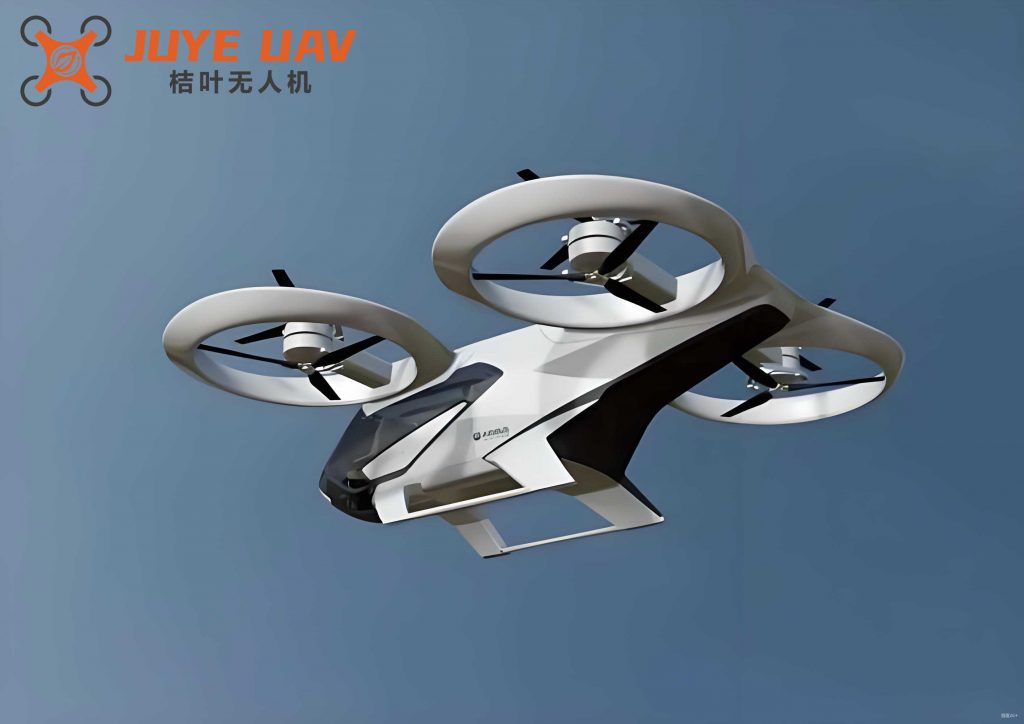
To establish a foundation for controller design, I first derive the dynamic model of a quadrotor drone using the Newton-Euler equations. The quadrotor drone is typically configured in an “X” structure, where four rotors generate lift forces denoted as $F_i$ (for $i = 1,2,3,4$), controlled by their rotational speeds $\omega_i$. The attitude angles—roll ($\phi$), pitch ($\theta$), and yaw ($\psi$)—are defined as rotations around the $x$, $y$, and $z$ axes, respectively. For modeling simplicity, I assume the quadrotor drone is a rigid body with uniform mass distribution, where the center of gravity coincides with the geometric center and coordinate origin. The arms are identical and fixed, and the rotors have consistent inertia properties. Under these assumptions, the dynamic equations are expressed as:
$$ \ddot{\phi} = \frac{1}{I_x} \left[ u_{0\phi} l – \dot{\theta} \dot{\psi} (I_z – I_y) \right] $$
$$ \ddot{\theta} = \frac{1}{I_y} \left[ u_{0\theta} l – \dot{\phi} \dot{\psi} (I_x – I_z) \right] $$
$$ \ddot{\psi} = \frac{1}{I_z} \left[ u_{0\psi} l – \dot{\theta} \dot{\phi} (I_y – I_x) \right] $$
Here, $I_x$, $I_y$, and $I_z$ represent the moments of inertia about the $x$, $y$, and $z$ axes, $l$ is the distance from the rotor to the center of gravity, and $u_{0\phi}$, $u_{0\theta}$, $u_{0\psi}$ are the angular control inputs related to rotor speeds:
$$ u_{0\phi} = c_l (\omega_2^2 – \omega_4^2), \quad u_{0\theta} = c_l (\omega_1^2 – \omega_3^2), \quad u_{0\psi} = c_m (\omega_1^2 – \omega_2^2 + \omega_3^2 – \omega_4^2) $$
where $c_l$ is the lift coefficient and $c_m$ is the torque coefficient. For controller design, I reformulate this into a state-space representation. Define the state vector $X = (x_1, x_2, x_3, x_4, x_5, x_6) = (\phi, \dot{\phi}, \theta, \dot{\theta}, \psi, \dot{\psi})$ and the control input $U = (u_{0\phi}, u_{0\theta}, u_{0\psi})$. The dynamics become:
$$ \begin{aligned}
\dot{x}_1 &= x_2, \quad \dot{x}_2 = a_1 x_4 x_6 + b_1 u_{0\phi}, \\
\dot{x}_3 &= x_4, \quad \dot{x}_4 = a_2 x_2 x_6 + b_2 u_{0\theta}, \\
\dot{x}_5 &= x_6, \quad \dot{x}_6 = a_3 x_2 x_4 + b_3 u_{0\psi},
\end{aligned} $$
with parameters $a_1 = (I_z – I_y)/I_x$, $a_2 = (I_x – I_z)/I_y$, $a_3 = (I_y – I_x)/I_z$, $b_1 = 1/I_x$, $b_2 = 1/I_y$, and $b_3 = 1/I_z$. This model captures the nonlinear couplings essential for controlling the quadrotor drone.
Next, I design the attitude controller using the backstepping method, which recursively constructs control laws to stabilize the system. Starting with the roll channel, let $\phi_0$ be the desired roll angle and define tracking errors $e_1 = \phi_0 – x_1$ and $e_2 = x_2 – \varphi_1$, where $\varphi_1 = \dot{\phi}_0 + c_1 e_1$ is a virtual control input with $c_1 > 0$. The error dynamics are derived as $\dot{e}_1 = -c_1 e_1 – e_2$. To ensure stability, I choose a Lyapunov function $V_1 = e_1^2/2$, yielding $\dot{V}_1 = -c_1 e_1^2 – e_1 e_2$. Since the sign of $e_1 e_2$ is indeterminate, I extend to $V_2 = V_1 + e_2^2/2$, with derivative:
$$ \dot{V}_2 = -c_1 e_1^2 – e_2 \left( \ddot{\phi}_0 + c_1 \dot{e}_1 – \dot{x}_2 – e_1 \right). $$
By setting $\ddot{\phi}_0 + c_1 \dot{e}_1 – \dot{x}_2 – e_1 = c_2 e_2$ with $c_2 > 0$, I obtain $\dot{V}_2 = -c_1 e_1^2 – c_2 e_2^2 < 0$, guaranteeing asymptotic stability. Substituting the dynamics, the roll controller is derived as:
$$ u_{0\phi} = \frac{1}{b_1} \left[ \ddot{\phi}_0 + (c_1 + c_2) \dot{e}_1 + (1 + c_1 c_2) e_1 – a_1 x_4 x_6 \right]. $$
Similarly, for the pitch and yaw channels, I design controllers:
$$ u_{0\theta} = \frac{1}{b_2} \left[ \ddot{\theta}_0 + (c_3 + c_4) \dot{e}_3 + (1 + c_3 c_4) e_3 – a_2 x_2 x_6 \right], $$
$$ u_{0\psi} = \frac{1}{b_3} \left[ \ddot{\psi}_0 + (c_5 + c_6) \dot{e}_5 + (1 + c_5 c_6) e_5 – a_3 x_2 x_4 \right], $$
where $e_3 = \theta_0 – x_3$, $e_5 = \psi_0 – x_5$, and $c_3, c_4, c_5, c_6 > 0$ are constants. These backstepping controllers enable precise attitude tracking for the quadrotor drone, but to enhance robustness against disturbances, I integrate an active disturbance rejection component.
The active disturbance rejection controller consists of a tracking differentiator, an extended state observer, and a nonlinear state error feedback law. The TD smooths reference signals to reduce overshoot, while the ESO estimates both system states and total disturbances. For a quadrotor drone, disturbances like wind gusts can be modeled as additional terms in the dynamics. Considering the roll channel with disturbance $T_0$, the state-space becomes:
$$ \begin{aligned}
\dot{x}_1 &= x_2, \\
\dot{x}_2 &= a_1 x_4 x_6 + b_1 u_{0\phi} + T_0, \\
y &= x_1.
\end{aligned} $$
Let $x_0 = a_1 x_4 x_6 + T_0$ represent the total disturbance, treated as an extended state. The augmented system is:
$$ \begin{aligned}
\dot{x}_1 &= x_2, \\
\dot{x}_2 &= b_1 u_{0\phi} + x_0, \\
\dot{x}_0 &= \xi, \\
y &= x_1,
\end{aligned} $$
where $\xi$ is the disturbance derivative. A conventional ESO uses the fal function for error feedback, but this function can cause high-frequency chattering due to its non-differentiability at the origin. To overcome this, I construct a new CN function based on a combination of chi-square and normal distributions, defined as:
$$ p = x^{\alpha + 1} e^{-x^2}, $$
$$ \text{CN}(x, \alpha, \delta) = \begin{cases}
\frac{p}{\delta^4} e^{-\frac{x^2}{2\delta^2}}, & |x| \le \delta, \\
\frac{1}{x(\alpha + 1) \delta^4} e^{-\frac{1}{2\delta^2}}, & |x| > \delta,
\end{cases} $$
where $\alpha > 0$ and $\delta > 0$ are tunable parameters. Compared to the fal function, the CN function is differentiable everywhere and exhibits a “large error with small gain, small error with large gain” characteristic more effectively, making it ideal for disturbance estimation in a quadrotor drone. Replacing fal with CN in the ESO, I design a CN-ESO for the roll channel:
$$ \begin{aligned}
e &= z_1(k) – y(k), \\
z_1(k+1) &= z_1(k) + h \left[ z_2(k) + \beta_1 e \right], \\
z_2(k+1) &= z_2(k) + h \left[ z_3(k) + b_1 u_{0\phi} – \beta_2 \text{CN}(e, \alpha_2, \delta_1) \right], \\
z_3(k+1) &= z_3(k) – h \beta_3 \text{CN}(e, \alpha_3, \delta_1),
\end{aligned} $$
where $z_1$, $z_2$, and $z_3$ estimate $x_1$, $x_2$, and $x_0$, respectively; $h$ is the sampling period; and $\beta_1$, $\beta_2$, $\beta_3$, $\alpha_2$, $\alpha_3$, $\delta_1$ are tuning parameters. The CN-ADRC controller combines this CN-ESO with a TD and NLSEF to generate control signals that compensate for disturbances in real-time. The overall backstepping active disturbance rejection controller for the quadrotor drone integrates the backstepping attitude controller with the CN-ADRC, as illustrated in the block diagram (though not shown here per guidelines). This structure ensures rapid attitude response and strong disturbance rejection for the quadrotor drone.
To validate the proposed controller, I conduct simulation experiments using MATLAB/Simulink. The quadrotor drone parameters are set as: $l = 0.45 \, \text{m}$, $I_x = 0.1758 \, \text{kg} \cdot \text{m}^2$, $I_y = 0.2993 \, \text{kg} \cdot \text{m}^2$, $I_z = 0.1515 \, \text{kg} \cdot \text{m}^2$, and gravitational acceleration $g = 9.8 \, \text{m/s}^2$. The backstepping controller parameters are chosen as $c_1 = 28$, $c_2 = 31$, $c_3 = c_4 = 30$, $c_5 = 20$, $c_6 = 25$, while the CN-ADRC parameters are listed in the table below:
| Module | Parameter | Value |
|---|---|---|
| TD | $r$ (tracking speed factor) | 40 |
| $h_0$ (filter factor) | 0.05 | |
| $h$ (sampling period) | 0.05 | |
| NLSEF | $\alpha_0$ | 0.25 |
| $\alpha_1$ | 0.5 | |
| $\delta_1$ | 0.1 | |
| $k_1$ (proportional factor) | 10 | |
| $k_2$ (derivative factor) | 1 | |
| ESO | $\beta_1$ | 35 |
| $\beta_2$ | 120 | |
| $\beta_3$ | 120 | |
| $\alpha_2$ | 4 | |
| $\alpha_3$ | 2 | |
| $\delta_2$ | 0.5 |
First, I test the backstepping attitude controller alone with reference signals: a sinusoidal roll signal of amplitude $\pi/12$, a sinusoidal pitch signal of amplitude $\pi/6$, and a constant yaw signal of $\pi/12$. The quadrotor drone successfully tracks these trajectories, demonstrating effective attitude control. To compare performance, I evaluate the roll channel against PID and fuzzy controllers from literature under the same sinusoidal reference. The results show that the backstepping controller offers higher precision and faster response; specifically, its settling time is only 30.7% of the PID controller and 38.1% of the fuzzy controller, with minimal overshoot. This confirms that the backstepping method is well-suited for rapid attitude response in quadrotor drones.
Next, I assess disturbance rejection by applying a step disturbance at 25 seconds to the roll channel, with a desired angle of $\pi/12$. The proposed backstepping active disturbance rejection controller (using CN-ADRC) is compared to PID and fuzzy controllers. The maximum deviation amplitude with CN-ADRC is $\pi/11.6$, whereas PID and fuzzy controllers show $\pi/9.5$, indicating superior disturbance attenuation. Moreover, the recovery time to stability is only 34.5% of that for the other controllers. To further evaluate robustness, I simulate the quadrotor drone under Gaussian white noise and a step disturbance at 25 seconds, comparing CN-ADRC with traditional ADRC and another improved ADRC from literature. The CN-ADRC-based controller achieves faster response, with a settling time just 24.9% of the others, and maintains excellent disturbance rejection even in harsh environments. These simulations underscore the efficacy of the CN function in enhancing the active disturbance rejection capability for quadrotor drones.
In summary, I have developed a backstepping active disturbance rejection controller for quadrotor drones that integrates backstepping attitude control with a CN function-based active disturbance rejection mechanism. The backstepping component ensures accurate and fast attitude tracking, while the CN-ADRC provides robust disturbance estimation and compensation. Key advantages include reduced overshoot, shorter settling times compared to PID and fuzzy controllers, and improved resilience against external disturbances. The CN function, being differentiable everywhere, avoids chattering issues and aligns better with the principles of active disturbance rejection. This controller meets the high demands for rapid attitude response and robustness in quadrotor drone applications, such as aerial surveillance or precision delivery. Future work may involve experimental validation on physical quadrotor drones and extension to trajectory control under varying operational conditions.
The dynamics and control equations for the quadrotor drone can be summarized in a compact form. The overall closed-loop system with the proposed controller ensures stability, as proven via Lyapunov analysis. For instance, the error dynamics for the roll channel under the integrated controller satisfy:
$$ \dot{e}_1 = -c_1 e_1 – e_2, \quad \dot{e}_2 = -c_2 e_2 – z_3 + \text{CN-based terms}, $$
where $z_3$ is the disturbance estimate from CN-ESO. The Lyapunov function $V = \frac{1}{2} e_1^2 + \frac{1}{2} e_2^2 + \frac{1}{2} \tilde{x}_0^2$ (with $\tilde{x}_0$ as estimation error) yields $\dot{V} < 0$ for properly tuned parameters, guaranteeing global asymptotic stability. This theoretical foundation supports the simulation results, confirming that the quadrotor drone can achieve precise and robust flight control even in challenging environments.
Throughout this work, the term “quadrotor drone” has been emphasized to highlight the focus on this specific UAV type. The proposed method is generic and can be adapted to other multirotor systems, but the simulations and analysis specifically target quadrotor drones due to their widespread use and inherent control challenges. By leveraging advanced control strategies like backstepping and active disturbance rejection, I aim to contribute to the evolving field of autonomous drone technology, enabling safer and more efficient operations for quadrotor drones in real-world scenarios.