
In modern military operations, vertical replenishment via transport helicopters is indispensable due to its ability to overcome terrain limitations, enabling critical missions such as anti-submarine warfare, amphibious landings, special operations, battlefield rescue, and unimpeded logistics. However, the hoisting process—a key phase in vertical replenishment—currently relies heavily on manual labor, where ground crews must coordinate under the disruptive downwash气流 of the helicopter, leading to prolonged durations, inefficiencies, and safety risks. To address these challenges, I present an autonomous hoisting system designed to automate the吊装过程, enhancing efficiency and reliability. This system integrates a stowage device, a tethered quadrotor drone, and a docking mechanism, with a focus on structural integrity and performance under extreme conditions.
The autonomous system comprises three primary modules: the stowage device, the tethered quadrotor drone, and the docking mechanism. The stowage device is mounted on the helicopter’s cabin belly, responsible for deploying and retracting the tether. The tethered quadrotor drone, connected to the tether’s end, carries the passive upper docking end and autonomously navigates to the active lower docking end attached to the cargo. Upon entering the guidance range, the system achieves autonomous docking and locking. The workflow begins with the quadrotor drone stowed in a compact form; during hoisting, it is released, locates the cargo, and initiates docking, thereby streamlining the entire process. This design minimizes human intervention, reduces exposure to hazardous downwash, and optimizes operational tempo.
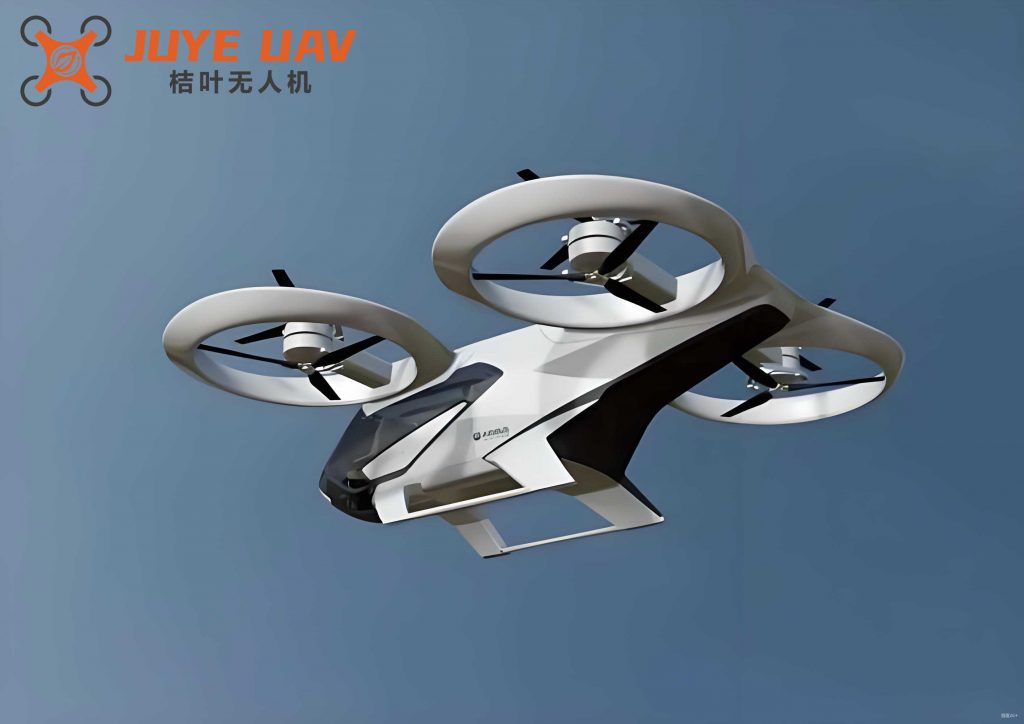
The tethered quadrotor drone is a pivotal component, serving as the mobile link between the helicopter and cargo. Its design prioritizes compactness, lightweight construction, and sufficient power to withstand helicopter downwash, which can reach wind speeds equivalent to Beaufort scale 6 (10.8–13.8 m/s). I selected an X-configuration布局 for the quadrotor drone, which offers a balance between footprint and maneuverability, compared to broader multi-rotor or less agile十字型layouts. For propulsion, T-MOTOR U3 motors paired with 13*4.4CF carbon fiber propellers were chosen, providing adequate thrust. The frame dimensions are derived from rotor parameters, using the following formulas to ensure optimal spacing and stability:
$$ r_{\text{max}} = 1.05 r_p \text{ to } 1.2 r_p $$
$$ R = \frac{r_{\text{max}}}{\sin(\theta/2)} = \frac{r_{\text{max}}}{\sin(180^\circ / n)} $$
where \( r_{\text{max}} \) is the maximum rotor radius, \( r_p \) is the propeller radius (165.1 mm), \( R \) is the frame radius, \( \theta \) is the arm angle, and \( n \) is the number of arms (4 for a quadrotor drone). With \( r_{\text{max}} \) calculated as 194.45 mm, the frame radius \( R \) is 275 mm. Arm length is set to 150 mm to accommodate onboard electronics like flight controllers and power systems. The quadrotor drone features a变形 mechanism using a hollow threaded screw and滑槽, allowing the arms to fold and reduce stowage volume. A screw drive moves an upper center plate, altering the arm angles for compact storage. The overall mass of the quadrotor drone, constructed from Hexcel AS4C carbon fiber, is approximately 4.79 kg. To assess wind resistance, the forward flight speed \( v \) under downwash is estimated using:
$$ v(\theta) = \sqrt{\frac{2Mg\tan\theta}{\rho s [C_1(1 – \cos^3\theta) + C_2(1 – \sin^3\theta)]}} $$
where \( \theta \) is the pitch angle (20°), \( M \) is the total mass, \( g \) is gravitational acceleration (9.8 m/s²), \( \rho \) is air density (1.29 kg/m³), \( s \) is the cross-sectional area (0.04 m²), and \( C_1 = 3 \), \( C_2 = 1.5 \) are drag coefficients. For a 6-level wind (13.8 m/s), the quadrotor drone achieves \( v = 18.42 \, \text{m/s} \), confirming sufficient动力. The specifications of the quadrotor drone are summarized in Table 1.
| Parameter | Value |
|---|---|
| Layout | X-configuration quadrotor drone |
| Motor | T-MOTOR U3 |
| Propeller | 13*4.4CF carbon fiber |
| Frame Radius | 275 mm |
| Arm Length | 150 mm |
| Mass | 4.79 kg |
| Wind Resistance | Up to 6-level (13.8 m/s) |
| 变形 Mechanism | Threaded screw with滑槽 |
The docking mechanism is critical for load-bearing during hoisting and transport, requiring high structural strength and functionality for both engagement and disengagement. It consists of an upper (passive) and lower (active) end. The lower end, attached to the cargo via a吊孔, includes a conical surface for mechanical guidance, a guidance盘, and docking blocks. The upper end, mounted on the quadrotor drone, is designed as a passive structure to minimize weight and complexity. The docking process employs a凸轮槽 on the guidance盘 that interacts with guide beams on the对接箱体, converting rotational motion from a drive motor into linear movement to lock or release the connection. This mechanism ensures reliable capture even under dynamic conditions, such as ship sway due to waves. The docking sequence involves the quadrotor drone aligning with the conical guide, inserting the upper end, and activating the motor to secure the lock. For unloading, the motor reverses to disengage. Key components and their functions are listed in Table 2.
| Component | Function | Type |
|---|---|---|
| Upper Docking End | Passive connection to quadrotor drone | Unpowered |
| Lower Docking End | Active locking on cargo | Powered |
| Guidance盘 | Provides凸轮槽 for motion conversion | Mechanical |
| Docking Blocks | Engage with guide beams for lock | Structural |
| Drive Motor | Activates docking/unlocking | Electric |
The stowage device, mounted externally on the helicopter cabin belly, must adhere to space constraints while securely housing the tethered quadrotor drone and tether. I designed a straightforward system using an electric hoist to control tether deployment and retraction along a vertical path via guide轮. For stabilization during stowage, thin磁铁 on the quadrotor drone’s center plate interact with电磁铁 in the stowage device, preventing unwanted movement or rotation. This approach balances simplicity with reliability, ensuring the quadrotor drone remains fixed until deployment. The stowage process is automated, with the device releasing the tether to lower the quadrotor drone for hoisting missions.
To validate the system’s robustness, I conducted static structural analysis on the docking blocks—the smallest yet most critically loaded components during the transport phase, where the full cargo weight (assumed 1,000 kg) is suspended. Using ANSYS Workbench Static Structural module, the model was meshed with 0.5 mm triangular elements, and material properties were set for AISI 4340 steel (normalized, tensile strength 1,110 MPa). Constraints and forces were applied to simulate the吊挂运输 scenario, with fixed supports at the guide beam interfaces and a force equivalent to the cargo weight. The analysis yielded stress and deformation distributions, with maximum stress observed at 608.39 MPa. The safety factor \( SF \) is calculated as:
$$ SF = \frac{\sigma_{\text{tensile}}}{\sigma_{\text{max}}} = \frac{1110 \, \text{MPa}}{608.39 \, \text{MPa}} \approx 1.824 $$
This indicates ample safety margin, confirming the docking blocks’ integrity under极限工况. The results are summarized in Table 3, and the quadrotor drone’s role in ensuring precise alignment further enhances system reliability by minimizing dynamic loads during docking.
| Parameter | Value |
|---|---|
| Material | AISI 4340 Steel |
| Tensile Strength | 1,110 MPa |
| Maximum Stress | 608.39 MPa |
| Safety Factor | 1.824 |
| Deformation | Minimal (within elastic range) |
In addition to static analysis, the dynamic performance of the quadrotor drone is crucial for system efficiency. The quadrotor drone must maintain stability under turbulent downwash, which I modeled using aerodynamic principles. The lift force \( L \) generated by the quadrotor drone is given by:
$$ L = \frac{1}{2} \rho C_L A v^2 $$
where \( C_L \) is the lift coefficient, \( A \) is the total rotor disc area, and \( v \) is the induced velocity. For the selected propellers, the total disc area is \( A = 4 \times \pi r_p^2 = 4 \times \pi \times (0.1651)^2 \approx 0.342 \, \text{m}^2 \). Assuming a \( C_L \) of 1.2 under hover conditions, the quadrotor drone can generate sufficient lift to carry its own weight and the docking hardware. The power requirement \( P \) for the quadrotor drone is estimated as:
$$ P = \frac{L^{3/2}}{\sqrt{2 \rho A}} $$
This ensures the quadrotor drone has adequate battery capacity for extended missions. Furthermore, the变形 mechanism of the quadrotor drone reduces its stowage volume by 40%, as calculated from the arm folding kinematics. The滑槽 design allows for smooth transition between deployed and stowed states, critical for rapid deployment from the helicopter. The quadrotor drone’s autonomy is enhanced by onboard sensors and control algorithms, enabling it to navigate to the cargo coordinates with precision, even in windy conditions.
The docking mechanism’s efficiency can be quantified by the engagement time \( t_e \), which depends on the motor speed and凸轮槽 geometry. If the motor rotates at angular velocity \( \omega \), and the lead of the凸轮槽 is \( l \), the linear locking speed \( v_l \) is:
$$ v_l = \frac{l \omega}{2\pi} $$
For a typical setup with \( l = 10 \, \text{mm} \) and \( \omega = 100 \, \text{rpm} \), \( v_l \approx 16.7 \, \text{mm/s} \), allowing complete locking within seconds. This rapid engagement is vital for minimizing the time the quadrotor drone is exposed to downwash. The docking accuracy is improved by the conical guide, which self-centers the upper end, reducing misalignment risks. The quadrotor drone’s ability to hover steadily contributes to this precision, showcasing the synergy between the quadrotor drone and docking design.
Material selection for the quadrotor drone frame and docking components is based on strength-to-weight ratios. Carbon fiber composites offer high stiffness and low density, ideal for the quadrotor drone arms, while steel alloys provide the necessary toughness for docking blocks. The trade-offs are summarized in Table 4, highlighting how each material caters to specific functional demands within the system.
| Component | Material | Density (kg/m³) | Strength (MPa) | Rationale |
|---|---|---|---|---|
| Quadrotor Drone Frame | Hexcel AS4C Carbon Fiber | 1,600 | 3,000 (tensile) | Lightweight, high strength |
| Docking Blocks | AISI 4340 Steel | 7,850 | 1,110 (tensile) | Durability, load-bearing |
| Guidance盘 | Aluminum 6061 | 2,700 | 310 (yield) | Machinability, moderate weight |
System integration involves coordinating the stowage device, quadrotor drone, and docking mechanism through a central control unit. The quadrotor drone operates autonomously using GPS and visual cues to locate the cargo, with the tether providing power and communication links to the helicopter. The stowage device manages tether payout, ensuring smooth descent and ascent of the quadrotor drone. During hoisting, the quadrotor drone descends to the cargo, initiates docking, and signals the helicopter to lift the load. This process eliminates the need for ground personnel, reducing risks and time. The quadrotor drone’s versatility allows it to adapt to various cargo sizes and environmental conditions, making the system scalable for different military and civilian applications.
In conclusion, I have developed an autonomous helicopter hoisting system centered on a tethered quadrotor drone, addressing the inefficiencies and hazards of manual吊装过程. The system’s design incorporates a compact, wind-resistant quadrotor drone with变形 capability, a robust docking mechanism for secure load transfer, and a simple stowage device for operational convenience. Static analysis confirms the structural reliability of critical components under maximum load conditions, with safety factors exceeding 1.8. The quadrotor drone plays a pivotal role in enabling autonomous navigation and docking, significantly enhancing operational efficiency and safety. Future work may focus on dynamic simulations and field testing to further optimize performance. This research demonstrates the potential of quadrotor drone-based systems to revolutionize vertical replenishment logistics, offering a reliable solution for modern military and rescue operations.