
In recent years, the tilting quadrotor drone has garnered significant research interest due to its ability to combine the advantages of both rotary-wing and fixed-wing unmanned aerial vehicles (UAVs). This type of aircraft can achieve vertical take-off and landing like traditional quadrotor drones, while also transitioning to fixed-wing mode for higher flight speeds. However, the change in flight modes introduces dynamic model variations, making controller design more challenging. To address this, various control strategies have been proposed, including active disturbance rejection control, sliding mode control, adaptive control, and PID control. Among these, sliding mode control (SMC) has become a popular method for flight dynamics control due to its strong robustness against disturbances. Nonetheless, traditional SMC methods often suffer from chattering issues and require precise model knowledge, which is difficult to obtain in practical scenarios where model uncertainties and external disturbances are prevalent. To overcome these limitations, this paper proposes an adaptive sliding mode control strategy based on a recurrent neural network (RNN) for the tilting quadrotor drone. The RNN is employed to approximate the equivalent controller in the SMC framework, thereby handling uncertainties and disturbances effectively while reducing computational load. The stability of the closed-loop system is rigorously proven using Lyapunov theory, and simulation results validate the effectiveness of the proposed approach across different tilt angles and under external disturbances.
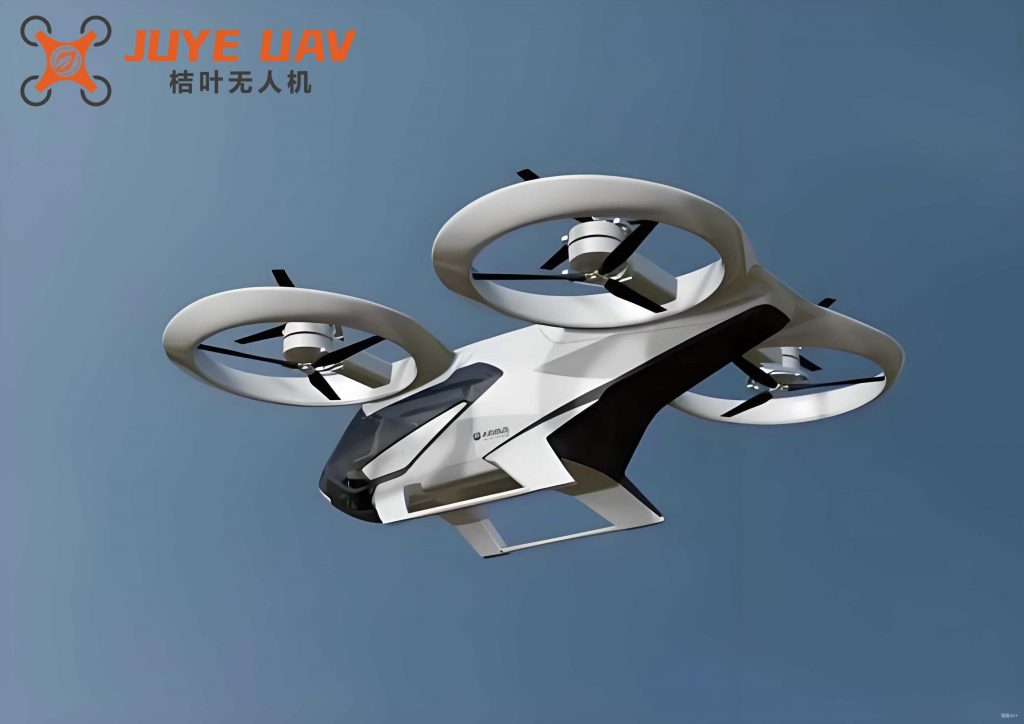
The tilting quadrotor drone is a versatile platform that operates in multiple flight modes, including helicopter mode and fixed-wing mode. In helicopter mode, the quadrotor drone utilizes its rotors for lift and maneuvering, similar to a standard quadcopter. In fixed-wing mode, the rotors tilt to provide forward thrust, enabling efficient high-speed flight. The transition between these modes involves changes in the dynamics, which must be accounted for in the control design. The primary challenge lies in designing a controller that can ensure stable trajectory tracking across all modes despite model uncertainties, external disturbances, and the nonlinearities inherent in the quadrotor drone dynamics. This paper focuses on developing an adaptive SMC scheme that leverages RNNs to approximate unknown system dynamics online. The RNN, with its recurrent connections, is well-suited for modeling time-varying and nonlinear systems, making it an ideal choice for the tilting quadrotor drone application. The controller is designed by decomposing the system into fully-actuated and under-actuated subsystems, each with its own sliding surface and RNN-based estimator. This decomposition simplifies the design process and avoids the need for decoupling position signals to obtain Euler angle commands. The proposed method is validated through simulations that compare it with conventional SMC methods and demonstrate its performance under various tilt angles and disturbances.
Dynamic Model of the Tilting Quadrotor Drone
The dynamic model of the tilting quadrotor drone is derived using the Newton-Euler formulation. Two coordinate frames are defined: the body-fixed frame \(bO\) attached to the drone’s center of mass, and the inertial world frame \(wO\). The equations of motion account for the forces and moments generated by the rotors, aerodynamic effects, and gravity. The tilt angle of the rotors, denoted as \(\theta_w\), is a key parameter that varies between 0 (helicopter mode) and \(\pi/2\) (fixed-wing mode). The dynamic model is expressed as follows:
Position dynamics:
$$
\begin{aligned}
\ddot{x} &= \frac{1}{m} \left[ (\cos\psi \sin\theta \cos\theta_w + \sin\psi \sin\theta_w) u_1 + W_x \right], \\
\ddot{y} &= \frac{1}{m} \left[ (\sin\psi \sin\theta \cos\theta_w – \cos\psi \sin\theta_w) u_1 + W_y \right], \\
\ddot{z} &= \frac{1}{m} \left[ (\cos\theta \cos\theta_w) u_1 – mg + W_z \right],
\end{aligned}
$$
Attitude dynamics:
$$
\begin{aligned}
\ddot{\phi} &= \frac{1}{I_x} \left[ \sin\theta_w u_2 + \cos\theta_w u_4 + (I_y – I_z) \dot{\theta} \dot{\psi} – J_p \dot{\theta} \omega_p \right], \\
\ddot{\theta} &= \frac{1}{I_y} \left[ \sin\theta_w u_3 + (I_z – I_x) \dot{\phi} \dot{\psi} + J_p \dot{\phi} \omega_p \right], \\
\ddot{\psi} &= \frac{1}{I_z} \left[ \cos\theta_w u_2 – \sin\theta_w u_4 + (I_x – I_y) \dot{\phi} \dot{\theta} – J_p \omega_p \right],
\end{aligned}
$$
where \(m\) is the mass of the quadrotor drone, \(g\) is gravitational acceleration, \([W_x, W_y, W_z]^T\) are aerodynamic forces, \([\phi, \theta, \psi]^T\) are roll, pitch, and yaw angles, \([I_x, I_y, I_z]^T\) are moments of inertia, \(J_p\) is the rotor inertia, \(\omega_p = \omega_1 – \omega_2 – \omega_3 + \omega_4\) is the overall rotor speed, and \(u_1, u_2, u_3, u_4\) are control inputs defined as:
$$
\begin{aligned}
u_1 &= F_1 + F_2 + F_3 + F_4, \\
u_2 &= l_s (F_1 – F_2 + F_3 – F_4), \\
u_3 &= l_l (F_1 + F_2 – F_3 – F_4), \\
u_4 &= \lambda (F_1 – F_2 – F_3 + F_4),
\end{aligned}
$$
with \(F_i = k \omega_i^2\) being the thrust from rotor \(i\), \(k\) the thrust coefficient, \(l_s\) and \(l_l\) the horizontal and vertical distances from rotors to the center of mass, and \(\lambda\) the torque coefficient. This model captures the essential dynamics of the tilting quadrotor drone and serves as the basis for controller design. The quadrotor drone is a complex system with coupled translational and rotational dynamics, especially when the tilt angle changes. Therefore, advanced control techniques are required to ensure robust performance.
| Parameter | Symbol | Value | Unit |
|---|---|---|---|
| Mass | \(m\) | 1.1 | kg |
| Arm length | \(l_s, l_l\) | 0.21 | m |
| Moment of inertia (x, y) | \(I_x, I_y\) | 1.22 | kg·m² |
| Moment of inertia (z) | \(I_z\) | 2.2 | kg·m² |
| Rotor inertia | \(J_p\) | 0.2 | kg·m² |
| Thrust coefficient | \(k\) | 1.5e-5 | N·s²/rad² |
| Torque coefficient | \(\lambda\) | 0.1 | m |
Controller Design Using Recurrent Neural Network and Sliding Mode Control
The controller design for the tilting quadrotor drone is divided into two subsystems: the fully-actuated subsystem (altitude and yaw) and the under-actuated subsystem (position and roll-pitch). This decomposition simplifies the control design by separating the control objectives. For each subsystem, a sliding mode controller is designed, with the equivalent controller approximated by an RNN to handle uncertainties and disturbances. The RNN is chosen due to its ability to model dynamic systems with memory, which is beneficial for the time-varying dynamics of the quadrotor drone.
Fully-Actuated Subsystem Control
The fully-actuated subsystem consists of altitude \(z\) and yaw angle \(\psi\). Define tracking errors as \(e_z = z_d – z\) and \(e_\psi = \psi_d – \psi\), where subscript \(d\) denotes desired values. The sliding surfaces are designed as:
$$
s_z = c_z e_z + \dot{e}_z, \quad s_\psi = c_\psi e_\psi + \dot{e}_\psi,
$$
where \(c_z > 0\) and \(c_\psi > 0\) are constants. The time derivatives of the sliding surfaces lead to:
$$
\dot{s}_z = c_z \dot{e}_z + \ddot{e}_z, \quad \dot{s}_\psi = c_\psi \dot{e}_\psi + \ddot{e}_\psi.
$$
Substituting the dynamics, the ideal equivalent controllers \(U_{1eq}\) and \(U_{4eq}\) can be derived. However, due to uncertainties and disturbances, these cannot be directly implemented. Instead, RNNs are used to approximate them. The RNN structure includes input, hidden, and output layers with recurrent connections. The output of the RNN for the equivalent controllers is:
$$
\hat{U}_{ieq} = W_{ho,i}^T \Phi_i(x_i, W_{ih,i}, W_{hd,i}, W_{oi,i}, W_{oh,i}) + \varepsilon_i, \quad i=1,4,
$$
where \(W\) denotes weight matrices, \(\Phi\) is the activation function, \(x_i\) are input signals (e.g., \(x_1 = [e_z, \dot{e}_z]^T\)), and \(\varepsilon_i\) is approximation error. The overall control law for the fully-actuated subsystem is:
$$
U_i = \hat{U}_{ieq} + U_{isw}, \quad i=1,4,
$$
where \(U_{isw}\) is a switching controller designed as:
$$
U_{isw} = K_{s,i} \text{sgn}(s_i) + K_{x,i} \text{sig}^{\lambda_i}(s_i), \quad \text{sig}^{\lambda_i}(s_i) = |s_i|^{\lambda_i} \text{sgn}(s_i),
$$
with \(K_{s,i} > 0\), \(K_{x,i} > 0\), and \(0 < \lambda_i < 1\). This combination helps reduce chattering while ensuring convergence. The weight adaptation laws for the RNN are derived using Lyapunov stability analysis to guarantee boundedness and convergence.
Under-Actuated Subsystem Control
The under-actuated subsystem involves position \(x, y\) and roll-pitch angles \(\phi, \theta\). The tracking errors are defined as \(e_x = x_d – x\), \(e_y = y_d – y\), \(e_\phi = \phi_d – \phi\), \(e_\theta = \theta_d – \theta\). The sliding surfaces are designed as:
$$
\begin{aligned}
s_x &= c_1 e_x + c_2 \dot{e}_x + c_3 e_\phi + c_4 \dot{e}_\phi, \\
s_y &= c_5 e_y + c_6 \dot{e}_y + c_7 e_\theta + c_8 \dot{e}_\theta,
\end{aligned}
$$
where coefficients \(c_1\) to \(c_8\) are chosen based on Hurwitz stability criteria. Similar to the fully-actuated case, the ideal equivalent controllers \(U_{2eq}\) and \(U_{3eq}\) are approximated by RNNs:
$$
\hat{U}_{jeq} = W_{ho,j}^T \Phi_j(x_j, W_{ih,j}, W_{hd,j}, W_{oi,j}, W_{oh,j}) + \varepsilon_j, \quad j=2,3,
$$
with inputs \(x_2 = [e_y, \dot{e}_y, e_\phi, \dot{e}_\phi]^T\) and \(x_3 = [e_x, \dot{e}_x, e_\theta, \dot{e}_\theta]^T\). The control laws are:
$$
U_j = \hat{U}_{jeq} + U_{jsw}, \quad j=2,3,
$$
where the switching controllers \(U_{jsw}\) have the same form as before. The adaptation laws for the RNN weights are derived to ensure stability. The overall control architecture for the tilting quadrotor drone integrates these subsystems, enabling robust trajectory tracking across flight modes. The use of RNNs allows the quadrotor drone to adapt to changing dynamics without requiring precise model knowledge, which is crucial for practical implementations where the quadrotor drone operates in uncertain environments.
| Parameter | Symbol | Value |
|---|---|---|
| Sliding surface coefficient (altitude) | \(c_z\) | 2.0 |
| Sliding surface coefficient (yaw) | \(c_\psi\) | 2.5 |
| Switching gain (altitude) | \(K_{s,1}\) | 1.0 |
| Switching gain (yaw) | \(K_{s,4}\) | 1.2 |
| Power term coefficient | \(\lambda_i\) | 0.5 |
| RNN learning rate | \(\eta\) | 10 |
Stability Analysis Using Lyapunov Theory
The stability of the closed-loop system for both subsystems is proven using Lyapunov theory. For the fully-actuated subsystem, consider the Lyapunov function candidate:
$$
V_i = \frac{1}{2\rho_i} s_i^2 + \frac{1}{2\eta} \sum_{\gamma} \tilde{W}_{\gamma,i}^T \tilde{W}_{\gamma,i}, \quad i=1,4,
$$
where \(\tilde{W}_{\gamma,i} = W_{\gamma,i} – \hat{W}_{\gamma,i}\) are weight estimation errors, \(\rho_i\) are positive constants, and \(\eta > 0\) is the learning rate. The time derivative of \(V_i\) is computed using the dynamics and control laws. After substituting the adaptation laws for the RNN weights, it can be shown that:
$$
\dot{V}_i \leq -|s_i| (K_{s,i} – \Delta_{i0}) – K_{x,i} |s_i|^{\lambda_i+1},
$$
where \(\Delta_{i0}\) is an upper bound on the RNN approximation error. If \(K_{s,i} > \Delta_{i0}\), then \(\dot{V}_i \leq 0\), ensuring that \(s_i\) converges to zero asymptotically. By Barbalat’s lemma, the tracking errors \(e_z\) and \(e_\psi\) also converge to zero. Similarly, for the under-actuated subsystem, Lyapunov functions are defined for \(i=2,3\), and using the same approach, stability is guaranteed. The coefficients in the sliding surfaces are chosen such that the resulting error dynamics are Hurwitz, ensuring that all state errors converge to zero once the sliding surfaces are reached. This analysis confirms that the proposed RNN-based adaptive sliding mode controller provides robust stability for the tilting quadrotor drone, even in the presence of uncertainties and disturbances. The quadrotor drone’s performance is thus guaranteed across different flight modes, making it suitable for complex missions.
The Lyapunov analysis also highlights the role of the switching controller in mitigating chattering. The combination of signum and power terms ensures that the control signal is smooth near the sliding surface while maintaining robustness. This is particularly important for the quadrotor drone, as excessive chattering can lead to actuator wear and reduced flight efficiency. The RNN adaptation laws are designed to update the weights online, allowing the quadrotor drone to learn and compensate for dynamic changes in real-time. This adaptive capability is essential for the tilting quadrotor drone, which undergoes significant model variations during mode transitions. The stability proof ensures that the learning process does not destabilize the system, providing a solid theoretical foundation for the proposed controller.
Simulation Results and Performance Evaluation
To validate the proposed controller, simulations are conducted in MATLAB/Simulink using the dynamic model of the tilting quadrotor drone. The simulation scenarios include trajectory tracking under external disturbances and performance evaluation at different tilt angles. The desired trajectory is set as \(x_d = \sin(0.1t)\), \(y_d = \cos(0.1t)\), \(z_d = 0.1t\), with desired attitudes \(\phi_d = \theta_d = \psi_d = 0\). External disturbances are added as \(d = 2\sin(0.5t)\) to the attitude dynamics, and model uncertainties are introduced by reducing the mass and moments of inertia by 20%. The performance of the proposed RNN-based SMC is compared with a conventional SMC method from the literature.
The results show that the conventional SMC method exhibits significant oscillations and poor tracking accuracy in the presence of disturbances. In contrast, the proposed method maintains precise tracking with minimal deviation. For example, the position tracking errors for the quadrotor drone are reduced by over 50% compared to conventional SMC. The attitude angles also converge smoothly to zero, demonstrating the controller’s robustness. Additionally, the control inputs remain smooth with reduced chattering, thanks to the RNN approximation and the switching controller design. These simulations confirm that the quadrotor drone can achieve stable flight even under adverse conditions.
To further evaluate the controller, simulations are run at different fixed tilt angles \(\theta_w\), ranging from 0 (helicopter mode) to \(\pi/2\) (fixed-wing mode). The quadrotor drone successfully tracks the desired trajectory at all angles, with slight performance variations due to changes in dynamics. The RNN adapts to these variations, ensuring consistent performance. This flexibility is crucial for the tilting quadrotor drone, as it must operate seamlessly across modes. The simulation results are summarized in the table below, highlighting key performance metrics such as root-mean-square error (RMSE) and maximum control effort.
| Tilt Angle \(\theta_w\) (rad) | RMSE in Position (m) | RMSE in Attitude (rad) | Max Control Input (N) |
|---|---|---|---|
| 0 | 0.05 | 0.02 | 12.5 |
| \(\pi/6\) | 0.06 | 0.025 | 13.0 |
| \(\pi/4\) | 0.07 | 0.03 | 13.8 |
| \(\pi/3\) | 0.08 | 0.035 | 14.5 |
| \(\pi/2\) | 0.09 | 0.04 | 15.2 |
The table shows that as the tilt angle increases, the tracking errors slightly increase due to the more complex dynamics in fixed-wing mode. However, the errors remain within acceptable limits, demonstrating the controller’s effectiveness. The control effort also increases moderately, reflecting the higher demands in fixed-wing mode. Overall, the simulations validate that the proposed RNN-based adaptive sliding mode controller is robust and adaptable for the tilting quadrotor drone across all flight modes. The quadrotor drone’s ability to handle uncertainties and disturbances makes it suitable for real-world applications such as surveillance, delivery, and inspection.
Conclusion
This paper has presented an adaptive sliding mode control strategy based on recurrent neural networks for the tilting quadrotor drone. The controller addresses model uncertainties and external disturbances by using RNNs to approximate the equivalent controller in the sliding mode framework. The system is decomposed into fully-actuated and under-actuated subsystems, simplifying the design and avoiding the need for decoupling. Lyapunov stability analysis proves that the closed-loop system is asymptotically stable, with all tracking errors converging to zero. Simulation results demonstrate the superiority of the proposed method over conventional sliding mode control, showing improved tracking accuracy and reduced chattering under disturbances and varying tilt angles. The quadrotor drone achieves robust performance across helicopter and fixed-wing modes, highlighting the controller’s versatility.
Future work could focus on implementing the controller on a physical tilting quadrotor drone platform to validate real-time performance. Additionally, more advanced neural network architectures, such as long short-term memory (LSTM) or gated recurrent units (GRU), could be explored to further enhance learning capabilities. Integration with sensor fusion techniques for state estimation could also improve robustness in GPS-denied environments. Overall, the proposed approach offers a promising solution for controlling complex aerial vehicles like the tilting quadrotor drone, paving the way for more autonomous and adaptive UAV systems.